Alan Arnette
is an Alzheimer's advocate for individuals, their families
and anyone impacted by this disease through his professional
speaking, climbing and website.
His objectives for the Memories are Everything® climbs
are:
- Educate the public, especially youth, on the
early warning signs and how to prepare
- Increase awareness that Alzheimer's Disease has
no cure
- Raise research money for Alzheimer's non-profits
His projects include:
Over $250,000 raised for Alzheimer's
non-profits and
50 million people reached through my climbs |
 • NO
CURE, always Fatal • NO
CURE, always Fatal
• No easy, inexpensive method of early detection
• 3rd leading cause of death in the US
• New case every 68 seconds, 4 seconds worldwide
• Impacts more than 5+m in US, 25m+ worldwide
• Devastating financial burden on families
• Depression higher for caregivers
• Issues are increasing rapidly as population ages |
|
|
|
The 7 Summits represent the highest point on each of the seven continents.
It has become a goal for climbers around the world and around 416 people
have met the goal as of 2016. See the list at this link. However, as in
most things in mountaineering there is controversy.
From a geology viewpoint, there are only 6 continents on the Earth:
Africa, Antarctica, Australia, Eurasia, South America and North America.
Europe is considered a peninsula of the Eurasia continental platform
and is not a true physical continent. However, from a political perspective,
Europe is considered a continent thus Elbrus (18,513'/5642m), located
on the border with Asia in southern Russia represents Europe and not
Mont Blanc (15,771'/4807m) which lies in the Alps on the border of France
and Italy.
Then there is the competition between Australia's Kosciuszko (7,310'/2228m)
and New Guinea's Carstensz Pyramid, aka Puncak Jaya (16,024'/4884m) both
located on the Oceania continent - which is not really a continent but
a region of the south west Pacific that includes Australia, Fiji, New
Zealand, Papua New Guinea, Samoa and many other islands.
Dick Bass the first 7 Summitter, choose Australia as one of the 7 continents
and Kosciuszko as it's mainland high point. However Canadian Pat Morrow,
who was competing with Bass to finish the 7 challenged Bass's summit
of Australia's Mt. Kosciuszko as the highest peak in Oceania saying that
Carstensz Pyramid on Irian Jaya (Papua) in Indonesia's New Guinea was
the true highpoint for the Australasian continental mass. Italian Reinhold
Messner jumped in and agreed with Morrow. Today Carstensz is considered
one of the seven but some 7 Summiteers try to bag the lower Kosciuszko
to meet both the Bass and the Messner lists.
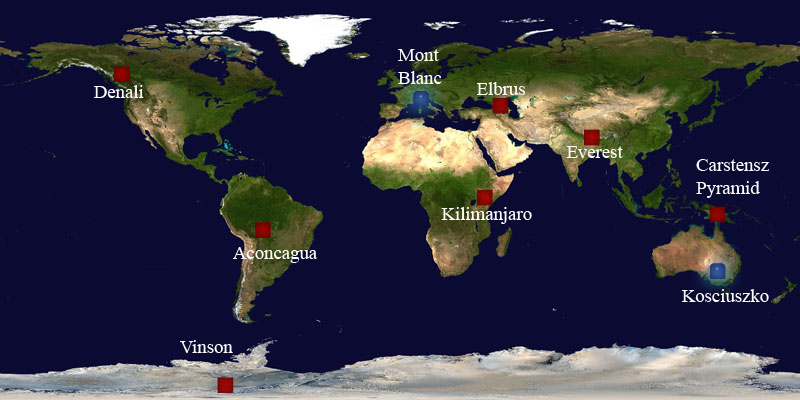 So
I guess if you want to cover all angles here is the list: So
I guess if you want to cover all angles here is the list:
- Everest, Nepal - 29,035/8848m
- Aconcagua, Argentina - 22,902/6960m
- Denali, Alaska - 20,320/6194m
- Kilimanjaro, Africa - 19,340/5896m
- Elbrus, Russia - 18,513/5642m
- Vinson, Antarctica - 16,067/4897m
- Carstensz Pyramid, New Guinea - 16,023/4884m
- Mt. Blanc, France/Italy - 15,771'/4807m
- Mt. Kosciuszko, Australia - 7,310/2228m
The 7 Summit idea was hatched and first accomplished by American Dick
Bass. He started with six summits in 1983: Aconcagua, Kilimanjaro, Elbrus,
Denali, Vinson and Kosciuszko. Then with guide, David Breashears, he
became the oldest person, at 55, at the time to summit Everest in 1985.
Canadian Patrick Morrow became the first to summit all seven with Carstensz
in addition to Kosciuszko ending in 1986. Messner summited all the peaks
without supplemental oxygen, a first, also completing the task in 1986.
Finally, since none of the seven are extreme technical mountaineering
climbs, with the altitude challenges of Everest notwithstanding, some
pundits suggest the second highest mountains on the continents is a better
challenge for real mountaineers. I would agree that that list would be
significantly more difficult if only for the fact that it includes K2
instead of Everest!
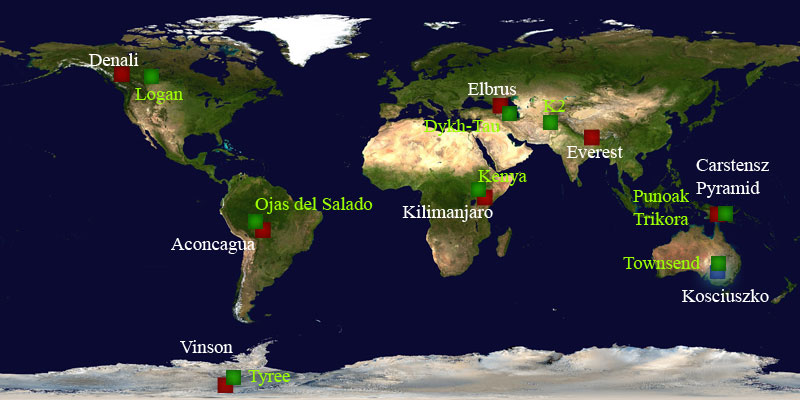 That
list includes: That
list includes:
- K2 (Pakastan-28,251'/8611m)
- Ojas del Salado (Argentina-22,608'/6983m)
- Logan (Canada-19,551'/5959m)
- Dykh-Tau (Russia-17,077'/5205m)
- Kenya (Africa-17,057'/5199m)
- Tyree (Antarctica-15,919'/4852m)
- Puncak Trikora (New Guinea-15,580'/4730m)
- Townsend (Australia-7,247'/2209m)
Here are the 7 Summits in height order:
Asia: Everest (29,031'/8848m) 5/21/11 5/21/11
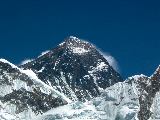 Mt.
Everest is on the border between Nepal and Tibet (China). It is in
the Himalaya mountain range which stretches 1500 miles from Northeastern
Pakistan to Bhutan. There are over thirty mountains higher than 25,000
feet and fourteen over 26,300 or 8000 meters. Of the fourteen 8,000
meter peaks, nine are located in the Himalayas making it clearly the
top of the world. Mt. Everest was first summited by Sherpa Tenzing
Norgay and Edmund Hillary with a British expedition in 1953. They took
the South Col route which is described on this page.
At that time the route had only been attempted twice by Swiss teams
in the spring and autumn of 1952.They reached 8500m well above the
South Col. Of note, Norgay was with the Swiss thus giving him the experience
he used on the British expedition. The Swiss return in 1956 to make
the second summit of Everest. Mt.
Everest is on the border between Nepal and Tibet (China). It is in
the Himalaya mountain range which stretches 1500 miles from Northeastern
Pakistan to Bhutan. There are over thirty mountains higher than 25,000
feet and fourteen over 26,300 or 8000 meters. Of the fourteen 8,000
meter peaks, nine are located in the Himalayas making it clearly the
top of the world. Mt. Everest was first summited by Sherpa Tenzing
Norgay and Edmund Hillary with a British expedition in 1953. They took
the South Col route which is described on this page.
At that time the route had only been attempted twice by Swiss teams
in the spring and autumn of 1952.They reached 8500m well above the
South Col. Of note, Norgay was with the Swiss thus giving him the experience
he used on the British expedition. The Swiss return in 1956 to make
the second summit of Everest.
Today, hundreds of climbers from around the world use
this route to try to stand on top of the world. It is considered slightly
more dangerous than the North Ridge Route due primarily to the instability
of the Khumbu Icefall. However some considered it slightly easier than
the north due to the absence of the ladders and rock climbing on the
steep steps of the North Ridge route.
The Grand Dame of all Everest statistics, Ms. Elizabeth
Hawley reports on the Himalayan Database that there have been 7,646
summits of Everest through June 2016 on all routes by 4,469 different
people. 1,015 people, mostly Sherpa, have summited multiple times totaling
3,861 times (included in the 7,646 total summits). The Nepal side is
more popular with 4,863 summits compared to 2,783 summits from the
Tibet side. 197 climbers summited without supplemental oxygen, about
2.5%. 14 climbers have traversed from one side to the other. About
60% of all expeditions put at least one member on the summit.
282 people (168 westerners and 114 Sherpas) have died
on Everest from 1924 to June 2016. Of the deaths, 109 died attempting
to summit without using supplemental oxygen. 70 climbers died on the
descent from the summit. The Nepalese side has seen 4,863 summits with
176 deaths through June 2016 or 3.7%. The Tibet side has seen 2,783
summits with 106 deaths through June 2016. or 3.8%. Most bodies are
still on the mountain but China has removed many bodies from sight.
The top cause of death was from a fall, avalanche, exposure and altitude
sickness. 640 people summited in Spring 2016 from both sides and there
were 5 Everest deaths.
From 1923 to 1999: 170 people died on Everest with 1,169
summits or 14.5%. But the deaths drastically declined from 2000 to
2015 with 5,832 summits and 112 deaths or 1.9%.However, two years skewed
the deaths rates with 17 in 2014 and 14 in 2015. The reduction in deaths
is primarily due to better gear, weather forecasting and more people
climbing with commercial operations.
Annapurna remains the most deadly 8000 meter mountain
with one death for every three summits (71:255) or 28% thru 2016.
see more facts here
The second highest mountain in Asia is K2 in Pakistan
at 28,251'/8611m and is about 800 miles northwest of Everest in the
Karakorum range. It is considered significantly more difficult than
Everest requiring technical rock climbing and extreme weather.
I summited Mt. Everest at 5:00 AM on
May 21, 2011 via the South Col route with IMG Sherpa, Kami Sherpa.
We stayed on top for about 10 minutes in cold and windy conditions.
It was a humbling experience given the massive scale of Everest but
it was the reaction from the Alzheimer's community that brought tears
to my eyes.
I have climbed on Everest
four times and last summited on May 21, 2011. You can read about
my climbs on my Everest pages.
South America: Aconcagua (22,834'/6960m) 1/29/11
 The
highest peak outside the Himalaya it is located in Argentina near the
border with Chile. It was first summited by Mathias Zurbriggen in 1897.
It is the highest mountain in South America at 22,834'. Most climbers
fly into Santiago (Chile) or Mendoza (Argentina) and take a bus to Puente
del Inca for the normal route or to Penitentes for the Polish Glacier,
Polish Traverse and Vacas routes. There are no central statistics but
about 3,500 climbers make a summit attempt each year with an estimated
30% success rate. The
highest peak outside the Himalaya it is located in Argentina near the
border with Chile. It was first summited by Mathias Zurbriggen in 1897.
It is the highest mountain in South America at 22,834'. Most climbers
fly into Santiago (Chile) or Mendoza (Argentina) and take a bus to Puente
del Inca for the normal route or to Penitentes for the Polish Glacier,
Polish Traverse and Vacas routes. There are no central statistics but
about 3,500 climbers make a summit attempt each year with an estimated
30% success rate.
The second highest mountain in South America is Ojas del Salado also
in Argentina at 22,608'/6983m and is 370 miles north of Aconcagua in
the Andes range.
I summited on January 29, 2011 with Peter Anderson
of IMG. Aconcagua is the highest peak outside of the Himalaya at 22,834'.
While not a technical climb per se, it is known for harsh winds and extremely
cold temperatures on summit day. We had a great team and 100% success
rate.
I have climbed Aconcagua three times, summiting
each time. You can read about my climbs on my Aconcagua page.
North America: Denali (20,310
feet 6,190 meters 7/17/11 7/17/11
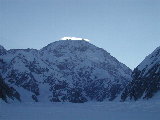 Denali
is the native American name for the mountain but it was changed to Mt.
McKinley in honor of President McKinley and then officially changed back
to Denali by the National Park Service in 1980. It is in central Alaska
- 300 miles South of the Arctic Circle and 200 miles East of the Bearing
Sea. Denali offers some the the largest vertical gain of any mountain
on Earth. With base camp at 7,200' and the summit at 20,310', this 13,110'
of gain over twelve miles is larger than Cho Oyu (8,407) or even Everest
(10,535). The biggest threat on Denali is the weather. It is well known
for socking you in for days with high winds and snow. An estimated 32,000
climbers have attempted Denali with about a 40% success rate. Almost
100 have died including 11 in 1992. Denali
is the native American name for the mountain but it was changed to Mt.
McKinley in honor of President McKinley and then officially changed back
to Denali by the National Park Service in 1980. It is in central Alaska
- 300 miles South of the Arctic Circle and 200 miles East of the Bearing
Sea. Denali offers some the the largest vertical gain of any mountain
on Earth. With base camp at 7,200' and the summit at 20,310', this 13,110'
of gain over twelve miles is larger than Cho Oyu (8,407) or even Everest
(10,535). The biggest threat on Denali is the weather. It is well known
for socking you in for days with high winds and snow. An estimated 32,000
climbers have attempted Denali with about a 40% success rate. Almost
100 have died including 11 in 1992.
The second highest mountain in North America is Mt. Logan in Canada's
Yukon at 19,551'/5959m and is 385 miles southeast of Denali. Similar
to Denali it is a huge massif but with eleven peaks. Logan is believed
to have the largest base circumference of any mountain. The normal route
is consider straightforward but weather is a huge problem for Logan like
it is for Denali in addition to being so remote.
I reached 17,200' at the High Camp on Denali in mid
July 2011 with Mountain Trip. We waited for 8 days there for lower winds
that never came. I consider this a non-summit and not a failure similar
to how Alzheimer's researchers feel when a clinical trial does not result
in their original objectives. Every effort results in lessons and I was
able to forward the message of hope, need and urgency for an Alzheimer's
cure during my climb.
I have climbed on Denali three times. You can read
about my climbs on my Denali page.
Africa: Kilimanjaro (19,340'/5896m) 9/19/11
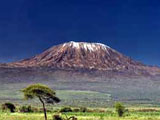 One
of the world's highest volcanoes it was first summited in 1889 by Meyer
and Purtscheller. There are actually three peaks: Kibo, Shira and Mawenzi
with Kibo being the summit. There are 5 main routes that meander from
the jungle through five microclimates to join the three final ascent
routes to Kibo. Both the Machame and Lemosho routes offer a more leisurely
paced scenic climb. The Lemosho route is less crowded while the Machame
route has a more difficult beginning but joins into the same route as
the Lemosho. The Marangu climb is crowded since it follows a road part
way. One
of the world's highest volcanoes it was first summited in 1889 by Meyer
and Purtscheller. There are actually three peaks: Kibo, Shira and Mawenzi
with Kibo being the summit. There are 5 main routes that meander from
the jungle through five microclimates to join the three final ascent
routes to Kibo. Both the Machame and Lemosho routes offer a more leisurely
paced scenic climb. The Lemosho route is less crowded while the Machame
route has a more difficult beginning but joins into the same route as
the Lemosho. The Marangu climb is crowded since it follows a road part
way.
It is considered a walk-up by many climbers but still represents a deadly
threat when climbers go too fast or ignore difficult weather. The local
park officials maintain strict rules thus requiring local guides to accompany
each team. The climb takes anywhere from 4 to 7 days with 7 being the
suggested time to allow for proper acclimatization. Huts are on some
routes as well as tent camping. Porters carry most of the load so climbers
usually just manage a small day pack with their personal gear.
The second highest mountain in Africa is Mt. Kenya in Kenya at 17,057'/5199m
and is 250 miles north of Kilimanjaro. The normal route to Peak Lenana
is considered a scramble but routes to Batina Peak offer challenging
rock climbing (5.7 range) to reach the summit.
I summited Kilimanjaro on September 19, 2011 with Eben
Reckord of IMG. We took the Machame route that started in the jungle
and went through five microclimates to the summit. Our team had 100%
success.
I summited Kilimanjaro from the Machame
route on September 19, 2011. You can read about and see pictures from
the climb here.
Europe: Elbrus (18,513'/5642m) 8/11/11
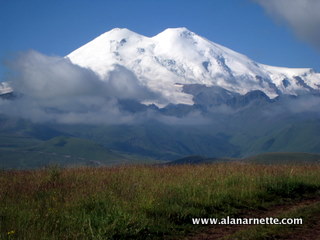 Mount
Elbrus is an extinct volcano in the Caucasus Main Range, the European
border with Asia in southern Russia. Mt. Elbrus has two main summits
- the western summit at 18,513'/5642m and the eastern summit at 18,442'/5621m.The
first ascent of the west peak was in 1829 by a Russian army team and
the east in 1874 by an English team. Mont Blanc is sometimes consider
the highest in Europe but Elbrus technically holds that honor. Mount
Elbrus is an extinct volcano in the Caucasus Main Range, the European
border with Asia in southern Russia. Mt. Elbrus has two main summits
- the western summit at 18,513'/5642m and the eastern summit at 18,442'/5621m.The
first ascent of the west peak was in 1829 by a Russian army team and
the east in 1874 by an English team. Mont Blanc is sometimes consider
the highest in Europe but Elbrus technically holds that honor.
The normal climbing season is May to September. The climb is quite short
by 7 Summits standards taking less than a week at most. It can be climbed
from the north or south with the north being significantly less crowded
and more difficult. The standard south route on Elbrus is technically
easy and includes a cable car up to the 12,500' level. It is snow slope
from there to the summit. Climber stay in 'huts' which are single room,
rock walled building with tin roofs at 12,700' and/or the Barrel Huts,
13,600', which are, well, huge barrels. A snow-cat is reported to be
available for climbers who want a ride even higher - up to 15,750. It
is common to have over 100 climbers going for the summit in a single
day in July. The north side has a longer, more complicated approach
and is considered more of a climbing experience than the south. As with
most mountains that have a reputation for being easy, they are also deadly
and Elbrus is no exception. About 25 climbers die each year due to ill-preparedness
or the weather. It can be extremely cold and windy. However literally
thousands of people have summited Elbrus included a Soviet team in 1956
of 400 climbers!
The second highest mountain in Europe, Dychtau in Russia at 17,077'/5205m
and is 40 miles southeast of Elbrus. It considered a very dangerous and
technical climb with the main peak accessible from a steep and narrow
ridge from the adjacent saddle.
I summited Mount Elbrus from the less climbed North
side on August 11, 2011 with AlpsIndustria out of Moscow. It was a fast
climb summiting 5 days after arriving in Russia. Elbrus is an extinct
volcano in the Caucasus Main Range with two main summits. I summited
the West peak at 18,513'/5642m.
I summited Elbrus from the north side on August
11, 2011. You can read about and see pictures from the climb here.
Oceania: Carstensz Pyramid (16,023'/4884m) 10/22/11
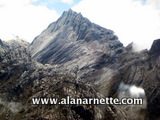 The
'newest' of the 7 summits when Pat Morrow and Reinhold Messner challenged
Dick Bass's summit of Australia's Mt. Kosciuszko as the highest peak
in Oceania. Carstensz Pyramid on Irian Jaya (Papua) in Indonesia's New
Guinea is now consider one of the 7 but most 7 Summiteers try to bag
the walk-up Kosciuszko as well. The
'newest' of the 7 summits when Pat Morrow and Reinhold Messner challenged
Dick Bass's summit of Australia's Mt. Kosciuszko as the highest peak
in Oceania. Carstensz Pyramid on Irian Jaya (Papua) in Indonesia's New
Guinea is now consider one of the 7 but most 7 Summiteers try to bag
the walk-up Kosciuszko as well.
The Dutch explorer Jan Carstensz first sighted the peak in 1623. It
was first climbed by Austrian Heinrich Harrer and team in 1962. Carstensz
is considered the most exotic of the 7 Summits surrounded by dense jungle
and rumors of cannibals! Even though it is near the equator, snow sometimes
graces the limestone slopes.
The climbing is consider the most technical of the 7 Summits requiring
rock scrambling a short section of 5.8 rock climbing with fixed ropes
and a Tyrolean traverse across a 80' gap. This involves pulling yourself
upside down across a suspended rope. But the real challenge is just getting
there. Often the road is closed to climbers by the owners of the Freeport
mine thus requiring a 5 day hike to reach to base of Carstensz. Instead
many teams charter a helicopter. Obtaining permits and travel logistics
can be quite difficult.
The second highest mountain in Oceania is Puncak Trikora also in New
Guinea at 15,580'/4730m and is 100 miles east of Carstensz.
I summited Carstensz Pyramid on October 22, 2011 with
Scott Woolums of Mountain Trip. Carstensz was a maze of logistics challenges,
difficult conditions and rewarding climbing; including the infamous Tyrolean
traverse across a 80' gap. I have a great video of me pulling myself
upside down across the suspended cable. But the real challenge was just
getting there. We arranged a helicopter to avoid the 6 day jungle trek
but barely made it in and out.
I summited Carstensz on October 22, 2011.
You can read about and see pictures from the climb here.
Antarctica: Mt. Vinson (16,067'/4897m) 12/9/10
 600
miles from the South Pole, Mount Vinson was first summited in 1966 by
climbers led by Nicholas Clinch from the American Alpine Club and the
National Science Foundation, it was the last of the 7 Summits to be conquered.
It was named after US Senator and Antarctica supporter, Carl Vinson.
It is in Ellsworth Mountains Range. Just getting there is an adventure
involving a 4 hour, 20000 mile plane trip on a Russian IIyushin 76 cargo
plane from the tip of South America to the snow camp of Union Glacier
Hills. Once there climbers are ferried via a Twin Otter to base camp.
Climbs usually take place between December and February. 600
miles from the South Pole, Mount Vinson was first summited in 1966 by
climbers led by Nicholas Clinch from the American Alpine Club and the
National Science Foundation, it was the last of the 7 Summits to be conquered.
It was named after US Senator and Antarctica supporter, Carl Vinson.
It is in Ellsworth Mountains Range. Just getting there is an adventure
involving a 4 hour, 20000 mile plane trip on a Russian IIyushin 76 cargo
plane from the tip of South America to the snow camp of Union Glacier
Hills. Once there climbers are ferried via a Twin Otter to base camp.
Climbs usually take place between December and February.
The climb is normally scheduled for about three weeks with the summit
taking place around the middle of the time. However once there, weather
can be the worst on the planet often stopping teams in their tracks for
weeks. Similar to Denali, climbers carry all their personal gear plus
a share of the group gear - no porters in Antarctica! The climb itself
is a series of long snow slopes not requiring significant technical skills
or gear however it is harsh with the weather and loads over 50 lbs split
between a pack and a sled. Once you summit, if you summit, you might
be stuck for more weeks waiting for the big IIyushin to return!
About 1200 people have summited Vinson since 1966 with no deaths. A
popular option after a summit is to fly to the 89 degree and ski the
final 70 miles to the South Pole.
The second highest mountain in Antarctica is Mount Tyree at 15,919'/4852m
and is 7 miles north of Vinson. Only 7 climbers have made it the top
of Tyree! It is significantly more difficult with it's steep faces. One
of the most famous climbs in mountaineering took place in January 1989
when the legendary American alpinist Terry ‘Mugs Stump, an American
climbing legend, soloed the west face without a rope in a roundtrip time
of 12 hours - an amazing feat that still stands out 20 years later.
I summited on December 9th with Phil Ershler of IMG.
This was the first of my 7 Summits climbs. 600 miles from the South Pole,
just getting there was an adventure involving a 4 hour, 20,000 mile plane
trip on a Russian IIyushin 76 cargo plane from the tip of South America
to the snow camp of Union Glacier. The view of endless ice and snow from
Vinson's summits was one of the most astounding scenes I have ever witnessed.
I summited Vinson on December 9th, 2010. You can
read about and see pictures from the climb here.
Australian Mainland: Kosciuszko (7,310'/2229m) 10/27/11
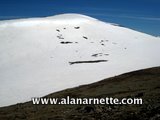 A
simple walk-up on the otherwise relatively flat Australian continent.
However, if you want to be very precise, while located on the Antarctic continent, the 3,490-metre (11,450 ft) Mount McClintock in the Britannia Range part of the Australian Antarctic Territory and thus claimed by Australia. It is higher than both Kosciuszko and the second highest Mawsons Peak, 9005'/2745m in Australia's territory on Heard Island, an active volcano about 2500 miles off
the western coast of Australia e.g. the middle of the Indian Ocean, an island has no ports or villages. A
simple walk-up on the otherwise relatively flat Australian continent.
However, if you want to be very precise, while located on the Antarctic continent, the 3,490-metre (11,450 ft) Mount McClintock in the Britannia Range part of the Australian Antarctic Territory and thus claimed by Australia. It is higher than both Kosciuszko and the second highest Mawsons Peak, 9005'/2745m in Australia's territory on Heard Island, an active volcano about 2500 miles off
the western coast of Australia e.g. the middle of the Indian Ocean, an island has no ports or villages.
The second highest mountain on the Australian mainland is Mt. Townsend
at 7,247'/2209m and is 2 miles north of Kosciuszko. It is somewhat more
'craggy' than Kosciuszko but is still a simple walk up. It is reported
that the locals ask each climber to take a rock to the summit with the
goal of surpassing it's higher neighbor.
I summited Kosciuszko on October 27, 2011. It was a
fun and easy walk with beautiful views of the Snowy Mountain Range. While
a walk up, this final climb in my 7 Summits Climb for Alzheimer's provided
another opportunity send our message of hope, need and urgency to find
a cure Alzheimer's, improve early detection and support family caregivers.
I summited Kosciuszko on October 27, 2011. You
can read about and see pictures from the climb here.
Western Europe: Mont Blanc (15,771'/4807m) 7/95
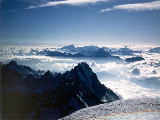 Mont
Blanc is the highest mountain in western Europe at at 15,771 feet. It
is on the boarder between between Italy and France and is called Monte
Bianco in Italy. While living in nearby Geneva, Mont Blanc was visible
on a clear day. I first climbed the Aiguille du Midi Route with a guide
in July, 1995. It was steep, snowy and one of the longest days of my
life. Mont
Blanc is the highest mountain in western Europe at at 15,771 feet. It
is on the boarder between between Italy and France and is called Monte
Bianco in Italy. While living in nearby Geneva, Mont Blanc was visible
on a clear day. I first climbed the Aiguille du Midi Route with a guide
in July, 1995. It was steep, snowy and one of the longest days of my
life.
It starts with an easy gondola ride up to the Agile du Midi - a spectacular
lookout point for the Alps. It takes about an hour to get to the Refuge'
for an short overnight rest. This was an interesting way to start the
climb since you are in the observation tower with hundreds of tourists.
However you are dressed in Gortex, gloves and crampons with a pack on
your back. You get very strange looks as you leave the warmth of the
building through what can only be described as an ice tunnel. The tunnel
leads to a very narrow ridge with steep drop-offs on both sides. The
ridge, about two feet wide, drops steadily then makes a right turn towards
the Valley Blanche - a beautifully wide valley that holds the approach
to hundreds of snow, ice and rock climbs throughout the year.
I summited Mont Blanc 3 times in 1995-1997.
You can read about my climbs here.
|