Here are some common questions
about climbing Denali. I am focusing on the West Buttress route since it
is the most common route and the one I took in 2001, 2007 and
2011 as one of my Memories are
Everything ® expeditions.
Since I am not a guide nor a professional climber, this information is
based on my experience and are my opinions so always consult with a professional
before making any serious climbing decisions!
Q: Where is Denali
A: The giant massif is located in Alaska. It is the
highest mountain in North America at 20,310', and one of the 7 Summits.
It is famous for extremely cold weather but is very popular as a
guided or self-guided climb. As you drive North from Anchorage, you
see the huge massif looming above all the other mountains. You fly
into Anchorage and drive about 2 hours North to Talkeetna. Then you
take a bush plane to the Kahiltna Glacier.
View
Denali on a larger map
Q: I understand Denali had a name change and new measured height
in 2015.
A: Per this press release from
the Secretary of the Interior on August 30, 2015:
In recognition of the long history of strong support from Alaska
state, tribal and congressional leaders, and in resolution of an
official request for a name change pending for 40 years, U.S. Secretary
of the Interior Sally Jewell today announced that the highest mountain
in the United States and North America, formerly known as Mount McKinley,
will be officially given the traditional Koyukon Athabascan name
of Denali.
President Obama endorsed Jewell's decision to issue a Secretarial
Order that officially changes the name. Jewell is granted the authority
to make such changes in certain cases per the 1947 federal law that
provides for the standardization of geographic names through the
U.S. Board on Geographic Names. The name change will be reflected
in all federal usage.
In a highly political move the name was changed back to McKinley in 2025, but everyone in the climbing community will continue to honor the name used for thousands of years by the Alaska Native peoples, particularly the Koyukon Athabaskan, who called the mountain Denali (from the Koyukon word “deenaalee”), meaning “the high one” or “the great one."
During July, 2015, a GPS unit was placed on the summit to
accurately measure the elevation and it resulted in lowering the
highest by 10 feet from 20,320 feet to 20,310. You can read more
details at this NPS
link.
Q: When
is it usually climbed?
A: Late April through July however May and June are the primary
months. Earlier finds very cold temps and later brings increased crevasse
danger. I was there in late June and early July and the temperature was
acceptable as was the crevasse danger. An advantage of going later is that
many of the snow camps are already built so you do not have to build snow
walls at every camp plus it is warmer. However, teams have been stalled in mid July from summiting due to low
pressure systems parked over the summit so perhaps the weather patterns are
changing. I would never target Denali summit after June 15 in the future.
Q: Is it true late season climbs (late June) are not as successful
as earlier in the season?
A: Yes and no. Guide Dave Hahn told me in 2011 that he had summited
20 out of 26 times - all in late season. A 76% success rate compared to an overall
50% for all expeditions throughout the season. However that is a normal success rate
for a commercial climb and recent weather patterns make the late season look more
difficult.
Q: I understand that Denali's West Buttress is just a long slog.
How hard is it?
A: It is not 'easy' but It depends on what you have done.
I did not find it very difficult after Mont Blanc, Everest, Ama Dablam
and some technical climbs like The Grand Teton. The biggest issue with
Denali is the weather and a very short section above the High Camp that
is fixed with ropes. Some people have trouble with pulling the sleds. I
did not find this a problem. All this said however, on my 2007 climb I
was stopped cold at 17,000' with a mysterious stomach illness and was helicoptered
off the mountain to an area hospital. I never did find out what the root
problem was after undergoing extensive tests once I got home. It could
have been altitude illness or food poisoning - I just don't know. The rest
of my AMS team turned back few days after also suffering from aliments.
Q: How does Denali compare with Rainier or Aconcagua?
A: Primarily it is a more physical climb involving heavy
loads. It is a much longer climb but similar to Rainier in that you climb
on steep snow slopes most of the time but obviously at a significantly
higher altitude. You are using fixed ropes on the headwall above the Ranger
camp at 14,200' and you are pulling a sled with personal and group gear.
Finally the weather can be extreme with brutal winds and cold temperatures.
Q: How does Denali compare with Everest or other 8,000m peaks?
A: It is a great training climb for aspiring Everest climbers
to learn about winter camping and experience high altitude climbing. There
are no features like Everest's Lhotse Face or Hillary Step on Denali's
West Buttress route. Also even compensating for the lower barometric pressure
making the "feel like" altitude higher, climbing at 25,000 is significantly
more difficult.
Q: Is a Denali climb dangerous?
A: Absolutely. You should only attempt Denali if you have
the proper experience and logistics for emergency situations. Almost every
year climbers die as a result of a fall or weather. On June 10, 2025, Nicholas Vizzini, a 29-year-old skier from Washington state, died after being caught in a soft slab avalanche while descending the West Buttress route above Camp 14. And on June 4, 2025, Alex Chiu, a 41-year-old ski mountaineer from Seattle, died after falling approximately 3,000 feet from Squirrel Point on the West Buttress route down to the Peters Glacier. Chiu was not roped in at the time of the fall.
Q: How many people had summited and how many people had died
trying?
A: 50,867 climbers have attempted Denali
with 26,358 summiting, a 52% success rate. Almost 130 have died including 11 in 1992.
Q: How did you train for this climb?
A: I did a lot of running for aerobic conditioning plus weight
training for the heavy loads. In 2011, I climbed other mountains extensively
as part of my 7 Summits program. While I have never used the CrossFit program, it
seems ideal for the demands of Denali.
Q: Was altitude a problem on this climb?
A: Yes, it is always a challenge on these big mountain climbs.
Many people feel some type of AMS above 11,000'. As I mentioned before, I
experienced some kind of problem in 2007 which could have been altitude related.
Q: Can you prepare for the altitude?
A: Not really. The common approach is to move slowly up the mountain
(1000' a day maximum) spending your days at a higher altitude than where
you sleep up until your summit bid. The human body simply does not function
well at high altitudes and especially above 8000m (26,300'). As you go
higher, the barometric pressure decreases, although the air still contains
21% oxygen, every breath contains less molecules of oxygen.
Everest legend Tom Hornbein explained it to the American
Lung Association this way:
The lower oxygen stimulates chemoreceptors that
initiate an increase in breathing, resulting in a lowering of the partial
pressure of CO2 and hence more alkaline blood pH. The kidneys begin to
unload bicarbonate to compensate. Though this adaptation can take many
days, up to 80% occurs just in the first 48 to 72 hours. There are many
other physiologic changes going on, among them the stimulus of low oxygen
to release the hormone, erythropoietin to stimulate more red blood cell
production, a physiological and still acceptable form of blood doping
that enhances endurance performance at low altitudes. Adaptive changes
are not always good for one’s health. Some South American high altitude
residents can have what’s called chronic mountain sickness, resulting
from too many red blood cells; their blood can be up to 84-85% red blood
cells. The increased blood viscosity and sometimes associated pulmonary
hypertension can result in right heart failure.
You cannot do much to acclimatize while at a low altitude but there
are companies that claim to help the acclimatization process through
specially designed tents that simulate the reduced oxygen levels at higher
elevations. I have no personal experience with these systems but you
can find more details at the Hypoxico website.
They cost about $7,000 or can be rented for about $170 a week. Outside
Magazine posted an article in
2013 questioning their effectiveness.
Q: What kind of equipment did you use?
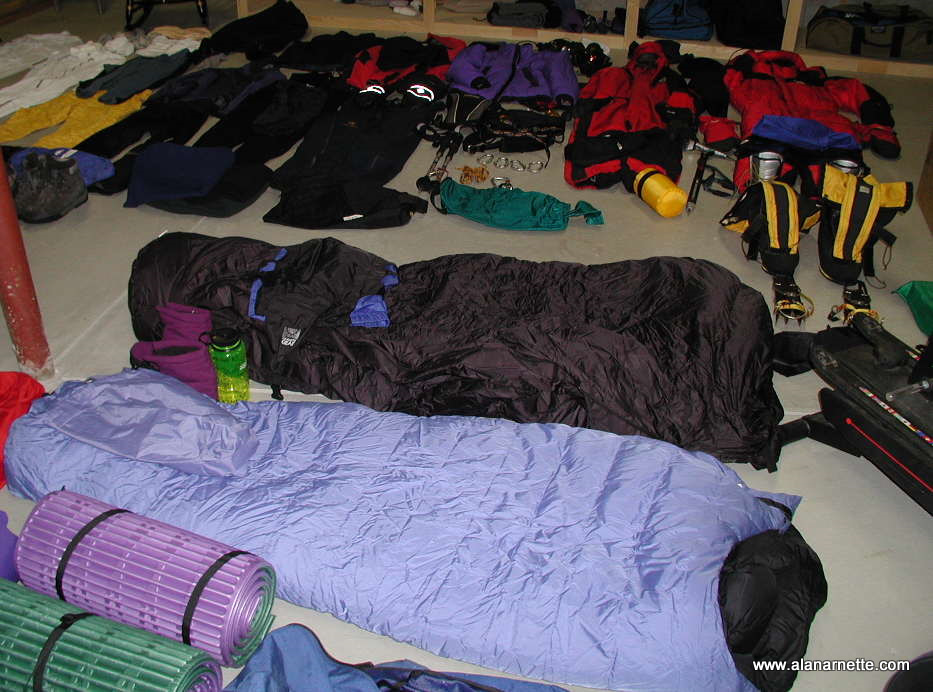
 A: Mostly I use the same gear
I used on Everest. Lot's of layers. My personal technical equipment included
a long handle ice axe, harness, carabineers and crampons. It is always
critical to protect my toes, fingers and face since these were most susceptible
to frost bite. As for warmth,
I always wear a knit cap and at least liner gloves when I get the
least bit cool - regardless of the outside temp. I use a 3 layer system
of Merino wool base layer (top and bottom), heavier fleece as in the
Mountain Hardware Power Stretch (a Farmer's John kind of suit) or just
my Patagonia Guide Pants depending on how cold it is that day then my top
wind or warmth layer e.g. Patagonia Micro Puff and/or JetStream Shell. When
the winds pick up and the temps hover near 0F, I add my Feather Friends
850 Fill down jacket plus my mitts. I have a gear page for reference.
I am very pleased with all my gear but had a few standouts that I note
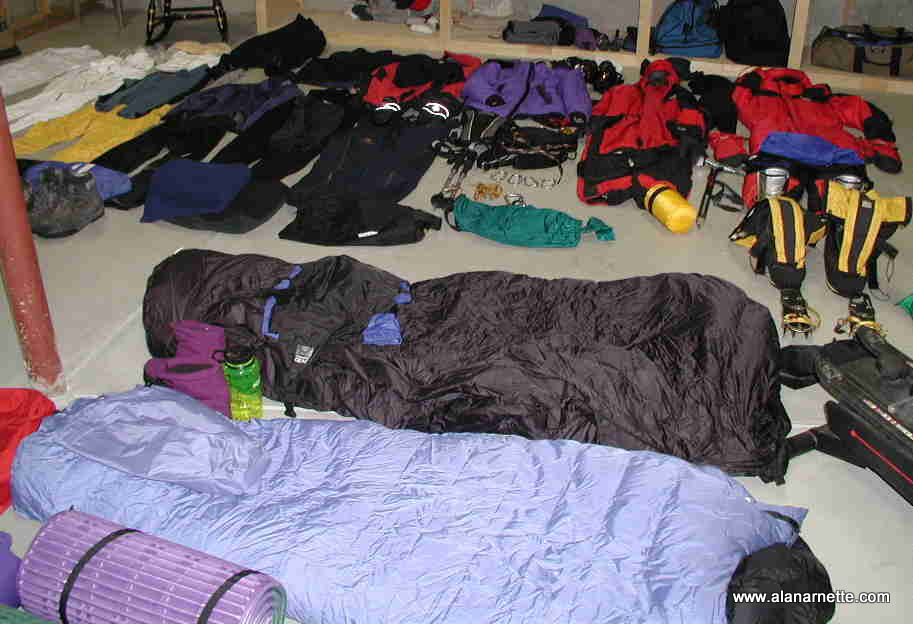
on my gear page. A: Mostly I use the same gear
I used on Everest. Lot's of layers. My personal technical equipment included
a long handle ice axe, harness, carabineers and crampons. It is always
critical to protect my toes, fingers and face since these were most susceptible
to frost bite. As for warmth,
I always wear a knit cap and at least liner gloves when I get the
least bit cool - regardless of the outside temp. I use a 3 layer system
of Merino wool base layer (top and bottom), heavier fleece as in the
Mountain Hardware Power Stretch (a Farmer's John kind of suit) or just
my Patagonia Guide Pants depending on how cold it is that day then my top
wind or warmth layer e.g. Patagonia Micro Puff and/or JetStream Shell. When
the winds pick up and the temps hover near 0F, I add my Feather Friends
850 Fill down jacket plus my mitts. I have a gear page for reference.
I am very pleased with all my gear but had a few standouts that I note
on my gear page.
Q: Anything special in your gear for Denali?
A: I used everything on my gear page under Denali. It can be
extremely cold and windy so multiple down layers are required. I think a good wind
shell is one of the most crucial items in addition to boots and gloves. Goggles are
also critical depending on conditions. My boots were the Kayland 6001 with 40 Below
Overboots in 2011, Koflachs in 2007 and Everest One Sports in 2001. The Koflachs
were warm enough.
Q: Did you use a satellite phone?
A: For details on my expedition communications, please see this tutorial.
I used an Iridium phone in 2007and 2011and a GlobalStar in 2001. The Iridium had
spotty connections. Cell phones connections are no longer available on Denali. There
used to be support for analog handsets but no longer as of 2011.
Q: Which route is most popular?
A: The West Buttress is the most popular. The other
routes including Cassin Ridge, West Rib & South Buttress are extremely
technical and subject to avalanches. 98% of all Denali climbers use the
West Buttress route.
Q: How long will it take?
A: 2 weeks on the mountain plus another few days to get onto
and out of the mountain so allow at least 3 weeks. However, it is very
common to be stuck for another week somewhere on Denali with bad weather.
Q: How much does a standard climb cost with and without a guide?
A: The costs can range from $6500 to $8000 depending on who
you use. Comment: I cannot understand these prices on Denali and feel there
is a significant lack of competition that has lead to this situation. If you
do everything yourself cut the highest cost in half or more and should cost
no more than $2000 assuming you have the basic gear. See my Guide page
for more details.
Q: Do I need a permit to climb?
A: Yes. Registration opens on January 1 of the current year. All climbers must register 60 days before their trip (7 days if they have reached at least Kahiltna Pass (10,000 ft / 3,048 m) on Mount McKinley or Mount Foraker since 1995) and pay a $440 fee ($340 for 24 and younger) as of the
2025 season to the National Park Service at
the park headquarters in Talkeetna. This can be done online.
There is a limit of 1500 climbers, guided or unguided, each season which has
never been exceeded.
Q: Are there local guides for Denali?
A: The NPS has approved seven companies to guide e.g. (charge a
fee) on Denali: Alaska Mountaineering School, Alpine Ascents International,
American Alpine Institute, International Mountain Guides, Mountain Trip Alaska, N.O.L.S. and Rainier
Mountaineering Inc. The NPS requires a 3:1 climber to guide ratio. Anyone
caught 'guiding' are removed and fined according to Rangers. Due these regulations
almost all the companies charge the same price, run the exact same program
and have the same conservative attitude. There have been several deaths over
the past few years on commercial trips as well as private ones.
Q: Do I really need a guide for Denali?
A: It all depends on your skills and experience. The monopoly
on Denali has created a suspect environment for most commercial outfits causing
them to be very conservative. Most commercial
Guides are good people but given they
run multiple climbs each year (as many as 3 or 4 climbs per guide), they
act burned out and appear to have little motivation to go to the summit,
especially late in the season. Another issue with the companies who have
a NPS concession is that they squeeze as many trip as possible (around
11 back to back) into the three month climbing season. As a result there
is virtually no time for weather delays. So once your time runs out, regardless
of the weather, it is time to go and your climb is over. With the crazy weather
patterns in recent years on high mountains this is becoming a huge issue
resulting in many climbers missing summits due to schedules and financial
considerations by the operators.
If you want a guided trip I suggest selecting a company
who runs only one or two climbs each season through getting a permit from
one of the authorized guides. The guides will more fresher and maybe more
motivated. However, make sure they use their own guides and do not simply
subcontract back to the permit owner which takes you back to the original
issue.
If you can go without a commercial guide, you
would probably have a more positive experience. But you need to have the
skills and qualified partners. Denali is dangerous and you can die. There
are usually a lot of climbers on Denali so you would probably not be alone
but easily could be. In harsh weather (white-outs) or in a medical emergency,
you will be on your own so consider your skill level carefully. Also crevasse
danger is real and always present on the lower glacier area so crevasse rescue
skills must be second nature to everyone on the team. Climbing alone or in
too small of a team is never a good idea.
Q: How do you get on an expedition to climb Denali?
A: Most reputable guides ask for your climbing resume and require
some climbing experience. Ideally they want to see climbs of Rainier
or Colorado or California 14ers. But most anyone can get on a
Denali commercial expedition these days without many questions and that is
a real problem. The guide services all run the same basic formula on the
West Butt route and are very conservative with weather, safety and risks.
Q: What is involved if I plan my own climb?
A: Basically everything: permits, travel, hotels, food, gear,
routes, communications, emergency contentions - everything.
You can save a lot of money this way, well over half the list price, but
as I said before, consider your skills in the event that something goes
wrong - are you self sufficient? What are your medical skills? HAPE and
HACE are really possibilities on Denali - do you have the proper medicine
and training to deal with it? And a hundred more questions. The Rangers
will strongly discourage solo climbs. You
must bring a two-way radio and a sat phone in my opinion and have the frequency
or number of the local rescue resources already programmed in. For help with meals
and logistics, ExposureAlsaka will
buy, prepare and pack meals, arrange all your lodging and glacier flights
for a very reasonable fee. An excellent resource is from Tim Hult after
his 2005 climb. He created a somewhat exhaustive guide to
climbing Denali on your own. for commercial trips, see my guide
page for
more information.
 Q: Did
you summit? Q: Did
you summit?
A: No. In 2001 I reached Denali Pass around
18,000' when high winds stopped our summit climb. In 2007, after waiting 7
days at the 14K Camp, a mysterious stomach illness hit me on the 17K ridge near
Washburn's Thumb. I was helicopter off the mountain to an area hospital. I never
did find out what the root problem was after undergoing extensive tests once I got
home. It could have been altitude illness or food poisoning - I just
don't know. In 2011, high winds stopped us at the 17,200' High Camp after waiting
there for 8 days.
Q: Why did you choose Mountain trip in 2001 and 2011 and Alaska Mountaineering
School in 2007 as guide services?
A: The 2001/7 my trips were scheduled on short notice and these
were my only options. Spaces fill up quickly on Denali's short climbing season.
I wanted to go with a guided team since I did not have suitable partners
to organize my own climb at the time.
Q: How did they perform?
A: I preferred Mountain Trip over AMS due to their overall
attitude and guiding style (but would not recommend either today). They treated
everyone more like adults and less as students. I observed them again in
2007 while with AMS and saw the same type of attitude. However,
I observed in 2011 that all commercial guides seem to follow the same formula and
do not show allot of flexibility plus cater to the slowest climber in the group.
So if you are fast or experienced, you may be frustrated with one of the authorized
guides. I suggest speaking candidly with your guide owner about his before signing
up and sending money. I would strongly suggest organizing your own climb if you have
the experience and partners to do it safely.
Q: Which route did you take?
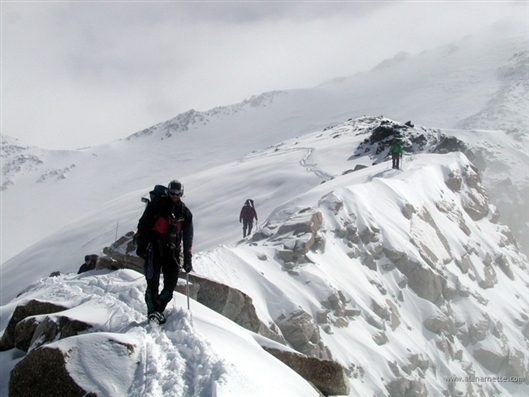
A: The standard West Buttress ridge. We had camps at 7.2K,
7.8K, 11.2K, 14.2K, 17.2K to the summit at 20.3K. While it is a bit of
a slog, especially on the lower part of the glacier, it is a fun climb.
The views are some of the best on the planet overlooking the vast Alaskan
ranges. Once above the Ranger camp, the climbing becomes much more interesting
with some nice exposure along the ridge plus the extra challenge of altitude,
high winds and even colder temperatures.
Q: What kind of weather conditions did you have?
A: It was cold - very cold especially when the wind picked
up. I believe Denali has been one of the coldest climbs I have ever experienced.
Q: Did you use bottled oxygen?
A: No, supplemental oxygen is usually only used above 26,300'.
Q: Would you climb Denali again?
A: I am not that excited about another West Buttress climb
given I have been there now three times. But I would go with good friends
or preferably on a small team to nab this summit.
Bottom Line
Denali is a beautiful climb in an awesome area. It offers many of the same
challenges as the 8000m mountains and even more if the weather turns bad.
The lower part of the West Buttress climb is kind of boring with long nights
of pulling a sled but once above the Ranger camp at 14,000' it becomes
an exciting and satisfying experience. The sad part of a Denali climb today is
the lack of adventure, the formula and the mass treatment by commercial operators.
if you want to climb Denali, find a few qualified friends and make the adventure
your own. |