Aconcagua is a popular climb for those wanting to test themselves at high
altitude. It is often a step before attempting Everest and of course one of
the Seven Summits. I summited it on February 19, 2005 and
again on January 8, 2008 one of my Memories
are Everything®: The Road Back to Mt. Everest expeditions
and again on January 29, 2011 as my 7
Summits for Alzheimer's project. I am asked many questions especially since
I am not a professional climber. So here are the most popular questions with
my answers. As always, this information is based on my experience and are my
opinions so always consult with a professional before making any serious climbing
decisions.
Q:Where is Aconcagua? A: Aconcagua is located in Argentina near the border with
Chile. It is the highest mountain in South America at 22,834' and one of
the 7 Summits. Most climbers fly into Santiago (Chile) or Mendoza (Argentina)
and take a bus to Puente del Inca for the normal route or to Penitentes
for the Polish Glacier, Polish Traverse and Vacas routes. In 2012, a
GPS aided
survey changed
the official height from 22,822 to 22,902 but later publications cited
the altitude at 6960m or 22,834 feet. View Aconcagua in
a larger map
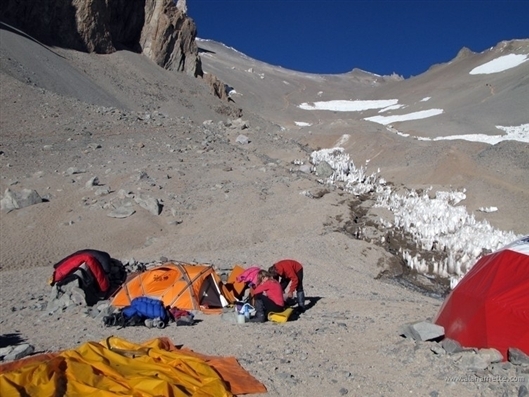
Q: When is it usually climbed? A: Being in the southern hemisphere, the climbing season is best
from December through March. However, the weather can be extremely cold and
windy anytime.
Q: I
read that Aconcagua is an easy climb, really just a high-altitude trek. How
hard is it? A: If you are in great aerobic shape, it can be "easy" on a perfect
weather day on the normal routes. But as with most of the extreme altitude
climbs, Aconcagua has brutal weather with cruel winds, driving snow and white-out
conditions that can create a nightmare scenario. The 2012/13 season was particularly
snowy after many years of somewhat dry conditions. Also, remember this is almost
7,000 meters, 23,000 feet so AMS, HAPE or HACE are always risks.
Q: How does the normal routes on Aconcagua
compare with Denali since it is at a similar altitude or with Rainier? A: It is a straightforward climb via the normal routes with
no real objective danger except for the vicious weather. You carry everything
yourself above base camp (mules can carry gear to BC on Aconcagua) but these days, 2018+, there
is support high on the mountain from porters for an additional fee. On a Denali you climb on snow from
day one to the summit. On Aconcagua, it is very dry and there was almost no
snow down low but usually some snow near the summit. There is no crevasse danger
like on Denali or Rainier on the normal routes.
Q: How does Aconcagua compare with Everest or other 8,000m peaks? A: In all honesty, they are in a totally different league from
Aconcagua. The expeditions are longer by more than twice and depending on the
mountain, more technically challenging. They require significantly more logistics,
gear, food and on mountain support. Your physical conditioning must be several
notches higher than what is required on Aconcagua. And, probably most important,
your mental state must be in a different place. Aconcagua is a relatively "simple" climb
in that the approach is short and easy, there are a couple of High Camps, summit
day should be no more than 12 hours. The 8,000m mountains take all this and
amplifies it greatly.
Q: Is an Aconcagua climb dangerous? A: Aconcagua is a relatively safe climb by the standard routes.
However, there are always deaths on these big mountains and Aconcagua is no
different. At least two climbers died in the 2012/13 season
when the team switched from the normal route to the Polish Direct Glacier route
which is significantly harder Five climbers died in January,
2009 alone: 2 were caught in a storm at 22,000', another died from a fall while
descending solo on the Polish Glacier, the third of a heart
attack near the summit (however an eyewitness reports a hard fall where
the victim hit his head so it may not have been an heart attack)and finally
a solo climber died from a fall at
16,200'. In 2000 four
climbers died on the Polish Direct when one climber fell taking the others
down with him to their deaths. Every year there are rescues, frostbite and
worse. In 2005, some of our members came close to getting frostbite on their
early summit morning. Climbing any mountain even if it is 10,000 feet can be
dangerous since you can be effected by factors out of your control such as
weather or avalanches. While we had no serious problems on my three climbs,
we did see climbers taken away by helicopter who were suffering from AMS or
frostbite.
Q: How many people had summited and how many people have died trying? A: There are no central statistics on summits but visitors to
the park where Aconcagua resides are required to register. In the 2015/2016
season 3,147 climbers registered. Local guides estimate about a 30% success
rate thus we can estimate about 1,000 summits a year. The busiest peroid from mid December to mid January. Since it is only 80 miles
from the Pacific ocean, Aconcagua gets hits with extremely high winds and storms,
similar to Denali in Alaska. The wind chills can drop to 80 degrees below zero
F. It is the weather and altitude that makes it dangerous. I usually hear of
one or two deaths a year but again I am not aware of anyone keeping central
statistics. As noted, January 2009 saw five deaths - an unusual amount. Aconcagua
Expeditions has a good chart of the park statistics.
Q: How did you train for this climb? A: I mostly ran for aerobic conditioning and lifted weights.
Also I climbed my local 14,000 mountains to get "real-world" miles underneath
me with a 30lb pack. As a note, I did not train quite as hard for Aconcagua
as I did for my other climbs including Denali.
Q: Was altitude a problem on this climb? A: Yes! Anytime you are above 8,000' you can experience problems.
Aconcagua is a serious high altitude mountain. Even though the normal and
False Polish routes are not technically difficult, the altitude takes it
toll on climbers each year thus the 30% success rate. We had one member who
had severe headaches from 9,000' up. He did summit but suffered a lot. He
had to slow down and got behind the rest of the group.
Q: Can you prepare for the altitude? A: Not really. The common approach is to move slowly up the mountain
(1000' a day maximum) spending your days at a higher altitude than where
you sleep up until your summit bid. The human body simply does not function
well at high altitudes and especially above 8000m (26,300'). As you go
higher, the barometric pressure decreases, although the air still contains
21% oxygen, every breath contains less molecules of oxygen.
The lower oxygen stimulates chemoreceptors that
initiate an increase in breathing, resulting in a lowering of the partial
pressure of CO2 and hence more alkaline blood pH. The kidneys begin to
unload bicarbonate to compensate. Though this adaptation can take many
days, up to 80% occurs just in the first 48 to 72 hours. There are many
other physiologic changes going on, among them the stimulus of low oxygen
to release the hormone, erythropoietin to stimulate more red blood cell
production, a physiological and still acceptable form of blood doping
that enhances endurance performance at low altitudes. Adaptive changes
are not always good for one’s health. Some South American high altitude
residents can have what’s called chronic mountain sickness, resulting
from too many red blood cells; their blood can be up to 84-85% red blood
cells. The increased blood viscosity and sometimes associated pulmonary
hypertension can result in right heart failure.
You cannot do much to acclimatize while at a low altitude but there
are companies that claim to help the acclimatization process through
specially designed tents that simulate the reduced oxygen levels at higher
elevations. I have no personal experience with these systems but you
can find more details at the Hypoxico website.
They cost about $7,000 or can be rented for about $170 a week. Outside
Magazine posted an article in
2013 questioning their effectiveness.
Q: What kind of equipment did you use? A: Mostly I use the same gear
I used on Denali. Lot's of layers. It is always critical to protect
my toes, fingers and face since these are most susceptible to frost
bite. As for warmth, I always wear a knit cap and at least liner
gloves when I get the least bit cool - regardless of the outside temp.
I use a 3 layer system of Merino wool base layer (top and bottom),
heavier fleece as in the Mountain Hardware Power Stretch (a Farmer's
John kind of suit) or just my Patagonia Guide pants depending on how
cold it is that day then my top wind or warmth layer e.g. Patagonia
Micro Puff and/or Jet Stream Shell. I did get horribly cold in January
2008 on our summit push near the summit when the winds hit 50 mph
and the air temp neared 0F. I stopped and put on a full Gortex bib
along with my Feather Friends 850 Fill down jacket and was fine. It
is was kind of scary how quickly I became so cold. I was glad I had
packed an additional 'emergency' layer. See my gear
page for a
complete discussion and my gear list updated for 2013. I am very
pleased with all my gear but had a few standouts that I note on my
gear page.
This a gear video I created for my 2011 Summit climb:
Q: Anything special in your gear for Aconcagua? A: I wanted to go as light as possible so for me there were
two considerations: sleeping bag and heavy down jacket. I brought my 0F
degree sleeping bag and was just fine, especially with two people in a tent.
Be careful about recommendations from your guide or friends to specify Fahrenheit
or Centigrade. I used my Koflachs Artic Expe' double plastic boots with two
pairs of wool socks. I used regular trekking shoes for the approach to base
camp at 14,000'. Use good approach shoes since the terrain is rough and the
scree is sharp on shoes.
Q: Was there web site coverage? A: I posted dispatches for all three climbs years on this
site at Aconcagua Dispatches using
satellite phones.
Q: How did the Sat Phones work? A: I used Global Star in 2001 and Iridium in 2007 and 2011.
They had mixed performances but was able to post dispatches both years. The
route is surrounded by high peaks and is in deep valleys. Sat phones require
line of site so it is difficult to get a strong signal that lasts. Also both
of these systems use satellites that are in constant motion so you gain a
signal then lose it however the signal is supposed to be transferred automatically
to the next satellite. The system works great at the High Camp or on the
summit since you have a clear view of the sky but not in low valleys. I did
not see any use of cell phones in 2011. For details on my expedition communications,
please see this tutorial.
Q: Which routes are most popular? A: The normal route is the Northwest Ridge with
the approach up the Horcones River valley. The second most popular route is the Polish Traverse using the Vacas
Valley. It is about 20% longer than the normal route. Both routes meet around 1,000m/3,000' below the summit. The Polish Glacier
is one of the most difficult routes on Aconcagua and is climbed by a minority
of the teams. It is 50 to 70 degree snow and ice slopes requiring technical
ice climbing skills, protection and roped climbing. This route requires significant
planning, preparation, gear and skills. Climbers die on this one and all
routes. In 2005, I turned back from the Polish Direct in favor of the Traverse
when avalanche conditions looked bad.
Q: How long does a climb usually take? A: My entire trips took about 20 days. 4 days to travel to
Argentina from the US including a day or so in Mendoza. Then 3 days trek
to base camp at 13,800'. After a couple days rest and getting used to the
altitude at base camp we spent the 4 days climbing between Camp 1 and Camp
2 at 19,000' on acclimatization climbs, gear carries to the camps and finally
moving to Camp 1, Camp 1.5 (2005 only) and Camp 2. On day 17 of the 2005
expedition we summited. The return to Mendoza was a swift two days.
Q: How much does a standard climb cost with and without
a guide? A: The costs can range from $3000 to $5000
depending on who you use. If you do everything yourself cut
the highest cost in half or more. See my Guide page
for more details.
Q: Do I need a permit to climb? A: All climbers regardless of route or guides must buy a permit
in Mendoza at the Aconcagua National Park office. There is a matrix of
permits fees depending on route then low, and high season finally guided
or unguided. The lowest permit costs USD$590 for the Horcones Valley route,
guided in low season (Nov 1- Dec 4 then Feb 1 - April 30). The highest
is USD$1,140 for unguided, Vacas Valley in high season between December 15 - January 31. I believe the financial penalty for without
a guide service is a result of so many rescues over the past several years,
a desire to raise more money and part of an effort to make Aconcagua
more like Denali with a limited number of guide services. This is the site for the park and download this PDF for
the permit fees. Also, helicopter rescue used to be included in the permit but no there is a charge so getting insurance is a good idea.
Q: Do
I really need a guide for Aconcagua? A: It all depends on your skills, money and time available.
Aconcagua is a serious high-altitude climb. Many people climb without a formal
guide and contract with local agencies for mules or carry everything themselves.
There are usually a lot of climbers on Aconcagua so you would probably not
be alone but easily could be. In harsh weather (white-outs) or in a medical
emergency, you will be on your own so consider your skill level carefully.
You must bring a two-way radio and a sat phone in my opinion and have the
frequency or number of the local rescue resources already programmed in.
As I mentioned, Aconcagua has brutal weather with cruel winds, driving snow
and white-out conditions that can create a nightmare scenario.
Q: Are there local guides for Aconcagua? A: Yes, there are many quality choices based out of Mendoza
and elsewhere. Some are less expensive than traditional Western companies
but most charge about the same price. My usual advice is to get recent references
from a climber with a similar background and skill level as yourself. Get
everything in writing. Especially understand the acclimatization schedule
since local guides have been known to rush people up and down. Finally ask
about food, group gear and language skills.
Q: How do you get on an expedition to climb Aconcagua? A: Most reputable guides ask for your climbing resume and
require some serious climbing experience. Ideally they want to see climbs
of 14,000' mountains. Guides emphasize conditioning since most people take
the non-technical routes. I think it is very, very helpful to had been on
a few 14,000 - 17,000 mountains such as Mts Rainier, Tasman or Mont Blanc
before you attempt Aconcagua.
Q: What is involved if I plan my own climb? A: Basically everything: permits, travel, hotels, food, gear,
routes, communications, emergency contentions - everything. There are local
companies in Mendoza who can provide some services such as getting food or
heavy tents to base camp. You can save a lot of money this way but as I said
before, consider your skills in the event that something goes wrong - are
you self sufficient? What are your medical skills? HAPE and HACE are real
possibilities on Aconcagua - do you have the proper medicine and training
to deal with it? And a hundred more questions. See my guide
page for more
Q: Did you summit? A: Yes, three times: in late February in 2005 and early January
in 2008 via the Polish Traverse route from the Vacas Valley and January 2011
using a variation of the Polish Traverse.
Q: Why did you choose Field Touring (FTA) as a guide service in 2005
and how was it? A: I followed their Gasherbrum climbs in 2004 with the aim of
joining them in 2005. But due to the unrest in that region plus some work considerations,
I changed my plans to Aconcagua. They run low cost trips and attract more independent
climbers. I liked the freedom to go at my own pace yet have the basic logistical
support given my experience in 2011. Their performance was adequate for this
relatively simple expedition. All expectations were met. On our climb, 6 of
7 clients summited. There were no serious surprises. The real uniqueness -
and risk - with FTA is their philosophy of not "guiding" but rather leading
clients and serving as a safety net. This is a fine line in that some clients
want to be "told what to do" but others left alone. If the guides are on the
wrong side of this line, clients feel over controlled or left out. Stu and
Martin did an excellent job in this respect. An example was on summit night,
a clear and windless rarity on Aconcagua, two climbers wanted to start at 1:00AM
instead of the agreed upon 5:00. They were told to go ahead but turn back at
the first sign of bad weather. They returned 20 minutes later as it started
to drizzle. They felt empowered yet understood the safety boundaries, however
it was a risky move given their experience that I would never endorse. The
base camp services were extremely basic and surprisingly sparse. The group
gear (tents, etc.) and meals prepared by FTA were very basic. The pre-trip
information was slightly confusing with respect to weight allowances and amount
of food we were required to bring but it all worked out. Stu was fun to climb
with but their logistics and oversight wanting for inexperienced clients.
Q: Why did you choose Mountain Professionals as a guide service
for 2008? A: I was climbing Everest with them later in 2008 so I
wanted to build the bonds. Plus I climbed on Broad Peak with Ryan in
2006. They performed very well for this climb. We had no surprises. I
found Dave and Cristina very professional. The had several opportunities
to demonstrate their skills in handling challenging client situations.
The food and group gear was good. Dave led one client successfully to
the summit via the Polish Glacier - they had a great time.
Q: Why did you choose International Mountain Guides (IMG) as a
guide service in 2011 and how would you rate their performance A: I returned to Aconcagua as part of my 7 Summits for Alzheimer's
project and used IMG for most of those climbs in 2010/11. I used a guide
service so I could concentrate on my fund raising and not the logistics of
a climb. IMG was outstanding - extremely professional and safest conscious
without being overbearing or regimented. We had 100% success wish 11 of 11
climbers on the summit, no frostbite and down safely. The guides Peter Anderson,
Josh Tapp and local guide Leo were quite skilled in both climbing and people
skills. They showed a level of professionalism you would expect from a service
like IMG.
Q: Which route did you take? A: Polish Traverse in 2005 and 2008. We had camps at 13.8K,
16K, 17.5K (2001 only) and 19.5K for the summit at 22.8K. In 2005 four of
us intended to take the Polish Direct route and the rest the False Polish
or the Traverse to the Normal route. But on our summit morning as we standing
about 600' above Camp 2 on the edge of the glacier putting on our crampons,
harnesses and getting ready to rope up Stu and I saw a car size block of
ice calve off a gap we were targeting. It followed the fall line on the glacier
spawning hundreds of pieces. We took into account that the Polish Glacier
was supposed to be a stable (if any glacier ever is!). However it had been
quite warm the past week with bright sun and warm winds. We finally determined
the risk were unnecessary and we abandoned the glacier for the traverse.
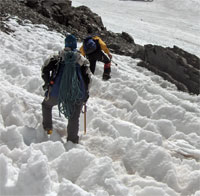
Q: How was the Traverse? A: Other than climbing from 19,000' to almost 23,000' it was
not that difficult. 2005, was very dry so there were only a few small snowfields
above Camp 2. Some teams used crampons and I saw a few people short-roped.
The route was well worn and crowded. From Camp 2 at 19,000' or from camp
Colera at 20,000' (where the rest of our team started in 2005) the route
has a continuous rise but not too serious. This continues for several hours
until you reach the Canaleta, a 1,000 foot u-shaped couloir of loose rock
at a 45-degree angle. This is at 21,800' so it was getting more difficult
to breath. Interestingly enough most people, including Stu and I, left our
packs at the base of the Canaleta and took only cameras, water bottles and
sat phone to the summit. In 2008, the Canaleta looked like a war zone with
people from other teams lying all over the place in various stages of AMS.
Q: Describe the variation in 2011? A: We took the Vacus Valley hike to Plaza de Argentina and
then the route to Camp 1. From there we climbed to what is commonly known
as Camp 3 on the Guanacos route or sometimes the Helicopter or Chopper Camp
due to some nearby crash debris. From there we climbed to Camp Colera and
established out High Camp. We made our summit push from there joining the
normal route to the Canaleta and the summit. We returned via Plaza de Mules
and the normal route.
Q: And
the summit? A: Seeing the famous Aconcagua cross was exciting. The summit
is about half the size of a football field. It is all rock. You can see the
Pacific Ocean, the surrounding mountains and glaciers in both Argentina and
Chili. It was also incredibly windy and cold!
Q: How long did the summit push take? A: About 12 hours roundtrip for all three climbs.
Q: What kind of weather conditions did you have? A: My late February 2005 climb was warmer than my January climb
in 2008. It was very warm for the trek to base camp. Then it gradually got
colder we gained altitude. It was always windy. Some nights the wind were
relentless. It was a straight-line wind, not swirling, that easily blew tents
and climbers around. You had to use large rocks to keep your tent secure
and leave nothing loose outside. We had no snow but a couple of nights of
light rain during the walk-in. The 2011 climb was quite snowy and windy throughout
the climb with more snow than the other two climbs.
Q: Anything different from 2005 to 2008 to 2011? A: There was much more snow on the route in 2011 but the weather
was always cold and windy!
Q: Did you use bottled oxygen? A: No, supplemental oxygen is usually only used above 26,500'.
Q: Would you climb Aconcagua again? A: Yes, even after 3 successful summits but only if I could
take the Polish Glacier route. Aconcagua was not my favorite climb in the
world due to how dusty it is and the lack of some serious challenges but
I would return with friends anytime.
Bottom Line
Aconcagua is a great climb for someone looking to see how their body performs
at high altitude. The normal routes are pretty safe and do not require technical
skills with ropes or crampons on most dry years. Without snow, it is extremely
dirty and dusty. Well worn trails mark the majority of the normal routes. It
can be crowded since it is low cost, easy to get to and has a reputation as
a walk-up. I would recommend the Upper Vacas route to avoid the crowds. But
it is dangerous and every year climbers die even on the normal routes. I liked
Aconcagua as a warm-up for higher peaks or a climb with friends.
If you dream of climbing mountains but are unsure how to start or to reach your next level from a Colorado 14er to Rainier, Everest or even K2 we can help. Summit
Coach is
a consulting service that helps aspiring climbers worldwide their goals through a personalized set of consulting services based on Alan Arnette’s 27 years of high altitude
mountain experience and 30 years as a business executive. Please see our prices and services on the Summit Coach website.
www.alanarnette.com is provided for informational purposes only and not for advice except through Summit Coach services. Please see the complete
disclaimer

 Q: I
read that Aconcagua is an easy climb, really just a high-altitude trek. How
hard is it?
Q: I
read that Aconcagua is an easy climb, really just a high-altitude trek. How
hard is it? 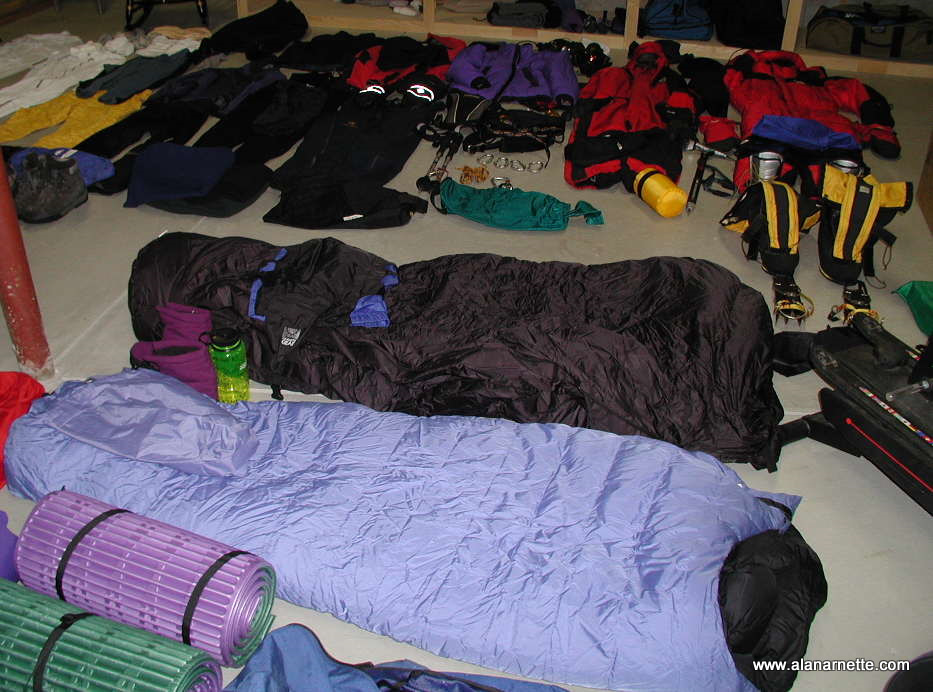
 Q: Do
I really need a guide for Aconcagua?
Q: Do
I really need a guide for Aconcagua?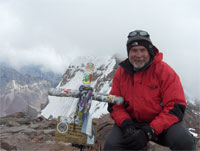 Q: And
the summit?
Q: And
the summit?