Podcast Series: 7 Summits Eposide 3–Mont Blanc

Welcome to my new limited series on climbing the Seven Summits. For the next eight weeks, I’ll drop a new episode discussing one of the 7 Summits in detail. Today is eposide 3 Mt. Blanc.

OK, I know what you are thinking, “Alan, Mont Blanc is not one of the Seven Summits!” Yeah, I know, but hear me out. On the border between France and Italy, Mt. Blanc stands at 15,771 feet or 4807 meters high, putting it between Kościuszko and Carstensz Pyramid on the “list(s).”

Month Blanc is a vast massif with three primary subpeaks: Mont Maudit, Mont Blanc du Tacul, and Aiguille du Midi.  Most people find Mont Blanc a serious climb given the objective dangers, such as crevasses, rockfall and avalanches, but it is also a cold and windy peak. While it is usually climbed in one day, it’s a long day of ten to fifteen hours, gaining up to 5,413 feet or 1,650 meters on most routes. Summer is the most popular time to climb, but as in 2022, it can be brutally hot. If you climb in winter, you must be a highly experienced mountaineer.

The 7 Summits idea was hatched and first accomplished by American Dick Bass. He started with six summits in 1983: Aconcagua, Kilimanjaro, Elbrus, Denali, Vinson and Kosciuszko. Then, with guide David Breashears, he became the oldest person, 55 at the time, to summit Everest in 1985. Canadian Patrick Morrow became the first to summit all seven with Carstensz in addition to Kosciuszko in 1986. Italy mountaineering legend Reinhold Messner summited all the peaks without supplemental oxygen, a first, and completed the task in 1986. #7summits

Episodes will drop each week:

September 15: Introduction
September 22: Mt. Kosciuszko, Australia – 7,310/2228m
September 29: Mt. Blanc, France/Italy – 15,771’/4807m
October 6: Vinson, Antarctica – 16,067/4897m
October 13: Carstensz Pyramid (Puncak Jaya), New Guinea – 16,023/4884m
October 20: Elbrus, Russia – 18,513/5642m
October 27: Kilimanjaro, Africa – 19,340/5896m
November 3: Denali, Alaska – 20,320/6194m
November 10: Aconcagua, Argentina – 22,902/6960m
November 17: Everest, Nepal/Tibet – 29,035/8850m

Podcast Series: 7 Summits Eposide 2–Kościuszko
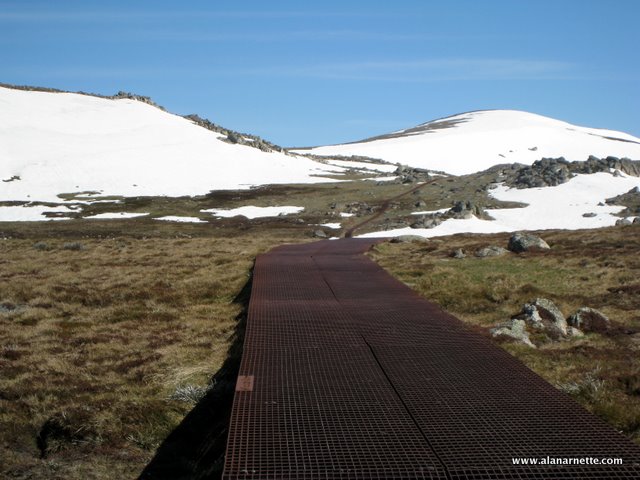
Metal Boardwalk to Kosciuszko

Welcome to my new limited series on climbing the Seven Summits. Episode 1 is an introduction plus a brief update on the Autumn climbing activity in Nepal and Tibet. For the next eight weeks, I’ll drop a new episode discussing one of the 7 Summits in detail. Today is eposide 2 Mt. Kościuszko.

Australia’s Kościuszko (7,310’/2228m), located in the Snowy Mountains, is the lowest of the 7 Summits but is perhaps the most controversial. First, there is the pronunciation, then there is the debate about how it compares to other high peaks in Oceania (is New Zealand continent?) ), and last is the relative ease of this “hill” located next to a ski resort. In any event, today, it’s considered one of the seven on the Bass list, so most people seeking the 7 Summits will tick the box. The first summit was in 1840 by the Polish explorer Paul Strzelecki. I assume the Aborigines or the Morano had a crack centuries earlier, but I could be wrong, as many Indigenous people treat mountains as sacred and not to be climbed.

The Seven Summits, aka 7S, represent the highest point on each of the seven continents. However, as with most things in mountaineering, there is controversy. From a geological viewpoint, there are only six continents on Earth: Africa, Antarctica, Australia, Eurasia, South America, and North America. Europe is considered a peninsula of the Eurasia continental platform and is not an actual physical continent. However, from a political perspective, Europe is regarded as a continent; thus, Elbrus (18,513’/5642m), located on the border with Asia in southern Russia, represents Europe and not Mont Blanc (15,771’/4807m), which lies in the Alps on the border of France and Italy.

The 7 Summits idea was hatched and first accomplished by American Dick Bass. He started with six summits in 1983: Aconcagua, Kilimanjaro, Elbrus, Denali, Vinson and Kosciuszko. Then, with guide David Breashears, he became the oldest person, 55 at the time, to summit Everest in 1985. Canadian Patrick Morrow became the first to summit all seven with Carstensz in addition to Kosciuszko in 1986. Italy mountaineering legend Reinhold Messner summited all the peaks without supplemental oxygen, a first, and completed the task in 1986. #7summits

Episodes will drop each week:

September 15: Introduction
September 22: Mt. Kosciuszko, Australia – 7,310/2228m
September 29: Mt. Blanc, France/Italy – 15,771’/4807m
October 6: Vinson, Antarctica – 16,067/4897m
October 13: Carstensz Pyramid (Puncak Jaya), New Guinea – 16,023/4884m
October 20: Elbrus, Russia – 18,513/5642m
October 27: Kilimanjaro, Africa – 19,340/5896m
November 3: Denali, Alaska – 20,320/6194m
November 10: Aconcagua, Argentina – 22,902/6960m
November 17: Everest, Nepal/Tibet – 29,035/8850m

Podcast Series: Introducing The 7 Summits

Welcome to my new limited series on climbing the Seven Summits. Episode 1 is an introduction plus a brief update on the Autumn climbing activity in Nepal and Tibet. For the next eight weeks, I’ll drop a new episode discussing one of the 7 Summits in detail.

The Seven Summits, aka 7S, represent the highest point on each of the seven continents. However, as with most things in mountaineering, there is controversy. From a geological viewpoint, there are only six continents on Earth: Africa, Antarctica, Australia, Eurasia, South America, and North America. Europe is considered a peninsula of the Eurasia continental platform and is not an actual physical continent. However, from a political perspective, Europe is regarded as a continent; thus, Elbrus (18,513’/5642m), located on the border with Asia in southern Russia, represents Europe and not Mont Blanc (15,771’/4807m), which lies in the Alps on the border of France and Italy.

The 7 Summits idea was hatched and first accomplished by American Dick Bass. He started with six summits in 1983: Aconcagua, Kilimanjaro, Elbrus, Denali, Vinson and Kosciuszko. Then, with guide David Breashears, he became the oldest person, 55 at the time, to summit Everest in 1985. Canadian Patrick Morrow became the first to summit all seven with Carstensz in addition to Kosciuszko in 1986. Italy mountaineering legend Reinhold Messner summited all the peaks without supplemental oxygen, a first, and completed the task in 1986. #7summits

Episodes will drop each week:

September 15: Introduction
September 22: Mt. Kosciuszko, Australia – 7,310/2228m
September 29: Mt. Blanc, France/Italy – 15,771’/4807m
October 6: Vinson, Antarctica – 16,067/4897m
October 13: Carstensz Pyramid (Puncak Jaya), New Guinea – 16,023/4884m
October 20: Elbrus, Russia – 18,513/5642m
October 27: Kilimanjaro, Africa – 19,340/5896m
November 3: Denali, Alaska – 20,320/6194m
November 10: Aconcagua, Argentina – 22,902/6960m
November 17: Everest, Nepal/Tibet – 29,035/8850m

Climbing Roundup
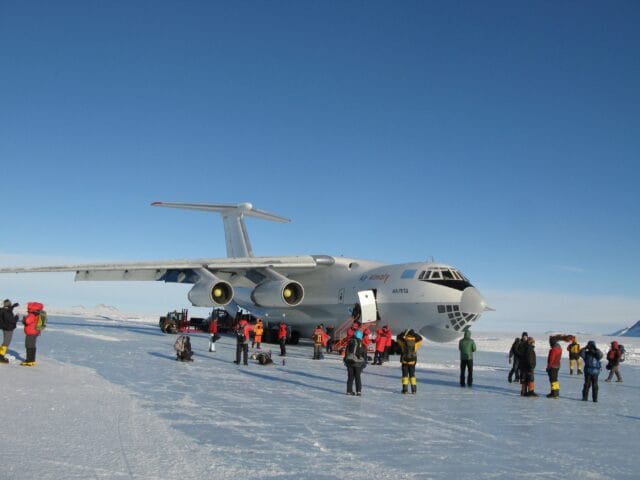
As we near the end of 2022, high-altitude climbing continues. We have activities in South America, Nepal, and Antarctica. The final summit numbers are in from the Himalayan Database for Everest. It was a record year for the number of Sherpas supporting clients.

Opinion: An Open Letter to Mountaineering Policy Decision Makers
An open letter to Mountaineering Policy Decision Makers,

After each season, pictures emerge showing trash left by climbers and long queues of climbers seeking their time on the summit. The public demands changes to protect the mountains. The operators announce clean-up campaigns and ask for donations. Countries respond with new rules. However, history shows these new rules are ghosts and are often ignored. There is time before the 2023 season to make significant changes. Please use this time to save your mountains and the tourism industry.

The 7 Summits – an Overview

Alan on Kosciuszko's Summit

In 2011, I summited seven of the eight seven summits. Confused? Read on! This post is a quick overview of the 7 Summits. My climbs were aimed to send a message of hope, need and urgency from the 7 Continents on behalf of everyone impacted by Alzheimer’s Disease. I made all the climbs in just 322 days. You can read more about each mountain, my personal experience and frequently asked questions by click on the links For an excellent book covering all the climbs, check out mountain guide Mike Hamill’s Climbing the Seven Summits. The 8 “7 Summits” The 7 Summits represent the highest point on each of the seven continents. It has become a goal for climbers around the world and around 416 people have met the goal as of 2016. See the list at this link. However, as in most things in mountaineering there is controversy. From a geology viewpoint, there are only 6 continents on the Earth: Africa, Antarctica, Australia, Eurasia, South America and North America. Europe is considered a peninsula of the Eurasia continental platform and is not a true physical continent. However, from a political perspective, Europe is considered a continent thus Elbrus (18,513’/5642m), located on the border with Asia in southern Russia represents Europe and not Mont Blanc (15,771’/4807m) which lies in the Alps on the border of France and Italy. Then there is the competition between Australia’s Kosciuszko (7,310’/2228m) and New Guinea’s Carstensz Pyramid, aka Puncak Jaya (16,024’/4884m) both located on the Oceania continent – which is not really a continent but a region of the south west Pacific that includes Australia, Fiji, New Zealand, Papua New Guinea, Samoa and many other islands. Just top make your head spin a bit more, Mawson Peak at 9,005’/2,745m on the Heard Island and McDonald Islands, is part of Australia and higher than Kosciuszko but not higher than Carstensz Pyramid. Dick Bass the first 7 Summiter, choose Australia as one of the 7 continents and Kosciuszko as it’s mainland high point. However Canadian Pat Morrow, who was competing with Bass to finish the 7, challenged Bass’s summit of Australia’s Mt. Kosciuszko as the highest peak in Oceania saying that Carstensz Pyramid on Irian Jaya (Papua) in Indonesia’s New Guinea was the true highpoint for the Australasian continental mass. Italian Reinhold Messner jumped in and agreed with Morrow. Today Carstensz is considered one of the seven but some 7 Summiteers try to bag the lower Kosciuszko to meet both the Bass and the Messner lists. Of the 416 7 Summiters, 148 have summited both Carstensz and Kosciuszko. So I guess if you want to cover all angles here is the list: Everest, Nepal – 29,035’/8850m Aconcagua, Argentina – 22,902’/6960m Denali, Alaska – 20,320’/6194m Kilimanjaro, Africa – 19,340’/5896m Elbrus, Russia – 18,513’/5642m Vinson, Antarctica – 16,067’/4897m Carstensz Pyramid, New Guinea – 16,023’/4884m Mt. Blanc, France/Italy – 15,771’/4807m Mt. Kosciuszko, Australia – 7,310’/2228m The 7 Summit idea was hatched and first accomplished by American Dick Bass. He started with six summits in 1983: Aconcagua, Kilimanjaro, Elbrus, Denali, Vinson and Kosciuszko. Then with guide, David Breashears, he became the oldest person, at 55, at the time to summit Everest in 1985. Canadian Patrick Morrow became the first to summit all seven with Carstensz in addition to Kosciuszko ending in 1986. Messner summited all the peaks without supplemental oxygen, a first, also completing the task in 1986. The 2nd 7 Summits Finally, since none of the seven are extreme technical mountaineering climbs, with the altitude challenges of Everest notwithstanding, some pundits suggest the second highest mountains on the continents is a better challenge for real mountaineers. I would agree that that list would be significantly more difficult if only for the fact that it includes K2 instead of Everest! That list includes: K2 (Pakastan-28,251’/8611m) Ojas del Salado (Argentina-22,608’/6983m) Logan (Canada-19,551’/5959m) Dykh-Tau (Russia-17,077’/5205m) Kenya (Africa-17,057’/5199m) Tyree (Antarctica-15,919’/4852m) Puncak Trikora (New Guinea-15,580’/4730m) Townsend (Australia-7,247’/2209m)   If you dream of climbing mountains but are not sure how to start or reach your next level from a Colorado 14er to Rainier, Everest or even K2, I can help. Summit Coach is a consulting service that helps aspiring climbers throughout the world achieve their goals through a personalized set of consulting services based on Alan Arnette’s 20 years of high altitude mountain experience and 30 years as a business executive. Prices and services at the Summit Coach website. Here are the 7 Summits in height order and my experience. Asia: Everest (29,035’/8850m) Mt. Everest is on the border between Nepal and Tibet (China). It is in the Himalaya mountain range which stretches 1500 miles from Northeastern Pakistan to Bhutan. There are over thirty mountains higher than 25,000 feet and fourteen over 26,300 or 8000 meters. Of the fourteen 8,000 meter peaks, nine are located in the Himalayas making it clearly the top of the world. Mt. Everest was first summited by Sherpa Tenzing Norgay and Edmund Hillary with a British expedition in 1953. They took the South Col route which is described on this page. At that time the route had only been attempted twice by Swiss teams in the spring and autumn of 1952.They reached 8500m well above the South Col. Of note, Norgay was with the Swiss thus giving him the experience he used on the British expedition. The Swiss return in 1956 to make the second summit of Everest. Today, hundreds of climbers from around the world use the South Col route to try to stand on top of the world. It is considered slightly more dangerous than the North Ridge Route due primarily to the instability of the Khumbu Icefall. However some considered it slightly easier than the north due to the absence of the ladders and rock climbing on the steep steps of the North Ridge route. The Grand Dame of all Everest statistics, Ms. Elizabeth Hawley reports on the Himalayan Database that there have been 7,646 summits of Everest through June 2016 on all routes by 4,469 different people. 1,015 people, mostly Sherpa, have summited multiple

Climbing Memories Week 1

As I climb the world to end Alzheimer’s, I have taken literally thousands of photographs. I am posting many on Facebook over the next few months and will do a weekly summary post here on my site. I hope you enjoy them. Mt. Vinson, Antarctica This is one of my favorite memories from Antarctica’s Mt. Vinson at 16,050’/4892m in December 2010. We were approaching the summit using the so-called right-hand variation lead by IMG legend Phil Ershler. I documented the moment in my trip report: “ … we made steady progress to the next ridge where we meandered around jutting rock formations and large boulders marking the highest ridge in Antarctica. As I looked out across the horizon, I had to keep reminding myself that the white I was seeing was not clouds but snow and ice. It was simply breathtaking. I was following Phil as he came to a high step at a snow wall. “I am touching the summit plateau. Don’t fall here!” And with that he took a big step, assumed the stance of a sea captain looking over his crew and monitored each of us as we duplicated his moves. I stepped on the summit area and immediately saw a small snow prow jutting into the air – a tiny spot symbolizing the highest point on the Antarctic continent. With no control or editing, I let out a whoop of delight. We spent an hour on the summit – forever in mountaineering time. But the skies were clear and there was no wind. Temps were near -20F but I felt like I was on a beach.”   Serengeti,Tanzania (Kilimanjaro) After summiting Mt. Kilimanjaro in Tanzania, we went on a short safari in the Serengeti. As much as I love climbing, the safari topped everything else on this trip to Africa. One moment is forever etched in my memory. Off to the right of the Land Rover walking slowly, methodically through the tall grass, was a full grown male Cheetah who suddenly stopped in his tracks. Slowly he turned his head to the left in order to see what the noise was all about. Perhaps it was lunch? Or maybe a mate, but no, this time it was just another load of tourists with their cameras clicking away. He moved on, not bothered in the least. Of course if he had wanted to, he would have taken off going from a dead stop to full speed of 60 miles per hours in just 3 seconds. Less than 10,000 of these magnificent creatures remain on earth. I am grateful he shared a few moments with me that September 2011 day.   Carstensz Pyramid, Puncak Jaya Indonesia The most exotic of the 7 Summits has to be Carstensz Pyramid in Puncak Jaya Indonesia at 4884 m (16,024 ft). it is the most “technical” of the 7 Summits, you do a bit of rock climbing, rappelling and a fun move called  a Tyrollean Traverse.  Basically you hang upside down from a rope/cable by your harness praying the cable was not installed by the headhunting, cannibal natives and that the inventors of nylon webbing knew what they were doing. If something fails, it’s several hundred feet to the first bounce off the rocks – a serious bad hair day! I understand they recently installed something called a Burma Bridge but I don’t think it an improvement. Tibet (Cho Oyu) In September 1998, I was on my way to climb Cho Oyu, 26,907’/8201m, in Tibet. This was my first ”big mountain” and first time in Tibet. I was awe struck by the barren, yet beautiful, landscape of the Tibetan Steps as it spread out as far as the eye could see at 14,000 feet. As we took our time to adjust to the ever increasing altitude, we stopped at several towns. Outside of one desolate town, Tingri, I came upon 50 tents – Tibetan nomads. The dark skinned Tibetan men enthusiastically gambled, rolling dice on the only paved highway for miles while the women tended to the sheep. I made my way to one pyramid shaped tent and gently looked towards an open flap. I made eye contact with an impressive woman and glanced at my camera, she simply nodded and placed her right hand on grand-baby’s leg. She looked at me for a slight moment as I pressed the shutter, careful to let the camera focus on this special moment. I slightly bowed my head and said thank you. I gave her a dollar bill. She smiled and pressed her palms together as I moved away. I wonder where these nomads are today, 17 years later. Are they still tending to their sheep, raising their children, living off the land? I would like to think their lives remain pure and simple in this difficult world.   Ama Dablam Ama Dablam is often considered one of the world’s most beautiful peaks. I was fortunate to summit it in October 2000. Standing tall at 22,494 feet or 6828 meters, it’s about 30 miles south of Mt. Everest. Anyone who has trekked in the Khumbu has many photos of this spectacular peak. Today Ama Dablam is quite crowded, as are many of the popular Himalayan Peaks and that is why Nepal opened up 104 new peaks for climbing last year. But in 2000, there was only a few other teams on the mountain and we had the summit all to ourselves. We had only one Sherpa, Lhapka, with us and he was amazing. The picture is of him approaching Camp 2. By the way, I’m looking forward to seeing the new film, Sherpa, featuring Phurba Tashi Sherpa of Himalayan Experience fame and who is tied with Apa Sherpa for a record 21 summits of Everest. When I first saw Ama Dablam in 1997 on a trek to Everest Base Camp, I dismissed it as impossible; I didn’t have the skills or ability to even attempt it. It was on my descent from the summit and

Documentary on Alan’s 7 Summits Climb for Alzheimer’s
Alan on the summit Mt. Elbrus

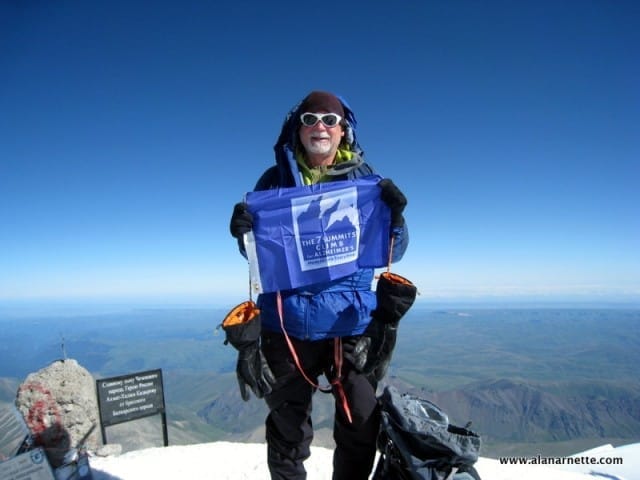
I am very pleased with a 6 minute documentary by the AARP on my Summits Climb for Alzheimer’s: Memories are Everything project. The producer, Lauren Cardillo, did a great job of taking my original pictures, videos and our live interview to tell the story of Ida Arnette, Alzheimer’s and my passion to make a difference. The film is scheduled to air on AARP’s television series, My Generation, hosted by Leeza Gibbons the week of September 16, 2012. My keynote presentations expand on the themes I discusses in the film. I want to remind anyone in the West Tennessee area that I will be speaking on behalf of the Pat Summit Foundation on October 7th. Also at Yale University Master Tea on September 27. As usual, I want to remind everyone that all donations go directly to your choice of Alzheimer’s organization to raise awareness, and research money; none ever to me. Climb On! Alan Memories are Everything

Communicating from Everest – 2012 Update

I receive many questions on how I did my live dispatches for the 7 Summits so I put together this short tutorial for anyone wanting to communicate during an expedition from anywhere on our planet. While staying in touch is mandatory and part of an expedition for me, some people want to get away from it all and escape the modern noise that comes with 24 by 7 communications. If that is your case, then take a sat phone for safety but don’t use it unless there is an emergency! Tell everyone that no news is good news and you will see them when you get home. And enjoy your time off the grid For everyone else, online here are several basic ways to keeps friends and family informed while you are on an expedition. Call a Friend: Call a friend who passes it along or transcribes your conversation and posts on your Facebook page or blog Email an update to a friend who forwards it, posts on Facebook or cuts and pastes it to your blog Do it Yourself: Phone in a voicemail through a service that posts it directly to your blog Send an email that automatically posts to your WordPress Blog Write a post and upload it using the Internet along with pictures and/or videos directly to your blog There are many ways to do this communication but I will cover what I have been doing for over 10 years. I have learned a lot and stick with what works – for me. I do all the programming but I am not THAT technical. There are consultants who you can hire at $150 an hour to do the work for you. I started with “Call a Friend” (my wife managed the transcription much to her chagrin) but soon switched to a fully automated system. The minimum setup you need is a phone, either satellite or cell depending on where you go and what service is available. For more sophisticated and independent postings you need to add a computer of some type, a digital camera and an Internet connection. This will enable you to connect with software that is linked to a website which may include a Blog, WordPress for example. If this sounds confusing, it is and it is not. So let’s break it down. Websites The first decision to make is where do you want followers to follow you – Facebook, Twitter, your own Blog or a dedicated website – or a combination of all of these. Also, is this a one time event or something you want to build over time. For a one time expedition, using Facebook is easy but limited over what you can control and present. A dedicated Blog, WordPress or Blogger for example, gives you significant control over how you present your information plus you can add links and pages for more information, causes or other sites. A dedicated website is the choice if you want full control over look and feel to build a long term destination for family and friends to follow your adventures for years to come. But all this comes with a bit more work. If this is all too much, there is a one stop shop approach for dispatches coming up. Don’t get overwhelmed with all these choices, it is actually much simpler than you think. COMMUNICATIONS This is the crux of your dispatch plan. You have two basic choices: Phones or Bgans. Again, one step at a time. For phones, there are cell phones and/or satellite phones using networks from Iridium or Thuraya depending on where you are climbing. A combination of phones sometimes might be in order. Iridium vs Thuraya Satellite Phones I always suggest bringing a sat phone since cell service is not reliable in remote mountain areas even though it may be in the local mountain gateway city. I feel there are only two satellite systems to consider: Thuraya which is for Asia, Africa and Europe and Iridium for North and South America, the oceans and the poles. Thuraya is the choice for data if you are climbing in their coverage area (which includes Everest) because once you lock onto a satellite you do not usually lose it whereas with Iridium you are switched between satellites as they move across your view and in my experience, you will lose the data connection during each switch most of the time, even though they tell you it will switch seamlessly. This lost connection limits your data uploads to a short few minutes preventing a dispatch with several images. If you lose your connection you must restart the upload process meaning lost time, money and sat time. The only time my Iridium connection was rock solid was on Kosciouszko’s summit where I had a 100% clear sky and unlimited visibility. Even in Antarctica, I could only connect for 4 minute periods before losing my data connection. To state the obvious, most mountainous areas rarely have unobstructed views of the sky, duh. Thuraya can be less expensive than Iridium on a per minute basis by almost 50% depending on your location. For example calls to the US from Nepal cost US$0.90 a minute but from China or Pakistan it goes up to US$1.90 per minute using their new NOVO SIM. The NOVO SIM is new for Thuraya and now automatically changes rates based on your GPS location eliminating their prior ECO and Prepaid SIMS. If you in bulk, say 500, 1000 or 2500 minutes/units, you can gets 30% discount lowering the per minute costs to US$0.63 or USD$1.33. Iridium is a flat US$1.30 per minute from anywhere in the world. It might be less expensive over the long run to your satellite phone instead of renting it depending on how many trips you plan and how many minutes you will use. Usually renting a phone implies more expensive minutes but not always so shop around. Sat phones range from $800 to $1800 and rentals around