Avalanche perhaps stops summits on K2 and the Karakorum – Updated
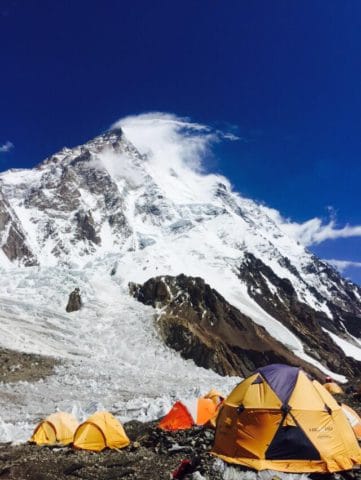
K2 summit winds July 13, 2016. Courtsey of Dawa Sherpa Seven Summits Treks

Update 26 July : Gasherbrum II summits. Heavy weather moving. Team down climbing now.  Update 25 July : Nanga Summit. GII attempt underway. Broad Peak over.  K2 BC emptying. Independents give up also – no K2 summits for 2nd year in row due to weather and snow conditions. A large avalanche reported on 23 July, 2016 on K2 has destroyed tents, buried fixed ropes and swept way the cache of food and oxygen bottles at Camp 3.  There were no injuries or fatalities reported. While not 100% certain, it appears for the second year in a row no one will make the top. While most climbers on the large commercial teams and a few independents stayed safely at Camps 1 and 2, several reports said 25 Sherpas were on their way to fix ropes to Camp 4 when they found the destruction. It was at this same location in 2013 that professional mountain guide Marty Schmidt and his son Denali were killed while sleeping in their tent at Camp 3 by an avalanche. All the other teams that year had descended fearing such an event. Camp 3 is perched on a steep slope just above the top of the Black Pyramid but a few hundred meters lower where the relentless angle of K2 finally lets up for a short distance thus serving as a perch for High Camp or C4. Camp 3 is usually located at 24,000 feet or 7,315 meters – still a long way from the summit. K2 has always been tough, thus one reason so few attempt it. From 1986 to 2015, there were 11 years with no summits. From 2009 to 2015, there were only three years with summits – 2011 only from the Chinese side, and 2012 and 2014 each with between 30 – 50 people summiting – record breaking years as a result of a week of excellent and rare summit conditions. Everest went from 1974 to 2014 with summits every year – 40 straight years! Efforts Continue on other Peaks There have been no reports of similar events stopping progress on the other Karakorum peaks but conditions are not good throughout the region. Teams received a good weather forecast a few days ago calling for a week of good weather, but with a small front coming thru the area on 21 July. But the area is notorious for sudden changes. The small front that came thru on Friday proved stronger than forecasted and stalled progress with high winds and heavy snow. In addition to the heavy snow the previous week when teams were in base camps, this front brought additional fresh snow on the peaks.  Teams delayed climbing higher and stayed put at low camps waiting for the new snow to settle. The poor conditions were not isolated to K2. Some teams, for example on the Gasherbrums, reported warm temps, rain at lower levels and weak snow bridges – all in all a dangerous environment, but somewhat normal for the high peaks of Northern Pakistan. Colorado based meteorologist Chris Tomer told me this morning (Saturday) that the area received a lot of snow on Friday and was not surprised by the avalanche. He is advising a team on Gasherbrum that they will see calm conditions from Saturday thru Monday but turning poor again on Tuesday: There is disagreement amongst sources.  Teams were told by other groups that Monday is going to bad and Tuesday better for summit.  I disagree with that.  I think Monday is better than Tuesday.  But at this point avalanche danger might be the trump card. There has only been one peak summited thus far this season –  Broad Peak by Slovenian climbers Aleš ?esen and Luka Lindi?. They pushed on when other teams paused and summited with no fixed ropes or assistance. They were last reported to be attempting the West Face of Gasherbrum IV. Broad Peak Summit – Over On Broad Peak, Spanish climber Oscar Cadiach with six other climbers plus the five person Mountain Professional team were last reported to be climbing higher. After waiting for the last batch of new snow to settle (not this latest round!), MP posted on 21 July: It was a long day up but we climbed almost 12 hours in total bypassing a stop at camp one and going directly to C2,. The weather tomorrow could be a bit lousy and some snow but as long as it is mild, we are going into the better weather and still have the morning of 24th as our target for the top. I have not seen a recent report and would not be surprised if they encounter deep snow, similar to 2015, and will also abandon their summit bids. Update 25 July: Deep snow and yet another whiteout stopped summit attempt near Col. Teams returning to BC. Mountain Professional posted this update: Last night we left high camp at 11 pm to battle with the infamous slopes to reach the Col. It was essentially us and some Spanish climbers making the track all night long, we are the only two teams here in a very unusual season. The net net is that after 11 hours of 600 meters gain we were just below the Col. Or we thought, steep icy slopes with old fixed rope marked our final obstacle , but in reality it was just another slope with about one more hour to go to the Col, and wouldn’t you know the weather turned to total whiteout and wind. We waited on the lines but nothing was changing. We decided that going into even more technical terrain in that weather after working so hard was questionable for a safe descent. So with tearful back and for the we decided to go down. I will go over and over this trip and take away lots of valuable lessons as an expedition leader. I can say that Broad Peak is a challenging climb, I climbed it without O2 exactly 10 years ago, and to me the upper summit day feels harder than back then. Our group was ready and I think they were strong enough to reach the summit. Nanga Parbat SUMMIT!!! After another stalled attempt a couple of weeks ago, Ferran Latorre and team are pushing for their summit again:

High Winds Stop Summits Push on K2; Broad Peak Summit

K2 summit winds July 13, 2016. Courtsey of Dawa Sherpa Seven Summits Treks

Teams knew this was a risky chess move to try and summit K2 during a narrow weather window, and they lost this bet. July 14th was predicted to have acceptable winds on the summit of K2 but as is normal in the Karakoram and especially K2, the weather changed dramatically causing everyone to quickly descend back to base camp. So the good news is those climbers have spent quite a few nights at Camps 1, 2 and 3 thusly improved their acclimatization. The bad news is they also spent a lot of energy and for some teams, supplemental oxygen, so far. Over on Broad Peak, most reports have climbers making the same quick descent to base camp as over on K2 but it has also been reported that 2 Slovenian climbers, Aleš ?esen and Luka Lindi? summited Broad Peak. They apparently did not use fixed ropes and pushed hard to beat the weather. The daring duo will now move on to the Shining Wall of Gasherbrum IV. Over on Gasherbrum II, the US team has established and cached gear at C3 ~23,000. The weather looks bad for next several days so climbers will hole up in their tents to recover from this false start. Hopefully the next window will appear as forecasted towards end of July but as we know the weather in the Karakoram is rather finicky. Climb On! Alan Memories are Everything

Summits Pushes Begin on K2 and the Karakorum
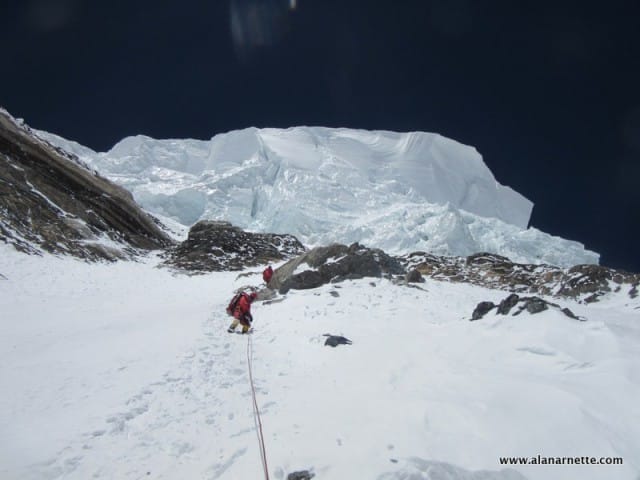
Downclimbing below the K2 infamous ice serac

After a normal short period of high winds and heavy snow in the Karakorum, the weather forecast calls for acceptable conditions this week thus teams are moving up their mountains towards the summit today. And, to be sure, it will be crowded on K2 with 60 climbers reported to be going for the summit on July 14th. The crowds are not from the climbers themselves but more from the support staff provided by some of the commercial expeditions or heavily staffed private efforts. One individual climber on a single permit has 5 Sherpas for support. This is a list of the Karakorum 2016 Expeditions permits issued for all the Karakoram mountains this summer. Nanga Parbat NOW! First over on Nanga Parbat, Ferran Latorre and team are pushing for their summit now: Tomorrow we will try to do summit! Today it has snowed for 5 hours, it will be an attack on the summit hard but we’ll try it if the weather is leaving us. With these views from the store to the c4 to 7.400 M I say goodbye for today. You can follow their push on his InReach page. This is the same route used to obtain the first winter summit a few months ago. Broad Peak Progress On Broad Peak, the Mountain Professional team continues to make progress and are enjoying the views of K2 from their perch: There was quite a bit of wind and snow during the night, so we were actually expecting to turn our nose back down towards basecamp. However, looking at the snow and not least the weather forecast for the next 24 hours, Tomas and Ryan decided to make an attempt for camp 2. We woke up to a blue, blue sky and a fantastic view of K2. The scenery here is unbelievable, with sharp mountains basically everywhere. Sorry boss, but the view looking out of our the tent this morning beats any day in the office. K2 Summit Push On K2, it appears that Adventure Peaks, Seven Summits Treks and the Polish team are headed higher looking for a summit on July 14th. The heavily supported commercial teams of  Madison Mountaineering and Kari Kobler are also moving higher: The Madison Mountaineering 2016 K2 Expedition has four climbers, two western guides, and six Nepalese Sherpas. Our neighboring Swiss K2 expedition has eight climbers, two western guides and ten Sherpas. We are very international as we have 13 climbers from 11 countries. We are working closely and well together with the Swiss expedition. We also have about 20 Pakistani high altitude porters that will carry loads to higher camps and 15 cook and camp staff between the two expeditions. The two expeditions are working together with all route fixing, camp establishment and summit bid preparations. Climbers, guides and Sherpas (total of about 30 people) for the two expeditions will be on full O2 from C2 to K2 summit and back to C2 on summit bid. The two expeditions will requiring over 120 bottles of O2 to be in place at the respective camps of C2, C3 and C4. This is a huge change from when I summited K2 with Madison in 2014. We had three climbers and three Sherpas. There were about 30 people who summited on July 26th, 2014, and 15 on July 27th – the last year K2 saw summits. The biggest issues with so many people are limited tent space at Camps 1 and 2 and potential delays on the Bottleneck and the Traverse below the summit serac while the ropes are being fixed.  In 2014, 30 climbers waited several hours near the Traverse while the ropes were being put in – they narrowly escaped frostbite or worse. Perhaps the most serious issue is with rockfall. K2 is notorious for rockfall anyway, with scores of climbers above you, the danger significantly increases. This year’s technique, or formula, of a large ratio of guides, Sherpas and support staff to paying members is becoming more common on the world’s 8000 meter mountains. Women on K2 There are several women climbers on K2 this year. As many readers know, K2 has a special reputation for women climbers, some called it a ‘curse’. Prior to 2014, of the nine women who had summited, five had died – 3 descending from K2’s summit and 2 on other 8,000m peaks. Basque climber Edurne Pasaban was the sixth woman to climb K2 in 2004 and was the only one of four still alive today along with Norwegian climber Cecilie Skog in 2008, Nives Meroi from Italy and Austrian climber Gerlinde Kaltenbrunner who summited from the north side of K2 in 2010. But in 2014, that ‘curse’ was broken with six women summiting: The Nepali women’s team (Pasang Lhamu Sherpa, Maya Sherpa and Dawa Yangzum Sherpa); Chris Burke (New Zealand), Luo Jing (China), Tamara Lunger (Italy). This year, Vanessa O’brien, Laura González del Castillo Aranda and Bonita Norris are among the women climbing. Best of luck to all! Climb On! Alan Memories are Everything

K2 and Karakorum Mid-Season Update

Camp 2 on Broad Peak in 2006

Climbing teams are scattered all across the Karakoram this early July seeking to summit the five 8000ers located in Pakistan. Most are progressing well with several nights already spent at the lower to mid level camps around 7, 000 meters as they acclimatize to the higher altitudes. A few climbers, five reported thus far, have abandoned their climbs due to injury and other issues. The week starting with the 4th of July saw the weather turn a bit ugly with heavy snow reported at multiple base camps thus teams are locked down for a few days – all quite normal in July in the Karakoram. As previously noted, it is a busy season on K2 but the other peaks seem to be about normal for permits. This is a list of the Karakorum 2016 Expeditions permits issued for all the Karakoram mountains this summer. The summary is: Gasherbrum IV: 2 Gasherbrum I: 3 Gasherbrum II: 6 Gasherbrum I/II: 28 Gasherbrums: 40 Nanga Parbat: 19 Broad Peak: 19 K2/Broad Peak: 60 K2: 62 K2 total: 112 Others: 25 224 total Gasherbrum I/II At 26,362’/8035m. GII is often considered the most attainable of the Karakoram’s 8000ers. There have been about 334 summits of GI and 930 of GII. Usually the Gs are fairly crowded but K2 seems to be taking the spotlight this year.  My Colorado climbing buddy, Ryan Kushner and team are on GII and have reached 7000 meters thus far. Nanga Parbat The ‘Killer Mountain’ has a deadly reputation not only for climbers but also as the site of a the 2013 massacre at base camp where 10 people were savagely killed allegedly by terrorists. At 26,660’/8126m Nanga is know to be one of the more technical 8000ers. There have been around 350 summits including several this past winter leaving K2 as the only 8000er not summited in winter. There are just a few teams on NB and they are making progress. Ferran Latorre reports on his blog that they have been in base camp for two weeks. They tagged 7,000 meters and began considering a quick summit run but the jet stream arrived to stall their plans. However, the excellent website Altitude Pakistan reports “Ferran, Yannick & Helias are ready for summit-bid on unfinished line on North Side, whereas Kinshofer Route climbers are still to reach C2.” Broad Peak BP is often concerned a warm-up for K2 but that grossly understates the difficultly of this 26,414’/8051m peak. About 410 people have summited. For 2016 there are only a few teams based at Broad Peak base camp even tho 79 permits were issued – many of those were for K2 climbers hoping to summit BP after K2. In reality many plan for this and few accomplish it. The Mountain Professional team arrived at base camp on 21 June to find it all to themselves, and not to their liking: It has been crazy to watch the daily influx of climbers and groups to K2, as they walk right next to our camp, but still no other team on Broad Peak except us. This is challenging for our team, since commonly in Pakistan teams band together to fix rope and we have been left to do the lions share here, since we heard at least two groups had problems getting in to Pakistan, and of course these were the ones that were most likely bringing lots of manpower and gear to contribute to fixing our route. We have ordered up more rope and pitons from Skardu, in the event we are forced to be self reliant here, we hear rumors of groups coming but not sure what is the case so we press on. We were a bit early arriving so we expected to most likely fix the first part of the route but now could use some collaboration, we press on and look forward to a good C1 rotation. But a couple of other teams arrived, however not as strong as the MP team wanted to see. They were on their second rotation planning on a night at C2 or 6300 meters but when the winds picked up, they returned to BC. K2 With a sobering death to summit ratio of about 25%, K2 is the most challenging of all the Karakoram 8000ers. The second highest in the world at 28,251’/8611m it is significantly more difficult and dangerous than Everest. This year, K2 has a record 112 permits issued for it. Historically, only 355 people have summited K2. From 1986 to 2015, there were 11 years with no summits. From 2009 to 2015, there were only three years with summits – 2011 only from the Chinese side, and 2012 and 2014 each with about 40 – 50 people summiting – record breaking years as a result of a week of excellent and rare summit conditions. Everest went from 1974 to 2014 with summits every year – 40 straight years! Weather is reported acceptable thus far with some days showing high winds but snow conditions seem better than last year when no one summited K2. Teams are reporting the fixed ropes have been set to C2 (22,000′) and a combined effort of Sherpas from several teams are working to fix the Black Pyramid to C3. There are only a few large commercial teams but a slew of small teams consisting of a few foreigners supported by many Sherpas and Pakistanis. This means coordination could be difficult and is requiring the long time experienced K2 leaders like Kari Kobler to step in. However it seems that the crowds and inexperience are beginning to show on K2.  Laura  & Yuri posted this on their Facebook page (translated by Facebook). They are with Austrian Kari Kobler: If something we talk about when we refer to the mountain, is the team work and the importance of this to get to the summit. On this occasion, it has come a lot of people at the k2, make it a bit later to go behind the expeditions as big as ours (sucking wheel, as in the cycling), but due to the difficulty of this mountain, where the spaces for the camps They are truly reduced, a lot of people had the nerve to come up with no store and just

Why K2 Will Never Become Everest

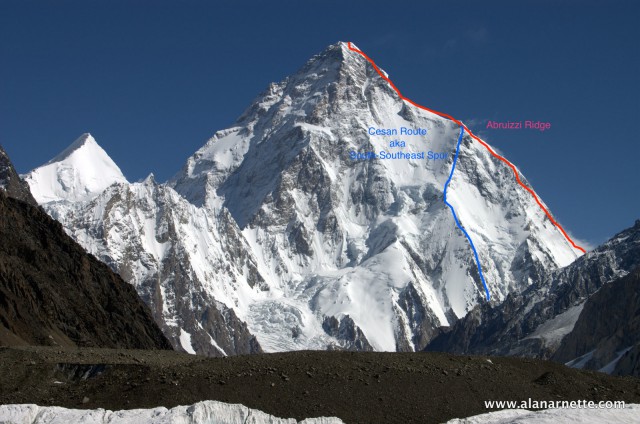
K2 routes

Update 25 July 2016 :no K2 summits in 2016 due to weather and snow conditions. With 112 permits issued for K2 the summer of 2016, the press will soon go wild with articles saying “K2 is the New Everest.” Never mind the fact that in the year ever, K2 saw about 50 summits and in a “normal” year, Everest will greet over 500 on the summit. With my 2014 summit of K2 and 36th major expeditions including four on Everest and two on Lhotse, my honest assessment is that K2 is not Everest. As anyone who has read my blog for the past decade can attest, I have utmost respect for Everest and her climbers. After all, it is the highest mountain in the world! But K2 is totally different. And it starts steep and ends steep! These are a few reasons why K2 may never become Everest, but I’ve learned to never say never in this sport! K2 is a Technical High Altitude Climb, Limiting the Attraction With all due respect to Everest, there is little actual “climbing” by the normal routes. By that I mean using your hands and feet to maintain balance and move higher, other than on aluminum ladders. It is mostly walking on moderate snow slopes attached to a fixed line. There are exceptions in spots such as Steps on the North, the mid part of the Southeast Ridge on the South and on the rarely climbed more technical routes, mainly from the North. That said, Everest is not easy and should never be taken lightly as evidenced by the 5 deaths this year that, by most counts, could have been prevented. And in 2014, 18 Sherpas were killed from an ice serac release onto the Khumbu Icefall. But in general, while Everest is all about attitude, K2 is all about climbing. Even tho K2 is lower than Everest by about 800 feet, the climbing presents an entirely different level of difficulty, complexity and needs for skills. Each climber must has proven, long term skills in rock, ice, snow. Falter on one, you gamble with your life. The fixed ropes are mostly a placebo, some showing the route but others not strong enough to stop a fall. You actually rock climb using hands and feet, look for hand holds, literally use your upper body to ascend using a jumar. You use the front points of your crampons, not for traction on a snow slope, but to secure your body to a vertical ice or rock wall. It is a game of tiny edges, of inches. Your body is supported by your feet, your hands prevent you from falling backwards. If you slip on loose rocks and are not properly secured, you will fall and die. There is no recovery opportunity. Climb K2 is about as serious as one can get and at severe altitude. And the descent is in some ways worse. You must rig rappel (or abseil) over and over, each one must be perfect, there is zero room for error. There is a maze of old ropes on K2 that need to be cleaned up. If you choose the wrong rope, and you slip thus weighting the rope, it will break under your weight. You are exhausted, the lack mental focus is very real so mistakes are easy and often. No one can climb for you, you are on your own, totally responsible for yourself; no guide, sherpa, teammates or porter can climb for you. You must be constantly on the outlook for large, as in microwave size, falling rocks that can kill you instantly. Avalanches are a constant threat. Before I get comments citing other 8000ers or other mountains around the world with tougher routes, I fully acknowledge that sections of Nanga Parbat, Makalu or true rock climbs like Meru, Fitz Roy offer similar and significantly more difficulty to sections of K2. I am positioning K2 with Everest by the ‘normal’ routes that most readers might consider. The local mountaineering support pales in comparison to Everest Pakistan and Nepal/Tibet have very different levels (and availability) of High Altitude Workers. There are Sherpas in Nepal, Tibetan Sherpas in Tibet and High Altitude Porters (HAPs)in Pakistan. Clearly the Sherpas are the known as they have been supporting foreign climbers since the early 1900s. There is a school in Lhasa that has trained many Tibetans and today they fix the rope on the north side. In Pakistan, there are a limited number of highly qualified and skilled HAPs but there are efforts to train more. Many expeditions bring Sherpas in from Nepal to support their teams and fix ropes on K2 (and Broad Peak, the Gasherbrums, etc) and Pakistan doesn’t like this at all. Each Sherpa must have a full price climbing permit and there have been discussions to ban them as they are viewed as taking the jobs of the HAPs. All of this results in higher prices for Pakistan climbs, but they are still less expensive than Everest. A permit to climb K2 is around $1,700 versus $11,000 for Everest. Thankfully a ban on Sherpas has not happened as the Sherpas and HAPS work well together and a transfer of skills is taking place faster than if the HAPs climbed on their own. Personally I think having more local support in Pakistan is good for everyone, but they need to have the same skills as the Sherpas if more inexperienced climbers continue to attempt Karakoram peaks.   K2’s weather is worse than Everest thus reducing summit success From 1986 to 2015, there were 11 years with no summits. From 2009 to 2015, there were only three years with summits – 2011 only from the Chinese side, and 2012 and 2014 each with about 40 – 50 people summiting – record breaking years as a result of a week of excellent and rare summit conditions. Everest went from 1974 to 2014 with summits every year – 40 straight years! K2 sits to the West of the other large Karakorum peaks thus takes the brunt of the west to east weather fronts. The weather has been notoriously difficult to predict and many deaths have