Why Climbers Don’t Summit
Practical advice from more than 30 years of climbing, from Colorado to the summits of Everest and K2: how to progress, the skills you need, what gear to take, how to choose a climb and a guide, and what to expect on the mountain. For one-on-one help planning your climb, see Summit Coach.
I am not a doctor. Discuss everything on this page that touches your health with yours, and get a medical checkup before you start training.
I believe it’s essential to understand why people don’t always summit or have a positive experience, so you can learn from it and prepare for your own climbs. After 36 major expeditions, including four attempts on Everest before I summited, these are the reasons I see again and again.
Altitude and Fatigue
Spending weeks at elevations above 14,000 feet (4,300 meters) and walking for 4 to 6 hours daily takes a toll on the human body. Getting sufficient quality sleep, staying hydrated and eating well are essential. My rule of thumb is that losing 10% of your body weight means you won’t have the strength to reach your goal.
Altitude sickness is the leading cause of death on many high peaks, and it is managed primarily by taking your time on the expedition. Remember, descending, not medication, is the only cure for altitude sickness.
Some climbers use medication to help with acclimatization, and some carry drugs for emergencies. These are prescription decisions with real side effects and very individual responses: talk to your doctor about whether anything makes sense for you, and never use medication to keep climbing while you have symptoms.
Health and Illness
Upper respiratory infections are common at high altitude, and treatment should be guided by a clinician and the specific infection.
Occasionally a climber will severely sprain an ankle or twist a knee, though such incidents are relatively rare. After summiting Kilimanjaro, I severely sprained my ankle hiking below the high camp, and the porters carried me down the mountain on a gurney. Most reputable guide companies require evacuation insurance, such as that offered by Global Rescue or similar providers.
One challenge on many climbs is hygiene. Some huts, camps and toilets on the heavily commercialized peaks can be cesspools of bad habits. A good guide company will keep a clean camp with boiled water for cooking, drinking and washing, but it’s the little things that trip us up. Develop and maintain clean habits from the day you leave home until you board the plane home.
Climbing Conditions
This general category includes weather, snow and ice conditions, winds, and avalanche or rockfall danger. Much of it is beyond your control: there’s not much to do except wait out bad weather, wait for new snow to bond, or end your climb for safety. You may be confined to camp for a day or more, but don’t let impatience get the better of you; stay positive.
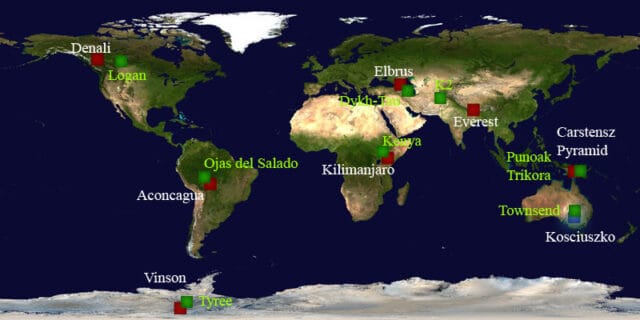
Conditions vary by mountain and by season, so be prepared for anything. Here is an overview of the Seven Summits, plus Rainier:
- Everest, Vinson and Elbrus: snow, ice and rocky slopes; short icy walls in the Khumbu Icefall; days of moderate to steep (45-75 degree) climbing.
- Aconcagua, Kilimanjaro and Carstensz Pyramid: hot, humid days on well-defined dirt-and-rock trails low on the mountain; snow and ice possible up high, including at the summit, which requires crampons. Carstensz requires mid-5th-class rock climbing with exposure.
- Kosciuszko: a ski lift goes halfway up the mountain, then a moderate half-day walk to the summit, which can be snow-covered.
- Rainier: hot days possible on the lower trails, then snow, ice and rocky slopes with days of moderate to steep climbing.
- Denali: potentially open crevasses from the Kahiltna airstrip to Camp 1 and beyond, a short icy section on the Headwall, and snow and ice on the upper mountain, including the summit.
Natural Events
Objective dangers such as rockfall, avalanches and earthquakes can happen at any time. There’s not much you can do but accept nature’s reality and make wise decisions about further climbing. I was in the Western Cwm on Everest when the 2015 earthquake struck; some things are simply out of our hands.
Politics
Expeditions can feel like being back at work, where people inevitably engage in politics. Avoid team politics by staying focused and surrounding yourself with positive people. Don’t hesitate to distance yourself from negative people or those who bring you down. Early in the expedition, identify the people you get along with and stick with them. A positive mental attitude creates a better experience for you and your teammates.
Guides
A poor or incompetent guide or company can ruin your experience and even jeopardize your chances of reaching the summit. Find a guide you can trust, communicate with effectively and enjoy being around. The people you talk to in a company’s home office may not be the ones on the mountain, so if possible, talk with your actual guide before signing up or paying. See Questions to Ask a Guide.
Age
Age is less of a factor than it once was, and I summited K2 at 58. However, VO2 max, the maximum amount of oxygen your body can use during exercise, declines with age. It usually peaks around age 20 and can fall by nearly 30% by age 65, so we often climb more slowly as we get older. The key is finding a pace you can hold all day without trying to compete with younger climbers.
Using Everest as an example, Himalayan Database figures show that as of 2025, 6,656 members (excluding Sherpas) had reached the summit. Between 2015 and 2025, the summit rate for all climbers was 63%, and the average age of summiters was 43 for men and 40 for women.
Get help planning your climb
Every climber starts somewhere different. If you want an independent, one-on-one plan for your next objective, with no ties to guide companies or gear brands, that is what I do with Summit Coach. Start with a free call, or download my free Climber’s Starter Handbook.
Preparing for a Climb is More Than Training
Summit Coach
From Your First Summit to Everest. One Coach, the Whole Way.
Planning your next big climb? Work one-on-one with Alan Arnette, Everest and K2 summiteer, for personalized training plans, independent guide-service advice, gear recommendations, and experienced support from preparation through expedition.
No commissions. No conflicts. Just advice focused on your success.
www.alanarnette.com is provided for informational purposes only and not for advice except through Summit Coach services.
Please see the complete disclaimer.