Climbing the World to End Alzheimer's
Ama Dablam

Ama Dablam

Since I started climbing in 1992 I have climbed on peaks around the world, from Colorado to K2, which I summited in 2014 at age 58. These pages cover my climbs beyond Everest and the 7 Summits, with trip reports, dispatches, FAQs and photos. See all of my climbs.

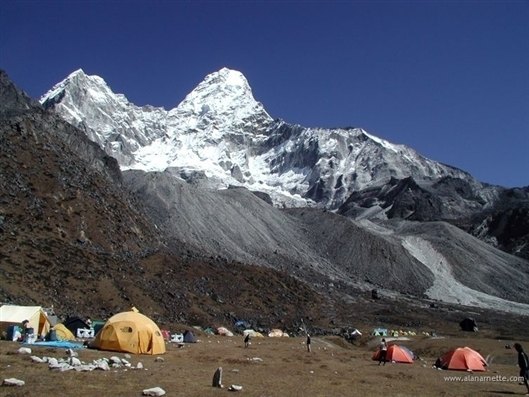
Ama Dablam from the trek to basecamp

Ama Dablam is often called the Matterhorn of the Himalayas. I admired it first while trekking in the Khumba – the area leading up to Mt. Everest. It stands alone with a sharp top and a huge snowcap. Sir Edmund Hillary once called it “unclimable”.

I summited Ama Dablam at 10:30 on October 26, 2000. I went with Adventure Consultants out of New Zealand. I found the mountain a great challenge with a nice mix of rock (up to 5.7), ice and snow. We had excellent weather and a strong team resulting in summiting 4 days ahead of schedule.

Climbing the tower on Ama Dablam
Alan on the summit of Ama Dablam

I left Denver for Katmandu on October 9 and arrived in base camp about 10 days later after taking our time acclimatizing during the trek in from Lukla. We established base camp in a beautiful grassy meadow at the terminal moraine of a glacier coming down from Ama Dablam. A stream provided fresh water.

We followed an aggressive acclimatization schedule on this climb. There was one trip to Camp 1 followed by a day climb to cache some gear below the Tower. After two nights at Camp 1, we returned to BC for two days rest and then left for the summit. We spent one night at each camp followed by one night at Camp 3 after the summit due to one member not feeling well enough to go lower.

Camp 1 was at 18,500 and took about 3 hours to reach with boulder scrambling required at the end. It is perched on a rocky area just below a steep ridge. It was well protected but very steep and dangerous. The primary technical climbing is between camps 1 and 2 and camps 2 and 3 with steep snow slopes from Camp 3 to the summit.

The “tower” between 1 and 2 is the most challenging and this year there was little ice or snow so it was nice rock. We pulled our packs up the tower to allow us to climb with more freedom. With our crampons still on, it was truly mixed climbing on the fixed ropes. Our Sherpas fixed the ropes and hauled our packs up the Tower.

Camp 2 sits atop a rock pillar. There is barely enough room for two tents. There are extreme drop-offs on all sides. When the wind blew, it was incredibly cold. We quickly ate before sunset when it really got cold! The 70-degree couloir between camps 2 and 3 was fun and required attention to detail since there was extreme exposure. It was mostly ice with a few spaces of bare rock. It was not as difficult as the tower.

From here we followed narrow snow ridges to Camp 3 which was on a relatively flat snow field just below the big snow mushroom everyone sees from the Khumbu. We got a good nights sleep and left for the summit about sunrise. Note, in 2006 an avalanche from the ‘Dablam’ killed six clibmers at this same spot where the alos established their Camp 3.

The summit climb was very cold. The route was mostly straight up but not technically difficult. Similar to the other climbing days, it was about a 5-hour climb up then about 4 down. We used the fixed ropes set by our Sherpas. The summit was awesome on our clear, dry day. The wind was howling and the temps cold but the views of Everest, Lhotse and Maklu were great. We stayed at Camp 3 that night and returned to base camp the following day.

I trained seriously for the previous 6 months. In training for Cho Oyu, I mostly ran and got climbing experience in the Alps. Generally speaking, my level of fitness was acceptable for that climb but I often felt that I need more upper body strength. So this time I have added weight training to my regiment and have added over 15 pounds of muscle to my upper body. I think this helped my overall strength since I had also been running a 5 mile course at 5,000 feet 3 times a week for the the past several months. Finally, I climbed the local Rocky Mountain peaks such as Longs and The Grand Teton.

I believe my training helped during this climb since I rarely felt leg weary, had headaches or other health difficulties. Even though I lost 15 pounds (mostly muscle so I have to start over again!) and got very minor frostbite on my finger tips, I never felt better after a climb!


Preparing for a Climb is More Than Training

Summit Coach

From Your First Summit to Everest. One Coach, the Whole Way.


Planning your next big climb? Work one-on-one with Alan Arnette, Everest and K2 summiteer, for personalized training plans, independent guide-service advice, gear recommendations, and experienced support from preparation through expedition.

No commissions. No conflicts. Just advice focused on your success.

Explore Summit Coach & Book a Free 30-Minute Call

www.alanarnette.com is provided for informational purposes only and not for advice except through Summit Coach services.
Please see the complete disclaimer.