Climbing the World to End Alzheimer's
Menu
Everest Latest Statistics
I summited Everest on May 21, 2011 and have climbed it three other times (all from Nepal) – 2002, 2003 and 2008, each time reaching just below the Balcony around 27,500′ (8,400 meters) before health, weather, or my own judgment caused me to turn back. I attempted Lhotse twice – 2015 and 2016. When not climbing, I cover the Everest season from my home in Colorado as I did for the 2004, 2005, 2006, 2007, 2009, 2010, 2012, 2013, 2014, 2015, 2016, 2017, 2018, 2019, a virtual 2020 season, 2021, 2022, 2023, 2024, 2025, 2026 and soon the 2027 season.
Follow Alan Arnette’s Annual Everest Coverage
“One of the world’s most respected chroniclers of Everest” — Outside Magazine
Read the Latest Season Coverage
Read the Latest Everest Statistics—summits, deaths, by sides, climbers
Sign up for post’s notification
This page is a summary of the latest Everest climbing statistics
CONTENT
Latest: Spring 2025
- In 2025, there were 851 summits, including 731 on Nepali and 120 from Tibetean side.
- The Nepal side split by 303 members supported by 428 Sherpas for a support:client ratio of 1.4:1 and on
- The Tibet side had 68 members supported by 52 Sherpas for a support:client ratio of 0.76.
- Of the total on both sides, 766 males (56% success) and 85 females (76% success) summited.
- All but 4 of the 851 summiteers used supplemental oxygen.
- On the Nepal side, 63% or 303 of all 481 attempts by members were successful.
- On the Tibet side, 86% or 68 of all 79 attempts by members were successful.
- Overall, the Tibet side saw a 68% summit rate compared to 57% on the Nepal side.
Geography
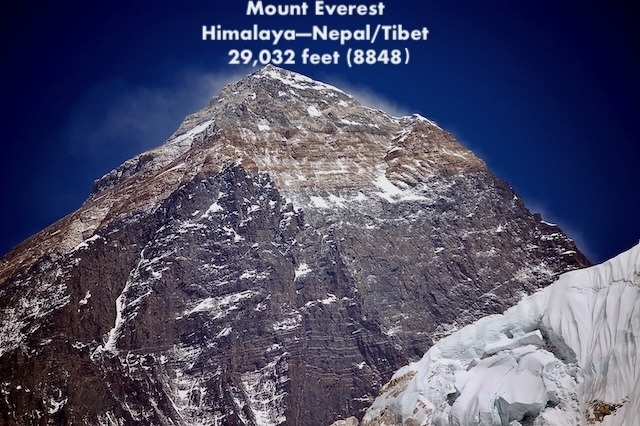
- Everest is 29,031.69-feet or 8848.86-meters high
- The summit is the border of Nepal to the south and China or Tibet on the north
- It is over 60 million years old
- Everest was formed by the movement of the Indian tectonic plate pushing up and against the Asian plate
- Everest grows by about a quarter of an inch (0.25″) every year
- It consist of different types of shale, limestone and marble
- The summit is covered with deep snow all year long
Weather
- The Jet Stream sits on top of Everest almost all year long
- The wind can blow over 200 mph
- The temperature can be -80F (-62C)
- In mid May each year, the jet stream moves north causing the winds the calm and temperatures to warm enough for people to try to summit. This is called the ‘summit window’. There is a similar period each fall in November.
- It can also be very hot with temperatures over 100F (38C)in the Western Cwm, an area climbers go through to reach the summit.
History
- Like all mountains around the world the local indigenous people were the first to see it
- Everest is called Chomolungma (Jomolangma) by the Tibetan people. It means mother goddess of the universe
- Everest was named Sagarmatha by the Nepal Government. It means goddess of the sky
- It was first identified for the western world by a British survey team lead by Sir George Everest in 1841
- Indian mathematician Radhanath Sikdar in 1852, working for the Great Trigonometrical Survey of India calculated the first Everest elevation.
- Everest was first named Peak 15 (XV) and measured at 29,002 feet in 1856
- In 1865, it was named Mount Everest, after Sir George Everest
- In 1955, the height was adjusted to 29,028 feet
- China used 29,015 feet for decades
- In 2020, using GPS technology, using a joint measurement by Nepal and China the summit was measured at 29,031.69 feet (8,848.86 m)
Early Attempts and Summits
- In 1921, a British reconnaissance expedition led by Charles Howard-Bury, explored the Tibetan plateau and the northern approaches of the mountain.
- In 1922, the first expedition attempting to reach the summit were British climbers George Finch and Geoffrey Bruce who reached over 27,000 feet.
- Britons Geore Mallory and Sandy Irvine disappeared in 1924 near the Second Step on the Tibet side and is notable for the mystery of whether they summited or not.
- Mallory’s body was found in 1999 and Irvine’s foot inside his boot on the Tibet side low on the Central Rongbuk Glacier in September 2024, but neither discovery shed any light on the summit question
- The first summit was on May 29, 1953 by Sir Edmund Hillary from New Zealand and Tenzing Norgay, a Sherpa from India. They climbed from the south side on a British expedition led by Colonel John Hunt.
- The first north side summit was on May 25, 1960 by Nawang Gombu (Tibetan) and Chinese climbers Chu Yin-Hau and Wang Fu-zhou.
- The youngest person to summit is American Jordan Romero, age 13 years 10 months, on May 23, 2010 from the north side.
- The oldest person to summit is Japanese Miura Yuichiro, age 80 on May 23, 2013 from the south side.
- The first climbers to summit Everest without bottled oxygen were Italian Reinhold Messner with Peter Habeler in 1978
- Reinhold Messner is the only person to have truly summited Everest solo— completely alone on the mountain, and without supplemental oxygen in 1980 from the Tibet side via the Great Couloir.
Male Summits
- The youngest male to summit is American Jordan Romero, age 13 years 10 months, on May 23, 2010 from the north side.
- The oldest male to summit is Japanese Miura Yuichiro, age 80 on May 23, 2013
- Kami Rita (Topke) Sherpa (Thami) holds the record for most summits (male or female) with 32, the most recent one on May 17, 2026.
- Pasang Dawa Sherpa of Pangboche has summited 28 times, with the last in May 2025.
- Legends Apa Sherpa (Thami Og) and Phurba Tashi Sherpa (Khumjung) have 21 summits each. Both are now retired.
- Briton Kenton Cool has the most non-Sherpa summits with 20, the most recent in 2026.
- 13,753 males have summited with a 43% summit rate.
Female Summits
- The first woman to summit Everest was Junko Tabei of Japan in 1975
- The oldest woman to summit was Japanese Tamae Watanabe, age 73, in 2012 from the north.
- The youngest woman to summit was Indian Malavath Poorna, 13 years 11 months, on May 25, 2014 from the north side.
- Nepali Lakpa Sherpani, 48, holds the women’s summit record with 10 (3 South, 7 North)
- 1,048 women have summited through December 2025 with a 54% summit rate.
Summit Statistics
- There have been 13,753 summits of Everest for a 43% summit rate through December 2025, on all routes.
- 7,563 different people have summited, 0.00000091 of the 8.3 billion people on Earth.
- 6,654 members (clients) have summited and 7,083 hired (Sherpas)
- 1,779 people have summited multiple times.
- Sherpas have the most summits at 7,083 by 1,284 different people.
- 124 Sherpas have summited Everest ten or more times.
- There are 1,166 Sherpas with multiple summits totaling 6,359 summits.
- The Nepal side is more popular with 9,876 summits compared to 3,861 summits from the Tibet side.
- 232 climbers summited without supplemental oxygen through December 2025, about 1.69%
- 35 climbers have traversed from one side to the other.
- 681 climbers have summited from both Nepal and Tibet.
- 172 climbers have summited more than once in a single season, including 84 who summited within seven days of their first summit that season.
- About 66% of all expeditions put at least one member on the summit.
- Member climbers from the USA have the most country member summits at 1,139, followed by China at 1,054, India at 1,134, and the UK at 583.
Death Statistics
- 339 people have died on Everest from 1922 to December 2025. This is about 2.5% of those who summited or a death rate of 1.06 of those who attempted to make the summit.
- 207 Westerners and 132 Sherpas have died on Everest from 1922 to December 2025.
- Member climbers age 60–64 have the highest death rate at 3.30.
- Westerners die at a higher rate, 1.33 compared to hired at 0.80.
- Of the total deaths, 180 died, or 53% attempting to summit without using supplemental oxygen.
- 14 women have died, with a death rate of 0.73 compared to 1.08 for male climbers.
- Of the 339 deaths, 98 died on the descent from their summit bid, or 29%, a rate of 0.72
- The Nepalese side has seen 9,876 summits with 229 deaths through December 2025 or 2.3%, a rate of 1.07. 132, or 58% of the Nepal deaths did not use Os.
- The Tibet side has seen 3,861 summits with 110 deaths through December 2025 or 2.8%, a rate of 1.05. 48, or 44% died on the Tibet side not using Os.
- Climbers from India (30), Japan (20), the UK (19) and the US (17) have the most all-time deaths.
- Most bodies are still on the mountain, but China has removed many bodies from sight.
- The top causes of death on both sides were from avalanche (77), fall (75), altitude sickness (48), exhaustion (32) and exposure (26).
- From 1922 to 1999: 170 people died on Everest with 1,170 summits, or 14.5%, a rate of 1.80. But the death rate drastically declined from 2000 to 2023 with 12,567 summits and 169 deaths, or 1.3%, for a rate of 0.75.
- However, four years skewed the death rates with 17 in 2014, 14 in 2015, 11 in 2019 and the record 18 in 2023, all natural disasters – earthquakes, avalanches, serac collapses.
- At least 11 of the 18 2023 deaths were preventable through better logistics, adequate oxygen, and better on-mountain support.
- The reduction in deaths is primarily due to higher levels of Sherpa support, supplemental oxygen at higher rates, better gear, weather forecasting, and more people climbing with commercial operations.
Climbing
- There are 18 different climbing routes on Everest
- It usually takes 30-40 days to Mt. Everest in order for the body to adjust to the high altitude
- Some climbers use altitude tents to “pre-acclimitize” at home thus reducing an Everest expedition to between two and three weeks, home to home.
- There is 66% less oxygen in each breath on the summit of Everest than at sea level
- Thin nylon ropes attached tot he mountainside are used to keep climbers from falling.
- Climbers wear spikes on their boots called crampons
- They also use ice axes to help stop a fall
- Thick, puffy suits filled with goose feathers keep climbers warm
- Most climbers eat a lot of rice and noodles for food
- Almost all climbers use bottled oxygen because it is so high. It helps keep the climbers warm.
- Climbers start using bottled oxygen at 26,000 feet but it only makes a 3,000 foot difference in how they feel so at 27,000 feet, they feel like they are at 24,000 feet
- You have to be 16 or older to climb from the Nepal side and between 18 and 60 on the Chinese side.
Sherpas
- Sherpa is the name of a people. They mostly live in eastern Nepal. They migrated from Tibet over the last several hundred years
- In Tibetan, shar means East; pa is a suffix meaning ‘people’: hence the word sharpa or Sherpa.
- Sherpa is also used as a last name
- Usually their first name is the day of the week they were born.
- Nyima – Sunday
- Dawa – Monday
- Mingma – Tuesday
- Lhakpa – Wednesday
- Phurba – Thursday
- Pasang – Friday
- Pemba – Saturday
- Sherpas are hired by climbers to guide, carry tents and cooking food to the high camps
- Today, many Sherpas climb mountains for their own enjoyment and not as a job.
- Sherpas climb Everest as a job to support their families
- Sherpas can get sick from the altitude like anyone but are stronger at altitude than foreigners.
- Sherpas feel it is disrespectful to stand literally on the tippy top since that is where Miyolangsangma, the Tibetan Goddess of Mountains, lives.
Trivia
- Babu Chiri Sherpa spent the night on the summit in 1999
- Kami Rita (Topke) Sherpa (Thami) holds the record for most summits (male or female) with 32, the most recent one in 2025
- Over 33,000 feet of fixed rope is used each year to set the South Col route
- You have to be at least 16 to climb Everest from the south side and 18 from the north
- Climbers burn over 10,000 calories each climbing day, double that on the summit climb
- Climbers will lose 10 to 20 lbs during the expedition
Courtesy of the Himalayan Database and my own research.
Preparing for a Climb is More Than Training
Summit Coach
From Your First Summit to Everest. One Coach, the Whole Way.
Planning your next big climb? Work one-on-one with Alan Arnette, Everest and K2 summiteer, for personalized training plans, independent guide-service advice, gear recommendations, and experienced support from preparation through expedition.
No commissions. No conflicts. Just advice focused on your success.
www.alanarnette.com is provided for informational purposes only and not for advice except through Summit Coach services.
Please see the complete disclaimer.