Practical advice from more than 30 years of climbing, from Colorado to the summits of Everest and K2: how to progress, the skills you need, what gear to take, how to choose a climb and a guide, and what to expect on the mountain. For one-on-one help planning your climb, see Summit Coach.
Fitness gets you to base camp. Skills get you up and back down safely. These are the skills I expect climbers to have before they head to high-altitude, snow-covered peaks.
What makes many climbs difficult is the mix of rock, snow, ice, cold winds and high altitude. On many peaks you climb connected to a fixed rope or another climber and use crampons, a jumar and a rappel device.
Expect many long days carrying 15 to 25 pounds (7-11 kg) to increasingly higher camps. The “feel-like” weight of your pack rises dramatically as the air thins, so don’t be fooled: just because you can carry 25 pounds and gain 1,000 feet (300 m) in an hour at 14,000 feet doesn’t mean you are ready for the same day at 20,000 feet (6,100 m).
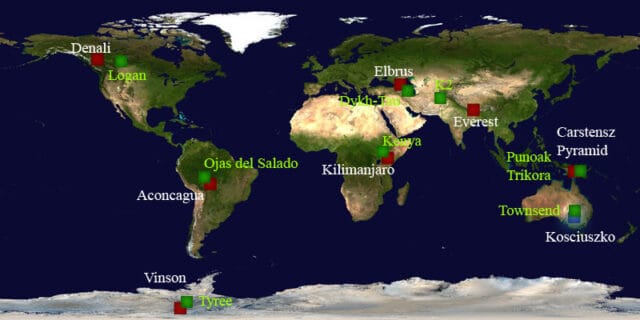
Using the Seven Summits as an example, two stand out for the skills they require, altitude notwithstanding: Everest, for climbing through the Khumbu Icefall, and Carstensz Pyramid, for mid-5th-class rock climbing.
On Everest’s Nepal side, the Khumbu Icefall is glacial ice, not comparable to ice climbing in places like Ouray, Colorado. The terrain varies from almost flat to steep, with short climbs where ladders are often, but not always, used. Any ice-climbing experience will help you move through these sections confidently. The primary danger comes from ice falling off Everest’s West Shoulder, seracs collapsing, or the ice structure itself collapsing, as happened in 2014 when the upper section collapsed and killed 16 Sherpas.
On the Tibet side, the concerns are weather and rock. It is colder, windier and dustier, with wind chills near -40°C/-40°F. There is more exposed rock, especially at the three Steps, where you will scrape crampons against smooth rock at extreme altitude, so your lower body and core need to be at full strength.
The 300-foot (100 m) headwall between Carstensz Pyramid’s base camp and the ridge requires mid-5th-class rock climbing. There is a fixed rope you can clip a jumar to, but mostly you will be climbing with your hands and feet, so solid rock-climbing experience is essential.
You can hire porters on some climbs, such as Aconcagua, and you will have strong Sherpa support on Everest, but you carry your own gear on most other peaks. On Denali you climb roped to others with crampons, a jumar and a rappel device, and you’ll split around 120 pounds between your pack and sled.
Two simple techniques make a big difference on every one of these climbs: see The Rest Step and Pressure Breathing. For a ladder of climbs to build these skills, see The Climbing Progression.
Every climber starts somewhere different. If you want an independent, one-on-one plan for your next objective, with no ties to guide companies or gear brands, that is what I do with Summit Coach. Start with a free call, or download my free Climber’s Starter Handbook.
From Your First Summit to Everest. One Coach, the Whole Way.
Planning your next big climb? Work one-on-one with Alan Arnette, Everest and K2 summiteer, for personalized training plans, independent guide-service advice, gear recommendations, and experienced support from preparation through expedition.
No commissions. No conflicts. Just advice focused on your success.
www.alanarnette.com is provided for informational purposes only and not for advice except through Summit Coach services.
Please see the complete disclaimer.
We use cookies to improve your experience on our site. By using our site, you consent to cookies.
Websites store cookies to enhance functionality and personalise your experience. You can manage your preferences, but blocking some cookies may impact site performance and services.
Essential cookies enable basic functions and are necessary for the proper function of the website.
Google's current Sign in with Google client library. It renders the Google sign-in button, or the One Tap prompt, so visitors can log in to your site with their Google account. It replaces the older Google Sign-In platform library.
Service URL: policies.google.com (opens in a new window)