Climbs Home | Everest | 7 Summits | 8000m: K2 | K2 & Broad Peak 2006 | Lhotse | Manaslu | Cho Oyu | Shishapangma | Dhaulagiri | The 8000ers
Himalaya: Ama Dablam | Island Peak | Americas: Alpamayo | Bolivia | Ecuador | Orizaba | Patagonia | Rainier | Hood | Grand Teton | Colorado: Flatirons | Ouray Ice | Elsewhere: Ben Nevis | New Zealand
Since I started climbing in 1992 I have climbed on peaks around the world, from Colorado to K2, which I summited in 2014 at age 58. These pages cover my climbs beyond Everest and the 7 Summits, with trip reports, dispatches, FAQs and photos. See all of my climbs.
There are 14 mountains above 8000 meters or 26,246 feet. As of early 2016, only 34 people have summited all 14, including only one American, Ed Viesturs (note: Ed did them all without supplemental oxygen and on private climbs, nothing like me at age 60). I will attempt to summit them from today to 2020.
With my summits of Everest, K2 and Manaslu and good efforts on Shishapangma, Broad Peak and Cho Oyu, I feel well prepared to attempt these 11 mountains and optimistic we can reach the $5M goal for Alzheimer’s research.
My objectives for each climb include: safety, cause results, and climb success. To minimize costs, I will try to organize the climbs leveraging logistics from local organizations. Each climb will be conducted in small, safe teams utilizing proven Sherpa support, hopefully including Kami Sherpa whom I summited both Everest and K2 with in 2011 and 2014.
As the 18th and oldest American to summit K2, I attracted world-wide attention, reached 5 million people and raised $70K in just 6 weeks. The Cure Alzheimer’s Fund said this was one of “most successful campaign ever†of its type. This combined with my 7 Summits campaign in 2011 that reached 30 million people, validated my model of using climbing to raise awareness and critically needed funds.
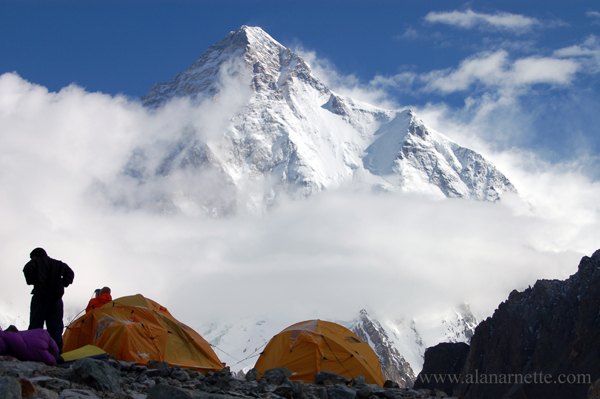
Other names: Sagamartha, Chomolangma or Qomolangma
Altitude: 8848 m, 29,028 feet
Location: Tibet / Nepal
First ascent: May 29, 1953 by Sir Edmund Hillary and Tenzing Norgay with a British expedition
Summits/Deaths: 7,646/284 or 3.71%
Challenge : The two normal routes are mostly non-technical climbs but it is the altitude that makes Everest difficult. The south has the Khumbu Icefall that has claimed many lives and on the summit push, the Hillary Step, a short section of rock, challenges some people. The North side is windy and cold with a lot of exposed rock. On both routes fixed ropes are used from Base Camp to the summit. Nowadays crowding is mentioned as a factor.
My Experience: I summited Everest on May 21, 2011. I climbed fast with IMG’s Kami Sherpa, making the climb from the South Col to the summit in 7:40 and returned in 3:20. This was my 4th attempt with non-summits in 2002, 2003 and 2008. read more
Other names: Mount Godwin-Austen or Chogori or Dapsang
Altitude: 8611 m, 28,251 feet
Location: China / Pakistan
First ascent: July 31, 1954 by Achille Compagnoni and Lino Lacedelli, Italian
Summits/Deaths: 354/82 or 23.16%
Challenge: Arguably the world’s most difficult mountain to climb. It’s high, steep, with a high risk for avalanches and rock fall. The weather is often bad and there are no easy route to the peak’s summit. It is technical climbing from start to end. The North Ridge is a bit easier but the approach through China is demanding and long.
My Experience: I summited K2 on July 27, 2014. I climbed with Garrett Madison of Madison Mountaineering and Kami Sherpa once again. It was an incredible climbed that started steep and never let up. The most fun was technical rock climbing on the Black Pyramid at 23,000′.
Other names: Kanchanfanga
Altitude: 8586 m, 28,169 feet
Location: India / Nepal
First ascent: May 25, 1955 by George Band and Joe Brown
Expedition: Great Britain
Summits/Deaths:332/48 or 14.46%
Challenge: It’s one of the largest of the peaks of the 8000ers and the route to the summit is long. This fact and the many short, but technical sections place Kangchenjunga firmly in the higher end of the difficulty list. The altitude is also a factor.
Altitude: 8516 m, 27.940 feet
Location: Tibet / Nepal
First ascent: May 18, 1956 by Ernst Reiss and Fritz Luchsinger
Expedition: Switzerland
Summits/Deaths: 604/19 or 3.15%
Challenge: The normal route share the South Col route on Everest and starts with the Khumbu Icefall. The altitude and exposure on the final climb to the summit are contributing to the peak’s reputation of being one in the middle of the list in terms of difficulty.
Other names: Makalufeng
Altitude: 8463 m, 27,838 feet
Location: Tibet / Nepal
First ascent: May 15, 1955 by Lionel Terray and Jean Couzy
Expedition: French
Summits/Deaths: 455/43 or 9.45%
Challenge: One of the more technical peaks and is amongst those considered hard climbs. Steep passages, both on rock and snow, exposure and avalanche danger makes this peak a tough target.
Altitude: 8201 m, 26,906 feet
Location: Tibet / Nepal
First ascent: October 19, 1954 by Joseph Joechler, Pasang Dawa Lama and Herbert Tichy
Expedition: Austrian
Summits/Deaths: 3,508/50 or 1.42%
Challenge: Technically speaking the easiest of the 14. No technical climbing, but large snowfields and long distances. Many climbers don’t reach the true summit, as it’s located some distance from where you enter the summit plateau and is only marginally higher than the fore summit.
My Experience: My first 8,000m peak. I climbed it from Tibet with IMG. A 5 week expedition, I reached 26,600′ (8,060m) on the summit plateau before turning back. It was a learning experience that I never forgot.
Other names: Aulagiri
Altitude: 8167 m, 26,795 feet
Location: Nepal
First ascent: May 19, 1960 by Kurt Diemberger, Peter Diener, Nawang Dorje, Nima Dorje, Ernst Forrer and Albin Schelbert
Expedition: Switzerland
Summits/Deaths: 480/82 or 15.40%
Challenge: Considered to be a hard peak to climb by the pioneers in the area, but it’s nowadays considered as one on the lower half of the list. The normal route on the peak has some short technical sections and some avalanche danger, but overall it’s a quite straight forward climb.
Other names: Kutang
Altitude: 8163 m, 26,781 feet
Location: Nepal
First ascent: May 9, 1956 by Toshio Imanishi and Gyalzen Norbu
Expedition: Japanese
Summits/Deaths: 1,115/81 or 7.26%
Challenge: On the lower half of the peak’s normal route, avalanche danger is usually a main problem. Higher on the peak, the climb is mostly non-technical and easy. Manaslu has one of the higher death rates and is considered a dangerous peak.
My Experience: I summited Manaslu on September 25, 2013. The route was the most difficult in years due to a large avalanche in 2012 plus other mountain movements and a low snow year. The tiny summit was scary indeed!
Other names: Diamir
Altitude: 8126 m, 26,660 feet
Location: Pakistan
First ascent: July 3, 1953 by Hermann Buhl
Expedition: Austrian
Summits/Deaths: 335/68 or 20.30%
Challenge: Nanga Parbat’s normal route is not extremely technical, but it’s long and exposed. The mountain is infamous for bad weather and the route offers many tricky sections. It’s considered as one of the harder peaks.
Other names: Morshiadi
Altitude: 8091 m, 26,545 feet
Location: Nepal
First ascent: June 3, 1950 by Maurice Herzog and Louis Lachenal
Expedition: French
Summits/Deaths: 255/71 or 27.84%
Challenge: Considered the most dangerous of the 14. The north and its original route is not that technical, but extremely avalanche prone. The south is of high technical Challenge and also holds lots of objective danger.
Other names: Hidden Peak or K5
Altitude: 8068 m, 26,444 feet
Location: China / Pakistan
First ascent: July 5, 1958 by Andrew Kauffman and Peter Schoening
Expedition: U.S.
Summits/Deaths: 334/29 or 8.68%
Challenge: When the icefall and some easy ground have been covered, the climb gets more difficult. Steep mixed climbing and some objective danger makes Gasherbrum I a peak which belongs with the more difficult 8000ers.
Other names: Falchen Kangri or K3
Altitude: 8047 m, 26,414 feet
Location: China / Pakistan
First ascent: June 9, 1957 by Hermann Buhl, Kurt Diemberger, Marcus Schmuck and Fritz Wintersteller
Expedition: Austrian
Summits/Deaths: 404/21 or 5.20%
Challenge: Considered a straight forward climb. The constant, but quite low angled steepness to the summit ridge can hold avalanche danger, but apart from that no technical surprises. Some rocky sections around the false summits and exposure offers the final test before reaching the true summit.
My Experience: I organized this expedition to climb Broad Peak and then to “have a good showing” on K2. I reached 21,000′ on Broad or Camp 2 before abandoning the climb due to weakness that resulted from a severe bug I contracted on the trek in. The Karakorum ranges was magnificent and I was very lucky to have unbelievable weather for the month I spent there. It was instrumental having this experience for my summit of K2 in 2014. read more
Other names: K4
Altitude: 8035 m, 26,358 feet
Location: China / Pakistan
First ascent: July 9, 1956 by Josef Larch, Fritz Moravec, Hans Willenpart
Expedition: Austrian
Summits/Deaths: 930/21 or 2.26%
Challenge: Some years back G II was mentioned as one of the easiest 8000m peaks, usually together with Shishapamgma and Cho Oyu. After the “Banana Ridge’s†collapse the climb has become more difficult. The main obstacles are the huge icefall, crevasses, some steep climbing on snow and the exposure on the final part.
Other names: Gosainthan or Xixabangma
Altitude: 8027 m, 26,335 feet
Location: Tibet
First ascent: May 2, 1964 by ten climbers led by Hsu Ching
Expedition: China
Summits/Deaths: 302/25 or 8.28%
Challenge: Considered as one of the easiest and it is a non-technical climb, to the fore summit, that is. The final part to the true summit is an airy and sometimes dangerous walk on a knife edge ridge and therefore a majority of climbers only reach the fore summit. The rest of the climb is easy, but sometimes avalanche prone.
My Experience: I attempted Shishapangma in September 2007. Weather conspired to stop all but two climbers that year and no one reached the true summit. I topped out at 7000m or 23,000′ in excellent health and raised some money for the Cure Alzheimer’s Fund – so I was pleased. read more
From Your First Summit to Everest. One Coach, the Whole Way.
Planning your next big climb? Work one-on-one with Alan Arnette, Everest and K2 summiteer, for personalized training plans, independent guide-service advice, gear recommendations, and experienced support from preparation through expedition.
No commissions. No conflicts. Just advice focused on your success.
www.alanarnette.com is provided for informational purposes only and not for advice except through Summit Coach services.
Please see the complete disclaimer.
We use cookies to improve your experience on our site. By using our site, you consent to cookies.
Websites store cookies to enhance functionality and personalise your experience. You can manage your preferences, but blocking some cookies may impact site performance and services.
Essential cookies enable basic functions and are necessary for the proper function of the website.
Google's current Sign in with Google client library. It renders the Google sign-in button, or the One Tap prompt, so visitors can log in to your site with their Google account. It replaces the older Google Sign-In platform library.
Service URL: policies.google.com (opens in a new window)