Note this report is from 2011. Well, fifteen years later, much of what I describe is standard for many teams. One company stands out today: Climbing the Seven Summits—Mike Hammill. He has one of the broadest, most diverse offerings on Nepal’s side of Everest. Check out their site for more information.
I’ve been in many base camps, but I knew I was somewhere special when I was told “… and this is our garbage tent.” Welcome to Everest Base Camp, Russell Brice style. In 2011 while climbing Everest, I spent the afternoon with Brice getting to know this man and how he runs his expedition base camps. Let’s just say, it’s different.
Most expeditions will promote their excellent base camp facilities and talk of gourmet food, individual tents, and clean kitchens. Today, this is the ante to play the game, and let me say from the start that many operators take great pride in their base camps, and rightfully so. With guided expeditions becoming more competitive along with soaring prices, climbers are starting to expect more, sometimes unrealistically so.
Everest Base Camp
A base camp is just that, the camp where you are based for an expedition. In this sense, you want it to be comfortable, clean, and convenient. A place where you can recharge after a difficult acclimatization climb or regroup after a summit bid. A place you literally call your home away from home.
Most expeditions will offer dedicated tents for dining, cooking, sleeping, showers, and toilets. Then they may add communications, medical, and storage tents. Almost all will heat the dining tent with a propane heater and provide power lights from solar panels supplemented by a generator.
The next level up is when there is a “social tent” where climbers can hang out and relax on comfortable chairs or even some kind of sofa, believe it or not. And then the entertainment: stereos, and flat screen TVs with DVD’s for movie night. Finally we reach a crescendo with an open bar and espresso machines. Yes, all this at 17,000 feet surrounded by rock, dirt and ice.
Himex Base Camp
Brice came over to our camp one snowy afternoon in May 2011 and over lunch invited me to tour his base camp. He never expected me to write this article, but with so much attention on Everest these days, I thought my readers would enjoy seeing an inside look at how he runs an Everest Base Camp. As I took the tour with Brice, he took great pride in showing me his version of the expected amenities. It was one of the most impressive camps I had ever seen in over 30 major expeditions. It was set up with military precision and 5-star hotel cleanliness and service.
Cooking, Eating, Sleeping and More
Each climber had a private 3-man sleeping tent that provided more than enough room to spread gear out and sleep comfortably on thick mats. They were lined up in a straight line, suggesting a laser was used to align the tents.
The kitchen was a very large yellow canopy that covered stainless steel tables, Dutch ovens, and food prep stations. The dirt floor was covered by a nylon tarp. So far, nice but not unique amongst the top operators, I mentioned to Brice. His response:
“The dirt floor is covered by a nylon tarp, then insulation followed by outdoor carpet. Actually, this is quite different from other operators. Others have a stone floor as it makes it much easier for cooks to tip water/fat, etc., on the floor rather than taking it outside. By having carpet means that cooks cannot do this, so hygiene is improved and it makes it safer and more easy for the cooks whilst cooking.”
The dining tent was another large and long yellow canopy that Brice had custom-made for his expeditions. A long table was covered in a plastic tablecloth; plastic flowers adorned the table next to well-organized condiments, all sitting on top of indoor/outdoor carpeting. Comfortable chairs with padded cushions lined the perimeter of the table; a sturdy heater in the corner stood by for the cold evening. Several light bulbs hung from the ceiling to provide light, powered from solar panels. Brice prides himself on not using a generator unless absolutely necessary, such as for charging a film crew’s batteries overnight.
Sherpas arrive in mid-March, well before the clients, to set all this up so when the clients arrive they can focus on, well, enjoying base camp.
The toilet tent was the nicest I had ever seen, and I say that with sincere appreciation. Another large yellow tent, actually there were two tents – a men’s and a ladies’ – with sit-down toilets (a urinal in the men’s), and carpeted floor. A sink for hand washing was in each restroom. Another separate, rather large tent provided room for propane-heated on-demand hot water showering. A chair and hooks were conveniently located inside the tent to accommodate changing clothes.
The Sherpas also had it nice with more yellow tents smartly lined up housing four to six persons per tent.
Oh, and about that garbage tent. Well, you guessed it, another large yellow version that housed all the kitchen scraps and trash generated by modern climbers stored in plastic bags outside the reach of ravens, yaks, and yetis. As with all Everest Nepal side expeditions, this trash is taken down valley and burned or buried like in a modern city.
The Dome
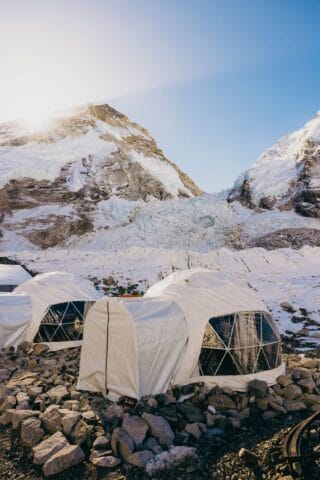
But the Pièce de résistance for Brice was his social tent, aka the Pleasure Dome, White Pod, or Tiger Dome (winning!). Again, many expeditions will use a dome from Mountain Hardwear for a similar feeling, but there is more to this than nylon.
The Dome, made by White Pod, was literally an extremely large round domed tent, maybe 50 feet across and 20 feet high, with clear plastic floor-to-ceiling windows serving as a window to watch the world passing by. You entered through a small wooden entry room, a foyer so to speak, to prevent the cold and snow from spoiling the interior ambiance.
The day I visited, most of his clients were at the higher camps on Everest, so the base camp staff were taking advantage of the dome. They were sprawled out across the padded sofas and lounge chairs, watching a Bruce Lee movie on the 60-inch flat-screen television. They all smiled and laughed as we passed through, relaxed and at ease in this warm tent as it snowed gently outside.
There was in fact an open bar, an honor bar, stocked with spirits, wine, and mixers, and yes, there was a fully functioning espresso machine. A large heater kept it warm; the stereo played music in the background— a random sample of music from the ages— and a community reading library lined a shelf nearby. And of course, video games. Two computers sat idly by, ready to connect to the Internet via satellite upon request.
I went back to Brice’s command center, where he slept and also used as an office. Yes, another large yellow tent with a carpeted floor, chairs, a table, and individual rooms inside dedicated to his team physician, Brice’s bunk, and his office. He offered me, and our expedition doctor who was on the tour with me, refreshments as we sat down to discuss his philosophy on Everest expeditions.
The Man Behind the Camp
Most people know of Brice through the Discovery Channel’s Everest: Beyond the Limits series. Born in New Zealand in 1952, now living in Chamonix, France, Brice told me he wished he had not done these shows; they had not helped his business. He felt they were edited for drama and reflected poorly on some individuals. The David Sharp incident came to mind as we discussed the pros and cons of global exposure.
Brice made it clear that he did more than any other expedition operator would have to try to save Mr. Sharp, given he was not a Himex client. He sent his own Sherpas back up the North side in 2006 with oxygen; he took Sherpas away from his own climbers on their summit bid to provide assistance; and he met with Mr. Sharp’s parents in London to return his personal items at his own expense. Brice looked at his shoes as he told me these stories, sighing occasionally. It reminded me of the saying that no good deed goes unpunished.
We spoke of death on the mountain, and while he has seen many deaths of personal friends while climbing, he had experienced only one death in all his years of guiding, a junior Sherpa in 2006 from altitude sickness. Again, he became reflective as he spoke. He told me of sending two of his clients back home early on an expedition after heart conditions surfaced. I asked Brice if he felt like he was God sometimes – “Not God, but these people pay me to give them a chance to climb Everest and not die. And I take that responsibility seriously,” He responded.
I moved on to ask him about the evolution of climbing Everest. Brice’s first commercial expedition to Everest was on the north side in 1994. He personally has 14 summits of 8,000m mountains, including two Everest summits under his belt. Also, a 1988 attempt via the never-before-climbed Three Pinnacles on Everest’s northeast ridge. He knows what he is talking about.
I asked about the location of camps, the acclimatization schedule most teams use today, and the routes we all use. He surprised me with his candid answer of “we made it up as we went along early on the north side.” I was expecting something more analytical. He said of the high camps on the north side, they ended up where they are because that was where the Sherpas ran out of line, or out of daylight. They moved a bit over time but are basically in the same spots that Mallory and Irvine used in 1924.
Today, he prides himself on looking for new ways to climb Everest, such as using Lobuche for acclimatization.
A Camp too Far?
OK, so what’s up with a bar, espresso machine, and televisions in one for the most remote places on earth? Another well-thought-out answer entailed, as Brice told me, that his clients are not looking for a bargain. They are looking for a positive experience with a solid chance to safely summit Mt. Everest. He spoke of his Sherpas, cooks, porters, and staff that had been with him for years and what they meant to him. That they deserved to be treated with as much respect as any client.
He went on to provide his overriding philosophy: if you expect it at home, it should be available at base camp. If you have a glass of wine with dinner, why not at base camp? If you sleep warm at home, why not on Everest?
“But this is not home!” I countered. Climbing a mountain is not supposed to be comfortable. You are not supposed to be coddled, pampered, and have luxuries. You need to suffer, to want, to yearn for creature comforts— oh, and summit, of course! We laughed.
Brice began to talk of the early British expeditions where literally thousands of porters would travel for hundreds of miles carrying the finest Irish scotch whisky, the best food available from India and back home. They had the finest in wool clothing, the best leather boots. Tables and chairs were assumed— not a luxury. They traveled in style almost 100 years ago, so why not today?
He concluded with: if you want to suffer, there are many companies that will help you!
The Difference
I walked back to my own base camp thinking about the afternoon. While the Himex camp stood out, it was equal to many of the others in most respects.
I walked back through my base camp and looked at our individual tents, also lined up with laser precision. I passed our kitchen tent, clean and organized, and was met with smiles and laughs. I crawled into my personal tent and looked at my gear strewn around. Our camp was right up there. OK, we didn’t have a garbage tent and our toilets were more like stalls, not rooms; but it was home, my home.
So why did Himex feel so different? First, Brice locates his camp a bit away from the main Everest Base Camp. This reduces the noise and traffic but also gives him the space to spread the tents out, creating a more organized feeling. Second, there is a consistency with all those yellow tents lined up. You feel like there was a lot of planning and thought that went into every detail. Then the touches inside the tents: the carpet, the area rugs, the solar lights dotting the pathways at night.
But the fact that Brice himself, as owner and Big Boss, is there year after year makes a huge difference. I left the Himex camp impressed with the man, his camp, and his approach. He presented an aura of competence, of thoughtfulness and caring. His personal relationships around base camp make things happen.
He seems to always be involved one way or another, sometimes to the chagrin of others. I personally saw him seek advice from our leaders, generously provide information to others, and unselfishly participate in emergencies. Other guide company owners also go on their expeditions, but Brice’s experience, consistency, and formula make it work well for his clients.
Many expeditions do some or most of this at their Everest Base Camp, but Brice has found a way to pull it all together and make it feel like home while still focusing on the real purpose – climbing Mt. Everest.
Himex charges €43,600, about USD$55,700 for a 2012 Everest climb.
Climb On!
Alan
My thanks to Steffi Luka Lomp for some of the Himex pictures. She climbed with Himex in 2010. You can read about her experience at her website.