Kala Patar & Khumbu Trek
Everest Home | Pictures | Climbs | Coverage | Statistics | Essays | Extras | F.A.Q. | Links
I summited Everest on May 21, 2011 and have climbed it three other times (all from Nepal) – 2002, 2003 and 2008, each time reaching just below the Balcony around 27,500′ (8,400 meters) before health, weather, or my own judgment caused me to turn back. I attempted Lhotse twice – 2015 and 2016. When not climbing, I cover the Everest season from my home in Colorado as I did for the 2004, 2005, 2006, 2007, 2009, 2010, 2012, 2013, 2014, 2015, 2016, 2017, 2018, 2019, a virtual 2020 season, 2021, 2022, 2023, 2024, 2025, 2026 and soon the 2027 season.
Follow Alan Arnette’s Annual Everest Coverage
“One of the world’s most respected chroniclers of Everest” — Outside Magazine
Read the Latest Season Coverage
Read the Latest Everest Statistics—summits, deaths, by sides, climbers
Sign up for post’s notification
This page is about trekking to Kala Patar and Everest Base Camp (EBC)
Nepal. Sherpas. The Himalayas. What is this place? Who are these people? Are these mountains as tall as I envisioned? In 1997, I decided to find out by signing up with Mountain Travel Sobek for something they called The Ultimate Everest Trek. Looking back, it was the real inspiration for my alpine mountaineering interest. For 21 days, we hiked the Khumbu, going up and down the valley walls, sleeping in tents each night and being musically greeted each morning with “Morning, sir, Sherpa tea?”
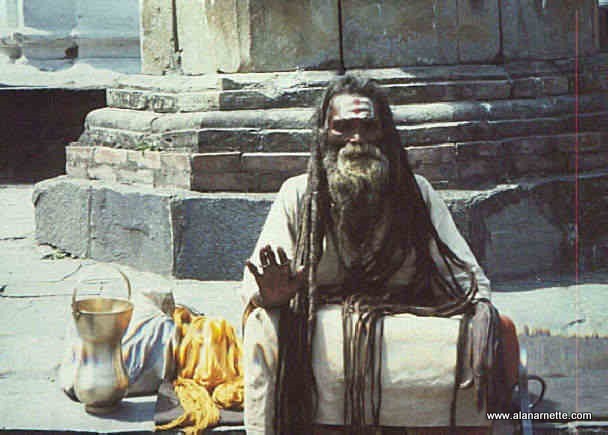
The trip started in Kathmandu by staying in a hotel in Thamel. We took a tourist trip to the Bagmati River, which is the home of a significant Hindu temple. Ghats, or river steps, line the river. I saw things I had never seen before. Bodies are cremated here, and I saw several burning bodies. They are painted and set on top of logs and set afire. When all that remains are the ashes, they are put in a small bowl with milk and flower petals covering them, and then washed into the river with an elaborate religious ceremony. Certain areas of this temple are reserved for burning royalty and others for burning the lower classes.
Pashupatinath is the holiest Hindu pilgrimage destination in Nepal. Boudhanath is among the largest stupas in South Asia, and it has become the focal point of Tibetan Buddhism in Nepal. Monks walk about in maroon robes, as well as Tibetans with prayer wheels in their hands. I also saw the ritual of prostration, where worshippers circle the stupa on their hands and knees, bowing down to their lord. We also saw the Swayambhunath, or Monkey Temple. This temple is located a short distance from Kathmandu. There must have been 500 wild monkeys crawling around on the steps and buildings— thus the Monkey Temple. I got a great workout climbing the 365 well-worn steps leading to the top of the temple.
Saying good-bye to Kathmandu, we left for the high mountain village of Lukla (9,350′). The one-hour flight in a 40-year-old Russian helicopter brought fantastic views of the green valleys and hilltop mud homes that protect their mountain barley fields. We then started the Trek.
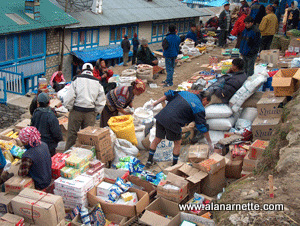
Initially, following the Dudh Kosi River, we visited all the main Sherpa villages such as Namche, Thame, Khunde, and Khumjung. The Namche Bazaar is a weekly market where Sherpas come from 100 miles away over high, snowy mountain passes to buy, sell, and trade all sorts of everyday staples: peppers, meat, wheat, rice, shoes, and of course Western items such as Coco Cola, cigarette lighters, and Gore-Tex jackets!
We then started towards Tibet via the remote Gokyo Valley. Approaching the highest point on the trip, the landscape turned dark and eerie. The short, brown tundra had patches of snow everywhere. The lakes were an amazing turquoise color, and the glaciers hung like clouds on the earth. The views were incredible at the village of Gokyo (15,580′). I saw Cho Oyu for the first time, never considering that I would climb it only 18 months later! At one point high on Gokyo Ridge, I could see four of the eight highest peaks on earth: Everest, Lhotse, Makalu, and Cho Oyu.
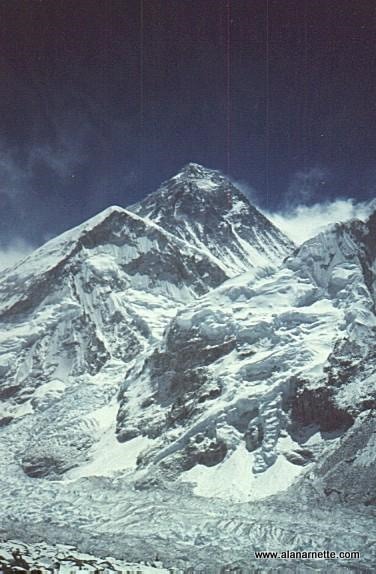
Our plan was to cross the Ngozumpa Glacier; hike across the Cho La Pass (17,780′) to a campsite beneath the north wall of Cholatse, but deep snows made the pass difficult, and we had several members of our team suffering from altitude sickness, so we returned back down the Goyko Valley and focused on the village of Gorak Shep (17,000′), nestled under the summits of Pumori and Nuptse. After the coldest night of the trip (-10F), we left before sunrise for close-up views of Everest from Kala Patar. It was difficult at the time, but in hindsight, the climb was simply slippery with ice on the loose gravel covering this 18,192′ peak. In any event, it was my highest climb ever at the time, and I was quite proud to stand on top!
From the summit of Kala Patar, we hugged, took pictures, and celebrated the wonderfully clear views of Mt. Everest. It was a clear, cold day with only the clouds generated from the jet stream hitting the Himalayan peaks adding color to the azure sky. From the summit, we could see the Khumbu ice fall sliding down the slopes of Everest and the famous mountaineer’s base camp.
A couple of days later, we hiked to Everest base camp. Following the lower part of the Khumbu glacier, it took several hours to reach base camp. It was just as advertised: an ocean of colorful tents randomly laid on top of tiny, medium, and huge-sized boulders. Music played loudly, and climbers walked around easily in the thin air. Satellite dishes sat outside tents, and yaks looked at you for a generous handout. This was THE base camp, and again, I felt honored to be there.
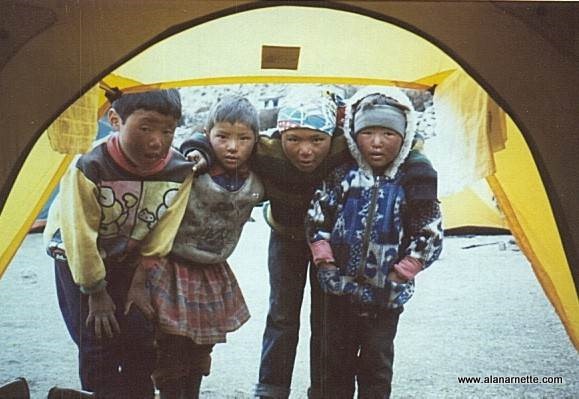
We soon left for another valley in the Khumbu, the Chhukhung Valley, and a hike to Chhukhung Ridge (18,300′). This was the most desolate part of the 21 days. Few villages, almost no other trekkers, just us. This is the route to the “Trekking Peaks” of Island and Mera, both over 20,000′ and a great experience for those not wanting to tackle serious alpine mountaineering but still wanting to summit a Himalayan 6,000-meter mountain. We camped on a cloudy, dark night at Chhukhung and prepared to go to the ridge the next day. In the morning, the clouds blew away, and we were rewarded with the most beautiful, rugged view of mountains I had ever seen. The backsides of Lhotse and Nuptse are almost vertical rock walls covered with thick ice. In the brilliant sunlight, it was a stunning sight. Upon returning to our camp in Chhukhung, I played with some of the local children. These kids were friendly, smiled easily, and had a carefree style that made me laugh. The picture at the right was not staged. I was lying in my tent when the girl on the right came over to see what I was doing, and soon she was joined by her brother and sisters. Special people.
Soon, we started to trek back to Lukla, visiting Tengboche Monastery en route. This is the primary Monastery in the region with about 50 monks and serves as the Rinpoche’s home. He blessed us during our stay after a small donation of 100 rupees (about a dollar). The monks travel the valley to bless the Sherpas of the area but also maintain a strict schedule of praying in the Monastery. We were honored to sit quietly inside the Monastery to listen to the chants as they read their prayers that were often interrupted by the gong of a bell or the sharp clash of cymbals. Two small boys, probably about six years old, could not keep from smiling at us and laughing throughout the service. A sideways look from an older monk quickly brought them back in line!
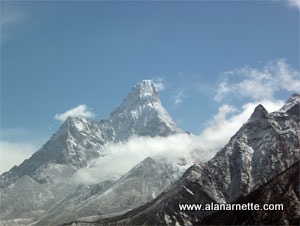
The rocket-like-shaped Ama Dablam looms directly over Tengboche. You can see Ama Dablam from almost everywhere along the trek. It stands so high and so alone that it is impossible to miss. I probably took fifty pictures with it in the background! Again, it never crossed my mind that I would stand on top of it a few years later.
As we made our way back to Namche and to Lukla for the helicopter flight back to Kathmandu, I thought about what I had experienced. I was touched by the Sherpa way of life. No mistake, there was extreme poverty. Cooking with wood, you could almost see people developing tuberculosis and other lung diseases developing inside the poorly ventilated homes. But they focused on family and life. They lived simple lives. They laughed and smiled easily and seemed sincerely pleased to give a helping hand. I can still hear the Buddhist chants to this day.
Once back in Kathmandu, we had a thank-you and good-bye dinner and soon returned to our various parts of the world, remembering the magic of Nepal… and a promise to return one day.
Please visit the Everest Base Camp Trek Frequently Asked Questions page on common questions about trekking in the Khumbu and to Everest Base Camp.
Preparing for a Climb is More Than Training
Summit Coach
From Your First Summit to Everest. One Coach, the Whole Way.
Planning your next big climb? Work one-on-one with Alan Arnette, Everest and K2 summiteer, for personalized training plans, independent guide-service advice, gear recommendations, and experienced support from preparation through expedition.
No commissions. No conflicts. Just advice focused on your success.
www.alanarnette.com is provided for informational purposes only and not for advice except through Summit Coach services.
Please see the complete disclaimer.