Climbs Home | Everest | 7 Summits | 8000m: K2 | K2 & Broad Peak 2006 | Lhotse | Manaslu | Cho Oyu | Shishapangma | Dhaulagiri | The 8000ers
Himalaya: Ama Dablam | Island Peak | Americas: Alpamayo | Bolivia | Ecuador | Orizaba | Patagonia | Rainier | Hood | Grand Teton | Colorado: Flatirons | Ouray Ice | Elsewhere: Ben Nevis | New Zealand
Since I started climbing in 1992 I have climbed on peaks around the world, from Colorado to K2, which I summited in 2014 at age 58. These pages cover my climbs beyond Everest and the 7 Summits, with trip reports, dispatches, FAQs and photos. See all of my climbs.
These peaks have become extremely popular climbs for aspiring high-altitude climbers. With relatively easy access, low cost and reasonably high success rate, many people new to climbing seek these out for their first big peak. I had a few different reasons to go there in July 2019.
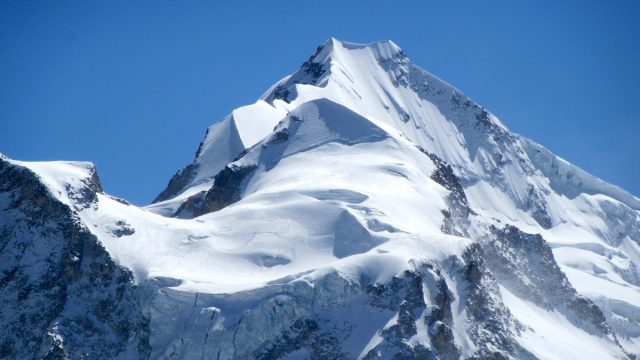
Located at the Condoriri Group in La Coordillera Blanca in Bolivia it stands at 17,749 ft / 5,410 m. It is a pyramid of snow, with the standard route being about 55 degrees, snow, nice in the morning, but sticky later in the day. It was first climbed in August 1962 by South Africans Irene and Keith Whitelock. We wanted to take the West Ridge but a foot of new snow the night before our climb caused us to summit nearby Tarija at 17,400′ instead due to avalanche danger. I took this picture of Pequeno Alpamayo from the summit of Tarija.
Huayna Potosí is 19,974-feet/6,088-meter in the Cordillera Real and the closest high mountain to La Paz. Surrounded by high mountains, it is roughly 15 miles due north of the city, which makes this mountain the most popular climb in Bolivia. The climbing sounds like fun! As one person put it “The summit ridge of Huayna Potosí provided a spectacular finish to this climb. The snow at the top is too narrow for pickets, and too soft for ice screws. If someone falls the only recourse is, hopefully, to jump off the other side in time – in other words “watch you step!” The normal ascent route is a fairly straightforward glacier climb, with some crevasses and a steep climb to the summit. The first ascent of the normal route took place in 1919 by Germans Rudolf Dienst and Adolf Schulze.
When we made our attempt, the winds were gusting to 50 mph with a wind chill well below zero. No one summited that day. I took this picture on the drive out.
At 21,122 ft / 6438 m, Illimani is the highest mountain in the Cordillera Real of western Bolivia. It is in easy sight of El Alto and La Paz at the eastern edge of the Altiplano. It is the second highest peak in Bolivia, after Nevado Sajama, and the eighteenth highest peak in South America. The name seems to derive from the word Aymara Illi mani, meaning Golden Eagle. It is infamous when on January 1st, 1985 Eastern Air Lines Flight 980 crashed into the mountain, killing all 29 people on board. I didn’t make an attempt due to illness but the rest of the Illimani team summited. I took this picture as we drove out of La Paz.
A full Trip Report is available plus the updates from the climb on my Blog.
As usual, my climbs are to raise awareness and research funds for Alzheimer’s Disease. I was thrilled to raise almost $6,000 during these climbs all going to the Cure Alzheimer’s Fund for Alzheimer’s research. You can still donate at this link. Please learn more at this link.
Climb On!
Alan
Memories are Everything
I attempted Pequeno Alpamayo, Huayna Potosi, Illimani in July 2019 with Mountain Madness
From Your First Summit to Everest. One Coach, the Whole Way.
Planning your next big climb? Work one-on-one with Alan Arnette, Everest and K2 summiteer, for personalized training plans, independent guide-service advice, gear recommendations, and experienced support from preparation through expedition.
No commissions. No conflicts. Just advice focused on your success.
www.alanarnette.com is provided for informational purposes only and not for advice except through Summit Coach services.
Please see the complete disclaimer.
We use cookies to improve your experience on our site. By using our site, you consent to cookies.
Websites store cookies to enhance functionality and personalise your experience. You can manage your preferences, but blocking some cookies may impact site performance and services.
Essential cookies enable basic functions and are necessary for the proper function of the website.
Google's current Sign in with Google client library. It renders the Google sign-in button, or the One Tap prompt, so visitors can log in to your site with their Google account. It replaces the older Google Sign-In platform library.
Service URL: policies.google.com (opens in a new window)