Mid-December is a quiet time in the mountaineering world, so I thought it would be nice to pick meteorologist Chris Tomer of Tomer Weather Solution’s brain on the upcoming winter season for mountaineering across the globe. And, of course, we have to touch on Everest.
The 8000er season is chiefly over, and the true winter climbs have yet to begin in earnest. But soon, we will have activity in Antarctica with adventurers attempting full crossings, climbers going for Vinson, Tyree and maybe an unclimbed peak or two. Then, as we move towards the new year, the slopes of Acocnagua become busy with a new group of aspirants wanting to test themselves at 7,000 meters, perhaps for training for an upcoming Everest climb.
With the Himalayan Database now updated for 2025, I’ll be posting several Everest 2026 big-picture updates before the season officially begins in early April, 2026:
Everest by the Numbers: 2026 Edition – A deep dive into Everest statistics as compiled by the Himalayan Database
Comparing the Routes of Everest: 2026 Edition – A detailed look at Everest’s routes, commercial, standard, and non-standard.
How Much Does it Cost to Climb Everest: 2026 Edition – My annual review of what it costs to climb Everest, solo, unsupported, and guided.
Everest 2026: Welcome to Everest 2026 Coverage – an introduction to the Everest 2026 Spring season.
In this Podcast, I briefly review the 2025 year in mountaineering and share my thoughts on a “Climber’s Holiday Season.”
Autumn Over
The 2025 autumn expedition season wrapped up with summits across the Himalaya, with special emphasis on Manaslu and Ama Dablam, where the summits reached 500 people or more.
Also making news was the return of Marc Batard with his Khumbu Icefall bypass project. I wrote extensively about this last month, so please take a look if you are interested in following this project. Spoiler alert, I don’t see it being used extensively if it ever gets completed – too technical, physical and risky for the average Everest climbers today, and the Sherpas will continue to climb the devil they know instead of the one they don’t.
Upcomming
Simone Moro is back for his seventh attempt to summit Manasslu in winter in alpine stlye. He’s climbing with Nima Rinji Sherpa, and Oswald Rodrigo Pereira of Poland. Staying true to his definition of winter, Moro and team will arrive at Manaslu Base Camp on December 21.
Pakistani Mountainers Organize
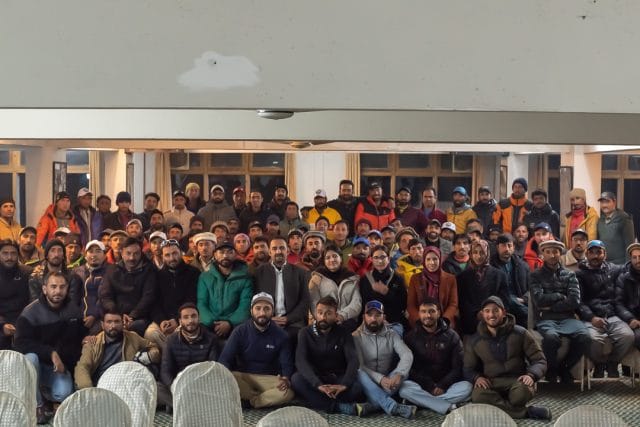
Late last month, a group of 100 Pakistani mountaineers gathered to announce the creation of the (KMGA), which they noted as being “the first national body created by mountaineers, for mountaineers.” They selected Sirbaz Khan to be the President. Khan has become quite famous in his homeland after becoming the first Pakistani to complete all 14 eight-thousanders in 2024, and in May 2025, he also became the first Pakistani mountaineer to summit all 14 without supplemental oxygen.
Karakoram Mountain Guides Association
These are the officers of the KMGA:
President: Mr. Sirbaz Khan
General Secretary: Mr. Mirza Ali
Vice President: Mr. Saad Munawar
Vice President: Mr. Zahid Hussain Rajput
Vice President: Mr. Sajid Ali Sadpara
Treasurer: Mr. Shah Daulat
In a press release they noted their primary mission and specific goals:
Enhance safety, rescue systems, and high-altitude protocols
Develop training, certifications, and career paths for youth
Advocate for insurance, medical aid, and welfare
Align standards with international organizations
Partner with government on tourism and sustainability
This inclusive launch promotes transparency, equal opportunities, and professional growth in Pakistan’s mountains.
While their website is under construction, you can follow progress on Facebook pages.
Nepal’s Approach to Managing their Peaks
It’s great to see Pakistan organzie, so I thought its a good time to review how Nepal amanges their peaks. Nepal’s mountaineering system is primarily managed by a government ministry and industry/association groups, each with distinct responsibilities. Each plays a specific role in permitting, regulation, and on-the-ground safety operations.
Nepal Mountaineering Association (NMA)
The NMA is Nepal’s national alpine association, focused on promoting mountaineering, training, and welfare rather than directly organizing large expeditions. It supports mountaineering education, safety awareness, and the welfare of mountain workers. Historically, it administered permits for a set of “trekking peaks” in the 5,800–6,600 m range, though much of that authority has now reverted to the government.
NMA also works to develop mountaineering infrastructure, such as training facilities and museums, and represents Nepal at international climbing forums. It collaborates closely with registered local trekking agencies that handle permit acquisition and logistics for climbers.
Expedition Operators Association (EOA)
The EOA is a trade group of experienced high-altitude expedition companies, such as those with multiple 8,000 m expeditions over several seasons. Membership is restricted to established operators, and the association serves as a collective voice and mediator among expedition companies, workers, and the government.
EOA’s most visible role is coordinating the commercial rope-fixing effort on major routes like Everest above Camp 2, funded by a per-climber fee collected from expeditions used to pay fixing teams and purchase hardware. Standardizing rope quality, schedules, and staffing helps reduce traffic jams and enhances safety for all teams on the normal route
In Kathmandu, on December 12, The EOA has renewed its leadership team for the 2025–27 term, re-electing Dambar Parajuli as President and unanimously appointing a new executive committee.
Ministry of Tourism (MoCTCA)
Within the Government of Nepal, the Ministry of Culture, Tourism and Civil Aviation (often called the Ministry of Tourism in climbing circles) acts as the official regulator. It formulates mountaineering regulations, sets royalty and permit fees, designates which peaks are open, and issues permits for the 8,000ers and most peaks above about 6,500 m.
The ministry also appoints and oversees liaison officers, establishes rules for waste management and conduct, and uses royalty income to support both national tourism and local communities. Significant policy changes, such as transferring permit control for trekking peaks away from the NMA, are decided at the ministry level, effectively centralizing control over Nepal’s mountaineering sector.
Nepal Tourism Board (NTB)
NTB serves as Nepal’s national tourism promotion authority, marketing the country globally as a premier mountaineering destination while supporting broader adventure tourism policies. It develops guidelines for trekkers and climbers, such as mandatory guides in protected areas, and advocates for sustainable practices to enhance safety and environmental protection.
Unlike the Ministry’s permit issuance or NMA’s training focus, NTB influences policy through campaigns and stakeholder coordination, including recent pushes for experience requirements like prior 7,000m summits on Everest.
China’s Approach to Managing their Peaks
China and Tibet manage their mountaineering industry through centralized oversight by state bodies like the China Tibet Mountaineering Association (CTMA) and the Chinese Mountaineering Association (CMA), emphasizing permits, safety, and economic integration.
Permit System
Climbing permits are issued exclusively through authorized Chinese companies, prohibiting independent climbers since 2024; the CTMA handles applications via local outfitters, often with opaque timelines and conservative approvals. Foreigners face strict limits, such as 300 annual permits on the Tibet side of Everest, requiring one guide per summit climber and banning solo ascents.
Safety and Control Measures
Authorities prioritize “controllable scenarios” due to public opinion and safety pressures, enforcing a “contract system” where CMA manages logistics like porters, transport, and food—expeditions pay upfront and cannot handle these independently.
Best of luck to all mountaineers and adventures as we cross into 2026.
We use cookies to improve your experience on our site. By using our site, you consent to cookies.
This website uses cookies
Websites store cookies to enhance functionality and personalise your experience. You can manage your preferences, but blocking some cookies may impact site performance and services.
Essential cookies enable basic functions and are necessary for the proper function of the website.
Name
Description
Duration
Cookie Preferences
This cookie is used to store the user's cookie consent preferences.
90 days
Google's current Sign in with Google client library. It renders the Google sign-in button, or the One Tap prompt, so visitors can log in to your site with their Google account. It replaces the older Google Sign-In platform library.
Set on your own domain by the Sign in with Google client library and submitted together with the sign-in credential, so your site can confirm the sign-in came from its own page and not from a forged cross-site request.
5 minutes
g_state
Set on your own domain by the Sign in with Google client library. Records whether the visitor has dismissed the One Tap sign-in prompt and for how long it should stay hidden, plus the time the library last loaded and a browsing session id used for the same purpose. Sites that pass a custom state_cookie_name will see that name instead.
180 days
Marketing cookies are used to follow visitors to websites. The intention is to show ads that are relevant and engaging to the individual user.
Google Ads is an online advertising platform that enables businesses to create targeted ads displayed on Google search results and partner sites.
Google uses cookies for advertising, including serving and rendering ads, personalizing ads (depending on your ad settings at g.co/adsettings), limiting the number of times an ad is shown to a user, muting ads you have chosen to stop seeing, and measuring the effectiveness of ads.
90 Days
FPGCLGB
Google uses cookies for advertising, including serving and rendering ads, personalizing ads (depending on your ad settings at g.co/adsettings), limiting the number of times an ad is shown to a user, muting ads you have chosen to stop seeing, and measuring the effectiveness of ads.
90 Days
FPGCLAW
Google uses cookies for advertising, including serving and rendering ads, personalizing ads (depending on your ad settings at g.co/adsettings), limiting the number of times an ad is shown to a user, muting ads you have chosen to stop seeing, and measuring the effectiveness of ads.
90 Days
Conversion
Google uses cookies for advertising, including serving and rendering ads, personalizing ads (depending on your ad settings at g.co/adsettings), limiting the number of times an ad is shown to a user, muting ads you have chosen to stop seeing, and measuring the effectiveness of ads.
90 days
_gcl_aw
Google uses cookies for advertising, including serving and rendering ads, personalizing ads (depending on your ad settings at g.co/adsettings), limiting the number of times an ad is shown to a user, muting ads you have chosen to stop seeing, and measuring the effectiveness of ads.
90 Days
_gcl_gs
Google uses cookies for advertising, including serving and rendering ads, personalizing ads (depending on your ad settings at g.co/adsettings), limiting the number of times an ad is shown to a user, muting ads you have chosen to stop seeing, and measuring the effectiveness of ads.
90 Days
_gcl_gb
Google uses cookies for advertising, including serving and rendering ads, personalizing ads (depending on your ad settings at g.co/adsettings), limiting the number of times an ad is shown to a user, muting ads you have chosen to stop seeing, and measuring the effectiveness of ads.
90 Days
__Secure-3PSIDTS
Targeting cookie. Used to create a user profile and display relevant and personalised Google Ads to the user.
2 years
__Secure-1PSIDTS
Targeting cookie. Used to create a user profile and display relevant and personalised Google Ads to the user.
2 years
__Secure-1PAPISID
Targeting cookie. Used to create a user profile and display relevant and personalised Google Ads to the user.
2 years
__Secure-3PSID
Targeting cookie. Used to profile the interests of website visitors and display relevant and personalised Google ads.
2 years
__Secure-3PAPISID
Profiles the interests of website visitors to serve relevant and personalised ads through retargeting.
2 years
AEC
AEC cookies ensure that requests within a browsing session are made by the user, and not by other sites. These cookies prevent malicious sites from acting on behalf of a user without that user's knowledge.
6 months
ADS_VISITOR_ID
Cookie required to use the options and on-site web services
2 months
__Secure-3PSIDCC
Targeting cookie. Used to create a user profile and display relevant and personalised Google Ads to the user.
2 years
__Secure-1PSIDCC
Targeting cookie. Used to create a user profile and display relevant and personalised Google Ads to the user.
2 years
__Secure-1PSID
Targeting cookie. Used to create a user profile and display relevant and personalised Google Ads to the user.