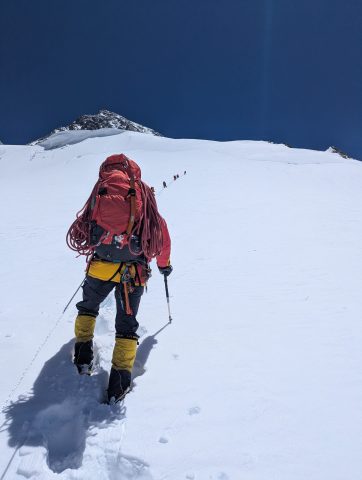
The Karakorum climbing season has ended: two peaks unsummited and a tragedy. It was an extremely quiet season with the lowest number of permits issued in a long time, perhaps twenty or more years. For the first time in years, no one summited K2 or Gasherbrum I.
Broad Peak – Summits & Tragedy
On July 30, 2026, ten climbers died in a single avalanche on Broad Peak. The event has received extensive media coverage, in part because Nirmal “Nims” Purja, one of the most consequential mountaineers of his generation, died. Also among the dead were six other highly experienced high-altitude guides — one with 28 8,000-meter summits — two very experienced clients, including one with twelve 8,000-meter summits, and a Texas client who was attempting her first 8,000er.
I did a podcast trying to extract the lessons from this tragedy. I’ve repeated it in this season wrap-up post below.
I begin with what matters most: who they were, not just how they died. Then I ask the harder questions. Heavy snow had fallen for days. The route above Camp II crosses obvious avalanche terrain — I stood on that exact slope during my 2006 Broad Peak attempt. I remember it clearly. Other climbers on the mountain last month were concerned about conditions and went home.
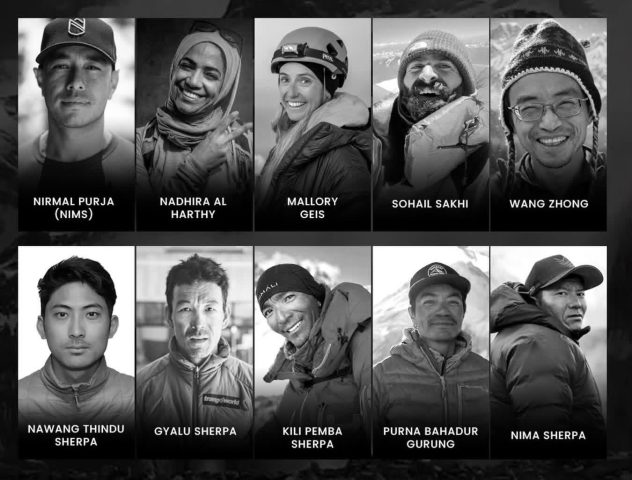
Courtesy of Tourism Times
Recently, I sat down over lunch with one of them, Ian Overton, who was climbing with Hungarian climber David Klein and was trapped by heavy snowfall at Base Camp for two weeks after making an acclimatization climb to Camp 3. When Ian ascended to Camp 3, he noticed a cornice and a heavy wall of snow above a loaded snowfield, and thought, “I hope this doesn’t go.” They left Broad Peak four days before the accident. When I asked Ian why the teams went on July 30, he told me he didn’t know and couldn’t explain it.
My deepest condolences to the families, friends, teammates, and communities of all ten climbers.
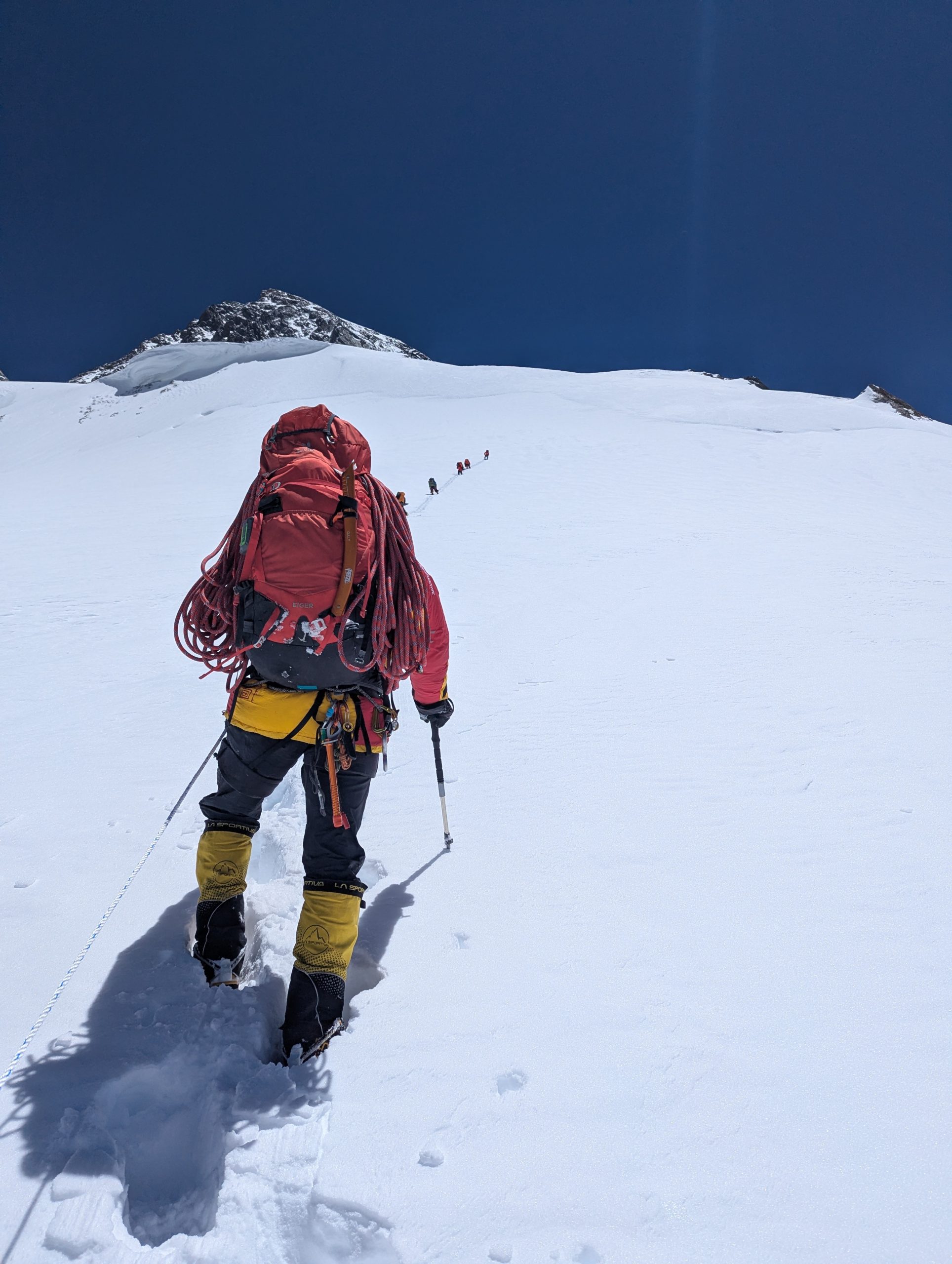
Before the tragedy, other teams did summit Broad Peak this season. Karakorum Expeditions’ Mirza Ali—the team leader — reached the rocky summit. They claimed a new route, but it appears a very similar route had been soloed in 1995 by Mexican climber Carlos Carsolio and used again in 2013 by an Iranian group.
K2
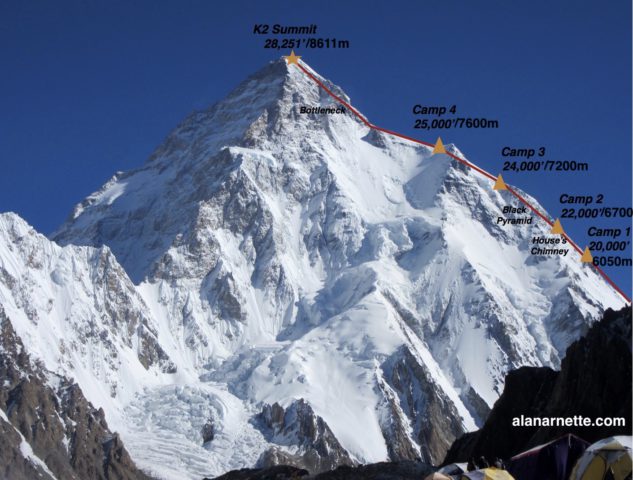
Nepali operators Seven Summits Treks (SST), 14 Peaks, and 8K Expeditions were climbing K2 again this year. Multiple Pakistani guides, including those from Summit Karakorum, were there. The absence of non-Pakistani or Nepali commercial teams was rare; in other words, no American-, European-, or South American-led teams. I estimate around 50 people attempted K2 this season. Similar to 2025, K2 was pelted by rockfall, high winds, and heavy snow.
The only team hoping to summit K2 this season, Mingma G, who was at K2 C3, heard about the Broad Peak avalanche around 9 p.m. on July 30; they abandoned their summit plans and began descending the next morning to search for the climbers on Broad Peak. As I described in an earlier post, they risked their lives with continuous avalanches to rescue the fallen they could.
Gasherbrum I/II
A six-member team with equal Sherpa support from Imagine Nepal summited GII on July 21. This was on their second attempt. Fresh snow and lack of sufficient rope stalled the first attempt on July 18.
On GII, Romanian Horia Colibasanu aimed for July 18 to summit and left the mountain after the unsuccessful attempt. Other climbers there include Uxue Murolas and Ignacio Barrio, who are about a day behind. There were no GII summits.
Nanga Parbat -Early Summits
Nanga is part of the Himalayan range, not the Karakoram, even though it’s in Pakistan; it’s more western and southern than Pakistan’s four other 8000ers. It’s in the Himalaya Range, whereas the other Pakistani giants lie in the Karakoram Range. NP usually sees the first summit each year.
After climbing Everest alone and descending on skis, then Lhotse in May, Polish skier Andrzej Bargiel made history again on June 30, 2026, by skiing from the summit of Pakistan’s Nanga Parbat via the Diamir Face/Messner Route to base camp without supplemental oxygen.
He was a fast follower of the rope-fixing team that opened the peak for commercial climbing. A five-member Sherpa rope-fixing team from Seven Summits Treks did the work.
The publication Dawn reported summits on Nanga Parbat by a seven-person team with Seven Summit Treks.
Also summiting and finishing his quest for all 14 of the 8000ers was Imagine Nepal’s Kili Pemba Sherpa, who summited on July 3, 2026, along with Lakpa Chhiri Sherpa and Chinese climber Wang Zhong. Tragically, Kili Pemba Sherpa (“Kilu “) was among the 10 climbers who died in the Broad Peak avalanche on July 30.
8K Expeditions got six to the summit – 3 Japanese with 3 Sherpas.
On June 30, 14 Peaks put an international team of four clients, one Western leader and five Nepali Sherpas on top, with one Pakistani High Altitude Worker.
Next?
Climb On!
Alan
Memories are Everything
Receive Publication Notification of Alan Arnette’s Upcomming Memoir
A surge of debilitating fatigue overtook me. My shoulders drooped. I stared at my yellow boots, crushed by disappointment. I had trained hard for K2 and tried to anticipate every scenario, but now I was failing, and there was nothing I could do.
Closing my eyes, I was powerless, hopeless, and ready to surrender to the mountain. Everything I wanted—the summit, a safe return, my vow to my mother—was slipping away.
My ice axe fell onto the snow.
Staring at the small yellowish spot illuminated by my headlamp on the snow, it was over, and, oddly, I didn’t care.
It was 12:30 a.m. on July 27, 2014—my fifty-eighth birthday.
If you would like to be notified when my memoir, “Hard or Impossible? Summiting K2 for Ida” is available – I’m still looking for an agent. Complete the form at the bottom of this introduction page.
5 Responses
Strange year. Are any Karakoram peaks safe anymore with global warming?
Good question. To add to it… As someone who has been to the Himalaya and is very much jonesing to see the Karakoram in person, the massive glacial collapse that just happened in Nepal makes me wonder if even the locations of approach/trekking camps should be reevaluated anticipating an increase in large events like it. Perhaps most camps are in the best possible spots already…don’t know…just seems change is upon us and it’s interesting to think about what can/should be done on climbing routes and at the foot of these big peaks on trekking paths. I find myself taking a fresh look at satellite images to see what’s hanging over each camp along the way to K2BC, that’s for sure!
Thanks for the comment, Bob. There are avalanches near K2BC, but nothing is directly overhanging.
You’re the “Best” Alan
Thanks,
Joe
Hi Alan, thanks for your hard work with these. It does look like G1 was summited after all, according to Angela at EW: https://explorersweb.com/summits-continue-on-gasherbrum-i/