Kosciuszko
Australia 7,310 feet/2229 meters Summited October 27, 2011 7 Summits Climb for Alzheimer’s Australia’s Kościuszko, located in Australia’s Snowy Mountains, is the lowest of the 7 Summits but is perhaps the most controversial. First, there is the pronunciation, then there is the debate about how it compares to other high peaks in Oceania (is New Zealand continent?) ), and last is the relative ease of this “hill” located next to a ski resort. In any event, today, it’s considered one of the seven on the Bass list, so most people seeking the 7 Summits will tick the box. The first summit was in 1840 by the Polish explorer Paul Strzelecki. I assume the First Peoples, Aboriginal people, Torres Strait Islander peoples or the Morano had a crack centuries earlier, but I could be wrong, as many Indigenous people treat mountains as sacred and not to be climbed. A simple walk-up on the otherwise relatively flat Australian continent. But if you want to be precise, Australia has a volcano in her territory on Heard Island – Mawsons Peak, 9005’/2745m. It is an active volcano about 2500 miles off the western coast of Australia, e.g., the middle of the Indian Ocean, and the island has no ports or villages. The second highest mountain on the Australian mainland is Mt. Townsend, 7,247’/2209m, 2 miles north of Kosciuszko. Although it is somewhat craggy than Kosciuszko, it is still a simple walk-up. It is reported that the locals ask each climber to take a rock to the summit to surpass its higher neighbor. Kosciuszko Resources: 2011 Summit Climb Report Kosciuszko Dispatches Kosciuszko FAQ 7 Summits Climb for Alzheimer’s In late 2010, I launched the 7 Summits for Alzheimer’s campaign, where I wanted to climb all seven (eight) of the Seven Summits in one year. The first summit was Vinson in Antarctica on December 9th, 2010. This was the last summit on October 25, 2011. I had made every summit except Denali, which was stopped by weather, 3100′ short of the summit. I have been able to send our Alzheimer’s message of hope, need and urgency from each continent, reaching over 12 million people and raising money for research, awareness and caregivers. In 2025, I will continue to dedicate my climbing and public presence to honoring my mom, Ida, and raising research funds for Alzheimer’s nonprofits. Please consider a donation today.
Kosciuszko FAQ
Australia 7,310 feet/2229 meters Summited October 27, 2011 7 Summits Climb for Alzheimer’s About Kosciuszko Q: Where is it A: Known historically as Tan Gan Gil, “Kozzy” is located in Australia in New South Wales and is also a local ski area in the Kosciuszko National Park. The nearest largest city is Canberra, equidistant between Sydney and Melbourne (6-8 hour drive). Mount Kosciuszko is part of the Snowy Mountains in the Great Dividing Range. The first recorded ascent was in 1840 by Polish explorer Paul Strzelecki. Still, according to local information, it was most likely climbed (hiked) for centuries by the local First Nation people of the Monaro. It is sometimes considered the highest in Oceania, but Carstensz Pyramid holds that honor. Q: When is it usually climbed (hiked)? A: Due to the lack of snow, the typical climbing season is Australia’s summer ( November to May), but it can be climbed (hiked) year-round with proper equipment. From June through October, hikers should plan on dealing with snow. The summit was snow-covered for my hike in mid-October. The best time to hike Kozzie is in Australia’s summer months of December through February, but March and April, plus October and November, also offer nice weather. Q: I understand that Kosciuszko’s is just a simple walk-up. How hard is it? A: In winter, it can test your skills. While it can be hiked year-round, winter offers more of an alpine experience, and you will need proper clothing and gear to be safe. While not a hiking or climbing accident in 1999, four snowboarders were caught in an unexpected storm and lost their lives in a snow cave in Kozi. The group and their bodies were discovered in November after they had been missing since August. On August 14, 1928, W. Evan Hayes and W. Laurie Seaman departed Charlotte’s Pass and were never seen alive again. Finally, in 2024, in 2022, a backcountry skier, Andrew Seton, died in Kosciuszko National Park. Q: How does Kosciuszko compare with the other 7 Summits? A: It is the easiest of them all and very enjoyable. Kosciuszko National Park is a beautiful environment; if desired, you can enjoy all the comforts of a world-class ski resort. Q: Is a Kosciuszko climb dangerous? A: It can be if the weather turns on you. I have heard many stories from other 7 Summit climbers about being lost or struggling with high winds, deep snow or drifts. So, weather monitoring is essential, just like any outdoor activity. Q: How many people had summited, and how many people had died trying? A: It is estimated that over 100,000 people hike Kosciuszko each year. There has been a rare death in the area, mainly in the winter. Training, Gear & Communication: Q: How did you train for this climb? A: This was part of my 7 Summits Climb for Alzheimer’s: Memories are Everything® project. So, I climbed (hiked) almost continuously throughout 2010 and 2011, either in training or on the climbs. I was in excellent physical and mental condition for this climb. But I suggest the usual training regime of running, lightweight and aerobic conditioning. Q: Was altitude a problem on this climb at 7,000′? A: Not really, even for the people I observed walking up. However, it can always be a surprise. Many people feel that some type of AMS is above 8,000. As I mentioned, I had already climbed (hiked) seven other 7 Summits peaks in the previous 11 months, plus Carstensz four days before, so I was in excellent condition and never felt the altitude. Q: What kind of equipment did you use? A: I used simple trekking clothing but carried a warmth and wind layer in my pack, plus a pair of gloves and a knit hat, the same gear I used on the lower parts of Kilimanjaro. Q: Is there anything unique in your gear for Kosciuszko? A: Not really, just a good pair of sunglasses because I had excellent weather in mid-October with temps in the high 60sF. I would carry bug spray in the summer. But Kosciuszko can sometimes be extremely cold and windy, so multiple layers are required. My boots were the Montrail High Top and were fine for the snow-covered sections near the summit. Q: Did you use a satellite phone? A: I used an Iridium phone to post dispatches on this site. Cell phone connections are available. Expedition Basics Q: Which route is most prevalent? A: There are two primary routes to summit Kozzie, with the most popular starting at Thredbo Alpine Village. From there, you can take the Kosciuszko Express Chairlift to begin the 8-mile round trip Kosciuszko Walk, aka Summit Walk, a gain of 6,354′ to 7,310′. The “trail” is a metal walkway that protects the delicate alpine environment. The gain is a gentle 991 feet or 302 meters. The second main route from Charlotte Pass (6,026′) is longer (11 miles round trip) and follows a dirt road. The third and least known is the Hannels Spur Track, 9.5 miles, with the largest vertical gain in Australia at 5,900 feet. It crosses Rawson’s Pass, intersecting with the Thredbo ski ascent route. The gain is 1,273 feet or 388 meters. Thanks to reader Stewart Aickin for updating me on this route. He adds that the Hannels Spur Track was the same route that explorer Sir Paul Strzelecki climbed and ‘discovered’ Mt. Kosciusko in 1840. It is also the same route that the cattlemen once used to annually muster the cattle up from the Murray Valley to the high country (around Kosi.) to graze throughout the summer. The many indigenous tribes from the Murray Valley also used this same route annually for 1000s of years to climb Kosciuszko to feast over the summer months on the ‘delicacies’ of Bogong moths. It approaches Mt. Kosciuszko from the NW – with the trailhead near Geehi. (Geehi is a simple camping area on the Alpine Way road). Q: How long will it take? A: Depending
Kosciuszko Trip Report
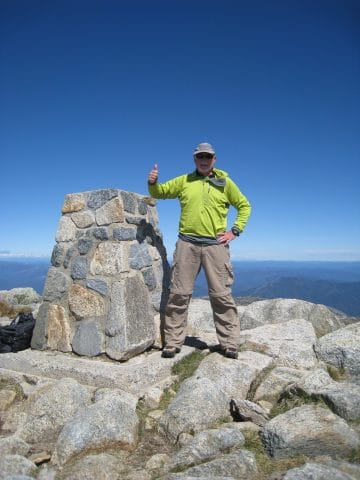
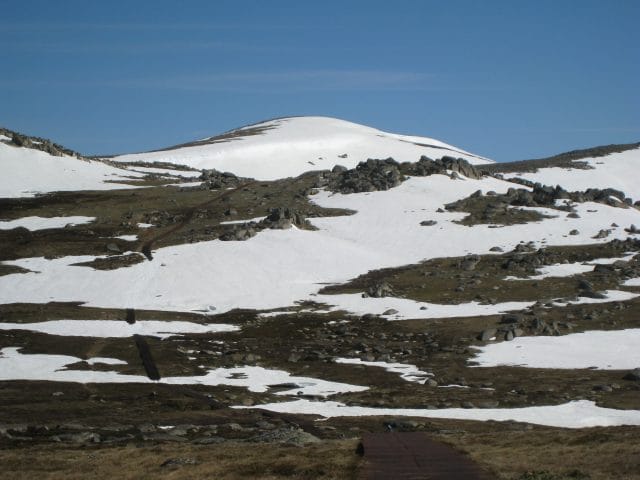
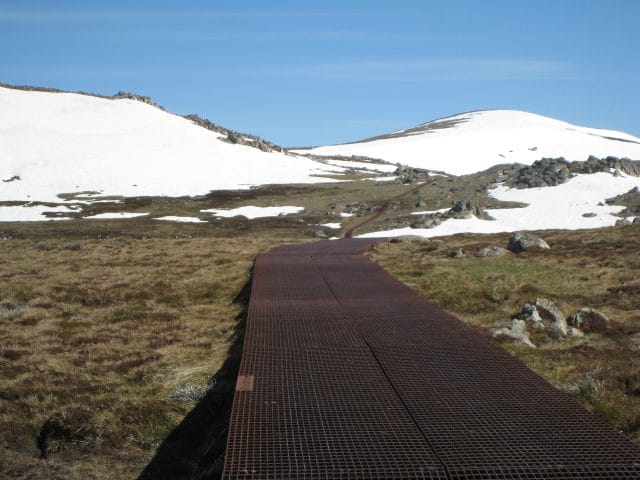
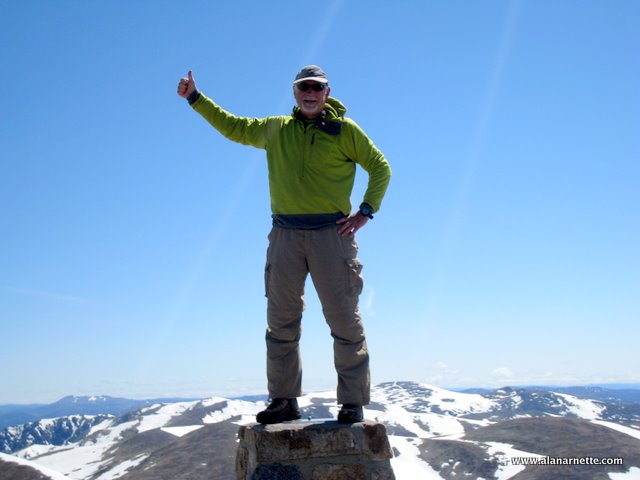
Australia 7,310 feet/2229 meters Summited October 27, 2011 7 Summits Climb for Alzheimer’s With a tip of my hat to Dick Bass, who started all the 7 Summits stuff, I wanted to include Kosciuszko in my project. I had summited Carstensz on October 22, 2011, and flew immediately to Sydney, focused on completing my 8th of the 7 Summits climbs in one year. Arriving in a bit of a haze, I rented a car to leave Sydney and rest up for a couple of days before going to Kosciuszko. However, once on the road, I kept driving thoroughly, enjoying the vast countryside of the New South Wales (NSW) area of eastern Australia. Drive Left I kept saying out loud, “Look right, drive left,” to cope with the swapped lane driving. I reached a small tourist town that served as a gateway to the Snowy Mountain area and asked for information about Kosciuszko at the information center. The polite woman behind the counter told me it was snow-covered, I needed snow shoes, and I would probably not make it. I smiled and politely thanked them. The next stop was more encouraging, as I bought my entrance ticket to the Kosciuszko National Park. This time, I was told that many people climb it daily, and the route is a bit snow-covered. The summit proper was heavily corniced, preventing the usual approach, so everyone went straight up. I liked this scenario better! I continued to the ski village of Thredbo and found a great studio apartment for one night; it even included Wi-Fi. As I looked out my window towards the ski lifts, however, low clouds covered the tops of the mountains. I knew the weather could be a problem, with many fellow climbers telling me that Kosciuszko proved the most difficult of all the 7 Summits, but I was unsure if that was a joke. Some said they were getting lost in dense fog, and others were experiencing high winds and blowing snow. So I went to bed wary. A Perfect Day The following day, the skies were as if someone had taken glass cleaner to the skies—pure blue, no clouds and temperatures in the high 30sF. I had considered taking the slightly longer route from Charlotte Pass rather than the ski lift from Thredbo. Still, in the end, the ski lift won out, and I bought my lift ticket and boarded it at the opening time of 9:00 AM along with a large group of international students. I relaxed on the short ride up, reflecting on the culture shock of being in the jungles of New Guinea only three days earlier. This was my eighth climb, and I had been gone from home for almost seven of the last eleven months. But I was eager to stand on the summit of Australia’s highest peak on the mainland and looked anxiously ahead as the lift stopped. It was an 8-mile round trip with an elevation gain from 6,354′ to 7,310′. The route was more than obvious—a raised metal grated boardwalk had been installed for the majority of the walk. Over 100,000 people a year do this walk, so the walkway was constructed to protect the fragile tundra. A few other people soon joined the walk, and I made good progress towards Kosciuszko. It became visible about halfway. I was surprised at how large it looked, even from a distance. It was a classic, smooth mound standing high over the surrounding area. Completely snow-covered, I could understand how some people might go astray in harsh weather, but the day was beyond perfect. 8 Summits of the 7 Summits I reached the end of the boardwalk, where the Kosciuszko Walk merged with the trail from Charlotte Pass, which started at 6,026′. All that was left was to gain the summit by going straight up the snowy mountainside. I was glad I had worn my jacket and gloves. It was a bit chilly, with a light breeze off the snow, but I stood on the summit in a few minutes. It had taken a little over an hour—the shortest summit climb of all eight by far! I asked some of my fellow summiteers to take my picture while standing on the rock marker; it seemed everyone was doing this. I called for the eighth time from these climbs and posted an audio dispatch to my blog. Then I sat down on a big rock and looked around. The first summit was Mt. Vinson in Antarctica on December 9th, 2010. This was the last summit on October 25, 2011. I had made every summit except Denali, which was stopped by weather, 3100′ short of the summit. But it was OK. I have been able to send our Alzheimer’s message of hope, need and urgency from each continent, reaching over 12 million people and raising money for research, awareness and caregivers. It had been a good year. Kosciuszko Resources: 2011 Summit Climb Report Kosciuszko Dispatches Kosciuszko FAQ 7 Summits Climb for Alzheimer’s In late 2010, I launched the 7 Summits for Alzheimer’s campaign, where I wanted to climb all seven (eight) of the Seven Summits in one year. The first summit was Vinson in Antarctica on December 9th, 2010. This was the last summit on October 25, 2011. I had made every summit except Denali, which was stopped by weather, 3100′ short of the summit. I have been able to send our Alzheimer’s message of hope, need and urgency from each continent, reaching over 12 million people and raising money for research, awareness and caregivers. In 2025, I will continue to dedicate my climbing and public presence to honoring my mom, Ida, and raising research funds for Alzheimer’s nonprofits. Please consider a donation today.
Kosciuszko Summit: Brief Recap
It may have been the lowest, but it was certainly worth the effort. Mount Kosciuszko was easy and fun plus a wonderful way to end my current 7 Summits Climb for Alzheimer’s: Memories are Everything project. Only three days after summiting Carstensz Pyramid, here I flew to Sydney and then drove to the ski resort village of Thredbo. I found a great place to stay and looked out my window to see a cloud covered mountain side. More than one climber had told me that Kozzy presented a challenge in difficult weather conditions. But when I woke up, I was greeted with clear blue skies! I took the Kosciuszko Express ski lift up the mountain side and started my walk to the summit. OK, so maybe this was more walking than climbing; but I was happy to be here. I was not alone for much of the hour it took to reach the summit as a group of international students were there,couples enjoying the day and an entire herd of school kids screaming their way up the trail. Everyone was having a great time. The route is actually on a raised metal boardwalk to protect the fragile tundra given there are over 100,000 visitors a year on Kozzy. It is a huge source of pride for the Australians and rightfully so. The entire area is absolutely beautiful with grass covered mountains surrounding the peak and spindly Snow Gum trees dotting the area. Most of the route was snow free but Kozzy proper was covered with deep snow preventing the normal circular approach so everyone took a somewhat steep direct route to the summit. As I walked up the snow, my thoughts went to the past 11 months and all my climbs. Also of my purpose. My audio dispatch was a bit long but I wanted to share several thoughts with all the dedicated followers, donors and supporters. You can listen to it here: While these climbs may be over, my climbing is not. I have some unfinished business on one for them! Also, I hope to share my experiences of climbing and Alzheimer’s as much as possible and continue sending our message of hope, need and urgency. This disease is not going away. Over 435,000 people in the US alone were diagnosed with Alzheimer’s since I started climbing only 11 months ago. So this is a milestone, not the start or the end. My deepest appreciation to everyone who made a donation (you can still make one!) and please continue to follow me as I to work to eliminate this disease. Climb On! Alan Memories are Everything