Deaths on Chimborazo
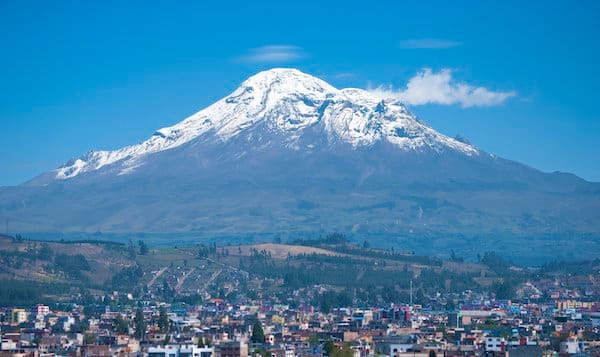
A rare deadly avalanche on Ecuador’s highest peak, Chimborazo at 20,549-feet/6,263-meters, took four lives on Sunday, October 24, 2021. An all Ecuadoran team of 12 climbers and guides was approaching the false summit near 6,100-meters when the snow gave way. One person was injured. Another group of 20 required assistance. The incident occurred at 6:30 in the morning as reported by Emergency organization Integrated Security Service ECU911. The mountain is closed for climbers at the moment.
Ecuador 2019: Climbing the Volcanoes: Final Trip Report

Climbing three volcanoes in Ecuador was a pleasant, rewarding experience. One that I would repeat. I found Ecuador to be filled with a rich history, friendly people, great scenery, challenging climbs with convenient access and quite affordable. We climbed three of their 32 volcanoes located on the mainland: Cayambe 18,997 feet/5790 meters, Cotopaxi 19,348 feet/5897 meters, and Chimborazo 20,703 feet/6310 meters. We used Mountain Madness and I found them excellent in all aspects and would climb with them again without hesitation. Big Picture These three volcanoes are quite popular for a guided trip and for some independent climbers. As I will develop, Ecuador is a foreigner-friendly country with excellent hotels (haciendas) located near the peaks. The mountain refugiós are nice, similar to what you would find in Europe. And the local guides are excellent. Ecuador has proven oil reserves and is cashing in with China as a partner at the risk of their environment (Amazon Rain Forest), it is still considered a developing country with the wealth gap, government corruption, petty crime and the need to only drink bottled water. All that said, I felt very safe there. They cater to tourists primarily based on visits to the Galapagos Islands (still on my list) but seeing and climbing the volcanoes, especially Cotopaxi is near the top of the list. Also, a large part of Ecuador is taken up by the Amazon Rain Forest. So the country has quite the eco-diversity. Almost all the major guides across the world offer packaged climbs of the Ecuadorean volcanoes. The pricing is similar ranging from $3,500 to $4,500 for two or three peaks. Most use local guides but some have their foreign national as the lead guide – unnecessary use of clients money in my view as the local Ecuadorean guides are outstanding both in soft and technical skills. Almost all companies follow a similar pattern of a few days being a tourist, then a few days of acclimatizing on the local 14,000-foot peaks before starting the volcano climbs usually ending with Chimborazo. As usual, if you have the skills, experience and risk tolerance, you can try to climb these independently but Ecuador requires a guide for any climb over 5,000-meters so be aware. The Logistics So why did I want to climb these peaks? I’ve never climbed these peaks but they are perfect for some of my Summit Coach clients looking to build their skills at modest altitudes so I wanted to climb them myself. Also, I’ve never climbed with Mountain Madness but they are one of the best guide services out there and have been developing their South American programs for years. In 2017, I did an interview for this blog with Mark Gunlogson, their CEO, were he discussed MM’s business, Scott Fischer and Christine Boskoff. Next, Robert LeClair and I have summited almost all of the Colorado 14ers together as well as Mexico’s Orizaba. He signed-up for these climbs almost a year ago and invited me then. Finally, my Island Peak climb in October 2018 was a bit more difficult than I had anticipated so I want to get back to that 20,000-foot level and figure out what’s going on. Glad to report no issues this time. We had three local Ecuadoran guides and no America leaders. The team was small made up of six people: four Americans and one Polish and one Canadian member. The pre-trip communication with MM was excellent. They provide all the information you needed from gear list to route details and local contracts well before I left the States. I flew from Denver to Quito, the capital of Ecuador via Copa Airlines through Panama City and on to Quito. Others flew United or American airlines from Houston or Miami. I would not use Copa again due to inconvenient connections. I had a 12-hour layover in Panama City. Welcome to Ecuador I was met by a MM representative at the airport and driven to our amazing hotel, the Hacienda Rumiloma. This is a Mountain Madness exclusive as it’s owned and run by Ossy Friere and his wife Amber. They live two minutes up the road with their four daughters on this 100-acre former rock quarry. While connected with MM, the Rumiloma is open to everyone and many people use it as a base for their Ecuadorian adventures – highly recommended. Ossy is MM’s Latin American Program Director, has climbed Aconcagua’s South Face, summited Everest without supplemental oxygen and guided throughout the globe. His English is perfect, perfectly polite and holds a UIAGM certification. He also runs one of Ecuador’s climbing clubs and trains other guides. If you go to Ecuador, getting Ossy as your guide and staying the Hacienda Rumiloma, is worth any slight premium you might pay and will make the trip extremely special. The Schedule We started with a tourist day in Quito learning about the history of Ecuador, their chocolate, and rose industries plus enjoyed local food in the city center. In spite of the touristic aspect to the day, we were acclimatizing as Quito is at 9,350-feet/2,850 meters. Next were acclimatization hikes to 15,407-feet/4,696-meters and the summit of Pichincha Volcano. The next day to Fuya Fuya at 13,986 feet/4,263-meters. In between, we spent a morning visiting the local, very colorful market in Otavalo where I bought several Llama wool blankets and scarfs for gifts back home. Finally, after six days in Ecuador, we were ready to attempt our first volcano, Cayambe. Cayambe As with all these climbs, we started at a fairly high elevation. We drove with Ossy, and his fellow guides Joshua Jarrin, also UIAGM/IFMGA certified, and the third guide, Ecuadoran Camilo Jose Andrade Davila to the excellent hut, Refugio Ruales Oleas Berge at 15,420-feet/4,700-meters. We had visited the hut the previous day hoping to get some ice time but strong winds and rain kept us in the hut all afternoon. We retreated lower to spend the night at the newly built hut/climbing school complex built by the Mountaineering Club of the Jesuit school San Gabriel. It was about half an hour away
Ecuador 2019: Climbing the Volcanoes: Chimborazo “Summit”

Chimborazo proved to be the toughest of the three climbs this week. We got very near the summit of 20,703-feet/6,310-meters, it was the highest of the three. Here is the story: As we got up at 11 pm last night, Jan 27, the view of the stars from the High Camp on Chimborazo was breathtaking. The Milky Way looked like a long narrow cloud and the billions and billions of stars made even the best known constellations like the Southern Cross, Orion, Big Dipper almost invisible. We left at midnight for our summit push full of energy and optimism. I felt great, yes great, at 17,500 feet. The benefit of living and climbing in Ecuador the past ten days. We made good time as we began following a nondescript path under an unstable rock wall for about an hour. We were swift and deliberate with our motion. Soon we left the wall for the flanks of this extinct volcano. Honestly, Chimbo is more of a mountain than a volcano like Cotopaxi with its perfect cone shape. This volcano thinks it’s a massif with five summits and a base that takes up several square miles. Anyway, the wee hours of the morning passed as we navigated the route to the light of the stars. An impressive glow soon emerged on the summit as a half moon said hello. The climb was challenging, more so than Cotopaxi. The snow was hard and icy at times and the angles were relentless, a constant 35 to 55 degrees that became more aggressive as we closed in on 20,000 feet. Then it happened. With seemingly no warning, the stars disappeared, our calm morning became a play named Gale and snow began to fall. All that was missing was Bing Crosby. Our group of eight held an impromptu conference at 20,433 feet on Pico Veintimilla, one of the sub peaks of this “volcano”. We were a quarter of a mile away, 131 vertical feet, from the invisible main peak of Chimborazo standing at 20,564 feet. So close yet … Hell we couldn’t see anything!!! So with the objective danger of the rock wall, which was known to hurl soccer and microwave oven sized boulders on top of really nice people aka climbers as the sun warmed the walls, it was determined an orderly retreat was a honorable decision to get back to High Camp ASAP. Oh, and snow was blowing up our noses. So did I get the highest point on the planet as measured from the center of the earth? Did I poke my head into the atmosphere higher than when I was on Everest? And most importantly, did I win my battle with that know-it-all 6th Grader who challenged me with “my dad says Everest is not the highest mountain…” Well, actually the answer to all those questions, while fun, is not all that important. What is, is that I found a new country I really like with some wonderful people, I figured out I can still climb to 20,000 feet and I confirmed that climbing mountains, even if they are cone heads, feeds my essence and makes me happy. I’ll be posting on my blog a full trip report probably next week plus a comparison between climbing in Nepal compared to Ecuador. Climb On! Alan Memories are Everything Please enjoy these pictures of the Chimborazo climb: Two of the five Chimbo summits Alan and Robert LeClair with Chimbo behind Chimborazo The Mountain Madness team on the summit of Pico Veintimilla 20,433-feet Lower sections of Chimborazo A little down climbing on the lower sections of Chimborazo Heading down as weather closes in Pico Veintimilla 20,433-feet On the “summit” in a whiteout Our summit “view” Chimborazo High Camp
Ecuador 2019: Climbing the Volcanoes: Cotopaxi Summit!!!
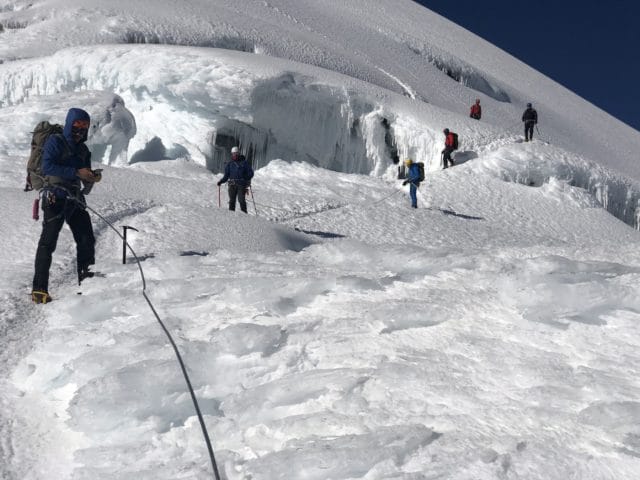
Our Mountain Madness team summited Cotopaxi, 19,348-foot/5897-meters, around dawn this morning January 25, 2019. It was a good climb with everyone making it except for one member who sprained an ankle on Cayambe and stayed in the hut. As is normal for these climbs, we left the hut at midnight to climb in the early morning hours to avoid the weather that always develops near the equator. Coto has a nice hut perched at 4,800 m (15,744 ft) on the flanks of the active volcano. The hut has an active history especially when in 1996 on Easter Sunday when an avalanche partially buried the hut along with dozens of tourists. It holds about 90 people in two large dorm rooms with bunk beds and the caretakers serves dinner and breakfast, including at midnight when everyone takes off for their summit push. Another “interesting” point of the hut is that the road ends about 1,000-feet lower thus encouraging anyone wanting to visit, or climb, to hike the dirt path carrying all their gear – good training! We arrived around 4 pm yesterday, visited and enjoyed dinner then promptly went to bed. The 11-12 wake up call (via our watches and anxiety) came on time and after a light breakfast of rolls, jam and coffee or coco, we were dressed, packs loaded and out the door. The skies were perfectly clear but the wind was gusting to 15 mph, and sometimes twice that speed. The lower part of the route is on red dirt with switchbacks but soon meets the glacier. There we put on crampons and donned ice axes. The temps were in the lower 40sF but the wind kept you alert. Climbing Coto is not technical as in using extra climbing gear (protection, cams, pitons, ice screws, pickets, etc) but is what I would considered “sustained”. After all think of a volcano’s shape – it’s basically a cone with steep sides all around. Cotopaxi is no different. The route starts somewhat steep and gains in angle as you gain in altitude. In general, the last third of the climb was the steepest with angles ranging from 30 to 50 degrees. It was a bit exposed and in some sections, a fall would be serious. We climbed roped together in groups 2 to 3 to protect in case of falls into a crevasse. There were several but two that were quite large. Both had stable snow bridges that allowed for easy crossing but in some years, ladders are put across the open cracks. Once on the summit, you get to look down into the caldera that was formed when the eruptions of magma, or lava, left a gigantic empty chamber underground. It was filled with steam, smelled of sulfur and had an eerie aura about it. We stayed on the summit for about half an hour. Our fast team of kids (26 – 42) had arrived earlier and this old man at 62 arrived about a half an hour later. While I didn’t experience any of the problems I did on Island Peak in Nepal last October, I still wanted to do bit better, but I’m pleased with my overall performance and want to extend gratitude to Ossy with Mountain Madness for staying with me. The down climb was scary fast – 2 hours and we were back in the hut for a 9 am breakfast of corn tortillas and fresh fruit. We hiked down the road to our cars and are now at the Hacienda Tambopaxi for the night before moving on to Chimborazo for a Monday summit climb. Ecuador continues to be a rewarding experience, especially with a summit now. The next one, our last climb, will be the highest and toughest. Climb On! Alan Memories are Everything
Ecuador 2019: Climbing the Volcanoes: Cotopaxi Up Next

As I wrote in the last blog, Cayambe iced us off the upper slopes so now Cotopaxi is up next. After Cayambe, we returned to heal and regroup at Hacienda Rumiloma outside of Quito. We had a great dinner with Ossy, Amber and their family at a local Sushi restaurant, yes Sushi!! Yesterday, Wednesday, January 23, we drove to another amazing Hacienda, Los Mortinos located in Limpiopungo roughly translated as “Clean Valley” just a few miles from Coto and just outside the national park. Mountain Madness continues to impress me with logistics, staff and choices. The drive in was on surprisingly smooth, rock covered roads that took us away from civilization and ever higher into the Andes Mountains. We are currently at 11,500 feet. Today we will drive to the end of the road and hike 45 minutes to the Cotopaxi hut around 15,000-feet. To bed at sunset and up at midnight. Hopefully will take us 5-7 hours to summit and about half that to return to the hut and then on to another hacienda for the night. Cotopaxi is 19,348-foot/5897-meters. Please enjoy these sunset picture took last night. Climb On! Alan Memories are Everything
Ecuador 2019: Climbing the Volcanoes: Cayambe’s Ice Age
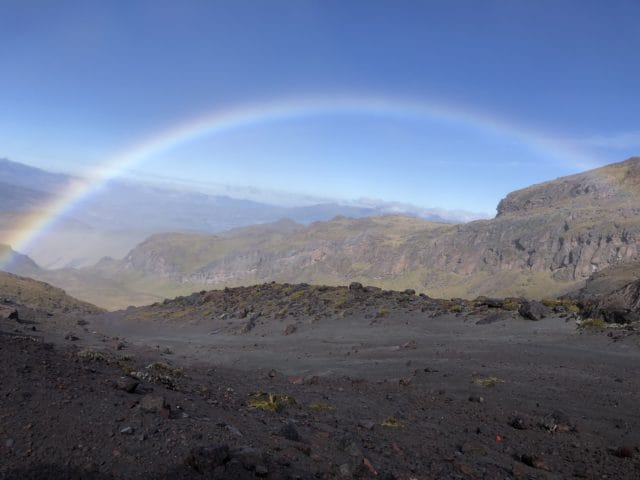
“Sometimes you’re the windshield, sometimes you’re the bug.” Today we were the bug on Cayambe! Before I get to the crash, let’s catch up a bit from the last full post. I’ll keep repeating that I find Ecuador delightful. The cities, the countryside, the people, the mountains/volcanoes (what I can see of them!) It’s a similar feeling I had on my first visit to Nepal and now I’ve returned 13 times. Perhaps the same is in store for this South American treasure. As I covered when I first announced my plans to climb the three Ecuadoran volcanoes: Cayambe, Cotopaxi and Chimborazo with my good friend Robert LeClair and guided by Mountain Madness, I really had no idea what was I was in for. Of course, I researched the climbs and knew they could be dicey, or more accurately icy, and also the weather was always a variable given they are situated next to the huge Ecuador Amazon Rainforest which launches moisture-laden clouds over all the volcanoes, especially Cayambe. But I yearned to return to 20,000-feet and climb something new. “Acclimatizing” Since I arrived here about a week ago, we have spent most of our time “acclimatizing.” I quote this because some of it involved shopping and taking city tours, not exactly the standard program. However remember that Quito, which serves as our base is at 2,850-meters/9,350-feet. Also, we took several hikes as high as 15,500-feet. So if you are looking for hard-core, stinky, no-shower, freeze-dried food, isolated with the people you came with, well this may not be your thing! In addition to our day hikes, we also visited the colorful market in Otavalo. Another fun surprise with all the beautiful textiles, rugs, clothing, sculptures and art. Bargaining was fun but not cutthroat like other parts of the world. Again, having lunch or dinner in a local restaurant was a treat. So before you think this is a glorified shopping trip, which I won’t deny, We made our way to the hut on Cayambe at 15,500-feet to get ready to attempt Cayambe last night. Our team of nine, six members and three Ecuadorean guides, were all acclimatized and well prepared for whatever might come our way. Class Guides The Mountain Madness team here is top shelf. Perfect English, impeccable organizational skills and polite to a tee. It’s been a nice case study to see expert mountain guiding as it continues to develop around the globe. Lead by Oswaldo Freire aka Ossy, his fellow guides Joshua Jarrin are both UIAGM/IFMGA certified and show their skills constantly putting safety first along with the third guide, Ecuadoran Camilo Jose Andrade Davila. On Monday 21, January 2019, we went to the Cayambe hut hoping to do a short 1,000-foot climb to the glacier but strong winds and constant rain stopped those plans so we relaxed in the hut for three hours “acclimatizing.” 🙂 We returned for the night to a newly built hut/climbing school complex built by the Mountaineering Club of the Jesuit school San Gabriel. It’s about half an hour away from the Cayambe Hut and was much for comfortable and had excellent food. So with all the prelims out of the way it was time to climb our first volcano. We returned to the high hut aiming to go to bed at 6 for an 11 pm wake-up. Clouds covered the peak damping our spirits but just before bed, the skies cleared and I can confirm I saw at least one volcano, and it was stunning! Pumped, we went to sleep. Wet Winds Everyone was prompt and excited sincerely assuming we would summit given the absence of clouds a few hours earlier. However, during the evening, the winds picked up disturbing what little sleep we were hoping to get. Getting dressed was like a fire station with ongoing alarms: layers, harness, coffee, bathroom, sunscreen (joke) (not), crampons (not on, quite yet) … anyway, you get the idea. Nine people focused on being on time and out the door at midnight. We made it at 12:15. Out for a group picture taken by the Boss, Ossy, and off to the summit. The first couple of hours went well. The climb started on rocky terrain, mostly class 2 with class 3 scrambling on some short sections. I was surprised at the level of rock involved, albeit, quite doable. Soon the terrain somewhat flattened into a sandy loam before intersecting with the glacier. So far, so good. We put on crampons and swapped trekking poles for ice axes. We roped into three teams for safety as the upper part of the mountain has many crevasses, again, not a huge issue as most are easily stepped over and present little danger … but you never know. Again we made good time and were on schedule for a six-hourish summit push when everything fell apart, quite literally. I felt moisture on my face but didn’t see any rain or snow falling. I pointed my headlamp towards my down jacket sleeve and was surprised to see it saturated. Soaking wet. And down and water do not go together as down loses its warmth when wet. We were experincing Hoarfrost, defined as “a deposit of ice crystals on objects exposed to the free air, such as grass blades, tree branches, or leaves. It is formed by direct condensation of water vapor to ice at temperatures below freezing and occurs when air is brought to its frost point by cooling.” We stopped to add layers, including Gortex jackets to ward off the moisture. About this time low clouds overtook the upper part of the mountain. I was on the middle team with the others 5 – 20 minutes ahead and behind. Impressively, the three guides who are like brothers on the mountain, all reached the same conclusion at almost the exact same and brought their teams to a halt. Easy Decision Joshua turned back to us and said: “It looks bad and it’s still 3 hours to the summit
Ecuador Volcanoes 2019: Acclimatization and Rare Bird Sightings!
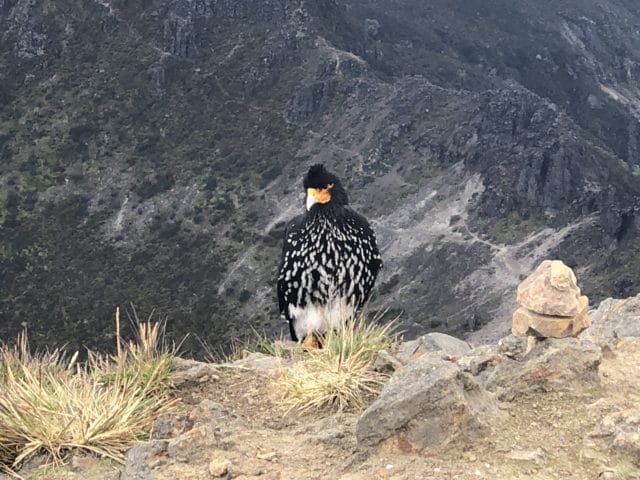
Ecuador keeps getting better and better. Today was a real acclimatization hike on a super trail above Quito We had another fabulous breakfast at Hacienda Rumiloma and hopped in Ossy’s FourRunner for the 10 minute drive to the telefèric or cable car to the Start of the trail to the summit of Pichincha Volcano which is considered extinct although it is next to Guagua Pichincha which erupted in 1996 covering Quito in a foot of ash. The modern convenience of the cars on cables (image that!!) to 12,950’/3,947-meters to start the hike. It was a clear, mostly cloudless cool day offering up unlimited views of Quito but not of our three volcano objectives we are here to attempt. The trail were full but not crowded with groups of all ages, nationalities and objectives laughing and huffing as we all hiked higher. Click on any image for a larger view. The trail is well worn due to continuous use by visitors and locals alike and offers up some surprises as you go above 15,000-feet. The trail turns into a sandy hill that requires full use of legs and balance, then it graduates to the Eagle Rock, a rocky buttress that ask for easy Class 3 to 4 rock scrambling before surrendering to a rocky summit with great views at 15,407-feet/4696-meters. On the summit we were greeted by two Mountain Caracara birds who seem to originate in Panama but like to live in Ecuadoran Mountains above 14,000-feet. Like most mountain birds, they have figured out people mean food, but I saw no one feeding them. Ossy lead the way all day setting an excellent pace for acclimatization. It took us 3:30 hours up and 1.5 down with a total distance of 6 miles and 3,750-foot gain Our clear skies gave way to low cloud that masked the descent but also cooled down the activity. With light down jacket and food gloves were were comfortable. We did wear helmet near the top due to other people above us on loose rock. One the way day, once again we were rewarded with the sighting two Condors – a unique sighting of a male and a female, flying another 1,000-feet above us. Both the Caracara and Condors are somewhat rare sightings so we were pleased to see them in one day. Now back at Hacienda Rumiloma, we will have dinner and sadly leave tomorrow for Otavalo with an afternoon hike at Lake Cuicocha for more acclimatization. The schedule calls for us to spend the first part of next week on Cayambe, preparing to climb with summit near dawn on the 22nd. This is an excellent acclimatization schedule that should set us up nicely for the summits of Cayambe, Cotopaxi and Chimborazo all with a 7 day period. One final note about Hacienda Rumiloma., we will spend three nights here. In conversations with Amber and Ossie the Hacienda as often used as a base camp of sorts for visors to the Galapagos Islands, Ecuadorean Amazon Rain Forest and Quito. Since the opening 2007, it has become a tradition for families around the world to visit as well as the locals to celebrate marriages, anniversaries or just a weekend get away. Again, Mark Gunlogsonand team at Mountain Madness deserve a hat tip for such a find along with Ossy Friere who directs their South American programs. Climb On! Alan Memories re Everything
Ecuador 2019: Climbing the Volcanoes: Quito
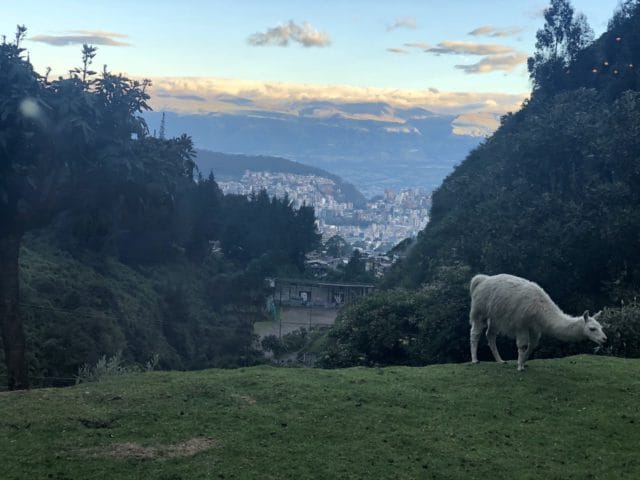
When I started telling people that “I am going to Ecuador to”, I never got out the “climb volcanoes” part before they gasped, put their hand to their heart and squealed, “you are going to love it!” Oh my, were they right. I arrived in Quito, the capital of Ecuador, late last night after a relatively short flight from Colorado but a long 12 hour connection in Panama City, Panama. My bags arrived on time, I got a local SIM for my iPhone and easily found the driver for the 40 minute ride to one of the most amazing places I’ve ever seen, the Hacienda Rumiloma. The unbelievably quaint, romantic and stunning “hotel” is owned and run by Ossy Friere and his wife Amber. They live two minutes up the road with their three daughters on this 100 acre former rock quarry. I met up with my teammates, Robert and Marcin from Switzerland along with one of our guides, Ossy Friere from Mountain Madness for a healthy breakfast of fresh fruit, juice and eggs. As is normal in these expeditions, there was a bit of getting to know you, but Robert and I have know each other for over 20 years and climbed many Colorado peaks plus Orizaba together so we got to know this Google executive from Switzerland a bit and of course Ossy and Amber. Today was an “acclimatization day” which is one of the best in my 25 years of climbing. We spent the day touring Quito and a bonus spot. Mind you, Quito is at 9,350-feet/2,850-meters so this is a real acclimatization day. Since I live at 4,950-feet, that’s my story, and … 🙂 Quito First up was a visit to the El Panecillo, a 200-meter hill located between southern and central Quito and the 135-foot/45-meter high aluminum statue of the Virgin Mary. It was commissioned in 1976. The virgin stands on top of a globe and is stepping on a snake, however, less traditional are the wings. Locals claim that she is the only one in the world with wings like an angel. As impressive as she was, the view was breathtaking. Quito is a city of over 2 million people covering 125 square miles or 324 Km2, in other words it’s huge! The city is basically surrounded by high mountains. To the west is the Amazon rain forest and the east, only 100 miles away, is the Pacific Ocean. Ossy, who should be a tour guide in addition to a mountain guide, explained what we were seeing and pointed out the key building in this sprawling city. He went on to talk about the history of the Quita people, Incas, Spainish, revolutions, independence and more. This is another country with a rich, sometime violent history. Today Ecuador is known as a safe, friendly country with a forward looking government and a careful eye on the climate as they are the custodians of the Galapagos Islands. We left the viewpoint and entered the city stopping first at a chocolate store. Ok, I know what you are thinking but new to me is that Ecuador claims to grow the highest quality Cacao. The store owner took us through the process of growing the nuts to turning them into the chocolate we love. Ecuador exports 99% of all the Cacao they grow. And the streets were alive with families and street vendors and entertainers. Next up was a walk through the town center and a visit to one of the most ornate churches I’ve ever seen anywhere in the world. The Jesuit church took over 160 years to build and the inside is covered in gold leaf. Lunch was near the city center and then we drove to our surprise spot – the Equator! North or South The equator runs across Ecuador and is only a few miles from the city center. We went to the “new” location as compared to the “old” one that was 240 meters/800-feet away. Modern GPS measurements showed the new location but, fascinatingly, it’s said that the indigenous people identified the exact same location over 1,000-years earlier using the “shadow” method noting that there was no shadow from a stick in this location on the two equinoxes. As with most things, the equator has an interesting back story. The Equator was discovered and mapped out by a French geodesic expedition team that was led by an explorer named Charles-Marie de La Comdamine in the year 1736.As I’ve already talked about relative to Chimborazo’s fame as being the “world’s highest mountain,” La Condamine spent 10 years in Ecuador taking measurements and proved that the world is not perfectly round, but that it bulges at the equator. Anyway, we put on our tourist hats and took the “Equator Tour” where we were shown demonstrations of water going in different directions, balancing an egg on nailhead, and a bit of history of the local people, including a shrunken head and the disturbing penis fish. I invite you to Google this nightmare. However the shrunken head was kind of interesting and I leaned it’s really only the skin, not the skull or teeth that is shrunk. Also a collection of guinea pigs (non-edible) and a lama. Is anyone still reading this? 🙂 OK, back to the Hacienda Rumiloma. It is built above Quito and sits around 10,000-feet overlooking Quito. There are only 5 rooms but each one is sculpted out of rock and natural wood beams and exquisitely appointed. Well done Mountain Madness to team up with Amber and Ossy to start your Ecuador climbs with class and style. More pictures of the room tomorrow. Next up is an acclimatization hike about Quito to 15,500-feet then our last night at Rumiloma. Did I say I’m have a great time? Climb On! Alan Memories are Everything