
Recently, I recorded a podcast with Lainie Holcomb and Dr. Tammy Awtry from the Cure Alzheimer’s Fund.
It was my first Podcast focused entirely on Alzheimer’s, not mountaineering, and it left me with a clear realization:
We’ve made real progress.
But we are not there yet.
In 2006, my mom, Ida, looked at me and asked, “Now, who are you again?”
That moment changed the course of my life.
For nearly two decades, I’ve honored that promise by climbing mountains and raising money for Alzheimer’s research.
Since 2007, I’ve supported Cure Alzheimer’s Fund—an organization where 100% of every donation goes directly to research, with all overhead covered by its board.
This is personal—but it’s also universal.
It’s about what we can do—together—right now.
We are closer than ever to changing the course of this disease:
But none of this happens without funding.
I ask you to take one simple step:
Make a donation today to the Cure Alzheimer’s Fund.
After donating, please add this note in the comment box:
“This donation is a result of Alan Arnette’s podcast with Lainie Holcomb and Dr. Tammy Awtry.”
And if you feel comfortable, include the name of someone you’re honoring.

I’ve also committed 10% of Summit Coach’s revenue each year to the fight.
If you want to understand why there is real hope, here’s what’s happening behind the scenes.
Alzheimer’s is the most common form of dementia—but not all dementia is Alzheimer’s
It is a progressive brain disease where cells die, causing memory loss, cognitive decline, and eventually dependence.
By the time memory is affected, it has often been developing quietly for over 20 years.
The disease begins with short-term memory loss due to its early impact on the hippocampus, which forms new memories.
This explains why someone may forget recent conversations but recall events from years ago.
A 3D cell model now allows researchers to replicate Alzheimer’s in weeks instead of decades.
This means:
Traditional funders initially rejected this approach until The Cure Alzheimer’s Fund supported it.
Two recently approved drugs—Leqembi and Kisunla—are important steps forward.
They:
They are not cures—but they prove progress is possible.
Simple blood tests can now detect Alzheimer’s-related changes.
This is a major shift:
The goal: routine screening before symptoms ever begin.
We are not finished.
We still need therapies that:
The ultimate goal is clear:
Stop Alzheimer’s before it starts.
While science advances, your daily choices matter more than you might think:
My mom began showing symptoms in the early 2000s. Four of her sisters also died from Alzheimer’s.
Like many families, we didn’t understand it at first.
From 2006 to 2009, I stepped away from my corporate career to help care for her.
And yet, even as the disease progressed, there were moments of grace:
She passed away on August 19, 2009.
In 2007, I began working with the Cure Alzheimer’s Fund.
In 2011, I completed the Seven Summits in a single year—using each climb to raise awareness and funds.
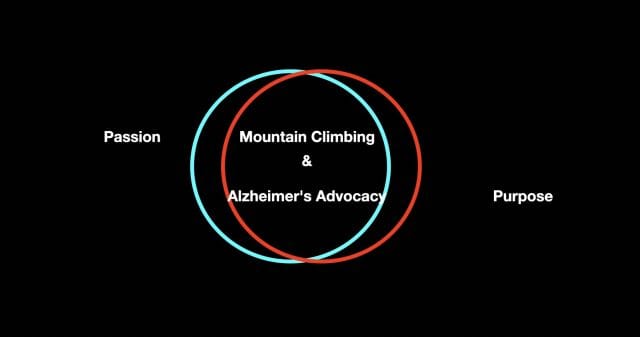
My life has become the intersection of:
Passion — climbing mountains
Purpose — fighting Alzheimer’s
Alzheimer’s remains one of the most complex diseases we face.
But for the first time, we are seeing real progress:
We understand more.
We can detect earlier.
We are developing treatments that make a difference.
And with continued support, we can go further.
Join me. Donate today—and I’ll match your impact.
Donate today—and I’ll match your impact.
Together, we can support the work of Cure Alzheimer’s Fund and move closer to a world without this disease.
Climb On!
Alan
Memories are Everything
You can listen to #everest2026 podcasts on Spotify, Apple, Breaker, Pocket Casts, Anchor, and more. Just search for “alan arnette” on your favorite podcast platform.