Big Picture
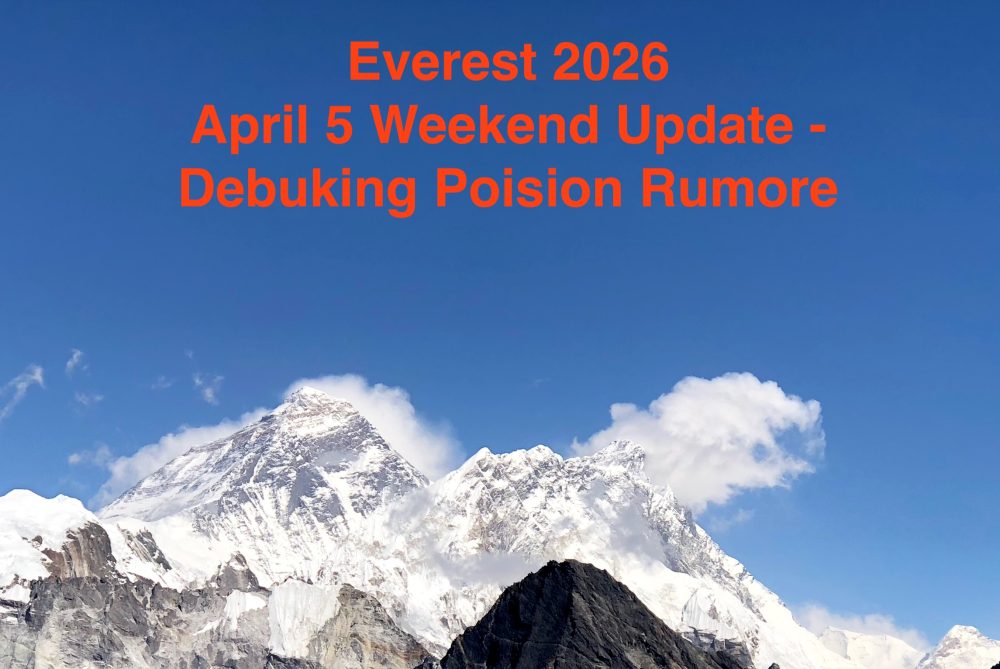
Most Everest climbers have not left home yet, but those already in Nepal are trekking to base camp, enjoying the beauty of the Khumbu. Traditionally, climbers arrive at EBC around April 15, but this date has steadily slipped over the last five years as expeditions have become shorter due to pre-acclimatization techniques at home. Some will arrive around the last week of April. In any event, many acclimate on Lobuche East before arriving at EBC, and once there, use Pumori High Camp for a nice day hike to adjust to the thinner air.
Ryan Mitchell Update
Other 8000ers
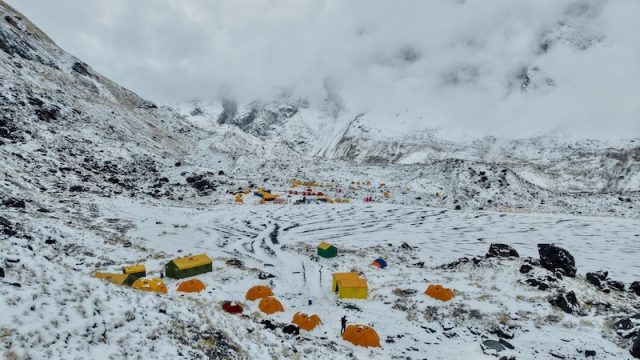
Everyone is back at base camp now. Some teams spent one or two nights at C3 before coming down. Last night, we had about 8 inches of snow at BC, and it’s expected to keep falling for the next 6-7 days. Some teams have gone back down to Tatopani or Pokhara for more comfort. We’re staying at BC. On the night of April 2nd, there was a massive avalanche coming off the western side of the valley, narrowly missing C1 and completely wiping out the route from BC to C1. Luckily, it happened around 8pm, and no one was on the route, or it would have been devastating. Our plan is to wait at BC and hope for a small window Wednesday or Thursday to be on the heels of the fixing teams.
Next Week
Here’s the summary of the Podcast:
Major Insurance Fraud Developments
- Nepal Police Central Investigation Bureau made multiple arrests connected to a fraud scheme that has been ongoing since 2017-18
- The scheme involves faking helicopter rescues, unnecessary hospital stays (3-5 days), and billing evacuation companies $50,000-$100,000 per incident.
- Helicopter companies charge full flight fees per person instead of per flight (4x revenue on a single flight with 4 passengers)
- One report of baking soda added to trekker water to induce vomiting and fake altitude sickness symptoms; 2017-18 rumors involved eye drops
- Fraud targets trekkers on circuits (Annapurna, Manaslu, Everest Base Camp trek), not Everest climbers
- Some UK insurance groups stopped covering Nepal in 2017-18; it could happen again if fraud continues
Critical Helicopter Rescue Policy Changes
- Global Rescue will not dispatch helicopters above Camp 2 (21,500 feet) for the 2026 season and possibly other 8,000m peaks
- Root cause: lack of qualified pilots at their contractor for longline rescue operations
- The Nepal government now requires central agency approval in Kathmandu for all helicopter rescues; extreme scrutiny above Camp
- Longline rescue limit: approximately 23,000 feet maximum (Camp 3 on Lhotse Face at 7,000m)
- Physics limitation: helicopter engines/rotors lose performance above 20,000 feet (6,000m) due to oxygen deprivation
Debunking the “Helicopter Safety Net” Myth
- Vertically integrated companies (owning both guide and helicopter operations) falsely promise clients rescue “no matter where you are.”
- 2005 Airbus AS350B3 summit landing was a test pilot with a specially equipped aircraft, skids on the surface for only 30 seconds at 100% power—not a rescue operation
- Helicopter crashes occur multiple times annually in Nepal due to updrafts, thin air, and mountain terrain
- 2022-2023 deaths: 26 people died on Everest; 23 were with budget operators and were not rescued
Critical Climber Guidance
- Climbers must self-evacuate to Camp 2 before helicopter dispatch if using Global Rescue
- Other evacuation providers (Nomad, Redpoint, Seven Summits Treks, 8K Expeditions) may claim broader rescue capability—verify claims carefully.
- Turn around immediately if experiencing problems above Camp 2; coordinate with the Sherpa/guide on evacuation protocols.
- Rescues are not guaranteed; Everest remains high-risk due to altitude, weather, and human decision-making.
Nepal Fuel Crisis Impact on Expeditions
- The US-Iran war and oil shortage are causing gas shortages in Nepal
- Government offices reduced from 6-day to 5-day work weeks
- Liquid propane (LP gas) refills are limited to 50% capacity
- Expeditions must bring double the number of LP gas canisters for cooking and water melting at Base Camp and Camp 2
- Transport implications: double yak loads, potentially double helicopter loads, or increased drone usage
- Drones are being used extensively in 2026 to ferry ropes, pitons, and ice screws through icefall to the summit
Business Model Context
- With higher costs, operators are facing a significant profit squeeze; Everest is typically a “loss leader” for most companies
- Companies charging $100,000-$200,000 are exceptions, making decent profit
- Budget operators ($40,000-$50,000) earn only a few thousand dollars per client
- Business model: high volume (100 clients at $50,000) vs. low volume (10 clients at $85,000)
Annapurna Conditions
- Extreme contrast to 2025: Last year had no snow between Base Camp and Camp 1; this year is experiencing heavy snowfall
- 8 inches of snow at Base Camp two nights ago; 6-7 more days of snowfall expected
- Teams evacuating to Pokhara hotels rather than staying at Base Camp
- April 2nd monster avalanche off the western valley side narrowly missed Camp 1 (around 8 pm), completely wiped out the route between Base Camp and Camp
- Route may be impassable until April 16-17, waiting for winds and snow to calm (12-day delay from April 5th)
- Annapurna ranked in the top three deadliest 8,000m peaks alongside K2 and Nanga Parbat; avalanche danger primary risk factor
Impact on Multi-Peak Expeditions
- Early Annapurna delays disrupting schedules for climbers planning Dhaulagiri, Kangchenjunga, or Makalu before Everest season 15
Ryan Mitchell & Justin Sackett Update
- April 4th message: acclimatizing at Pumori High Camp (behind Everest Base Camp)
- Previously summited Lobuche East (~20,000 feet) with excellent Everest views
- Currently at Everest Base Camp, doing rotations, waiting for icefall route completion
- Icefall Doctors’ progress unknown; Sagarmatha Pollution Control Committee (SPCC) not responding to information requests 1617
Upcoming Timeline
- April 15th (US Tax Day): typical date for the bulk of climbers arriving at Everest Base Camp
- Many trekking teams have already completed obligatory Base Camp visits, returning to Lukla; Gokyo Lakes side trips are recommended
- Expect increased reports of drones, helicopters, and potential rescue incidents—all now viewed with scrutiny, given fraud revelations.
Climb On!
Alan
Memories are Everything
The Podcast on alanarnette.com
Here’s the Podcast of the Weekend Update
(Please forgive the notetaker window. It’s there by mistake)
You can listen to #everest2026 podcasts on Spotify, Apple, Breaker, Pocket Casts, Anchor, and more. Just search for “alan arnette” on your favorite podcast platform.
Previous Everest 2026 Season Coverage Posts
- Everest 2026: April 6 Weekend Update
- Everest 2026: Are Everest Climbers Being Poisoned?
- Everest 2026: Climber Rescue Alert
- Everest 2026: Climbers to Watch this Season
- Everest 2026: North Side Closed, New Rules in Effect: Everest 2026 Season Update
- Everest 2026: Icefall Doctors Launched
- Everest 2026: Rumor Fire Season
- Welcome to Everest 2026 Coverage – An overview of what to expect during the Spring 2026 climbing season
Background
- Everest by the Numbers: 2026 Edition – A deep dive into Everest statistics as compiled by the Himalayan Database
- Comparing the Routes of Everest: 2026 Edition – A detailed look at Everest’s routes, commercial, standard, and non-standard
- How Much Does it Cost to Climb Everest: 2026 Edition – My annual analysis of Everest climbing costs, from solo and unsupported to fully guided
7 thoughts on “Everest 2026: April 5 Weekend Update – Debunking Poison Rumors”
Another timely and factual update!
Many thanks for keeping us who are far away.. closer to the Khumbu.
Thanks Grahm. It’s becoming a challenge to debunk all of these stories!
So cerebral or pulmary eadema above camp 2 is now a death sentence
Only if you are climbing alone, or ignore the early signs, or your partner doesn’t turn you around.
Great job great updates
Wonderful update as always. I’m glad you clarified the rumor
Thanks Linda!