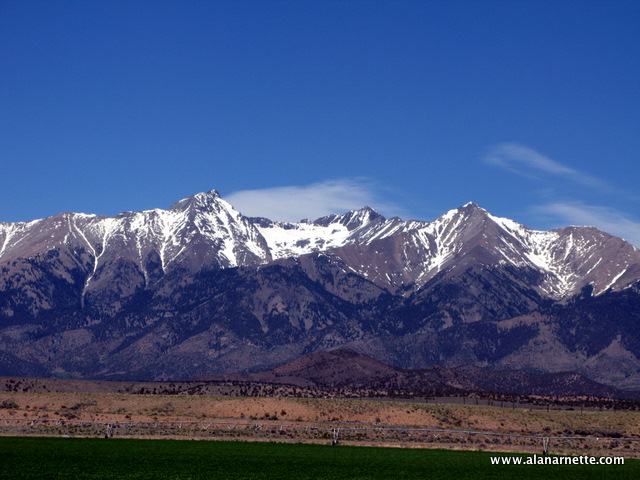
Colorado 14er · 14,037
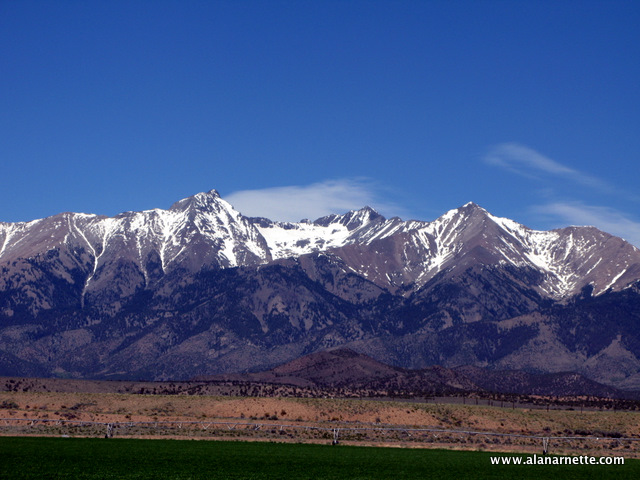
Colorado has 58 mountains over 14,000 feet. Within this grouping many peaks have ridges that connect them but only four are deemed worthy to be called Great.
To qualify as a 14er the peak must be 300 feet higher than the saddle of an adjacent peak. A notable exception is North Maroon Peak so 54 has become the ‘official’ number. I have climbed all of them but only recently competed the Traverses.
On June 14th, 2013, I completed my final traverse, the Little Bear – Blanca Traverse. In my opinion, it is clearly the most difficult.
As Gerry Roach, the undisputed KIng of the 14ers, writes in “Colorado’s Fourteeners: From Hikes to Climbs,” “Simply put, this is Colorado’s most astonishing connecting ridge.”
First I climbed Little Bear, 14,037′ via the rare West Ridge direct route with partners Tom and Barry. This was not the normal Hourglass route. I then continued solo across the Little Bear-Blanca Traverse to summit Blanca Peak, 14,345’. It was an extreme day with unbelievable exposure and fun rock climbing. The good news on both these routes is that the rock is somewhat stable (with huge exceptions) unlike the very loose holds in the Elk Range and on the Bells Traverse.
I would not recommend doing any of these solo or in uncertain weather – this is based on my own personal experiences.
Colorado Great 14er Traverses | |||
| Maroon Peak to North Maroon (Bells) | Elk | Class 5 | Difficult route finding, loose rock and exposure makes it tough |
| Creston Peak to Creston Needle | Sangre de Cristo | Class 4 | Starts easy and ends tough with the upclimb to the Needle |
| El Diente to Mt. Wilson | San Juan | Class 4 | Wonderful ridge climb with some final challenges |
| Little Bear to Blanca Peak | Sangre de Cristo | Class 4+ | The most exposure of the four. I completed the Traverse starting from the West Ridge Direct on Little Bear in June 2013 |
Little Bear West Ridge
This route is rarely climbed due to it’s technical nature. Identical to the hourglass route, we started from Lake Como around 5:00AM. We climbed the rock filled scree gulley to the West Ridge proper. The lower section of the ridge is straightforward and in fact is often taken by the Hourglass route climbers until they reach a deep notch that defines the start of more serious climbing.
From the notch, the route is circuitous and often invisible. Between Tom, Barry and I, we scrambled, climbed and nosed our way around small towers, sharp buttresses and the occasional dip. On occasion it was nearing class 5 in difficulty but mostly stayed at a high level of Class 4.
The key was to continue to gain elevation by staying on the ridge itself and not dropping onto the lower sections of the ridge. It was tempting a few times but we were glad we didn’t.
Near the summit, a sharp headwall defines the final obstacle. This is clearly class 5.2+. I free climbed half way up and found myself surrounded by loose rock within a narrow gulley. This garbage chute was dangerous so I retreated and followed the guys around the headwall on a slightly easier route.
We summited at 11:00AM making it a six hour climb.
Little Bear – Blanca Traverse
This is clearly a test of courage as the exposure over 1.5 miles is significant and sustained exceeding the small section of the knife edge on Capital Peak or the exposure on the Maroon Bells Traverse
The climb starts with a sharp descent on a combination of a slab then a knife edge from Little Bear onto the connecting ridge to Blanca. Throughout the entire traverse the ridge was between 2 to 5 feet wide. The first obstacle is a small tower blocking the narrow ridge called Captain Bivwacko Tower. I went climber’s left around the tower creeping along a narrow 2 foot wide ledge with over 1000 feet of air to my left.
The climb continues along the ridge with an amazing number of short ups and downs. It was never flat or even. Halfway through my climb, a small isolated thunderstorm developed directly overhead causing me to take cover for half an hour in a small rock pocket down from the ridge’s top section. I layered up due to the cold winds and pelting sleet.
Once the storm passed, I continued pass the deepest gulley on t he Traverse only to find three large towers between me and the summit of Blanca. I took the climber’s right on the first one and found myself skirting the ridge along a steeply angled hillside of scree. Once past the first of the three, I regained the top of the ridge and continued to the summit of Blanca.
It took me 3 hours to make the traverse with the half hour stop and another 2.5 hours to return to Lake Como. In total, a 12 hour day.
All in all, an incredible adventure in the Colorado Rockies.
Climb On!
Alan
Memories are Everything
Preparing for a Climb is More Than Training
Summit Coach
From Your First Summit to Everest. One Coach, the Whole Way.
Planning your next big climb? Work one-on-one with Alan Arnette, Everest and K2 summiteer, for personalized training plans, independent guide-service advice, gear recommendations, and experienced support from preparation through expedition.
No commissions. No conflicts. Just advice focused on your success.