Another week is completed on Everest and the season has a normal, no drama feel to it – thankfully.
The fixed ropes are all the way to the South Col and are above Advanced Base Camp on the north side. This is excellent on both sides!
The weather turned a bit cloudy and snowy over the past few days. Look for the first summits, probably from the south side in early May by the Sherpa team setting the route. The north side rope fixers will be close. All schedules at this point depend on weather. The mountain conditions seem good thus far.
Ueli Steck, attempting an Everest-Lhotse traverse starting from Camp 2 in the Western Cwm was sighted doing a solo reconnaissance climb to the West Ridge a couple of days ago. What most people call a climb of a lifetime is just an afternoon walk for Ueli!
In that same spirit, speed climber, Kilian Jornet is reported to be headed to Cho Oyu for a “run” up to the summit as he gets ready for his speed attempt on the north side of Everest.
And in the category of never give up, solo Japanese Nobukazu Kuriki climbing with no supplemental oxygen is at Base Camp on the north. This is his 6th attempt after trying five years in a row in the Autumn. Look for him to bring a massive amount of publicity with his huge Japanese following. He has lost nine fingers to frostbite in his previous attempts. Kuriki-san always does a great job of documenting his efforts and this recent video is no exception:
On the Nepal side, the fixed ropes are already to the South Col. This is excellent as it will enable the Sherpas to begin ferrying loads of tents and fuel to the highest camp.
This year there seems to be a lot of dual ropes on the Nepal route. There are double rope to Upper C3 on the Lhotse Face and new bolts at the yellow band to support a double rope there. Usually one rope will be designated as up and other for down. This is excellent as the large numbers will need unusual support this year.
With suitable weather for summit days still weeks away, having the ropes this high should reduce crowds on the Lhotse Face as the Sherpas can spread their work out over many days. Talk is of ropes to the summit on the south by end of April.
The combined Mountain Trip/Mountain Madness team posted guide Jacob Schmitz’s report:
The Khumbu Icefall is in good shape, with two, 3-ladder sections going up vertical ice towers for added excitement. The route makes a huge zigzag as it ascends through the Icefall. first heading up next to Nuptse, before jogging across towards the West Shoulder of Mount Everest. This means that it takes quite a long time to climb through, compared to the other two years I have climbed up through it.
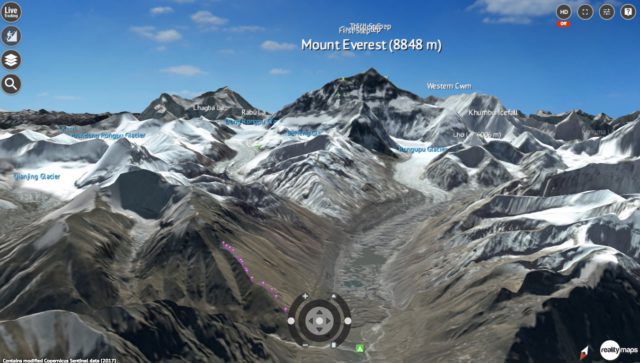
Jon Gupta just posted a pretty nice 3D tracker for he and Molly Hughes on the North side. It should be fun to follow their climb with the map as Mollie attempts to be the youngest Briton to summit from both sides. They will both be transmitting their location on the 3D map using GPS devices.
Every year on Everest, many people get injured (on both sides), sick or simply give up. It can be a shattering moment when the realization sinks in that your climb is over. Blake Penson, with Tim Mosedale, posted an outstanding writeup of his personal experience. It is the Blog of the Day. Refill your beverage and read the entire post. This is an excerpt:
On the 19th, the day after the Icefall introduction and the day of the Puja blessing ceremony I woke up confident. The right ankle was getting better (as it should because there was no major trauma there, just lots of little tweaks). The left ankle was not hurting when I woke. The sun was shining, there was no wind, the day optimistically invited me out of my tent. I looked up the Icefall and told myself “Of course these injuries will mend and I can get climbing soon”, “Of course I will stand on top of this mountain”.
I put my boots on and got out of the tent. Weight bearing on the right foot? OK. Now the left? EXPLODING PAIN. It could not hold any weight at all. Here we go again, the cycle continues. I hobble down towards the mess tent wincing and swearing with every step. Once inside, I fall into my seat. I get the usual question, “How is the foot?”, I have a nice collection of prepared responses for this point of the conversation. “Better”, “Worse”, “Getting there”, Thumbs Down Sign, but today I had a new one.
Climbing stopped thru Khumbu Icefall Sunday April 23 due to route collapse. The Icefall Doctors repaired the incident and climbing resumed on Sunday. Adventure Consultants clarified the closure:
Today fourteen of our Climbing Sherpas attempted to supply loads from BC-C2 but backed off after rumours of a collapse, that turned out to be only partially true- the route was still passable.
The delay caused some teams to remain at Camps 1 or 2, taking an extra acclimatization night at altitude. Actually this is good in the big picture.
Before global panic sets in that the Icefall is too dangerous this year and everyone should move en masse to the North side :), these incidents are quite common every year.
Yes, the Icefall can be a dangerous place as I covered in my full report a few weeks ago, and yes, the increased number of climbers in 2017 certainly increase the chance of “being in the wrong place at the wrong time”. And every person who is there from foreigners to Sherpas are extremely aware of the risk and made the choice to climb or work this season.
The larger issue are all the marginally qualified climbers on both sides of Everest. One team actually promoted their inexperience in a press release with “a team of youngsters who had little or no formal knowledge or skills in mountaineering craft to attempt scale the highest peak on the Earth” source
Another large team climbing from the Tibet (north) side has 23 members supported by 28 Sherpas. When I asked about their qualifications of how many had climbed on an 8000 meter peak, I was told only the leader and one member had been that high. The majority of the climbers have not been above 16,400’/5000m. This is the same team that put Indian Malavath Purna, 13 years 11 months on May 25, 2014 from the north side. source
update: I was contacted by a spokesperson for the Transcend team and was provided additional information not provided in my original exchange: “All have been trained in Professional Mountaineering training institues from India from Basic to Advanced courses touching a height of 18000ft. After many such exposures, they have been trained at 20000ft in Ladakh during the winter, to give them training in ‘Cold Environments’ at high altitude.”
Both teams emphasize “strenuous selection process for over 15 months” and one trekked to EBC in 2015. Strenuous selection does not replace years of experience in my humble opinion.
When I asked someone knowledgeable of these teams as we discussed inexperience on the mountain. Inevitably, the question comes up of why a guide would take on someone with so little high altitude experience. I was told:
with so many Nepali agencies today and cut throat competition no one really wants to say “no” to any Everest aspirant. I heard one agency guy say “If I don’t do it, someone else will. Why should I let go?
One more comment on young climbers, I strongly support and encourage people of all ages getting into climbing. There are many lessons and life experiences to be gained.
If you are 19 years-old, you have a lifetime of climbs to experience. There is zero reason for Everest to be one of your early climbs. I started climbing at age 38 and my first Everest attempt came at 46 and my summit at 54.
Take your time, build skills and experience on ever increasing altitudes and difficulties and when you are ready, perhaps climb Everest, not because it is the highest, because it has become a meaningful goal within your climbing career. Enjoy the journey, it is not to be rushed. If your motive is bragging rights, fame or fortune, you will be disappointed.
Almost without exception, every climber in Nepal depends on Sherpas for support. If a climber uses a fixed rope or steps on a ladder set up by the Tibetan or Sherpa support staff, that person was supported. And there is no glory in hiding that fact.
In my 20 years of climbing in Nepal, I have seen a mutual respect and genuine affection develop between members and Sherpas. So when I read Jon Gupta‘s post on Facebook, I had to smile. Thanks Jon for this great post. Pleased read the entire post at this link. An excerpt:
Lhakpa Wongchu Sherpa is undoubtedly one of the best young Sherpas guiding in the Himalayas at the moment. Born and raised under the shadow of Everest and Ama Dablam in the high altitude village of Pangboche – becoming a climbing Sherpa was in his blood. Somewhat overshadowed by his older brother Padawa (also a leading high altitude sherpa with nearly 20 summits to his name) Lhakpa joined his friends in the Khumbu trails.
Like many of the best sherpas in the Khumbu Lhakpa started out as porter in school holidays and then ‘full time’ at 18. In 2006 he got his first job on Ama Dablam as a kitchen boy and then just a year later topped out on Everest twice in once season! It was clear that at just 21 Lkahpa was top draw. He is now only 31 and has he most impressive list of peaks I have ever seen at his age – Everest (10 times!), Manaslu (3 times), Lhotse (2 times), Ama Dablam (22 times) and many many many Island Peaks, Lobuche’s etc.
But there is much more to Lhapka than a lot of summits. I have worked with Lhakpa on 12 of my 15 Himalayan trips and he is simply a cut above. His kind and selfless demeanour combined with his strength and competency in the mountains really sets him aside. I specifically asked Lhakpa if he would come and work on this expedition with me because in 2012 he summited Everest with Mollie from the south. It gives me great confidence having him around and I know Mollie is really happy too!
The problem with trash at Camp 2 from the sudden earthquake exodus in 2015 has generated a lot of attention. While this was announced a few weeks ago, it should be noted the major guide services lead by Russell Brice and the Expedition Operators Association (EAO) are sending large trash bags (capacity of 80 kg/176 pounds) to C2 to be filled. They will be taken back to a suitable area by helicopter. source Kudos to the guides for taking responsibility for the mountain environment.
OK, it is a good season on both sides thus far. The occasional weather blasts slows things down and makes climbers grumpy but overall, it is a normal season in the Himalaya. Next week I will try to give an update on the other peaks but teams have arrived and are doing similar route fixing and acclimatization rotations.
This next week will see a bit of rest in the beginning after the recent rotations. If the weather is good, don’t be surprised to see a summit or two by the Sherpas.
This week’s posts:
Everest 2017: How to Manage the Everest Crowds
Everest 2017: Into the Western Cwm
Everest 2017: Is Everest a Garbage Dump?
Everest 2017: Building the Climbing Route
Climb On!
Alan
Memories are Everything
I like to use these weekend updates to remind my readers that I am just one guy who loves climbing. With 35 serious climbing expeditions including four Everest trips under my belt and a summit in 2011, I use my site to share those experiences, demystify Everest each year and bring awareness to Alzheimer’s Disease. My mom died from this disease in 2009 as have four of my aunts. It was a heartbreaking experience that I never want anyone to go through thus my ask for donations to non-profits where 100% goes to them, and nothing to me.