Changing Mountains, Changing Risk: Is There Always Another Route?
A couple of months ago, I talked about the tragedy on Broad Peak. Many of you listened and left thoughtful comments. Thank you for that. Since then, it’s been a tough season in the mountains. A really hard year. I took some time to think deeply about a few key questions and how to move forward—not speaking for the industry or the climbing community, but from my own experience, observations and opinion.
Today I want to step back and look at the bigger picture. Are the mountains becoming too dangerous? Or is the risk changing, and are we changing with it?
I’ll tell you up front, I’m going to ask more questions than I answer. I don’t have all the answers. Nobody does. But I think there are some useful things we can learn together.
And let me be clear about one thing. I’m not ready to say the mountains are too dangerous to visit. I still believe in climbing. I also believe we should be willing to change our plans when the conditions call for it. That sounds simple from home. On a mountain, it can be one of the hardest things you’ll ever do.
Risk is part of the contract we make when we choose to climb. Sometimes we understand that risk. Sometimes we don’t. And sometimes we understand it and accept it anyway. That’s humanity. And for many people who live beneath these mountains, it isn’t much of a choice at all. It’s home.
So, grab a beverage, or take a walk with me in your ear. And if you’re driving, keep your eyes on the road.
Let’s get into it.
People First
But before I talk about forecasts and glaciers and snow, I want to start the same way I did with Broad Peak. With people.
Ten climbers on Broad Peak.
Four on Manaslu, including a client and his guide who were buried in their tent.
Fifteen Nepali workers at Himlung Base Camp, with one more still missing.
And more than fourteen hundred people in Nepal and Tibet, killed when a mountain collapsed into a valley in August.
These aren’t statistics. They were husbands and wives, sons and daughters, friends and climbing partners. Some were clients. Some were guides, cooks and camp workers. All of them had people waiting for them to come home. Their families may hear this, and I want to approach it with the respect they deserve.
You know, I was in the Western Cwm on Everest in 2015 when the earthquake hit. Later, I walked through Base Camp and saw what the avalanche had done. I saw the bodies. When I talk about these losses, they’re not just numbers to me.
There’s Always Another Route
Earlier this year, a Canadian guide named Mike Adolph said something on CBC Radio that has really stuck with me. If the danger feels unacceptable, stay home. There’s always tomorrow. There’s always another route.
I love that. It’s exactly the kind of flexibility we need.
But after this season, I keep asking myself: is there always another route on a big Himalayan expedition?
Hold that thought. We’ll come back to it.
What Broad Peak Left Us Thinking About
On July 30th, ten climbers died in a single avalanche on Broad Peak in Pakistan’s Karakoram.
I’ve stood below that slope myself, on my attempt in 2006. It’s obvious avalanche terrain. And when I covered this year’s accident, I spoke with Ian Overton, a climber who had looked at that same slope about a week earlier and thought, “I hope this doesn’t go.” He and his climbing partner left the mountain four days before the avalanche, because from where they stood, the risk was too high.
There had been heavy snow. Some climbers decided the conditions were unacceptable and went home. Others continued upward. And several of those who died had enormous high-altitude experience. They were on four independent teams, with no single leader.
I don’t know the conversations that led to their decisions. But I keep coming back to something many of us have probably felt:
If someone with that much experience is going, maybe it’s okay for me to go too.
It’s understandable. We look to people we respect. On a guided climb, we’re paying for their expertise. Experience matters. Of course it does. But even the most experienced climber still has to assess what’s in front of them that day.
As I said in the Broad Peak podcast, the avalanche tells us how they died. It doesn’t explain why they were there.
What did they know? How did they assess it? And why did continuing seem like an acceptable risk?
We may never know the whole answer. But asking the question gives us a chance to examine our own decisions. That’s not blame. That’s learning.
The Day the Mountain Fell
On August 26th, near the Nepal–Tibet border, a huge piece of a mountain called Langtang Lirung simply let go. Rock and glacier ice fell thousands of feet and turned into a wall of mud, rock and water racing down the valleys faster than highway speed—more than 20 kilometers, about 13 miles, in about seven minutes.
At first, the seismographs thought it was an earthquake. It wasn’t. The ground shook because the mountain fell.
As of today, the death toll stands at 1,455, and more than five thousand people are still missing. Most were in Nepal, with dozens more across the border in Tibet. This wasn’t a climbing accident. It was a human tragedy for Nepal and Tibet.
Did climate change cause it? Scientists were careful, and I want to be careful too. They haven’t attributed that individual collapse directly to climate change. But they have identified warming as an important part of the changing conditions there: Warming weakens the frozen rock, melts the ice in the cracks, lets more water in, and thins the glacier that braces the wall. Over years, the mountain loses its grip.
What matters to us as climbers is simpler. The ground under the Himalaya isn’t as solid as we like to think.
When a Familiar Route Changes
So much of climbing experience is pattern recognition. We’ve camped here before. We’ve crossed this glacier. This slope usually settles after a storm. That knowledge helps us make good decisions, and I’ve relied on it my whole climbing career.
But what happens when the pattern changes?
Glaciers are retreating. Some slopes are losing the ice that helped hold them together. Approaches and routes are changing. A route or a camp we’ve used for years may need another look. Familiar doesn’t mean unchanged.
Experience doesn’t become worthless. We just have to keep updating it.
And here’s a trap I talked about after Broad Peak. Surviving a decision doesn’t prove it was a good decision. You cross under that serac a dozen times, and nothing happens. So it must be okay. Maybe. Or maybe you were just lucky.
Is There Always Another Route?
Guides in Canada are watching their glaciers melt, and they’re adapting. They’re moving some trips earlier in the year, changing approaches and choosing other routes. Some routes they used for decades are simply gone. And sometimes they just don’t go.
A guide in the Rockies can turn to four clients over breakfast and say, “Not that one today. Let’s go over here.”
Now picture a Himalayan expedition. The permit is for one mountain. The camps, oxygen, ropes and staff are already in place on one route. You’ve arranged weeks off work. Moving to another objective isn’t a quick decision over breakfast.
So where’s the other route?
Sometimes there isn’t one on that trip. The flexibility has to come from somewhere else: another date, another mountain, or deciding to go home.
And maybe that’s the real weakness of the traditional Himalayan commercial model. Not that it’s too dangerous. That it isn’t very flexible.
So I’d ask: what happens if the route isn’t right this year? Can we change the plan? And if we can’t, are we prepared to end the expedition?
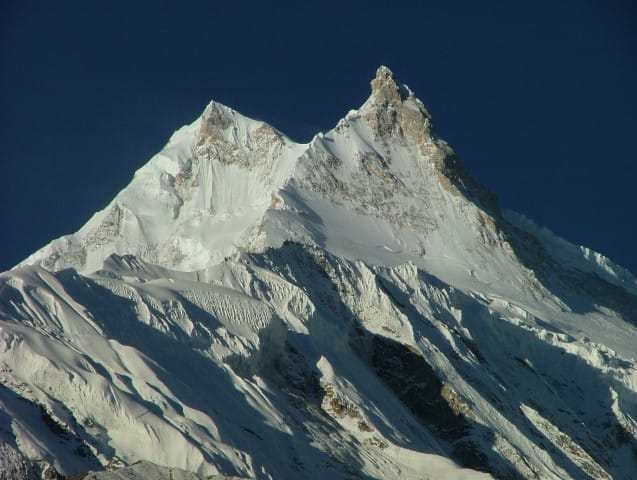
Manaslu and the Decision to Come Down
Manaslu gave us a painful example of those decisions this September.
I’ve climbed Manaslu, and I can tell you it has always been avalanche prone. Climate change didn’t turn a safe mountain into a dangerous one.
But this season was different. According to Nepal’s Department of Tourism, Manaslu set a record this autumn: 500 climbing permits across 43 teams. Add guides and support staff, roughly a thousand people were involved on the mountain. The rope team reached the summit on September 17th. Then the heavy snows began.
On September 19th, according to the operator, Makalu Adventure, six climbers on one team turned back, while two continued up to Camp 3—a client and his guide. That night, an avalanche buried their tent, and both men died.
I wasn’t there, and I don’t know what information each person had. I’m not going to sit here in Colorado and tell you their decision was obviously wrong. That accident deserves a careful account, not a quick judgment from a distance.
But it does raise a hard question. How do people on the same mountain, looking at the same snow, reach such different decisions?
A few days later, the forecasts stopped whispering and started screaming. A big storm was coming up from the Bay of Bengal, with the potential for eight to ten feet—roughly two and a half to three meters—of snow on the high peaks. That’s when you hear Mother Nature in your ear saying it’s time to go.
And most operators did, and brought nearly everyone down. No summit, and a lot of disappointed climbers. It’s always a difficult decision to end a season early, but bringing everyone down ahead of that storm was the right outcome, and those operators deserve real credit.
Now think about how hard that call is. You’re acclimatized. You feel strong. You’ve spent weeks on the mountain and tens of thousands of dollars. The ropes are in, and the summit is right there. Your permit has an end date, and your boss wants you back at work.
Perhaps the key question was: how long will it take for this new snow to become stable enough to climb? Talking with avalanche experts, there isn’t a simple answer. It may be days. It may be longer. It depends on what’s happening inside that snowpack—the wind, more snow, the terrain. It’s complicated. Snow that feels firm isn’t always safe. Sometimes firm just means it’s turned into one big slab.
There isn’t a countdown clock that makes a slope safe. Waiting is useful when it gives us a chance to reassess, not when it simply gets us to a date on the calendar.
So, when it dumps, do you go, or do you leave?
I was on Shishapangma once. It snowed and snowed, and then we got a forecast predicting more snow for weeks. We left.
And many of you know my Everest story.
Three attempts.
Three turnarounds above 27,000 feet, about 8,200 meters, just below the Balcony.
I finally summited on the fourth.
Turning back. Leaving. Those decisions hurt. I wanted to stay, to keep going, each time.
Making the sensible decision didn’t make it feel good at the time.
But all the work we’ve already put in can’t make the weather improve. It can’t make a loaded slope stable.
Information Isn’t Judgment
We’ve never had more ways to get information on a mountain. Private forecasts. Satellite phones. Internet at Base Camp. When I first went to the Himalaya, much of that was hard to imagine.
I sent postcards back home. They arrived after I did.
And yet experienced people still die. Because information isn’t judgment. A forecast can warn us about a storm. It can’t make us turn around. Somebody still has to say, “We’re done.”
And if the forecast misses something, we need to respond to the conditions we actually find. The snow and wind around us matter, even when the forecast looked encouraging.
So I’d want that conversation before we’re sitting in a high camp with the summit in reach. What would make us stop? Who makes the call? And will the company back that decision?
Himlung and the People Who Prepare the Mountain
Himlung brings another part of this into focus.
On September 27th, that same storm sent an avalanche into Himlung Base Camp. As I record this, fifteen Nepali expedition workers are confirmed dead, and one is still missing.
No clients had even arrived yet. These were cooks, guides and camp workers, doing the work every expedition depends on. Setting up the tents for everyone else.
And that’s what haunts me about Himlung.
On an expedition, you know the upper mountain is dangerous. You cross the glaciers. You climb under the seracs. You accept that. And then you come back down to Base Camp. You eat, you sleep, you call home. You let your guard down. You know it isn’t completely safe, but it feels like a refuge.
At Himlung, the avalanche reached the refuge.
Was that camp always exposed, and people had been fortunate for years? Did the unusual snowfall change the danger? I don’t know whether the camp could have been moved, or what warnings were available. Those are questions for a proper investigation.
But Himlung also reminds us that we usually talk about mountain safety from the client’s point of view.
Today’s commercial clients can arrive later than climbers did decades ago, because other people go early to fix the ropes and set up Base Camp. That reduces the clients’ exposure. But as Himlung showed, those jobs carry risk too.
So when we say climbing has become safer—safer for whom?
Conditions for Nepali workers have improved a lot over the years. That’s real.
But do they control their own schedule?
Can a rope fixer, or a porter, say no?
Can a cook ask to leave?
You shouldn’t have to be the loudest person in camp to be heard. If someone doing that work says they’re concerned, I want to know who listens, and who can actually do something about it. Expedition mountaineering is a constellation of experts, and everyone has the right to be heard.
Who Owns the Decision?
And there’s one more gap I keep seeing.
On today’s big peaks, hundreds of people share the same rope, the same route and the same weather. But they work for dozens of different companies, each making its own decisions.
So if the rope fixers think a slope is unsafe, can they close the mountain? If one operator says we’re done and another says we’re going, who’s right? If a Sherpa says stop and the client says go, who wins?
Sharing a rope doesn’t mean sharing the same information.
You may not evaluate that information the same way.
And often, you don’t make the same decision.
Questions Before You Sign Up
So, is commercial mountaineering the problem? No. I don’t believe that.
Clients are adults, and they choose to go. The industry supports many families across the globe—Manaslu alone brought Nepal almost a million and a half dollars in permit fees this autumn. Guides, oxygen, communications, forecasts and rescue have helped a lot of people climb and come home.
And just looking at Manaslu, operators showed this year that they could make the hard call and end their seasons.
But a plan can get rigid. Same route. Same camps. Same time of year. When conditions change, we need room to change with them.
So if you’re dreaming about your first big expedition, please don’t hear this as “don’t climb.” Hear it as “ask better questions.” Summit success, price and logistics matter. But before you sign up, I’d also ask:
Have you ever ended an expedition because conditions were unacceptable? What led to that decision?
Who has final authority to stop a summit push or evacuate a camp?
How do you reassess the route and the camp locations each season?
When several companies share one route, how do you share safety concerns, and who can act on them?
And what happens to the clients and the workers when the plan changes, including the money?
Listen carefully to those answers. Ask for real examples. If saying no costs everyone a fortune, we shouldn’t be surprised when saying no gets hard.
And as a client, you have a role too. Hiring a guide doesn’t mean you stop paying attention. You can ask what we’re seeing, say when something concerns you, and be honest about how you’re feeling. A concern isn’t proof that a route is unsafe. It’s a reason to have a conversation. I want to climb with people who welcome that conversation.
And when another team heads up, it’s easy to think they must know something you don’t. Maybe they do. Maybe they don’t. Their decision can’t substitute for yours.
Reasons for Hope
This has been a difficult year, and there are questions we won’t settle in one podcast.
Some events happen with little useful warning. Better judgment can’t prevent every death, and we should be careful about assuming an accident means someone made an obvious mistake.
But there are decisions we can improve. We can reassess a camp, respond to a forecast, listen to a worker’s concern, and leave ourselves more room to change the plan.
And there are real reasons to believe that works. In Switzerland, authorities evacuated the village of Blatten before a rock-and-ice collapse in May 2025. Guides in Canada are adjusting their trips. And on Manaslu, operators brought a thousand people down ahead of the big storm.
Those examples don’t promise safety. They show people responding to what they learned.
What Experience Has Taught Me
I’ve been climbing big mountains for almost thirty years. I’ve made good decisions and bad ones.
One of the bad ones was going back to Everest just ten months after my first attempt. I should have waited. Reflected. Asked for advice. And I should have trained a lot harder.
When you’re young, you think experience means having the answers. The older I get, the more I think experience means knowing which assumptions to question.
So, are the mountains becoming too dangerous? They’ve always been dangerous. You can’t take all the risk out of climbing without taking out the climbing. The more useful question, for me, is whether the risk is changing, and whether we’re changing with it.
Sometimes we’ll find another route or another time of year. Sometimes we’ll decide a particular trip no longer makes sense. And sometimes the answer will simply be, “Not this year.”
That can be disappointing. But it also leaves room for another trip, and another chance to enjoy the mountains.
Put Yourself There
So let me end the way I ended the Broad Peak podcast, by asking you to put yourself there. This is a hypothetical, not a reconstruction of any of these accidents.
You’re on a climb you’ve wanted to do for years. You’ve trained, paid, arranged the time off, and spent weeks acclimatizing. The ropes are in. You feel strong. Another team is getting ready to leave.
But it’s been snowing hard. You can hear it on the tent. Your guide is worried about the slope above you and says, “I think we need to come down.” Some people agree. Others want to give it another day. You look uphill, and the summit is right there.
What do you do?
What would you need to hear to accept that decision? Could you support coming down, even feeling disappointed? And if you were the one with the concern, would you feel comfortable saying so?
Those are conversations I’d like us to have before we’re in that position. As clients, guides and expedition companies, we can make it easier for someone to say, “Not today,” and be heard.
Final Thought
The mountain doesn’t care who you are. It doesn’t care what you paid or how many summits you have. It just gives you conditions. What we do with them is up to us.
We climb because it gives us something we value. I’ve learned a great deal about myself in the mountains, and I hope there are more trips ahead for all of us. Sometimes changing the plan is what keeps that possibility open.
So if you ever find yourself standing beneath your own version of that slope, ask yourself one question. Am I making my own decision, or am I borrowing someone else’s?
Please keep the families and friends of everyone who died this year in your thoughts. I’ve talked about their losses because I hope we can learn something useful, and I know those losses reach far beyond the mountain. In the blog post and at the end of the YouTube video, you’ll see the names of everyone who died this year on Broad Peak, Manaslu and Himlung.
I’ll put links to my Broad Peak podcast, my reporting and the science in the show notes.
And I’d like to hear from you. Have you ever walked away from a climb you really wanted? What helped you make that decision, and how did the people around you respond? Tell me in the comments.
Climb On.
Memories are Everything.
Alan
In Memory
Himlung Himal Base Camp avalanche, September 27, 2026 (all Nepali)
- Pasang Bhote (climbing guide)
- Chhebi Bhote (climbing guide)
- Ghan Shyam Rai
- Birendra Gurung
- Aash Bahadur Gurung (also reported as Aash Gurung)
- Suraj Rai
- Kalam Budha
- Birkha Dhoj Tamang
- Jagat Tamang
- Dorje Tamang
- Lak Kumar Gurung
- Pasang Nuri Sherpa (missing)
- Prem Tamang
- Santa Bir Tamang
- Urkha Dhoj Bohora
- Kirte Tamang
Broad Peak avalanche, July 30, 2026
- Nirmal “Nims” Purja (UK/Nepal)
- Pur Bahadur Gurung (Nepal)
- Kili Pemba Sherpa (Nepal)
- Nima Sherpa (Nepal)
- Nawang Thindu Sherpa (Nepal)
- Gyalu Sherpa (Nepal)
- Wang Zhong (China)
- Nadhira Al Harthy (Oman)
- Sohail Sakhi (Pakistan)
- Sarah Mallory Geis (United States)
Manaslu, autumn 2026
- Dhruba Jyoti Guha (Indian-born climber living in Germany) — Camp 3 avalanche
- Phursemba Sherpa (Nepali guide from the Makalu region) — Camp 3 avalanche
- Lau Wee Seng (Singapore)
- Tashi Sherpa (Nepali high-altitude worker)
With a climber’s respect,
Alan
Memories are Everything
The Podcast on alanarnette.com
You can listen to my podcasts on Spotify, Apple, Breaker, Pocket Casts, Anchor, and more. Just search for “alan arnette” on your favorite podcast platform.
Receive Publication Notification of Alan Arnette’s Memoir
A surge of debilitating fatigue overtook me. My shoulders drooped. I stared at my yellow boots, crushed by disappointment. I had trained hard for K2 and tried to anticipate every scenario, but now I was failing, and there was nothing I could do.
Closing my eyes, I was powerless, hopeless, and ready to surrender to the mountain. Everything I wanted—the summit, a safe return, my vow to my mother—was slipping away.
My ice axe fell onto the snow.
Staring at the small yellowish spot illuminated by my headlamp on the snow, it was over, and, oddly, I didn’t care.
It was 12:30 a.m. on July 27, 2014—my fifty-eighth birthday.
If you would like to be notified when my memoir, “Hard or Impossible? Summiting K2 for Ida,” is available, I’m still looking for an agent or a direct publisher. Complete the form at the bottom of this introduction page.
13 Responses
Thank you Alan for this thought provoking article and wonderful to see your concern for all around you. Am not a climber but have done a couple of treks. I work the stock markets, where risk is a constant and there is no place for emotion, only rational judgment and feel this approach is what is required up in the mountain. Only things are much more extreme there, risks way higher and there is no place for emotion or ego. Maintaining equanimity and voice of reason for risk assessment is a must. Also as you said, this conversation with oneself must happen before the expedition, which will help in decision making if any extreme risk arises up in the mountains. Much respect and regards. Sanjiv
Coach , Thank you! Always learning reading your comments and watching your videos. I had a situation on Mera peak this year. Although sick from a get go on my trek with bronchitis ,I’ve made it to the high camp but decided not to push for the summit and went down. Felt miserable going down ehrn my teammates were on the summit, but I made right decision. I couldn’t guarantee to muself I could get down safely with what felt like frozen bronchial ways. Nonetheless, I got better and continued to climb in Balkans and summited 59 peaks in 8 months there.
Pretty happy with that.
Love this, Tony and nice to hear from you. With 59 summits under your belt in the Balkans, you clearly made the right decision to climb Mera another day. A great example.
I am not a climber, at least of super high mountains like these, but I so enjoy your posts and podcasts. This year really touched on the risks. I am so sad for all those who lost their lives; so tragic!
It seems that over the past 5 years that I have been reading your blog the expeditions to Everest and other 8000 mountains have become only for the rich and wealthy, even if not properly trained! Also, the trash and filth the climbers leave on the mountains is shameful. One need to respect and care for these beautiful places!
I understand where you’re coming from, but in my experience since 1997, the climbing community has broadened from the rich to the middle class, especially in SE Asia, China and India. Yes, there is an experience issue, encouraged by budget operators that don’t require much experience. As for the trash, all it takes is one person to take a picture of a trash pile collected for disposal, post it on social media, and the community extrapolates that to an entire mountain. – It’s not a huge issue, but still an issue.
thank you Alan for the reflection & care that went into writing this. i appreciate your compassion & equanimity. thank you especially for speaking out for those with the smallest voices.
Appreciate this, Willow.
Not a climber but I’ve always made a point to read your posts, and this was was outstanding. Really appreciate your empathy, thoughtful words.
Thank you Lisa
Really great article thank you! Ending the expedition was a tough decision to tell our clients but an easy decision to make. Even a small amount of snowfall on Manaslu can be deadly, let alone 2 metres. Sometimes people fall into the trap of comparing to other companies and how they’re navigating the mountain and this makes our job 10x harder as every company has different risk assessments. Always choose a company that puts safety first of their clients and of their Sherpas and team.
Well done Adri.
Dear Alan
Thank you for your wonderful articles, how you show such respect to the deceased climbers and helpers, how you dont lay blame, how you ask such important and relevant questions. I love reading your opinions, the facts you enlighten us with and the thoughts you awaken. Thank you. Stay safe. Warmest regards Stephanie
I appreciate you taking the time to comment, Stephaine.