Everest 2010 Weekend Update May 16
We can summarize the week in one word: weather. After the excitement of summits on May 5th and 7th, teams on both […]
Climbing the World to End Alzheimer's
Climbing the World to End Alzheimer's
We can summarize the week in one word: weather. After the excitement of summits on May 5th and 7th, teams on both […]
update 2: 50+ climbers to South Col on Sat May 15, few, if any, went for summit as winds picked up. Look […]
The situation on the south side of Everest continues to be quite fluid. I have confirmed Phil Crampton of Altitude Junkies’ update that Ann-Marie will NOT attempt the summit during this narrow window. Phil had already kept the rest of his team back at base camp. They are planning on using the longer weather window in the forecast about a week from now. The situation is simply too dangerous according to Phil.
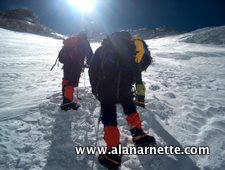
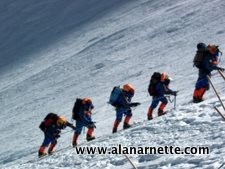
The summit push is on and the south is pushing hard. Teams are at camp 3, Sherpas are at the South Col with tents and oxygen ready for the summit push. If the weather window holds, per some forecasts, teams should arrive at the South Col mid-day Saturday, Nepal time and start their summit bids later that evening, May 15th. This would have summits on Sunday morning, May 16th starting perhaps as early as 6:00Am. Of course all of this assumes the winds die down enough for them to climb. The competition continues and now is a bit ugly with feelings of deceit designed to trick the competitors. The Sky Climber team down at base camp report Carina Räihä at the South Col prepared to go for the summit anytime and Anne-Mari Hyryläinen has climbed to Camp 3.
With teams now heading higher, the race between Carina Räihä and Anne-Mari Hyryläinen to be the first Finnish woman to summit Everest is being explained fully by their support teams, Peak Freaks and Altitude Junkies. Both are viewing it as a friendly race (kind of) and this is supported when I interviewed Anne-Mari back in February. She commented then on the “race”:
More teams have made the decision for a summit bid this weekend. The latest include the Malta Everest team, half of Peak Freaks and a two person team from First Ascent. They are now at camp 2. Why are these climbers going to the top in marginal weather? Well maybe the weather will not be marginal – at least according to some weather forecasts. Before looking at the weather, an quick update on the teams. There is movement on the north perhaps to fix the rope to the summit. On the south, the vast majority of the teams have chosen to wait for a longer weather window and the teams at C2 are resting up and waiting for the winds to calm before going higher. Most top teams pay for a professional weather forecast. These are teams of meteorologists who not only look at the data but also interpret it and then communicate the forecast and recommendations to their members. Climbers pay for these services and keep them private since it is a value to their team members and a safety issue.
The lure of Everest’s summit has taken on new dimensions and is spreading throughout the south base camp. First up, we have […]
With several teams targeting Sunday, May 16th as a summit window, the question of rescues often comes to mind; especially if the weather looks marginal as this one does. Followers of Everest know that rescues are difficult and sometimes impossible above base camp or 17,500′. In his book, Into Thin Air, Jon Krakurer details the daring rescue of climbers at the top of the Icefall at 19,800′. Now a new service from Fishtail Air is underway that designers are confident can rescue climbers deep in the Western Cwm, well above 19,500′. While an experiment this season, it has already proven to save lives on other high peaks.
It is getting interesting on Everest. Almost in Vegas fashion, teams are placing their bets on multiple weather forecasts but the stakes are higher than the table minimum. Most are content to stay at base camp and socialize, rest and wait for the clear window that appears year after year. Others are more aggressive with their bets looking to position themselves at the high camps and then take advantage of the next narrow opening. As we saw last week, this can work, but the most experienced teams are content with a wait and see approach.
With teams mostly enjoying the comforts and electricity of low villages or base camps, the blogs are full of rich details about their recent acclimatization climbs. As I have said so many times, I deeply appreciate it when a climber takes the time, and sometimes risk, to describe what is happening on the mountain. Not so much for the mountaineering details but for the insight into the human experience of climbing Everest. Thanks to you all. But first some mountaineering status.
Climbing the World to End Alzheimer's
We use cookies to improve your experience on our site. By using our site, you consent to cookies.
Websites store cookies to enhance functionality and personalise your experience. You can manage your preferences, but blocking some cookies may impact site performance and services.
Essential cookies enable basic functions and are necessary for the proper function of the website.
These cookies are needed for adding comments on this website.
Google Tag Manager simplifies the management of marketing tags on your website without code changes.
Statistics cookies collect information anonymously. This information helps us understand how visitors use our website.
Google Analytics is a powerful tool that tracks and analyzes website traffic for informed marketing decisions.
Service URL: policies.google.com (opens in a new window)