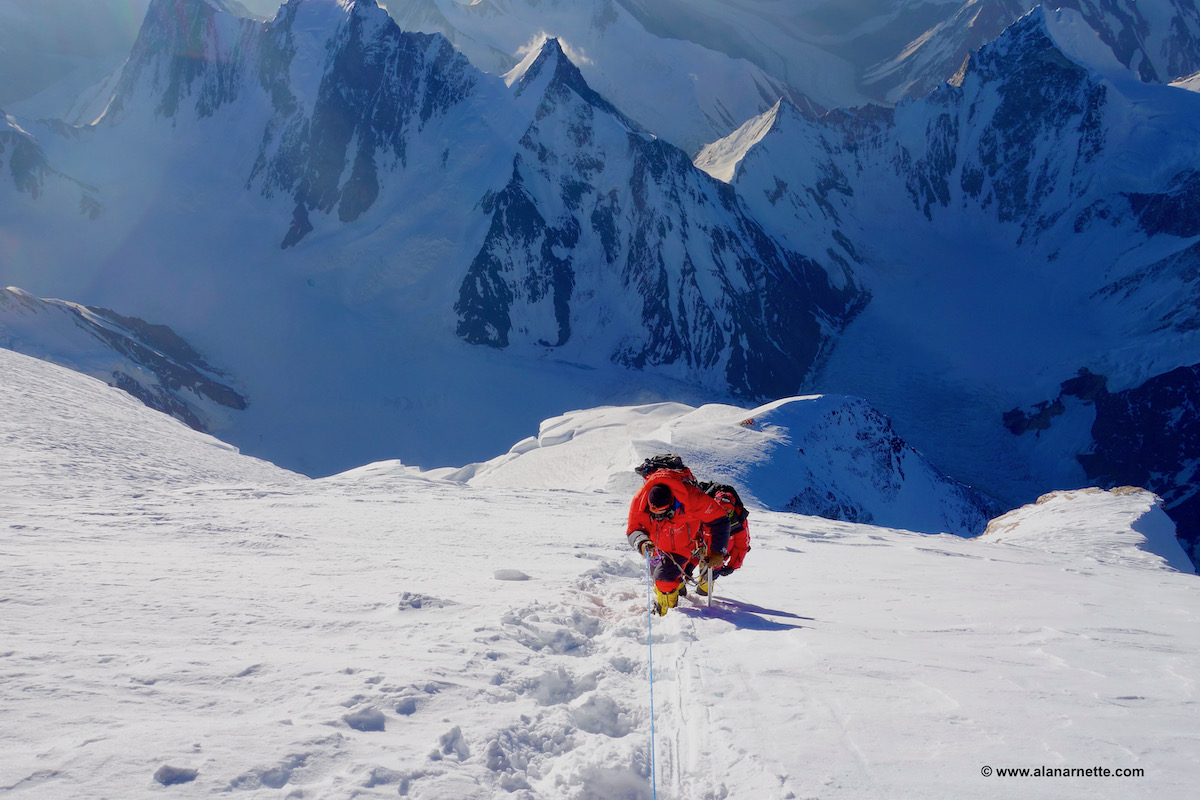
Inspired by Everest’s first winter summit in 1980, a 1983 Polish expedition went to K2 in the winter for reconnaissance. They found byzantine logistics, uncooperative government authorities, and costs that exceeded the most generous budgets. Now, 38 years later, K2 has been summited in the winter.
The first summits of 8000-meter peaks have been the mainstay of European and Asian climbers. Nepali, Tibetan and a few Pakistani climbers, especially Sherpas have long supported these efforts. In recent years, the Sherpas have sought to be recognized as world-class climbers in their own right. Mingma G. said before leaving Nepal that this was not about any individual but for a nation and for mountaineering pride:
For all the other 8000ers summited in winter, no Shepra was with them, so this is an opportunity for Sherpa to demonstrate their strength. Besides alpinists, all the climbers take help from Sherpa to fulfill their dreams of 8000m peaks. I have helped several foreign climbers to get to the summit of different 8000ers. I was a little surprised to see no Sherpa on winter first ascent. So this climb is for all the Sherpa community who are so known because of our friends and clients from different foreign countries.
Around 5:00 pm on Saturday, January 16, 2021, the team of Sherpas and Nepalis stood on the summit of the world’s second-highest mountain, K2, on the border of Pakistan and China. They are positioning the summit as a victory for Nepal and the Sherpa nation. All ten climbers stopped 30-feet below the summit on a relatively safe spot (still on a 40-degree snow slope at 28,200-feet) so that they could summit together in a sign of solidarity. No individual was listed as first.
Lead by Mingma Gyalje Sherpa,Nirmal Pueha, and eight Sherpas: Gelje Sherpa, Mingma David Sherpa, Mingma Tenzi Sherpa, Dawa Temba Sherpa, Pem Chhiri Sherpa, Kilu Pemba Sherpa, Dawa Tenjing Sherpa, and Sona Sherpa, they took advantage of a short weather window when winds were under ten mph – unheard of for K2’s summit in the summer, much less the winter. They are said to be descending now.
The team of ten climbers, left Base Camp on Tuesday, January 12. They followed the fixed rope already installed by John Snorri Sigurjonsson with Muhammad Ali Sadpara and his son Sajid Ali to Camp 1, then on to Camp 2 with lines set by Mingma G’s team. On Wednesday, they followed ropes established by Mingma G and Nirmal Purja over the Black Pyramid and set up Camp 3. On Thursday, they made fantastic progress and got the line to 7,300m near Camp 4, aka “High Camp,” the only flattish spot on the entire route. They established a camp a bit lower at 7,350-meters. Winds were so high on Thursday night that some climbers took cover in shallow crevasses rather than set up tents.
Winds are forecasted to pick back up to 40 and even 100 mph later in the week, so this window is closing quickly for the other aspirants. They may have a chance at the end of January or into February. Of note, with this summit today, there is zero doubt that it was in winter regardless of the Meteorological or Astronomical definition.
There have been questions as to why this Nepali National team was able to accomplish what world-class teams since 1987 have not. My opinion is that they worked as a unified team to get the camps and fixed line in early, they got lucky with the weather, especially in December and early January and on the summit push, they were able to stay healthy and avoid the objective dangers of avalanche and rockfall, they had a strong support team on supplemental oxygen breaking trail and fixing the lines and finally lead by Mingma G and Nirmal Purja, they were determined to show the world’s that Nepali climbers were amongst the best.
So is it an apples to apples comparison? Perhaps not 100% but they got the job done. Purist will cry foul, most will applaud the accomplishment. I say, well done Team Nepal, well done.
Previous K2 Winter Attempts
Winter Attempts
There have been six previous winter attempts, none successful.
1983 Reconnaissance: Pol Andrzej Zawada and Canadian-resident Polish national Jaques Olek
1987/88 Attempt: 13 Poles, seven Canadians, and four Britons / made Camp 3.
2002/03 Attempt: 14 climbers from Poland, Kazakhstan, Uzbekistan, and Georgia / made Camp 4.
2011/12 Attempt: nine climbers from Russia / made Camp 2
2014/15 Near Attempt: Denis Urubko and team lost permit from the Chinese side
2017/18 Polish/International: Abandoned due to conditions and team dynamics, Also Spanish with no summit
2018/19 Kazakhstan-Russia-Kyrgyzstan and Spanish/Galician Team 2018/19: poor conditions
2019/20 Mingma G./Snorri: only two weeks
First K2 Winter Expedition 1987-88
An international team of 13 Poles, seven Canadians, and four Britons made the first attempt on K2 via Abruzzi Ridge. As usual, they established the low camps quickly, but progress stalled at the higher altitudes, not setting C3 at 7300-meters until March 2. Then high winds began to take their toll, and members experienced frostbite; soon, they canceled the entire effort.
This expedition only had ten days of ‘good’ weather in the three months they spent at Base Camp, thus illustrating K2 winter weather issues.
International Expedition 2002-03
In the winter of 2002/3, Polish alpinist legend Krzysztof Wielicki lead a small team of four members from Kazakhstan, Uzbekistan, and Georgia. They arrived in mid-December, planning to climb via the North Ridge. In short order, they established the lower camps. By January 20, they had reached 6750m.
But discourse within the team caused the Eastern European members to leave except for Kazakh climber Denis Urubko. They reached Camp 4 at 7650m in mid-February, setting a Winter K2 altitude record that lasted until yesterday, January 15, 2021. They planned a summit attempt on February 21, but one member developed cerebral edema, and the rotation, and soon, the entire expedition, was called off.
When the expedition ended on February 28, 2003, Krzysztof Wielicki declared, “The mission of ascending the peak has not ended but rather been suspended. I will not give any dates, but I assure you that I will return to K2. One does not combat a mountain; one struggles against adversities. These adversities include snow, hurricane winds, and exhaustion.”
Russian Attempt 2011-12
In the winter of 2011/12, a large and robust Russian team attempted K2 using the Abruzzi Ridge. The group consisted of nine climbers. They began at the end of December and quickly established Camps 1 and 2 at 6050m and 6350m, respectively. By January 25, they had reached 7000m.
High winds hit the mountain in early February, and one member, Vitaly Gorelik, suffered from frostbite and pneumonia. The poor weather prevented an evacuation, and Vitaly died in BC on February 6. At that point, the expedition terminated.
Polish International 2017/18
67 year-old Krzysztof Wielicki returned to lead an effort in 2017/17. who lead the last Polish K2 attempt in 2003. Kazakstan alpinist Denis Urubko was part of the team. He has held Polish citizenship since February 2015. The team was composed of Adam Bielecki, Marek Chmielarski, Rafał Fronia, Janusz Gołąb, Marcin Kaczkan, Artur Małek, Piotr Tomala, Jarosław Botor and Dariusz Załuski in addiiton to Urubko and Wielicki.
They originally planned to use the Česen route, but they shifted to the Abbruzzi due to dangerous conditions. Difficult conditions hit the teams from the start, with injuries from rockfall and illness. Also, team dynamics was a big problem. Denis Uubko openly questioned the team’s tactics and leadership. Urubko believed that winter ends at the end of February, while leader Wielicki felt it ends with the spring equinox on March 20, 2018, at 12:15 pm EDT.
Also, Urubko along with Adam Bielecki – while taking part in the Krzysztof Wielicki led Polish winter expedition on K2 – led a rescue operation on Nanga Parbat to save climbers Élisabeth Revol and Tomasz Mackiewicz.
Frustrated with his teammates’ pace and feeling he was strong enough to attempt the summit, Uubko set out alone after not convincing the next strongest climber, Adam Bielecki, to join him. Urubko reached around 7,350-meters/24,100 feet on his solo push before poor weather (high winds and low visibility) forced him back on February 27.
Krzysztof Wielicki later cited these reason for not summiting and not making another attempt after Urubko returned:
Based on an in-depth analysis of the situation in consultation with the team today decided on the completion of the K2 mountain:
1. The result reconnaissance team Adam Bielecki and Janusz Golab today. We found that on the way to C1, all ropes are covered with tent advanced basecamp is damaged, there is also a high probability to destroy campsC1, C2, and C3.
2. Weather forecast, which only confirms the one short weather window around 11/03/2018
3. Inability to acclimatize minutes. 1st team at the height. 7200m, after which he would return to the base to attempt the summit on 11.03
4. Impact Avalanche in the upper path. In the last eight days, we recorded a total of more than 80cm of snowfall.
5. Warning Portal Ventusky large rainfall on wys.7600m
6. Bad forecasts for the period after 03.11.2018
The priority is the safety of the participants of the expedition.
Kazakhstan-Russia-Kyrgyzstan and Spanish/Galician Team 2018/19
First up is an international group, made up of climbers from Kazakhstan, Russia and Kyrgyzstan. The second that winter was by Alex Txikon with two Polish and five Sherpa climbers. Txikon left the expedition to help search on Nanga Parbat, that found the bodies of Daniele Nardi and Tom Ballard. Txikon never summited K2 but generated tremendous goodwill with his unselfiness.
The RUS-KAZ-KYG team reached 7634-meters/25,045-feet and the Basque/Sherpa team topped out at 6,906-meters/22,537-feet according to their respective GPS trackers on the 8,611-meter/28,251-foot peak.
Mingma G./Snorri 2019/20
This effort was a very short last winter by Mingma G Sherpa and Jon Snorri. In Mingma’s words, they underestimated how harsh the condition would be, along with illness, which stopped them after only a few weeks. Also, there was discontent amongst the team.
They experienced the usual poor weather and established Camp 1 on January 30 but ended their expedition on February 5, 2020.
Winter Definition
One of the ongoing controversies in mountaineering is the definition of winter. By any measure, this year’s January 2021 summit was in winter.
I get regular comments such as, “They can summit after February, but it won’t be winter.” Others say it is at the Spring equinox on March 20, 2021, at 12:15 pm EDT. The reality is, it depends on where you live and the local customs and definition.
Both Pakistan and Nepal issue climbing permits with different fees according to the season. On Everest, for example, they charge $11,000 per person for a spring permit – the most popular time. But for a winter permit, the least popular time, it drops to $2,750. Both countries’ tourism ministry define winter as December, January, and February for permit purposes. They take the year and divide it into four equal parts. For most people born and raised in this environment, that is what defines the seasons.
However, many people, including myself, learned that astronomical movements define the seasons. This paradigm uses how the sun hits the earth and the shortest and longest days each year, in other words, the equinoxes, and solstices.
Then there are the seasonal definitions influenced by the length of day and temperatures. March 1 at the North Pole compared to being on the equator are very different. Also, if it a rainy time of year or dry. The Hindu calendar has six seasons, making season definitions even more complicated!! But hold on, it gets worse (or different 🙂 ). Australia and New Zealand use the meteorological definition, so spring begins on September 1 each year. Ireland uses an ancient Celtic calendar system to determine the seasons, so spring begins on St Brigid’s Day on February 1. In Finland and Sweden, they use temperatures to define seasons.
In any event, congratulations to today’s team for making history and Nepal and the Sherpa people proud.
Tragic Accident
Spanish climber and Seven Summits Treks’ Co-Leader Sergi Mingote is reported to have fallen between C1 and ABC and was unconscious, a rescue is being organized. Simone Moro is assisting from Manaslu.
Next
There are around 20 climbers aspiring to summit, and claim a winter K2 summit. Some have acclimatized to Camp 3 but most have only reached Camp 1. Some will end their effort based on today’s first summit, and citing rockfall danger, others will still retain their motivation. We’ll see what the final K2 winter 2020/21 total is in a few weeks.
I like to use these K2 updates to remind my readers that I’m just one person who loves climbing. With 37 serious climbing expeditions including four Everest trips under my belt and a summit in 2011 and K2 in 2014, I use my site to share those experiences, demystify K2 each year and bring awareness to Alzheimer’s Disease. My mom, Ida Arnette, died from this disease in 2009 as have four of my aunts. It was a heartbreaking experience that I never want anyone to go through thus my ask for donations to non-profits where 100% goes to them, and nothing ever to me.
Ida Arnette 1926-2009
Related
Cookie Consent
We use cookies to improve your experience on our site. By using our site, you consent to cookies.
This website uses cookies
Websites store cookies to enhance functionality and personalise your experience. You can manage your preferences, but blocking some cookies may impact site performance and services.
Essential cookies enable basic functions and are necessary for the proper function of the website.
Name
Description
Duration
Cookie Preferences
This cookie is used to store the user's cookie consent preferences.
90 days
Google's current Sign in with Google client library. It renders the Google sign-in button, or the One Tap prompt, so visitors can log in to your site with their Google account. It replaces the older Google Sign-In platform library.
Set on your own domain by the Sign in with Google client library and submitted together with the sign-in credential, so your site can confirm the sign-in came from its own page and not from a forged cross-site request.
5 minutes
g_state
Set on your own domain by the Sign in with Google client library. Records whether the visitor has dismissed the One Tap sign-in prompt and for how long it should stay hidden, plus the time the library last loaded and a browsing session id used for the same purpose. Sites that pass a custom state_cookie_name will see that name instead.
180 days
Marketing cookies are used to follow visitors to websites. The intention is to show ads that are relevant and engaging to the individual user.
Google Ads is an online advertising platform that enables businesses to create targeted ads displayed on Google search results and partner sites.
Google uses cookies for advertising, including serving and rendering ads, personalizing ads (depending on your ad settings at g.co/adsettings), limiting the number of times an ad is shown to a user, muting ads you have chosen to stop seeing, and measuring the effectiveness of ads.
90 Days
FPGCLGB
Google uses cookies for advertising, including serving and rendering ads, personalizing ads (depending on your ad settings at g.co/adsettings), limiting the number of times an ad is shown to a user, muting ads you have chosen to stop seeing, and measuring the effectiveness of ads.
90 Days
FPGCLAW
Google uses cookies for advertising, including serving and rendering ads, personalizing ads (depending on your ad settings at g.co/adsettings), limiting the number of times an ad is shown to a user, muting ads you have chosen to stop seeing, and measuring the effectiveness of ads.
90 Days
Conversion
Google uses cookies for advertising, including serving and rendering ads, personalizing ads (depending on your ad settings at g.co/adsettings), limiting the number of times an ad is shown to a user, muting ads you have chosen to stop seeing, and measuring the effectiveness of ads.
90 days
_gcl_aw
Google uses cookies for advertising, including serving and rendering ads, personalizing ads (depending on your ad settings at g.co/adsettings), limiting the number of times an ad is shown to a user, muting ads you have chosen to stop seeing, and measuring the effectiveness of ads.
90 Days
_gcl_gs
Google uses cookies for advertising, including serving and rendering ads, personalizing ads (depending on your ad settings at g.co/adsettings), limiting the number of times an ad is shown to a user, muting ads you have chosen to stop seeing, and measuring the effectiveness of ads.
90 Days
_gcl_gb
Google uses cookies for advertising, including serving and rendering ads, personalizing ads (depending on your ad settings at g.co/adsettings), limiting the number of times an ad is shown to a user, muting ads you have chosen to stop seeing, and measuring the effectiveness of ads.
90 Days
__Secure-3PSIDTS
Targeting cookie. Used to create a user profile and display relevant and personalised Google Ads to the user.
2 years
__Secure-1PSIDTS
Targeting cookie. Used to create a user profile and display relevant and personalised Google Ads to the user.
2 years
__Secure-1PAPISID
Targeting cookie. Used to create a user profile and display relevant and personalised Google Ads to the user.
2 years
__Secure-3PSID
Targeting cookie. Used to profile the interests of website visitors and display relevant and personalised Google ads.
2 years
__Secure-3PAPISID
Profiles the interests of website visitors to serve relevant and personalised ads through retargeting.
2 years
AEC
AEC cookies ensure that requests within a browsing session are made by the user, and not by other sites. These cookies prevent malicious sites from acting on behalf of a user without that user's knowledge.
6 months
ADS_VISITOR_ID
Cookie required to use the options and on-site web services
2 months
__Secure-3PSIDCC
Targeting cookie. Used to create a user profile and display relevant and personalised Google Ads to the user.
2 years
__Secure-1PSIDCC
Targeting cookie. Used to create a user profile and display relevant and personalised Google Ads to the user.
2 years
__Secure-1PSID
Targeting cookie. Used to create a user profile and display relevant and personalised Google Ads to the user.