Mid-December is a quiet time in the mountaineering world, so I thought it would be nice to pick meteorologist Chris Tomer of Tomer Weather Solution’s brain on the upcoming winter season for mountaineering across the globe. And, of course, we have to touch on Everest.
The 8000er season is chiefly over, and the true winter climbs have yet to begin in earnest. But soon, we will have activity in Antarctica with adventurers attempting full crossings, climbers going for Vinson, Tyree and maybe an unclimbed peak or two. Then, as we move towards the new year, the slopes of Acocnagua become busy with a new group of aspirants wanting to test themselves at 7,000 meters, perhaps for training for an upcoming Everest climb.
With the Himalayan Database now updated for 2025, I’ll be posting several Everest 2026 big-picture updates before the season officially begins in early April, 2026:
- Everest by the Numbers: 2026 Edition – A deep dive into Everest statistics as compiled by the Himalayan Database
- Comparing the Routes of Everest: 2026 Edition – A detailed look at Everest’s routes, commercial, standard, and non-standard.
- How Much Does it Cost to Climb Everest: 2026 Edition – My annual review of what it costs to climb Everest, solo, unsupported, and guided.
- Everest 2026: Welcome to Everest 2026 Coverage – an introduction to the Everest 2026 Spring season.
In this Podcast, I briefly review the 2025 year in mountaineering and share my thoughts on a “Climber’s Holiday Season.”
Autumn Over
The 2025 autumn expedition season wrapped up with summits across the Himalaya, with special emphasis on Manaslu and Ama Dablam, where the summits reached 500 people or more.
Also making news was the return of Marc Batard with his Khumbu Icefall bypass project. I wrote extensively about this last month, so please take a look if you are interested in following this project. Spoiler alert, I don’t see it being used extensively if it ever gets completed – too technical, physical and risky for the average Everest climbers today, and the Sherpas will continue to climb the devil they know instead of the one they don’t.
Upcomming
Simone Moro is back for his seventh attempt to summit Manasslu in winter in alpine stlye. He’s climbing with Nima Rinji Sherpa, and Oswald Rodrigo Pereira of Poland. Staying true to his definition of winter, Moro and team will arrive at Manaslu Base Camp on December 21.
Pakistani Mountainers Organize
Late last month, a group of 100 Pakistani mountaineers gathered to announce the creation of the (KMGA), which they noted as being “the first national body created by mountaineers, for mountaineers.” They selected Sirbaz Khan to be the President. Khan has become quite famous in his homeland after becoming the first Pakistani to complete all 14 eight-thousanders in 2024, and in May 2025, he also became the first Pakistani mountaineer to summit all 14 without supplemental oxygen.
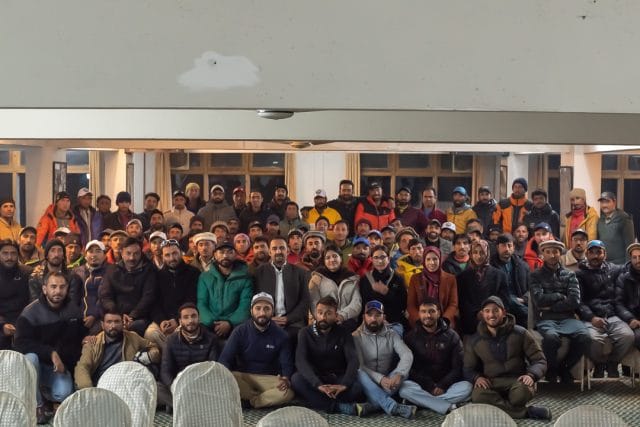
These are the officers of the KMGA:
- President: Mr. Sirbaz Khan
- General Secretary: Mr. Mirza Ali
- Vice President: Mr. Saad Munawar
- Vice President: Mr. Zahid Hussain Rajput
- Vice President: Mr. Sajid Ali Sadpara
- Treasurer: Mr. Shah Daulat
In a press release they noted their primary mission and specific goals:
- Enhance safety, rescue systems, and high-altitude protocols
- Develop training, certifications, and career paths for youth
- Advocate for insurance, medical aid, and welfare
- Align standards with international organizations
- Partner with government on tourism and sustainability
- This inclusive launch promotes transparency, equal opportunities, and professional growth in Pakistan’s mountains.
While their website is under construction, you can follow progress on Facebook pages.
Nepal’s Approach to Managing their Peaks
Nepal Mountaineering Association (NMA)
Expedition Operators Association (EOA)
In Kathmandu, on December 12, The EOA has renewed its leadership team for the 2025–27 term, re-electing Dambar Parajuli as President and unanimously appointing a new executive committee.
Ministry of Tourism (MoCTCA)
Nepal Tourism Board (NTB)
NTB serves as Nepal’s national tourism promotion authority, marketing the country globally as a premier mountaineering destination while supporting broader adventure tourism policies. It develops guidelines for trekkers and climbers, such as mandatory guides in protected areas, and advocates for sustainable practices to enhance safety and environmental protection.
Unlike the Ministry’s permit issuance or NMA’s training focus, NTB influences policy through campaigns and stakeholder coordination, including recent pushes for experience requirements like prior 7,000m summits on Everest.
China’s Approach to Managing their Peaks
China and Tibet manage their mountaineering industry through centralized oversight by state bodies like the China Tibet Mountaineering Association (CTMA) and the Chinese Mountaineering Association (CMA), emphasizing permits, safety, and economic integration.
Permit System
Climbing permits are issued exclusively through authorized Chinese companies, prohibiting independent climbers since 2024; the CTMA handles applications via local outfitters, often with opaque timelines and conservative approvals. Foreigners face strict limits, such as 300 annual permits on the Tibet side of Everest, requiring one guide per summit climber and banning solo ascents.
Safety and Control Measures
Authorities prioritize “controllable scenarios” due to public opinion and safety pressures, enforcing a “contract system” where CMA manages logistics like porters, transport, and food—expeditions pay upfront and cannot handle these independently.
Best of luck to all mountaineers and adventures as we cross into 2026.
Climb On!
Alan
Memories are Everything
The Podcast on alanarnette.com
Interview with Chris Tomer
You can listen to #everest2025 podcasts on Spotify, Apple Podcast, Breaker, Pocket Casts, RadioPublic, Anchor, and more. Just search for “alan arnette” on your favorite podcast platform.
Alan, great season wrap-up as always, I thought you might be interested to hear a few supplementary notes to yours based on my experience on Lobuche East and Ama Dablam in November:
1. The storm in late October that was well documented by Ryan changed how people needed to approach climbing in the area and will probably have a lasting effect. For example, on Lobuche it was possible and probably safest to wear crampons directly out of high camp, we only touched rocks once (for about a minute) all the way to the summit. Similarly for Ama Dablam, the trip from BC to C1 is now mostly snow covered and relatively slippery, my guide thinks it is going to stay that way for at least a few years given it doesn’t get a huge amount of sun. People should be prepared for alternative conditions to what they have seen on youtube.
2. The number of rescues on Ama Dablam was quite confronting. While I was there, we saw at least one helicopter rescue per day, and on the 15th of November we counted 4 rescues (from C2 and C3) in a single hour. Not sure what they were for, but on my summit day, there was one person choppered off C3 with frostbite and snow blindness. We had clear but chilly conditions, maybe -30C on top with wind chill, and this individual was sorely under-dressed despite being relatively experienced (based on previous conversations in BC). Most people I spoke to that day (including some guides) said they got very cold on ascent, which scared me given that the climbing conditions were very good and the weather was not exactly abnormal for that mountain at that time of year.
3. There were reports from guides of 12hr queues at the yellow tower after the storm broke. Less than 2 weeks later the mountain was largely free (which makes the number of rescues we saw even scarier), and the best weather was only just starting. We climbed 17-19 november and pretty much never waited for other groups.
4. Looking at historical weather, it seems as though the good weather windows are shifting away from historically good weather periods. For Ama for example it seems to be best later and later each year but the departure dates for trips don’t seem to have adjusted and this year people got caught out. Would love to get Tomer’s take on this, is there some sort of climate change going on here or is it just an illusion.
Anyways, apologies for the rant, would love to hear your take on some of these.
Thanks for the comment, Alasdair.
1. It looks like anothrer dry year for 2026. Perhpas the new norm.
2. Ama is a serious climb, underestimated by many and over-promoted by some guides.
3. Group think is often the problem on these peaks, when patience is needed.
4. Agree, long-time, historical trends are changing.
An interesting and informative listen. As always!
Thanks, Graham