The route is in to Camp 2, thus allowing Sherpa rope fixers to begin fixing it to the summit, starting with Camp 3. Sherpas have established Camp 2, also known as Advanced Base Camp, with tents and other supplies. They will begin stocking it with an oxygen bottle soon. Teams have started their acclimatization rotations to Camps 1 and 2. The ropes are expected to reach the summit around May 14th. Everest permits are nearing 2024’s record of 479, generating nearly $7 million in permit revenue alone.
Big Picture
Teams are beginning to move into the Icefall, while Sherpas are establishing high camps, and the rope fixers are making progress up the Lhotse Face.
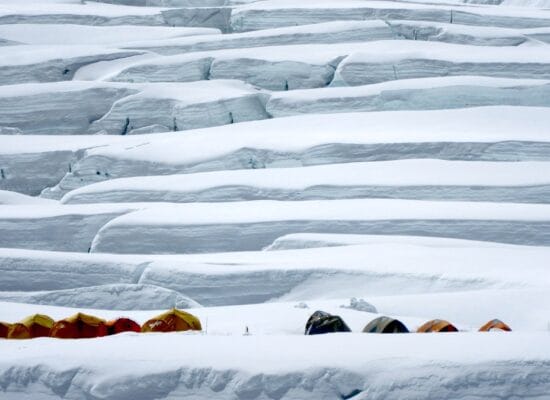
This morning, we left camp at 4 am and had our introduction to the icefall. Call it a dress rehearsal, getting ready in the dark, trying to eat breakfast in the middle of the night. Setting foot into the labyrinth of ice pinnacles, joining the fixed lines, skirting the edge of the rock outcrop, scoured smooth by the glacier over time, when the ice was deeper. We climbed about a quarter of the way up the icefall, happy with our efforts and turned and descended the ropes with much less effort than on the ascent. Tomorrow we will rest and prepare for the approaching rotation on the mountain.
Risks
Sherpas are taking 5-6 hours to reach Camp 1. The route is said to be in good condition and easier than last year, with one crevasse requiring five ladders to cross.
The SPCC, which manages the Icefall Doctors, put out this warning:
“Our Icefall Doctors explored an alternative path through the center of the section, but no safer option could be found. Given the circumstances
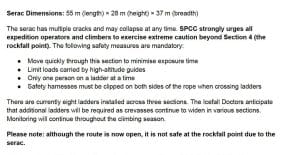
The past few weeks have been one of the most challenging periods for our SPCC Icefall Doctors — traversing the Khumbu Icefall day after day to find a safe route for the 2026 spring climbing season. On 28 April, our Icefall Doctors, with support from mountain guides across various expedition operators, successfully opened the route through the Khumbu Icefall. As communicated in our notice to all expedition operators at Base Camp on 28 April 2026, the route beyond the rockfall point (Section 4) carries significant risk due to a large serac. All climbers and guides must exercise extreme caution in this section. A BIG shoutout to our Icefall Doctors, who pushed through an extraordinarily difficult season and gave everything to make this route possible. Thank you to all mountain guides and expedition operators for your support during this time.
SPCC 2026 Serac Warning
I’ve received a lot of questions about why not to blow up the serac in question, like ski resorts do to trigger avalanches to make ski slopes safer. Well, several reasons not to blow up Mt. Everest:
It’s in a Nepalese national park, so it would be similar to blowing up part of Half Dome in Yosemite—it’s not a ski resort.
The size of these seracs is like houses or buildings—huge. So very different than causing a man-made avalanche.
Probably wouldn’t work, and if it did, the debris field would be massive, probably creating more problems.
But I get the notion, like the suggestion to fly a drone into it. All interesting ideas, but I think, let nature take its course and climbers take their risks.
Crevasse Danger
As if rockfall and seracs are not enough danger, Summit Climb reports a Sherpa fell into a crevasse near Camp 1. He was not clipped or roped to another person:
Today, the Sherpas were working in a somewhat foggy/snowy Camp 1 when one of them fell into an unmarked crevasse. There was no fixed rope yet on this new section of trail, so the Sherpa was unroped and could have fallen a long way, but luckily, his rucksack lodged in the crevasse and kept him from falling too far. With quick thinking, our Sherpas threw the downed Sherpa another rope with a loop in it, which he could clip to his harness, and then they rapidly hauled him out relatively unscathed. Lesson: take nothing for granted and constantly use probe poles to check the path, especially in new sections
Alternative Acclimatization Methods
With the delay in the Icefall and the increased risk, many Western guides are having their clients acclimatize on high trekking peaks by sleeping at their high camps or even on the summits, if it becomes the new normal, thus requiring only one fast trip through the Icefall. The first trip can take the average Everest climber six to ten hours. Once acclimatized to Camp 2 or 3 level, the time is cut by anywhere from 25% to 50%. possible. Let’s look at “replacement” pekas for the same elevation benefits:
Camp 1 – 19,500 feet (5943m)
Island Peak (Imja Tse) 20,305 feet (6,189m): Very popular technical climb near Everest.
Lobuche East 20,075 feet (6,119m): A common training peak for high-altitude climbing.
Camp 2 – 21,500 feet (6553m)
Ama Dablam 22,349 feet (6,812m): A highly technical and famous peak in the Khumbu region.
Mera Peak 21,246 feet (6,476m): Famous as the highest “trekking peak” in Nepal.
Camp 3 – 23,000 feet (7,000m), which these days is rarely slept at unless you are attempting an Os summit.
Himlung Himal 23,379 feet (7,126m): A non-technical popular 7,000er in the Annapurna region.
Baruntse 23,389 feet (7,129m): Located in the Khumbu region, offering a moderate technical challenge.
And of course, many, many people are sleeping in Hypoix tents, but before arriving in Nepal. Some feel they are acclimatized to 17,000 feet ( 5181m), and there are claims of reaching 23,000 feet (7,000m).
No Drones!
After last season’s drone success and this season’s early use to move rope-fixing gear to Camp 1, thus reducing dangerous work for the Icefall Doctors, Nepal has now banned all drone use, citing safety and security concerns. Drones were also to play a critical role in cleaning the mountain by ferrying trash from C1 to EBC.
In a letter dated April 30 and addressed to the District Administration Office, Solukhumbu, the Home Ministry’s Local Administration and Province Coordination Division instructed authorities that Airlift Technology Pvt. Ltd.’s application for permission to fly the FreeFly Alta X Gen 2 (Category C) drone could not be approved, citing concerns related to the Unmanned Aerial Vehicle Operations Regulations, 2075 and security sensitivities requiring wider stakeholder consultation.
Once again, Nepal Everest management takes one step forward and two steps back. Perhaps this will be sorted out soon.
Treking Death
Lakpa Tendi Sherpa, 51, from Gudel village in Solukhumbu district, died at approximately 5,200 meters (17,060 feet), according to Gyanendra Shrestha, liaison officer, who spoke to Everest Chronicle. He was a guide traveling with an expedition group.
Icefall Doctors discovered an unidentified body during routine route management operations on the trail between Everest Base Camp and Camp I, in the Khumbu Icefall. The body was partially buried under ice and positioned directly on the primary climbing path, raising safety and environmental concerns.
Other 8000ers – Summits
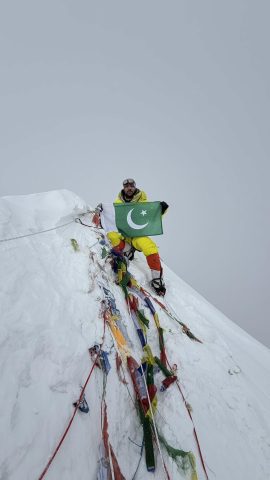
Sajid Sadpara on Makalu summit
There were a few more summits by the Nepali operators of Annapurna, Dhaulagiri and Makalu, with scores of summits over the past week.
A team of 8 Sherpas from 14 Peaks Expedition fixed the route to the summit of Annapurna I on Friday, April 18, marking the first 8000er summit of this spring 2026 season. Two foreign climbers also summited after the Sherpas. Seven Summits Treks noted 10 people summited, 5 Sherpas with 5 clients. Elite Expeditions also claimed six clients summiting.
Teams summited Dhaulagiri, including Pioneer Adventure with 9 Sherpas and 8 clients. Imagine Nepal saw summtis as well.
On Manaslu, Ukrainian Alexandr Moroz and Kyrgyz Mark Ablovacky summitted. They were the only climbers on the peak this season.
Next Week
Hopefully, the ropes reach the South Col. All the camps from 2 to the Col will be stocked, especially with oxygen bottles. Teams will do rotations to Camps 1 and 2 or on trekking peaks.
Weather Looking Good for Rope Team
I asked veteran mountain weather forecasters what the next couple of weeks look like. As always, the weather is never an exact science.
The jet stream weakens and moves off the summit of Everest 5/8-5/12. This should give the rope teams a nice window to reach the summit. Everest could see a higher chance of snow on 5/10.
Michael Fagin of Everest Weather gave more detail but a simlr out look:
Summary for May 4 to Sunday, May 10. All forecast models indicate no jet stream over Mt. Everest during this period. From May 8 to May 10, summit winds (maximum wind gusts) will be at or below 20 mph (32 km/hr). Some forecast models show summit winds as low as 20 mph (32 km/hr) for May 8 to May 10.
The snow forecast varies much more among forecast models than the wind forecasts. For the upcoming week, most models are bringing light snowfall. However, one model shows daily snowfall of 3 inches (7.6 cm) for several days. We are not expecting any tropical storm to emerge from the Bay of Bengal over the next seven days.
What is the extended outlook after May 10? At least through May 13, we do not see a jet stream over Everest. There appears to be a weak low forming near the Bay of Bengal, starting to form, but it’s too early to tell if this will develop into something stronger
Nepal Permit Update
As of April 30, 2026, Nepal has issued 1,050 climbing permits to 125 teams across 29 peaks. Everest climbers are from 55 countries. China has the most climbers at 100, followed by the U.S. at 67, India at 58 and the UK at 32. There are 100 female climbers on Everest this season. This is the current tally for the 8000ers.
8000er
Teams
Male Clients
Female Clients
Total
Annapurna I
4
19
8
27
Dhaulagiri
4
18
12
30
Everest
47
364
100
464
Kanchenjunga
4
23
13
36
Lhotse
9
78
33
111
Makalu
10
44
18
62
Manaslu
1
2
0
2
TOTALS
79
548
184
732
Here’s to a safe season for everyone on all the peaks.
Climb On!
Alan
Memories are Everything
The Podcast on alanarnette.com
Here’s the Podcast of the Weekend Update
1 view
Everest 2026 May 3- Weekend Update: Climbing!
You can listen to #everest2026 podcasts on Spotify, Apple, Breaker, Pocket Casts, Anchor, and more. Just search for “alan arnette” on your favorite podcast platform.
To provide the best experiences, we use technologies like cookies to store and/or access device information. Consenting to these technologies will allow us to process data such as browsing behavior or unique IDs on this site. Not consenting or withdrawing consent, may adversely affect certain features and functions.
Functional
Always active
The technical storage or access is strictly necessary for the legitimate purpose of enabling the use of a specific service explicitly requested by the subscriber or user, or for the sole purpose of carrying out the transmission of a communication over an electronic communications network.
Preferences
The technical storage or access is necessary for the legitimate purpose of storing preferences that are not requested by the subscriber or user.
Statistics
The technical storage or access that is used exclusively for statistical purposes.The technical storage or access that is used exclusively for anonymous statistical purposes. Without a subpoena, voluntary compliance on the part of your Internet Service Provider, or additional records from a third party, information stored or retrieved for this purpose alone cannot usually be used to identify you.
Marketing
The technical storage or access is required to create user profiles to send advertising, or to track the user on a website or across several websites for similar marketing purposes.
We use cookies to improve your experience on our site. By using our site, you consent to cookies.
This website uses cookies
Websites store cookies to enhance functionality and personalise your experience. You can manage your preferences, but blocking some cookies may impact site performance and services.
Essential cookies enable basic functions and are necessary for the proper function of the website.
Name
Description
Duration
Cookie Preferences
This cookie is used to store the user's cookie consent preferences.
30 days
These cookies are needed for adding comments on this website.
Name
Description
Duration
comment_author_url
Used to track the user across multiple sessions.
Session
comment_author_email
Used to track the user across multiple sessions.
Session
comment_author
Used to track the user across multiple sessions.
Session
Google Tag Manager simplifies the management of marketing tags on your website without code changes.
Name
Description
Duration
td
Registers statistical data on users' behaviour on the website. Used for internal analytics by the website operator.
session
cookiePreferences
Registers cookie preferences of a user
2 years
Statistics cookies collect information anonymously. This information helps us understand how visitors use our website.
Google Analytics is a powerful tool that tracks and analyzes website traffic for informed marketing decisions.
Used to monitor number of Google Analytics server requests when using Google Tag Manager
1 minute
_gid
ID used to identify users for 24 hours after last activity
24 hours
_gali
Used by Google Analytics to determine which links on a page are being clicked
30 seconds
_ga_
ID used to identify users
2 years
__utmx
Used to determine whether a user is included in an A / B or Multivariate test.
18 months
_ga
ID used to identify users
2 years
__utmv
Contains custom information set by the web developer via the _setCustomVar method in Google Analytics. This cookie is updated every time new data is sent to the Google Analytics server.
2 years after last activity
__utmc
Used only with old Urchin versions of Google Analytics and not with GA.js. Was used to distinguish between new sessions and visits at the end of a session.
End of session (browser)
__utmz
Contains information about the traffic source or campaign that directed user to the website. The cookie is set when the GA.js javascript is loaded and updated when data is sent to the Google Anaytics server
6 months after last activity
__utmb
Used to distinguish new sessions and visits. This cookie is set when the GA.js javascript library is loaded and there is no existing __utmb cookie. The cookie is updated every time data is sent to the Google Analytics server.
30 minutes after last activity
__utmt
Used to monitor number of Google Analytics server requests
10 minutes
__utma
ID used to identify users and sessions
2 years after last activity
_gac_
Contains information related to marketing campaigns of the user. These are shared with Google AdWords / Google Ads when the Google Ads and Google Analytics accounts are linked together.
90 days
Discover more from The Blog on alanarnette.com
Subscribe now to keep reading and get access to the full archive.