Alan Arnette: Audio Dispatch from Lhotse for Alzheimer’s
This is the latest audio update from Alan Arnette climbing Lhotse for Alzheimer's. Please sign up for the Alzheimer's Prevention Registry.
Alan Arnette: Audio Dispatch from Lhotse for Alzheimer’s
This is the latest audio update from Alan Arnette climbing Lhotse for Alzheimer's. Please sign up for the Alzheimer's Prevention Registry.
Alan Arnette: Audio Dispatch from Lhotse for Alzheimer’s
This is the latest audio update from Alan Arnette climbing Lhotse for Alzheimer's. Please sign up for the Alzheimer's Prevention Registry.
Everest 2015: First Steps in the Icefall
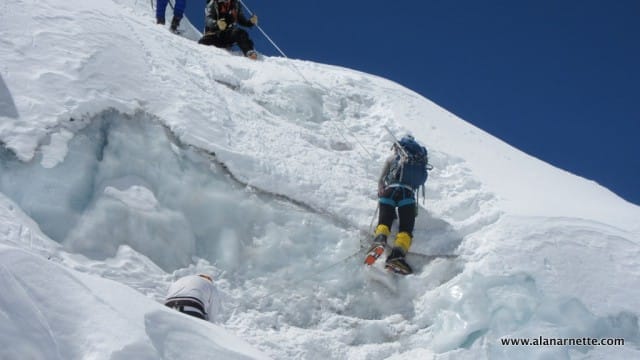
Long Expeditions are often filled with a lot of down time, sometimes by design to let your body adjust to the altitude and other times due to unforeseen events. Well we have had a bit of both thus far. I have been gone from home for 3 weeks so I’m ready to do some climbing. A combination of poor weather and the new route through the Khumbu Icefall has put everyone on the South side about a week behind schedule. But we have about 6 weeks to go, so there is no need for great concern at this point. Wednesday, April 22 was another perfect day at Everest Base Camp (EBC). I awoke to the sound of prayer flags in a gentle breeze, the sound of teammates quietly chatting in the dining tent, all rudely broken by the deep sound of helicopter rotors as the first of five choppers landed at the pad a short distance from our camp. For the fourth straight day communications from EBC is limited at . EverestLink has been down due to an equipment failure, Imarasat moved their satellite so all the teams counting on them for sat comms have been thwarted. Ncell voice works if you find the right spot, the same for data connection, but it is slow. And Mercantile sat works but also slower than most. So, getting an email or a post out was dicey regardless of the system you used. In spite of trying every trick I know, I was not able to get a dispatch out until now and even now it is painfully slow on EverestLink. But today is nice day, a rest day for our team after our first steps in the Icefall earlier this week and a lot of training in the lower part of the Icefall. But it is time to climb! We will move to four nights in the Western Cwm tomorrow, Thursday, April 23; two at Camp 1 and two at Camp 2. We get up at 1:00am Thursday morning, to try and beat the expected rush of teams with the same goal. Overall Climbing Everest from the South side is business as usual with teams working together well, new climbers and old veterans alike looking at the Icefall with awe. Let me describe our first steps in the Icefall on Monday: The white nylon line stood out even on the white snow next to my bright yellow boots. I reached down, picked it up and attached my jumar, I turned around and as always, Kami was standing nearby. “We are back in the Icefall.” I said. “Good Luck” was his response as we started out climbing the Khumbu Icefall on our way to hopefully summit Lhotse in about four weeks. It was another perfect day at Everest Base Camp and it seemed like every team was out taking advantage of it. It was reported that hundreds of Sherpas started in the dark hours of the morning to go to Camp 2 to check on the gear left there after the 2014 tragedy. Other teams were doing their first sorte’ into the Icefall to work on acclimatization and technique. I was eager to get there myself to see what new route held for us. We only climbed to 18,600, about 1,100 above our base camp but I found the new route faster, and more straight forward albeit a bit steeper. We never encountered a ladder. The Icefall typically tops out around 19,300’ so we still had a ways to go when we stopped. Other teams coming back down reported serious traffic jams near the top as it gets very steep as noted in the photos Garrett Madison posted. There is only one ladder, actually several lashed together, and it was reportedly taking one Sherpa ten minutes to climb it. The SPCC and the Icefall Doctors put up a second ladder today, however it is reported to be six ladders lashed together at a 90 degree angle -yes vertical! The also put in a rope to be used for rappelling or abseiling down to reduce this bottle neck. I anticipate this section will create serious delays and be troublesome for some. It felt good to be back in the Icefall, in spite of last years tragedy and the ever present danger. I find the ice sculptures inspiring, the terrain causes me to focus like I rarely do and views unparalleled. The route definitely is to the right of the previous years but not very close to Nuptse, that also has hanging seracs. So to say it is in the middle is not a bad description. There will be a rush now to establish Camps 1 and 2 in the Western Cwm. Each morning will see 200 – 300 Sherpas ferrying tents, stoves, food and fuel. The Expedition Operators Association submitted a formal request to use helicopters to at least ferry tons of fixed ropes and anchors to reduce Sherpas loads but thus far the Ministry has been silent on the request. This would reduce the Sherpa loads through the Icefall by 80. I will do a complete update when I get back to EBC on Monday. It finally feels like the Everest season has begun. Climb On! Alan Memories are Everything
Everest 2015: Weekend Update – April 19
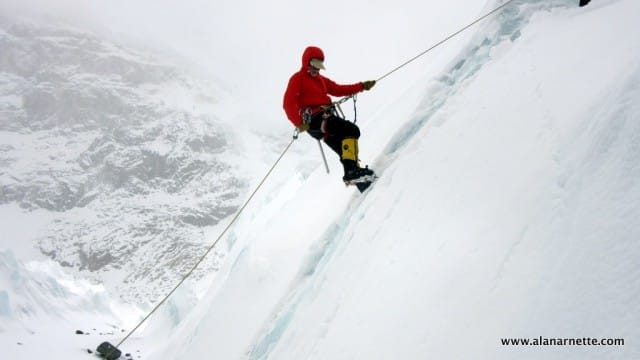
I will try to do a weekend update each Sunday while on Everest/Lhotse. This update is all about the weather. We arrived at Everest Base Camp on Monday, store April 13 to heavy snow, and overcast skies – and that is the story of the week. Each day brought cold temps and culminated with a very gusty night last night, April 18th. But today, Sunday, the 19th, we are enjoying mild temps, a gentle breeze and clear blue skies. The impact of all this weather is that no teams have been able to establish camps in the Western Cwm – Camp 1 and 2. Plans were also stopped when a four ladder traverse half way through the Khumbu Icefall collapsed or became unsteady enough to turn back 80 Sherpas on Friday. This is not all that unusual but did capture some attention as the Icefall Doctors had spent considerable time finding a new route away from the West Shoulder of Everest and that hanging ice cliff that took 16 lives last year. In that spirit, April 18th was a day of remembrance throughout Everest Base Camp as no teams went into the Icefall to honor those who died last year. It was a peaceful and somber day here. The time is being well spent waiting for better conditions as most teams have picked their favorite spot near EBC to set up a few ladders and rappel stations so everyone, including Sherpas, can tune techniques and work on skills. Communications continued to be a challenge ranging from slow to not working. EverestLink, when it worked, was excellent, but there were days when it simply refused to connect. For yet another season, the cell phone provider, Ncell, was spotty at requiring people to gather around “cell phone rock” to get a signal. Also, some teams noted their Bgan satellite modems could not connect for the second year in a row. There seems to be fewer individuals and expeditions posting updates this year. I’m not sure of the reason other than the intense media scrutiny around Everest – rarely positive. There are many journalists here, all with cameras and video equipment asking for interviews from both foreigners and Sherpas. Also this week saw many Pujas, including our own. The sounds of Lamas praying, Sherpas singing and everyone dancing filled the airwaves of Base Camp almost every day, regardless of the weather. Just so everyone does not become overconfident with today’s excellent weather, a small avalanche off Pumori, which guards EBC to the Northwest, this morning reminded everyone that the mountains are deadly and we all need to mind our steps. Over on the North side, several teams have arrived at Chinese Base Camp and a few have already started moving higher to spend time at Advanced Base Camp. There have been similar reports of heavy snow on that side, but similar to the south, not enough to stop progress entirely. OK, look for the activity to really pick up this next week, assuming good weather, with team after team establishing the camps in the Cwm. The Icefall is said to have some difficult sections that include steep ice walls, some with ladders and some without. Its time for the real climbing to begin. Climb On! Alan Memories are Everything Please consider joining ?Alzheimer’s Prevention Registry. Joining does not obligate you, just provides you the opportunity. Many trails are questions and surveys. Open to anyone over 18 worldwide. 80% of all al trails fail due to lack of volunteers http://bit.ly/1HONXgl Pumori Video Photo Gallery
Everest 2015: April 18, A Black Day with Lessons for all
It was one year ago today that a hanging wall of ice fell onto the Khumbu Icefall, the gateway to the south side of Mt. Everest, killing 16 mountain workers waiting for a ladder to be repaired that crossed a deep crevasse. Today, I’m at Everest Base Camp attempting to use almost the same route to climb Lhotse, the world’s fourth highest peak. After several days of harsh cold and snow, today is warm and sunny. Throughout today, there will be small memorial services at each camp to honor the dead on what is called a Black Day, April 18th, in Everest mountaineering. Lessons from Tragedy A year later, what have we learned from the tragedy? Actually the news is quite positive but I doubt you will see that sentence in most mainstream publications or outdoor oriented websites or magazines – positive news does not bring readers, or advertisers sadly. Base Camp is teaming with reporters and film crews looking to cash in on last year’s tragedy. I’m sure they can find someone to provide whatever quote they need to support their pre-defined narrative. One of the reasons I say the tragedy has created change for the good was what I personally witnessed yesterday. The dedicated team of Sherpas who install and maintain the route through the Icefall had lashed together four ladders across a wide and deep crevasse on the climbers right of the Khumbu Icefall. This was a major adjustment to the route that has been used for almost a decade and is designed to minimize dangers. The four ladder structure collapsed sometime in the night and before 80 Sherpas ferrying loads into the Western Cwm approached it. As soon as the Sherpas saw the route was impassable, they immediately turned back to the safety of Base Camp. Phil Crampton of Altitude Junkies said: This morning, 6 of our Sherpas, out of a total of 24 working for the Junkies this spring season, departed base camp at 3:30 AM for a load carry to camp one. Unfortunately, halfway up the icefall there was reportedly some collapsed ladders. It seems as if the route needs to be re-routed to avoid a bottleneck at this section as many Sherpas reported that no ladders had collapsed, but the trail of 80 Sherpas came to a standstill. With this in mind, Dorjee Sherpa and myself instructed our Sherpas to descend immediately and drop their loads at crampon point. The icefall is definitely not a place to stand around and wait for ladders to be fixed. The Sherpas returned to base camp with large smiles and even larger appetites. Last year, when the Sherpas came upon the broken ladder, they put down their loads and waited directly underneath the so called “objective danger” of the hanging serac for the ladders to be repaired. When it released, they had no chance. I personally witnessed Sherpas being trained this year on crossing ladders safely, in other words, using the safety line to protect them from a fall off the ladder and to a near certain death into a deep crevasse. It is almost unfathomable that anyone would cross a ladder without using the safety line, but that has been business as usual in the highly competitive world of Sherpa Guiding. The faster Sherpas win admiration from the Sherpa community, safety lines slow them down. This is slowly changing. I personally watched Sherpas being trained on how to use an avalanche transceivers so that if someone, Sherpa or member, was buried under a snow avalanche (unlikely on Everest) or were to be swept into a crevasse from an avalanche or serac release blast (likely), they could be located quickly thus reducing the rescuers exposure to more potential danger. Almost every team provides radios to members and Sherpas, this has not always been the case and there are still low-cost teams that cut this safety corner. Opportunities for Improvement Almost every non-Nepali team this year are equipping at least their Sherpas with transceivers. Note I say “non-Nepali” as therein lies the problem, and lack of learning from last year’s tragedy with Everest ”guiding” Most “non-Nepali” guide services keep their teams relatively small, under 15 climbers, a couple double that but having huge numbers is normal for the Nepali operators. Seven Summits Treks has 60 members this year who reportedly paid $32,000 each. This is compared to an average of $50,000 for “non-Nepali” operators. The difference in price? Primarily, they have no highly experienced Western guides who are trained in medical techniques, member relationships, safety measures, reading avalanche conditions, and more. To be clear there are outstanding Nepali guides who I would trust my life to and have and do, but they are not guiding the same level and it takes an experienced member to create a solid team. My main concern with a team of 30, 50, 60 or more is the ability of the operator to provide qualified support. This year there are over 400 Sherpas supporting the members. This is a dramatic increase from five years ago and it takes time to train support staff thus some for the largest teams may have Sherpas with none to little experience supporting a member with none to little experience – a deadly combination. Some of the promises made by the Nepal Ministry have yet to be fulfilled as documented in an article in today’s Himalaya. The only changes implemented by the government were the ones that increased revenue, not the ones that involved expenses. But no guiding company or climber ever really counted on these to materialize. Yet the impact on the long term health of Nepal’s climbing industry still remains in flux. If Nepal wants to get serious about making Everest “safer” it needs to start with putting minimum requirements on who can call themselves a guide. Today it is a free for all and it is climber beware. The Guiding Machine But back to last year’s tragedy and what came of it. As I
Everest 2015: New Icefall Route Proving Fickle
Today, Friday, April 17, a collapse of a four ladder traverse across a huge crevasse in the middle of the Icefall, caused 80 Sherpas to turn back. There were no injuries. The Icefall Doctors will go back up to inspect the situation and either reinstall the ladders, or find a new route around the crevasse. So all teams remain at Base Camp. This is not unusual but everyone in getting a bit anxious to get into the Western Cwm. The attached photo taken by Garrett Madison show the area. You need to zoom in to see the actual ladder and monster crevasse. Tomorrow, April 18th, is the first anniversary of the death of 16 in the Icefall from the release of an ice serac onto the Khumbu Icefall. There will be a ceremony at Everest Base Camp to honor all those who died. Climb On! Alan Memories are Everything
Everest 2015: Blessings on the Mountain
Before climbing in the Himalaya with Sherpas, a Puja ceremony must be held. There can be multiple Pujas, help or blessing. For example we had one with Lama Geshi a few days ago in his home in Pangyboche. Yesterday, Wednesday April 15, we held our Puja at our Base Camp for our Everest and Lhotse climbs. It is a very special ceremony where “members” and Sherpas come together to ask the mountain Gods permission to climb, forgiveness for any damage to the mountain and safety for all the climbers. It was a drawn out ceremony with a Lama coming from one of the lower villages. He chanted and prayed for about two hours from a 300 year-old Tibetan prayer book. We placed our climbing gear against the chorten to be blessed Even though it sounds quite formal it is actually fun and relaxed (see the end of the video) with everyone milling around, taking photos and chatting while the Lama does all the heavy lifting 🙂 Prayer flags are strung from the Puja pole across the tents at Base Camp so every time the wind blows, prayers are sent. The Puja ends with spreading sampa (barley powder) on each other’s faces to represent white beads and long life. Finally, everyone lines up for some Sherpa dancing – some are much better than others at this part! We had perfect weather this morning, albeit a bit chilly with a 7:00AM start! At the end Kami, serving as the Senior Sherpa talked about how we are family and must climb together as a team. Then Purba, who lost a brother in the ice fall last year, talked about how we must all be careful and support one another. All in all a moving ceremony which ended with copious amounts of Johnny Walker, Turborg beer and red wine – go figure! Snow, Snow, Snow Later yesterday afternoon, we all donned our climbing gear (boots, crampons, harness, ice axe, etc) and took a spin onto the Khumbu Icefall. It began snowing, again, and the clouds covered up any views. Today, we worked on more skills. This is happening all over EBC in hopes climbers will move quickly and efficiently thought the climb. Regardless of your experience, it is wise to review your skills and practice before doing the real thing. There were several Sherpas planning to go into the Western Cwm today (Thursday April 16) from multiple teams but the poor weather stopped them. In fact, no team has climbed into the Icefall, much less to Camp 1 or 2 yet. This morning, Thursday, it is still overcast with light snow. This is now three days of snow and cold temps and it the forecast looks like more of the same for a few more days. This is a bit unusual but happen occasionally, but it’s a long expedition so no worries. Climb On! Alan Memories are Everything Please consider joining ?Alzheimer’s Prevention Registry. Joining does not obligate you, just provides you the opportunity. Many trails are questions and surveys. Open to anyone over 18 worldwide. 80% of all al trails fail due to lack of volunteers http://bit.ly/1HONXgl
Everest 2015: “Safer and Shorter” from Head of the Icefall Doctors
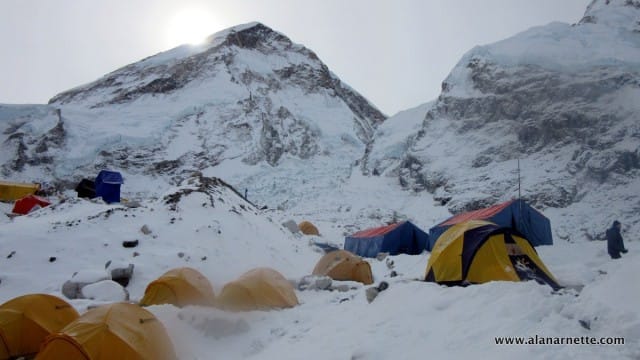
“Safer and shorter”, that is what the leader of the Icefall Doctors told me this morning on camera in an “exclusive interview” at Everest Base Camp. Looking at the Icefall, I am still in awe that is climbed each year. From my perspective it looks more broken and jumbled but I will have a better feeling once we start climbing it later this week This will be my fifth time to go through the multiple rotations to attempt Everest or this year, > Lhotse, in the Khumbu Icefall. It has been snowing heavily off and on all day and most everyone has reed to their tents to read or catch another nap. To date, April 14th local time, no commercial teams have climbed through Icefall. In addition to the Icefall Doctors, reportedly David Breashears, who is helping with the route placement, has climbed to Camp 2. Trek from Gorak Shep We arrived at Everest Base Camp (EBC) yesterday, Monday April 13, 2015 in overcast and snowy conditions. We awoke yesterday morning to heavy snow and a fresh one to three feet on the ground from an overnight storm. But the winds were low and the temps mild so our trek higher was enjoyable. As we crested one of the final hills, EBC came into view. Prayer flags were everywhere as were the red and yellow tents marking the temporary city that is created each April and May. In my estimation, camp looked smaller than in previous years. Also the glacier where base camp is established seemed much more broken thus spreading out the teams – a good thing. Old Friend Instead of heading to our Madison Mountaineering Base Camp, I went to find my friend Jim Davidson. I found his camp and called out his name, a teammate pointed to a tent and soon his head poked out like a prairie dog back in Colorado. We embraced tightly and he simply said, “Can you believe we are here?” This is my fifth time to EBC but Jim’s first. I am so happy for him. We probably have a couple hundred days together in our Colorado mountains back home. He has trained hard and is so focused that I know he will do great on his Everest climb. He looked healthy, confident and ready to climb. For his team, they will return down valley to acclimatize on the 20,000 foot Lobuche Peak before returning to EBC to begin their Everest climb. Madison Mountaineering Base Camp Soon I left him to find my team. Once again, I heard a familiar voice “Alan.” It was Kami calling out from our camp. I scrambled up a steep snow covered hillside to find our collection of yellow, red and green tents. Our team had an excellent lunch but it was quiet inside as I think each person was buried in their own private thoughts. The trekkers had made their “summit” and left today. The climbers, well, we have a lot of work ahead. Thus far, I’m very impressed with what Garrett Madison has put together. I will do a video tour of our camp in a few days. For now, we will rest up and adjust to the 17,300 foot altitude and early season cold temps – it was well below 0F last night. Numbers Updates About 375 Everest 2015 permits issues thus far, with 125 from 2014. 96 issues for Lhotse. Total Everest permits issues in 2014 was 326. Nepali Min bahadur Sherchan 84 to go for male age record. Comms and Climbing Update Garrett Madison, Outside Magazine Cover Boy, worked with EverestLink to get a repeater installed near our base camp and now are getting 2.5mbps upload and download speeds – that is fast!! It costs about US$40 per 1GB of data. It is only available at base camp and not at the higher camps so I will posting updates from high camps using my voice blogging. It appears most of the major teams have arrived at base camp. Many of them are sending Sherpas up to Camp 2 on Wednesday to check on the gear left there in 2014 after the tragedy. In spite of extreme lobbying by many expeditions leaders, helicopter flights to carry gear into the Cwm was denied once again for 2015. Curiously, however, helicopters were supposed to be banned from Base Camp except for emergency evacuations. As I type this at 3:45 PM, I just heard the 10th helicopter of the day arrive at base camp. I visited EverestER and they said they have been busy, but not 10 evacs in one day! Over on the north side, many teams are making their way by road to Chinese Base Camp. They will arrive in a few days and start climbing shortly thereafter. Climb On! I awoke this morning to the sound of prayers, the smell of juniper boughs burning and Sherpas dancing as pujas were taking place all around us. We will have ours tomorrow. As I lay in my tent this morning I heard the sound of gas stoves and the bustle of base camp, I let it all sink in. Stepping outside my tent, I saw the sun just rising off Everest’s West Shoulder, the Icefall was dimly lit in the morning sun. The fresh snow made for a clean carpet over the rocks of the Khumbu Glacier. Yes, I’m happy to be here. Climb On! Alan Memories are Everything Please consider joining ??Alzheimer?’s Prevention Registry. Joining does not obligate you, just provides you the opportunity. Many trails are questions and surveys. Open to anyone over 18 worldwide. 80% of all al trails fail due to lack of volunteers http://bit.ly/1HONXgl
Everest 2015: Updates and Impressions
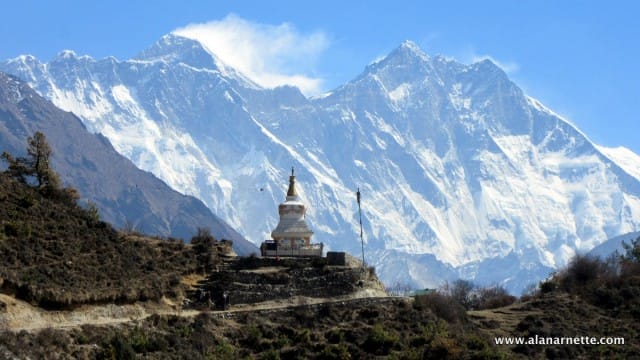
We are now at Gorak Shep and will arrive at Everest Base Camp tomorrow, Monday April 13. While the route has been fixed through the Icefall to Camp 1, there have been no reports of teams starting their climbs. Most are either still trekking in or doing acclimatization exercises on Lobuche Peak, or to Pumori Camp 1 near Everest Base Camp. As I have previously mentioned the route through the Khumbu Icefall takes a more right hand variation near Nuptse to avoid the potential serac danger off Everest’s West Shoulder that killed 16 last year. The route is reported to perhaps take a bit longer and have some long vertical ladders near the top, but lets wait until we actually go through it to make an assessment of the difficultly, and safety. I will post pictures and videos based on my own experiences as I do my own rotations for Lhotse in a week or so. 2015 Everest Numbers Update As for numbers, it appears last year’s tragedy has had little impact on Everest’s popularity from the south, the Nepal side. The Ministry of Tourism reported 319 individuals with Everest permits and 96 for Lhotse. 109 climbers from 2014 used their permits to return this year. There were a few more teams yet to report so this may go up a bit. But the bottom line is that the number are almost the same as last year, certainly not a surge as reported in some circles or a dearth as some who went to the North wanted to see to justify their move. Almost all the precautions announced by the Ministry of Tourism to “make Everest safer” from weather reports, to GPS systems to liaison officers and safety officials have yet to materialize. Once again, it is up to each climber to careful select their operator and to be self sufficient when climbing in Nepal. Most teams are at their traditional levels of 8 to 12 members but there are a few Nepali operators with as many as 60 members thus changing the landscape and business model of Everest. As always, lets hope for a safe season for all on both sides – full stop. The Khumbu Personality I have spent the last eight days trekking from Lukla to now at Gorak Shep. I can report that there is a change in the mood in the Khumbu. Sadly, the tea house operators seem not to be as accommodating as in the past. The prices have gone up dramatically for everything from water to recharging batteries to alleged Wifi access. And it is crowded. I have seen many trekking teams of 30 to 40 members snaking along the trails. These crowds are making the teahouse dining rooms very crowded and nosey. Of course, I am part for the problem as I am trekking right along with them! I am a bit dismayed by all the hype around wifi and the specifically the vendor EverestLink. Their website, emails and promotions marketed “high speed” Internet access from Lukla to Basecamp and you can cards at “100+ locations”. Thus far I’ve not been able to find one location selling the cards. The problem seems to be that the teahouse operators sell their own access, through EverestLink, at an enormous profit thus will not sell individual access. The issue is that when you have 100 people trying to access a single link, it brings access to a complete stop. The teahouse operators are happy to sell you access for US15 a day and then shrug when you complain about the speed. Similar, getting access to recharge batteries has come to a complete stop with teahouses overloaded with cell phones, laptops, cameras and the like. So, let’s keep all of this in perspective. This is all in an extremely remote area where all this are luxuries. However, the problem is when expectations are set and money is taken with little recourse for misrepresentation. So, as always, it is er beware. If batteries are important, bring your own solar panel. If communication back home is important, bring a satellite phone. And on and on. I guess I’m just a bit disappointed and miss the smiles and helpful attitudes of a few years. Mind you they are there, just not for everything we all want in this modern era. Trekking With all this said, I still find magic in the Khumbu. From the heavily forested lower Khumbu with rhodredrums to cherry and magnolias trees to the barren terrain above tree line where your eyes focus on 20,000 foot snow covered mountain tops. Each step is like turning a page in a book. The children still laugh and play with glee as we walk by. They shout out a glorious Namaste and laugh in delight when you smile back at them. The Sherpa women are doing back breaking work in the small dirt plots growing potatoes for themselves and the thousand of visitors each year. The Sherpas who are trekking along with us, remind me of why I love coming here. They are full of life, brimming with competency and confidence. They gladly answer the same question repeatedly, and their smiles are contagious. Blessings On our way we stopped at the home of Lama Geshi, who has been owing blessings on climbers for decades. I first saw him in 1997. In 2010 he suffered a stroke. Many of you made a donation to help cover his hospital costs. On Friday, April 10th, I was so happy to see his smiling face, and large grin. As he prayed for our safety, he beat a small drum on the table holding his prayer book, not that he needed it! He rang a bell and sprinkled holy water on us as he had us say O? ma?i padme h?? after him. He asked us to tell our friends back home to one another with loving kindness and that would bring peace to the world. He gave each of us a white