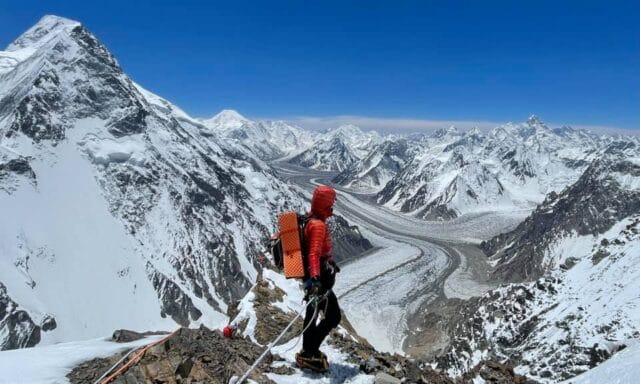
The Karakorum continues to be quiet as we approach the end of July. There have been summits only on Nanga Parbat, Broad Peak and Gasherbrum II. High winds have hampered attempts on K2, while other issues have emerged on GI and Broad Peak.
K2
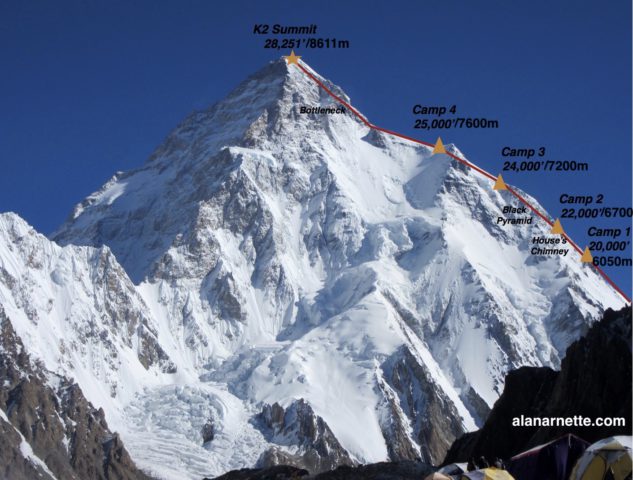
Teams are making their acclimatization rotations on K2, and the ropes have been fixed to around 7,000 meters. Another 2,000 meters of rope is cached at C3, so when the winds let up, we’ll see a mad rush of everyone there, around 50 people.
Nepali operators Seven Summits Treks (SST), 14 Peaks, and 8K Expeditions are climbing K2 again this year. There are multiple Pakistani guides, including Summit Karakorum. Most K2 summits occur at the end of July.
Remember that communication in Pakistan is drastically different from that in Nepal. Cell phone signals are unreliable, so many teams bring expensive satellite connection devices, even though they can sometimes be wonky. Also, since the Northern Territories are adjacent to the disputed area of Kashmir between India and Pakistan, the military will sometimes limit communications. The bottom line is that we cannot expect the same type of coverage we can for the Nepal mountains.
And the Other 8000ers
While K2 gets disproportionate attention, the other four deserve equal coverage. The Nepali outfit Seven Summits Treks, aka SST, has commercialized all fourteen of the 8000ers and usually handles the route-finding and rope-fixing.
Gasherbrum I/II – Summits
SST has not posted recent reports about their international environment with climbers from Spain, Austria, France and Italy..
A six-member team with equal Sherpa support from Imagine Nepal summited GII on July 21. This was on their second attempt. Fresh snow and lack of sufficient rope stalled the first attempt on July 18. Now they got to GI.
On GII, Romanian Horia Colibasanu aimed for July 18 to summit and left the mountain after the unsuccessful attempt. Other climbers there include Uxue Murolas and Ignacio Barrio, who are about a day behind. Also climbing on GI is Brazilian Roman Romancini.
Broad Peak – Summits
Karakorum Expeditions provided this update of a new route variation on July 21:
The new variation follows a challenging line of deep snow, mixed snow and rock terrain, and steep rocky sections leading directly to the main summit. The route was opened after three consecutive days of work above Camp 3 in extremely demanding conditions. On the second day, the team pushed through waist-deep snow and reached approximately 7,200 meters. On the third day, they launched their final summit push. The summit team departed at 2:00 AM on 19 July and, after a grueling climb through continuous snowfall and severe weather, reached the main summit at 9:55 PM. The round trip took more than 24 hours to complete.
David Klein‘s summited with the Karakorum Exp team.
- Mirza Ali —(Rocky Summit) Expedition Leader
- Ahmed Baig — Climbing Leader
- Rizwan Dad — Expedition Director
- Waqar Ali — Expedition Director
- Nawaz Ali Khan — Team Member
- Zaman Karim —(Rocky summit) Team member
- Mansoor Karim — Team Member
- Juan Toro (Argentina) — Expedition Member(Without O2)
- David Klein (Hungry) — Rocky summit (Without O2)
Nanga Parbat -Season Over
Nanga is more western and southern than Pakistan’s four other 8000ers. It’s in the Himalaya Range, whereas the other Pakistani giants lie in the Karakoram Range. NP usually sees the first summit each year.
Making mountaineering history after climbing Everest alone and descending on skis, then Lhotse in May, Polish skier Andrzej Bargiel made history again on June 30, 2026, by skiing from the summit of Pakistan’s Nanga Parbat to base camp without supplemental oxygen.
He was a fast follower of the rope-fixing team that opened the peak for commercial climbing. The rope-fixing team from Seven Summits Treks included Mingtemba Sherpa (“Mote”), Pasang Dukpa Sherpa, Dawa Rinji Sherpa, Pasang Nurbu Sherpa (“Makpa”), and Pasang Nurbu Sherpa.
The publication Dawn reports summits on Nanga Parbat:
The Seven Summit Treks expedition team comprised Tao Hu (China), Antonina Samoilova (Ukraine), Mindaugas Satkauskas (Lithuania), Dawa Sherpa, Dendi Sherpa, Lakpa Temba Sherpa (Nepal), and Abbas Ali Mehdi (Pakistan).
Also summiting and finishing his quest for all 14 of the 8000ers was Imagine Nepal’s Kili Pemba Sherpa, who summited on July 3, 2026, along with Lakpa Chhiri Sherpa and Chinese climber Wang Zhong.
8K Expeditions got six on the summit – 3 Japanese with 3 Sherpas: Naoko Watanabe, Keizo Konishi, Saori Eragaki, Pechhumbe Sherpa, Pasdawa Sherpa and Mingma Dorchee Sherpa. Of note, Naoko Watanabe is the first Japanese woman to complete all fourteen 8,000-meter peaks and the first woman in history to summit K2 three times.
On June 30, 14 Peaks put an international team on top:
Summit Members
- Anni Katri Penttila – Finland
- Ian Fraser – Scotland
- Rebecca Long – USA
- Alexander Joseph Hansen – USA
- Benjamin Edward Lieber – USA (Team Leader)
Sherpa Team
- Phurbu Kusang Sherpa
- Pasang Nurbu Sherpa
- Dorchi Sherpa
- Kusang Sherpa
- Serjangbu Sherpa
- Mehboob Ali
Peak Lenin
Lenin is becoming more popular as an alternative to Aconcagua for climbers seeking experience at 7,000 meters (5,642 meters, 18,510 ft). Mount Elbrus, 7,134 meters/23,405 feet. Located in the Pamir Mountains near Bishkek, Kyrgyzstan. Adventure Consultants and Madison Mountaineering both got teams to the summit.
Alps Troubles
In the Alps, the Zermatt Mountain Guide Association recommends avoiding climbing the Matterhorn (Cervino) on the Swiss side until the falling stones danger decreases.
On Mont Blanc, the Association of Mountain Guides of Courmayeur does not recommend the normal Italian route. The Trois Monts (Cosmiques) route has been impassable for three weeks, while the Goûter route remains open without major issues.
Deaths
Five Bosnian climbers feared dead on Russia’s Mount Elbrus after a storm, with search ongoing. Rescue service says two others saved.
Jaroslav Bánsky died from a fall while climbing Biarchedi II (6,759m), a peak northeast of Masherbrum.
In Peru, three climbers went missing while attempting Nevado Huascaran, Peru’s tallest peak at 6,768 meters (22,204 feet), on July 20th. Drone footage reveals footsteps leading into a crevasse, with no signs of additional footprints. The climbers’ base camp lost contact with them during their descent. The media identified the climbers as Alejandro Ugarte Jordan, Freddy Saul Mendoza Lizana, and guide Artidoro Salas Gaitan.
In the US, on Colorado’s Longs Peak at 4,346 meters/14, 259 feet, a climber fell to his death on the technical Kiener’s Route on July 5.
In Japan, there have been two deaths in one week on Mount Fuji, a 3,760-meter/12,338-foot volcano. A 58-year-old Swiss man and a 65-year-old Japanese man were identified as the victims. Japanese police also reported the rescue of Tome Sagawa, 99, who was rescued the same day while trying to scale the mountain after she had injured herself the previous day and spent the night in a mountain hut.
There have been two new deaths on Switzerland’s side of the Matterhorn. As reported;
The rope team was killed while descending via the Hörnligrat on Sunday for reasons that remained unknown. The accident occurred at around 11 am at an altitude of approximately 4,030 meters, as the Valais Cantonal Public Prosecutor’s Office announced on Monday. The two mountaineers were on their way down at the time. A third person alerted the emergency services. An Air Zermatt helicopter flew to the scene of the accident, but on arrival, the emergency services could only confirm the deaths of the two victims.
There have been two other mountaineering deaths this summer. On the 7,282-meter/23,891-feet Pakistan K6, French ski mountaineer Guillaume Pierrel died in an avalanche. And on Russia’s 5,642-meter (18,510 ft) Mount Elbrus, a 34-year-old climber from St. Petersburg died suddenly on July 6 while ascending.
Climb On!
Alan
Memories are Everything
The Podcast on alanarnette.com
You can listen to my podcasts on Spotify, Apple Podcasts, Breaker, Pocket Casts, RadioPublic, Anchor, and more. Just search for “alan arnette” on your favorite podcast platform.
Receive Notification of Alan Arnette’s Memoir
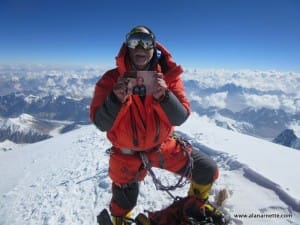
A surge of debilitating fatigue overtook me. My shoulders drooped. I stared at my yellow boots, crushed by disappointment. I had trained hard for K2 and tried to anticipate every scenario, but now I was failing, and there was nothing I could do.
Closing my eyes, I was powerless, hopeless, and ready to surrender to the mountain. Everything I wanted—the summit, a safe return, my vow to my mother—was slipping away.
My ice axe fell onto the snow.
Staring at the small yellowish spot illuminated by my headlamp on the snow, it was over, and, oddly, I didn’t care.
It was 12:30 a.m. on July 27, 2014—my fifty-eighth birthday.
If you would like to be notified when my memoir, “Hard or Impossible? Summiting K2 for Ida” is available. Complete the form at the bottom of this introduction page.