Everest 2014: Season Summary – A Nepal Tragedy

The 2014 spring season of mountaineering on Everest had more to do with politics, advice fame, power and positioning than mountaineering. These agendas dwarfed the deaths of 19 people. The final summit numbers will take months to determine but most likely will be the lowest total since 1997. From Tibet over 100 people summited. And from Nepal, six summits, albeit aviation assisted since the climbers flew to Camp 2 instead of climbing through the Icefall. This post will provide my analysis of the season, what went wrong along with ideas on going forward. These are my conclusions but with input from extensive post climb interviews with sherpas, guides and climbers who were there. For me, the tragedy of 2014 were the deaths of 19 people (16 sherpa in the Icefall, a sherpa who died from AMS, two sherpas who were killed returning home from base camp: one by lightening and another in an accident). The impact on the families of the dead will echo for decades to come. However, the insult of Everest 2014 is the way the deaths are being used to promote personal, national, press and company agendas through spin and selective reporting. Seeds of Discontent The seeds of this year’s controversy have been growing over several years. On Manaslu in 2012, a few young sherpas, allegedly lead by Pasang Tenzing argued to end the season using threats and intimidation after an avalanche killed 11 members. Many teams left the mountain not only fearing the objective hazards but also this new generation of sherpas. On Everest in 2013 controversy erupted after the fights between European climbers and sherpas fixing the rope on the Lhotse Face. A few young vocal sherpas lead an inexcusable attack at Camp 2 on the Europeans bringing global attention to a new generation of sherpa climbers. In recent years, new Everest guiding companies were formed in Kathmandu with their primary selling point being that they are not western owned companies. In 2014, over half the members guided up Everest were from local Nepali companies. Every non-Nepali company who guides on Everest uses a local company to organize logistics, hire staff and support the expedition. It has always been this way. In many cases, it is up to these local companies to set sherpa pay, benefits, life insurance, etc.; not the foreign companies companies. There are few if any written employment contracts. Some long time foreign operators do dictate pay, and that is not where the problem lies. To be blunt, some foreign operators don’t know what their workers are really paid or the amount of the life insurance. They pay a single per climber fee and assume the middle man will do the right thing. Local companies appear to have unlimited flexibility with no oversight or checking if policies are being met. The Nepal Government, embarrassed by years of stinging criticism over trash, safety and general order, floated idea after idea since 2013 to better manage the mountain. The suggestions generated even more uncertainty and criticism as most ideas were under developed, unnecessary and then not implemented. A 2013 article in Outside Magazine entitled “The Disposable Man” brought the world’s attention to the risk sherpas encounter while climbing Everest. While a balanced article that brought up the low life insurance issue, the provocative title lead many readers to an improper conclusion and unfortunately it focused on the risks from a statistical perspective and failed to put the overall role of sherpas into perspective. That article has been used countless times to support an accusation of sherpa exploitation and abuse. With all this as background, the deaths in 2014 have brought a power struggle over Everest into full bloom and the damage is severe. The current blame game is not only disingenuous but also potentially damaging to all involved. It is time to stop the sound bites with interviews and think deeply about the problem and the solution. Tragic Deaths On April 18th, 2014, 16 sherpas were killed in the single most deadly incident in Everest’s history. The deaths came when a well-known ice serac hanging off the West Shoulder of Everest released at 6:30am just as droves of sherpas were carrying loads into the Western Cwm from Everest Base Camp. They were bunched together, delayed after a ladder crossing a crevasse was just repaired, but underneath a known hazard. The gathering broke a common mountaineering safety practice of spreading out under known danger. When ice released from the hanging serac it was large, fast and deadly, they never had a chance. 13 bodies were recovered, multiple sherpas were rescued but three remain buried in the deep crevasses of the Khumbu Icefall. As tragic as these deaths were, the death toll could have been much higher as there were over 150 sherpas in the general area at the time of the release. The deaths set off a domino effect of reaction, decisions and implications that have yet to be understood. The blame game has intensified to the point of threatening the very survival of Everest climbing and the livelihood of the climbing sherpas. While the trekking industry brings in more money than mountaineering, without climbing, Nepal loses it leadership in the climbing world and many, many Sherpa families would suffer. A New Generation Similar to the previous two years, a few young sherpas lead the chant to stop climbing. I want to be clear at this point, it is not all the young sherpas who are part of this so from this point further, I’ll call the few (under 5 in total) the instigators. I wrote just after the deaths that there were three reasons for stopping climbing for 2014: respect for the fallen, fear of more ice releases and demands for more money through increased pay and life insurance. In reality, there was only one real reason – money. Today I would add another reason – desire for control over Everest climbing. In general, the new generation of sherpas are quite different from

Everest 2014: Team Locations

Welcome to Alan Arnette’s Everest 2014 coverage My coverage is based on my own summit and climb experiences, research, sources, and public information. I try to provide insight and interpretation of the activities ranging from routes to weather to the challenge of climbing Everest. Latest Everest News – May 31, 2014 My summary of this tragic season http://www.alanarnette.com/blog/?p=19748 NORTH: The season is over on the North side. I am estimating about 125 summits. NO deaths reported on the North side for 2014. SOUTH: The season is over on the South side. – 6 summits 19 deaths on South side in 2014 General News & Notes My sincere and deep condolences to families, teammates of the 17 Sherpa climbers killed on Everest this year. Donations for families of Sherpa killed in serac fall: American Alpine Club American Himalayan Foundation Himalayan Trust Juniper Fund Sherpa Education Fund Sherpa Fund Suport4Sherpa US Nepal Climbers Association Supporting Sherpa Children A sincere and deep thank you to everyone who makes a donation to one of the Alzheimer’s non-profits. Manage email notifications of new posts using the form in the lower right corner of this page South Col Route (map) Everest only TEAMS (members/western guides) 334 westerners 31 teams, 300+ Sherpa EBC C1 C2 C3 C4 S.Col Summits (climbers/Sherpas) Adventure Consultants (6/2)  e Adventures Global  e Alpenglow (3/1)  e Alpine Ascents Int. (12/3)  e Arnold Coster Expeditions (5/1)  e Asian Trekking Eco Teams (17/0)  e Altitude Junkies (7/1)  e Exploradus Expedition (3/1)  e Himex (17/4)  e IMG Classic (17/3)  e IMG Hybrid (11/5) e  H Ascent Himalayas (9/15) e Jagged Globe (9/3)  e RMI (8?/2?)  e Benegas Brothers  e Madison Mountaineering e Peak Freaks(8/3) e Saatori Expeditions (7/1)  e Summit Climb (8/2)  e Tim Mosedale  e Jing Wang 1/5 others SOUTH TOTAL (est)  6 Northeast Ridge Route (map) TEAMS (members/western guides) 100 Climbers CBC ABC C1 N.Col C2 C3 Summits (climbers/Sherpas) Asian Trekking (10) e  2+/2+ Adventure Peaks e 2/1 Kari Kobler (11/3) e 8/? Malta Everest (4) e 4/? Summit Climb (5/1) e  5/? 7 Summits Club (14/4) e  17/14 others  2++/2++ NORTH TOTAL (est)  125++ e=climb ended, x=last reported location, x+ =on summit bid, -x =descending h=high sleep point, t=touched not slept. Summit number=member/Sherpa. Locations estimated from public website. Please refer to each expedition’s site for current information. Contact me to add/remove your team from my coverage. I did similar coverage for the 2004, 2005, 2006, 2007, 2009, 2010, 2012 and 2013 seasons. I summited Everest on May 21, 2011 and have climbed Everest four times – 2002, 2003, 2008 and 2011. If you will forgive the self promotion, Outside Magazine posted in February 2013 an extensive interview with me where I talk abut my childhood, mountains, Everest and of course Alzheimer’s. I appreciate their interest and help. They even said I was “one of the world’s most respected chronicler of Everest” If you receive value from my annual Everest coverage, please consider a donation to one of these Alzheimer’s nonprofits, 100% for Alzheimer’s, none for me. thank you. Click this link to understand my personal journey with this disease 17 Confirmed deaths Mingma Tenzing Sherpa Peak Freaks, died from HAPE Mingma Nuru Sherpa, , Shangrila Nepal on NBC Everest Expedition, died from avalanche into Khumbu Icefall Dorji Sherpa, Shangrila Nepal on NBC Everest Expedition, died from avalanche into Khumbu Icefall Ang Tshiri Sherpa, Shangrila Nepal on AAI Everest Expedition, died from avalanche into Khumbu Icefall Nima Sherpa, Shangrila Nepal on AAI Everest Expedition,  died from avalanche into Khumbu Icefall Phurba Ongyal Sherpa, Adventure Consultants, died from avalanche into Khumbu Icefall Lakpa Tenjing Sherpa, Adventure Consultants, died from avalanche into Khumbu Icefall Chhiring Ongchu Sherpa, Adventure Consultants, died from avalanche into Khumbu Icefall Dorjee Khatri, Adventurist Everest, died from avalanche into Khumbu Icefall Dorjee Sherpa, Adventurist Everest, died from avalanche into Khumbu Icefall Phur Temba Sherpa, Adventurist Everest, died from avalanche into Khumbu Icefall Pasang Karma Sherpa from Juving Solukhumbu, Jagged Globe,died from avalanche into Khumbu Icefall Asman Tamang, Himalayan Ecstasy Lhotse,  died from avalanche into Khumbu Icefall Ankaji Sherpa, Everest Chinese Dream Expedition, from avalanche into Khumbu Icefall Ash Bahadur Gurung, Everest Chinese Dream Expedition,  from avalanche into Khumbu Icefall Missing – Unknown status, presumed d Tenzing Chottar Sherpa, Shangrila Nepal on AAI Everest Expedition,  from avalanche into Khumbu Icefall Pem Tenji Sherpa, Everest Chinese Dream Expedition, from avalanche into Khumbu Icefall [poll id=”-2″]

Everest 2014: Summits – Update 6

Update 6: Looks like about 100 people went for the summit from Tibet on Sunday but not all teams have reported. There were many comments about crowds preventing fast climbers from moving around slow ones. Weather was expected thus the season may be over, but for 2014, I have learned never to say closed …. The controversy around Jing Wang’s summit continues. She refused to discuss the use of helicopters but in a report today said she did not use a helicopter disputing the statements of her organizer and the helicopter pilot. According to Wang’s application stating her itinerary from May 9 to 23, she used the chopper only to airlift logistics, equipments and two sherpas (a porter and a guide) to Camp 2, Burlakoti said. “We are ing detailed report from the Civil Aviation Authority of Nepal and helicopter companies about the flights made in the Everest region,” he added. Earlier in a post-summit interview with THT, Wang had refused to provide details of chopper use, claiming she had crossed the dangerous Icefall route several times. But Da Gelge Sherpa told this daily in Namche Bazaar that he had flown with Wang to Camp 2 from the Base Camp on May 10. The Nepal Ministry said it would review her proof of a summit before issuing a certificate. She is anxious to fly to Alaska to summit Denali before the end of June in order to make her objective: speed record for the 7 Summits plus both poles. Update 5: I’ll update the summit stats from the north as I get them but I want to say this now: I am now writing the #Everest 2014 season summary and will post in a week or so, but this is a troubling season on many levels. Too many death, so many shattered dreams, a devastating intersection of labor vs management with no winners. Too many are using this season’s tragedies for their personal and professional agenda, spinning it to their own benefit. This is not what mountaineering is about. Everest 2014 – Nepal – has tarnished decades of honorable accomplishments, so many achievements that so many are proud of are now hurt by the actions of a few and the policies of a government. Lost in the noise are the accomplishments on the north side of Everest – from Tibet – Bill Burke at 72 and Poorna Malavath at 13 and many others summited. They had a dream, young and old, that they never lost. Dreams are meant to be fulfilled. If you are dreaming of Everest don’t let 2014 discouraged you. Your dream is what you make it, no one else. Ignore the voices, listen to your own, fulfill you dream. Climb On! Alan Memories are Everything     Update 4 May 25: Reports of more summits on Sunday including Adventure Peaks and Summit Climb. Very little detail. No word on the Romanian team but bad weather is now reported moving in. Stefan Nestler reports that Ralf Dujmovits abandoned his no O’s attempt. David Kline also stopped his no O’s climb. The Himalayan Times is reporting that Cleo Weidlich from Brazil but now an American citizen was helicoptered back to Kathmandu from her attempt to summit Lhotse after flying into the Western Cwm to Camp 2. The report says she abandoned her attempt. There is no mention of the two Sherpas who were reported to be with her. Cleo posted the following on her Facebook account in sharp contrast to her provocative comments before leaving “ I refuse to give in to the pressures of the Everest mafia.” Dear Friends, A lot has happened since I stopped by. I came down to Lukla today and was shocked at all the speculations regarding my Mt. Lhotse climb this season. Firstly, I’d like to assure all my fellow climbers around the world who are pursuing all of the 14 X 8000m+ that I could not, in good consciousness, claim a summit when I took a heli to C2 after the tension that took place in late April and a heli out today. That would be claiming a whole mountain when, in fact, I’d only have climbed half of it. I would like to let all my climbing mates around the world know that I respect everyone’s effort and I’ll continue to pursue the 14 X 8000m+ peaks by fair means as I have thus far. BC-summit-BC I did a lot of filming and photo shooting of the glaciars and hanging Seracs and will present to the ministry this week to illustrate the seriousness of global warming on Mt. Everest. Again, I apologize to all whom I might have offended by fliying to C2. I never intended to claim this summit. Cleo Another update on Jing Wang from an interview with her with National Geographic as she returned to Kathmandu. None of the Sherpas had summited Everest. She made this statement about her summit with respect to the fallen Sherpas: She said she was very sad about the death of the Sherpas killed in the avalanche, but she had made extensive plans to climb all seven summits (the highest peaks on the seven continents) in six months. It was reported her helicopter flight was authorized in contradiction to statements by the Ministry of Tourism only 10 days earlier. Further it is reported by National Geographic that Wang made a $30,000 donation to local hospitals. Update 3 May 24: More summits Sunday morning Tibet time. First up around 6:00 am Poorna Malavath a 13 year 11 month old girl from Hyderabad climbing with Transcend Hyderabad became the youngest female to summit. Anand Kumar Sadhanapally from the same team summited at 7:26 and kishor dhankude summitted at 10.30 am Bill Burke at age 72 summited #Everest2014 from the North at 9:45am. He is now descending. Bill summited from the South in 2009. There are many more summits Sunday morning but we will have to wait for the teams to report them. Update 2

I am proud to be called a Climber

On May 21, shop 2011 at 5:30am, I stood on the summit of Mt. Everest. I felt small, tiny, and insignificant as I watched the sun rise over the world’s tallest peaks. I felt grateful as I hugged a down covered Kami Sherpa (Ang Chhiring Sherpa – Pangboche). I felt sadness and inspiration as I dedicated the summit to my mom, Ida, and the millions of Alzheimer’s s and their caregivers around the world.   Standing on the summit of Everest, provided fuel to my passion and purpose in life. Today, May 21, 2014, marks the three year anniversary of that summit. But it is a time of immense sadness in the Everest climbing community. This year we saw the deaths of 17 Sherpa on the Nepal side of the mountain. 16 died in the single worse tragedy as a piece of ice released from a serac on the West Shoulder almost immediately killing the Sherpa waiting for a ladder to be repaired in the Khumbu Icefall. Once again, Everest garnered the world’s attention for the wrong reason. Climbing mountains is dangerous, you can be killed. This is not a secret or a mystery or even an epiphany to anyone, non-climbers included, who struggle with why someone would climb and are generous with their harsh judgments and conclusions. Most climbers just let the rhetoric roll off their shoulders knowing you cannot convince someone who is not open to listening, steeled in their world of superiority. Death in the mountains cannot be defended or explained. Looking for logic is a pointless exercise. There is no logical explanation as to why these Sherpa died the way they did. Yes, there is a physical explanation but ask each of them why they were there, and you would get a variety of reasons but the common theme would be it was their job. The member climbers, or as the most judgmental of the critics like to call them – tourists, are quick to receive the blame for the deaths with hyperbolic statements like the Sherpas wouldn’t have died if the members hadn’t been there. I received an email from one of my blog readers calling me a murderer. I assume he was blaming me for all mountain deaths because I climb mountains. He wasn’t specific in his spew of hatred. While I understand his anger, his aim is misplaced.  Climbing can be made safer, but the burden rests primarily on each individual. I have been on 35 major expeditions since I started at age 38, all with Sherpas for the climbs in Nepal and Tibet. My respect for their culture grew as did my own experience in climbing. I am proud that I summited Ama Dablam with Lhapka Sherpa, Manaslu with Pasang Ongcho Sherpa last year and Everest with Kami three years ago, but I’m more proud that I have new friends for life. I am proud to again be climbing with Kami, this time on K2. Our relationship is built on mutual respect. I climb mountains because I love the connection with nature, the spirit of adventure and the challenge of a difficult objective. My ethos is one of preparation, self sufficiency, respect for the mountain and appreciation for those who help me in my quests. I could not climb the mountains I do alone, unsupported or independent. This is my reality and one I say with pride. The support I receive enables me to aspire to greater goals than just a summit: to tell the world that Alzheimer’s must be stopped and caregiver support must improve. It is an means to an end, an environment of mutual dependency, of mutual gains. It is a relationship born of needs and desires. The member climbers of Everest 2014 struggle with a confluence of guilt and desire. They ask rhetorical questions of should they have been there in the first place, what was their role, should they go back to pursue their dream. The critics are quick with a quip, a piece of satire or an insensitive judgmental reply damming their ambitions to Hell or worse. Today, I mourn the deaths of the Sherpa. I mourn the deaths of all die in pursuit of making a better life for their families, those who work to survive. This dream has fueled ambition and risk since the beginning of human existence. It is life, and it is death. Death is a fact in the mountains. It is a voluntary endeavor. Those who choose to climb, accept the risk. I will continue to climb, accept the risk, accept the support I receive from those around me. We will climb together, benefiting in different ways for different purposes. I am proud to be called a climber. Climb On! Alan Memories are Everything

Everest 2014: North Teams Begin Summit Push – Update 4
Teams on the North side of Everest have been ly waiting for lower winds to begin their summit push. It now appears that window will emerge around May 23-26. This is a bit later than normal for the North side but still about right as that side receives more severe winds than the South.  There is no hard stop to the season as on the South when the Icefall doctors, in a normal season, try stop maintaining the route at the end of May due to warming temperatures. Summits on the North can easily go into June. The lines have been fixed to Camp 3 or 8300 meters for a couple of weeks but the Tibetans stopped work due to conditions. Bill Burke climbing with the Asian Trekking team just phoned in his schedule but I expect other teams to be similar: May 17 Intermediate Base camp May 18: Advanced Base Camp May 19: Rest day at ABC May 20: North Col/C1 May 21: Camp 2 May 22: Camp 3 May 23: Rest day at Camp 3 May 24: Summit May 25: Return to C2/ABC May 26: Return to CBC Kari Kobler’s team recently told me they were looking at a summit window of May 23-26 so it matches given they will not take a rest day at C3 most likely. The team of Horia Colibasanu and Peter Hamor attempted to start their push on May 14 when they announced with this Tweet: We left the ABC towards the Everest summit, with no oxygen and no Sherpa but then posted this on May 15: Back to Everest ABC today (6,400m). The strong wind (about 50km/hour) prevented from climbing further. Flu also 🙁 Cho Oyu and Shishapangma Summits Today the Triple 8 team of Mike and Matt Moniz, Jim Walkley and Willie Benegas successfully summited Cho Oyu and returned to ABC in a long 17 hour day. The sherpa team was lead by Nima Kanchha Sherpa (Thame), Kami Tshering Sherpa (Khumjung) and included Pemba Tshering Sherpa (Khumjung), Karchen Dawa Sherpa, (Khumjung), Phurita Sherpa, and  Ang Furba Sherpa. Also in this group was Charlie Mac summiting his 5th 8000m peak with Gray Watkins at age 62 grabbing his first 8000er. On Shishapangma, a team of four French climbers reported to have summited from the South Face in a single push aka alpine style. Makalu, Manaslu and Kangchenjunga Pushes Teams all across the Himalaya have been fighting strong winds all season with pushes delayed on Makalu and Manaslu. The only team on Manaslu is from Adventure Consultants. They have been stalled but posted today they are looking at a summit push from Camp 3 today, May 17. Billie Bierling climbing Makalu with Himex tweeted yesterday: First summit attempt on makalu abandoned. Almost all climbers came back from C2 this morning. Too windy. However on Mike Horn’s blog it is reported his teammate Fred Roux  summited Makalu today but it is unclear if Mike summited. On the North side of Kangchenjunga Txikon Alex, Adam Bielecki, Dmitri Sinev, Denis Urubko and Artem Braun are preparing for their summit push in a few days. Similar news on the south side from climbers Marco Confortola, Marco Camandona, Cazzanelli François and Favre Emrik. Meanwhile 75 year-old Carlos Soria Fontan continues his climb on Kangchenjunga trying to summit all 14 of the 8000m mountains. If he succeeds, he will have Annapurna, Dhaulagiri and Shishapangma remaining. He was the oldest person to summit K2 at age 65 South Update I really don’t have anything new to report. There has been a flurry of posts from everyone except for the alleged climbers. I say alleged because some reports say they never flew into the Cwm, others say they did and the flights were approved. But as of this post, there has been no word from any climber who may or may not be there. How’s that for a definite report? 🙂 Russell Brice is reported to say he was no longer under investigation for helping Chinese Jing Wang with her alleged unauthorized flight. Guy Cotter, Adventure Consultants posted what I think was an excellent update on their Everest 2014 season. They had three Sherpas die in the serac release.  Guy explains his thoughts on the season and makes this point with respect to the coverage: It is because of all this that I take offence to some of the diatribe from uninformed sources who would have everyone believe the Sherpas are being exploited. The Sherpas are moving rapidly forward with their own destiny unfolding before them in a very positive way.  They are very much in control of that momentum that will see them succeed. Yes the accident on Everest this season was extremely tragic; we who live our lives in the mountains must frequently balance the euphoria of a shared success – with the intensity of tragic loss. Even those of us who are way too experienced at enduring the gripping pain of loss of life cannot produce an appropriate amount of emotional reckoning to balance the loss/gain paradox. That there are people who would use this tragedy to further their own negative agenda and infer that these Sherpas were working in the mountains against their will is disappointing. But Everest creates a platform that can even be used by luddites from which to grandstand their nefarious negativism to which there is little we can do except expend countless hours offering a balanced perspective so the conversation isn’t so one sided. Please read the entire newsletter. Another update on the tragic accident comes from Mark Horrell who was there climbing with Altitude Junkies. Mark’s teammate, Mel Huang from China did an analysis of the release with annotated images. Please read Mark’s complete report on his blog. He is a talented and experienced writer and climber who maintains a calm view yet is very realistic about events. Japanese Ken Noguchi, announced a donation of 10 million yen ($97,000) to the Nepal Mountaineering Association to assist the families of the dead Sherpa. 

Everest 2014: Climbing Everest at any Cost from Nepal – Update 2

This is a season with no end from Nepal. As I reported yesterday, IMG noted the Icefall Doctors were removing the ladders from the Khumbu Icefall and, assumed, the season would finally come to an end. I noted there was one climber attempting Lhotse still there determined to climb with or without ladders. Cleo Weidlich, made this comment on her Facebook page a few days ago: This is just to let you know that my climb on the Everest Massif will continue with or without ladders. I have climbed some of the world’s most dangerous mountain WITHOUT them and this mountain is, actually, very tame when I compare it with the likes of Nanga Parbat, Annapurna 1 and Kangchenjunga. I refuse to give in to the pressures of the Everest mafia. I’d like to decide for myself when I have reached my limits. Thanks to ALL of you for all the positive energy; I can feel it.. And today it was reported Cleo did just that by taking a helicopter to Camp 2 in the Western Cwm. The report goes on to say: American climber Cleonice P Weidlich, who reached Camp 2 from Gorak Shep on a chopper, has apparently done so without taking permission from the ministry of tourism and civil aviation. Ministry’s permission is mandatory to take a chopper to the restricted area above the Base Camp. International operators, including IMG, Himex, AAI, Adventure Consultants, Jagged Globe and Peak Freaks, chartered helicopters to carry Cleo’s climbing equipment and logistics up to Camp 2. Chief at the Lukla airport, Rimji Sherpa, and legal division chief at MoTCA, Ranjan Krishna Aryal, said they were not aware if any such flights were conducted. They said neither Lukla airport nor the ministry were asked for permission for such flights My opinion is this is a misstatement regarding the commercial companies as the ones mentioned did receive permission to fly into the Western Cwm to remove gear at C1 and C2. I would be very surprised if they knowingly carried gear into the Cwm but nothing surprises any more on Everest. The reported cost was US$2,000 per person per flight, so a person would spend $4K to get into and out of the Western Cwm. Also, it appears she is climbing alone without Sherpa support. The second climber mentioned is Chinese Jing Wang trying to set a record for climbing the 7 Summits plus both poles. See these updates from Russell Brice on her project 7+2. She was with Himex on Everest and now appears to have reset her ambitions and will try to climb Everest through the Khumbu Icefall with a team of seven Sherpa: “Chang, on the other hand, has hired seven local Sherpas and is headed for the Base Camp from Namche Bazaar,” sources told THT, adding that she will leave for Camp 1 in the next five days. There is still time for these women to climb as the monsoons don’t usually arrive until late May to early June. However, recent reports on Cho Oyu show 100 mph winds on the summit and other reports have heavy snow in the Everest region.The usuall summit window on Everest is around May 21st. Meanwhile, teams on the North side have mostly reed to Chinese Base Camp or lower to rest up for an anticipated summit around May 20th. I don’t know about you but I’m getting whiplash! Update 1: Report of Jing Wang plus 7 Sherpa flown to C2 in Western Cwm to attempt Everest. Wang own the huge Chinese outdoor gear company Toread. She tried unsuccessfully to get a permit to climb on the North after the Nepal side effectively shut down. Update 2: Jing Wang’s helicopter flight has put Russell Brice and his company Himalayan Experience aka Himex at huge risk per this newsletter he sent out today: Many of you know that I have been dealing with the logistics for Jing Wang to climb the 7 summits and 2 poles in record time. Of course this project came to an abrupt end when I was forced to cancel my Everest and Lhotse trips. I suggested to Jing that she go to the North side of Everest and obtain a climbing permit from the CMA or CTMA, but this was not forthcoming. Although Jing asked if I could arrange for her trip to continue on the South side, I refused and so did all my Sherpa staff. In the event it appears that Jing has arranged to continue to climb with another agency and has without permission flown by helicopter to Camp 2, despite me warning her not to. This has caused me considerable problems with the Ministry, who say that I am still responsible for Jing, despite me not knowing who the other operator actually is. Well in fact I do know who this operator is, but he continues to tell me lies, saying that he has not organised the 7 Sherpa’s that are currently with Jing, although they all come from his company. Even after repeated phone calls he still does not come to the Ministry to take on the responsibility of the Sherpa’s insurance and other such matters. In the meanwhile the Ministry says that they will punish my company, quite a large fine and probably banned from coming to Nepal for 5 years. It is only in the past few hours that I have now been cleared of the responsibility for Jing and her phantom operator. So for members who might think that I have carried on with my expedition, please know that this is the exact opposite, these actions of others has caused me considerable pain and hard work to clear my company name in the past few days. Also, there are new reports of other people flying into the Western Cwm – no details on who they are. But the Nepal Ministry of Tourism seems to have lost control of Everest per this report on the Himalayan Times: The CAAN has been

Everest 2014: North Teams Target Summit Date

Right on schedule, s the teams on the north side of Everest are completing their acclimatization rotations and looking at potential summit dates. Thus far, the season is going very smoothly on that side. Bill Burke, at age 72, is climbing with Asian Trekking and posting regular audio updates. In today’s dispatch he noted they had competed their rotations and were going to the Tibetan village of Tingri for a little rest. He also said they were looking at a potential summit window of May 17 -19. I heard from Norwegian, Knut Grotli with Kari Kobler’s group. They are back at the Chinese Base camp after completing their acclimatization to the North Col. The Maltese climbers have also completed their acclimatization schedule and are back at CBC. Another team includes Phillipe Hullaert from, France. He notes that on his team is Ralf Dujmovits who’s trying to summit without O’s. Dujmovirs is the very well known German mountaineer and the first German to climb the 14 8000m mountains. Dujmovirs gain famed with his 2012 picture of th line of climbers up the Lhotse face and his further comments on what Everest had become. This from Outside in 2013: Being on Everest on the Tibetan normal route, people get no feeling for what it means to be on a lonely route, on an eight thousand meter peak, on your own, without all these crowds. The climbers on Everest are trying to achieve something that doesn’t exist any longer—at least on Everest. Of course Ueli Steck had a bad experience in 2013 but famously ended one interview with No, I’m not done with Nepal. It’s the wrong moment to ask me that. I lost something I really love in my life. It’s done. I’m not saying I’m never coming back, but give me time. I need to figure it out. There are many other mountains I can climb. Everest is Everest, and Everest lost a lot, but it’s still the highest mountain in the world. It seems that Everest still has an attraction even after a bad experience for amateurs and professionals alike. South Update Eric Simonson, IMG reports,  posted their final update for Everest 2014 from the Nepal side: Ang Jangbu also reports that up at Everest Base Camp, the Icefall doctors are now bringing down the ladders and ropes from the Icefall, so there will be no further climbing. For all of you Everest history buffs out there, I believe that this is the first season since 1986 that nobody climbed Mt. Everest from the Nepal Side during the spring climbing season. One independent climber is at EBC insisting on climbing solo, without ladders to Lhotse as of May 7th. Climb On! Alan Memories are Everything

Everest 2014: Weekend Update May 4: Climbing Continues, South Withdrawal

Climbing continues on Everest’s north side with over 100 climbers making steady progress with their acclimatization rotations. Also, teams on Cho Oyu and other Himalayan 8000m mountains are preparing for their summit pushes. The only place it is not business as usual is on Nepal’s side of Mt. Everest where April 18th will be remembered forever as the day 16 Sherpa climbers lost their lives. Tibet The rope fixing by the Tibetans from the China Tibet Mountaineering Association, CTMA, continues toward the summit as members with commercial teams are spending time at Advanced Base Camp and even the North Col to acclimatize. The reports have been steady with no issues noted, including decent weather for a change on that side of the mountain. 7 Summits Club noted: Hello! This is Alex Abramov from a height of 6400 meters, from advanced base camp. Today the first team (8 people) is here . We had breakfast , now it will be held ice classes. We will train ascending on fixed ropes, because tomorrow is our first team goes to the North Col of Everest in order to spend the night at an altitude of 7000 meters. The second team of 11 people spent the night in the Middle camp , and now rises toward the ABC camp. Tonight should all meet here. All feel fine, acclimatization goes according to plan, that is, sufficiently smooth, soft acclimatization. Adventure Peaks gave us a great shot of Chinese Base Camp with Everest looming in the background. The Triple 8 Team looking to summit Cho Oyu, Everest and Lhotse is leaving today for the summit of Cho Oyu. But they have also been working hard to find a way to keep part of their dream alive now that climbing from Nepal is not an option. Jim Walkley posted this on his blog: Obviously, we are intently focused on the next several days, but many are wondering (as are we) what will be next now that the climbing season on the south side of Everest has come to an unfortunate conclusion.  We are looking at all options, but the Everest-to-Lhotse link-up is no longer possible due to us being unable to climb from the south side as we had originally planned.  Our preferred Option B has been thwarted thus far due to an inability to obtain the climbing permit we need, but we are pulling out all the stops and will not give up until time runs out on us.  We have Options C & D in our sights as well, but we will not pivot to those until we absolutely must.  Sorry to be so cryptic, but I will share our plans once we’ve completed our adventure on Cho Oyu and know with certainty what our next objective will be.  Stay tuned. Nepal There are few if any teams now left at Everest Base Camp on the South. A few gave it a valiant effort to stay in hope the Icefall Doctors would relent and manage the route, but it does not appear to be the case. Local helicopter companies offered to ferry climbers into the Western Cwm for $2000 per climber per trip, but no one took them up on this offer. The operators began the long precess of negotiating with the Ministry of Tourism for refunds of permits, trash deposits and other costs associated with Everest 2014. Guy Cotter, Adventure Consultants told of his unsuccessful efforts to use helicopters to bypass the Icefall for gear. The Nepal Government did allow helicopters to retrieve some gear this year and to store gear in the Western Cwm. I fully expect this to become the standard and for 2015, almost all gear, but not members and Sherpa climbers, will be taken to the Cwm using Helicopters and not Sherpas. They also began the process of dealing with members wanting refunds. Others are already promoting their autumn climbs on Cho Oyu or Manaslu or even for Everest in 2015. Mourning But the real mourning began for the families of the fallen Sherpa. Apa Sherpa, who is tied for the most Everest summits with Phurba Tashi at 21 gave a impassioned plea to “Leave Everest Alone” to his local Salt Lake City newspaper: “It feels like the mountain needs to rest,” Apa said from his Draper home after returning this weekend from a trip to Nepal for the Apa Sherpa Foundation. “Too many people are climbing. Leave Everest alone. Everest will always be there. The mountain isn’t going anywhere. They can try next year.” Other Sherpa began to weigh in as well with a few high profile ones saying privately they will never climb on Everest or any other dangerous mountain again. Some member climbers tried to switch to the North but were told that the CTMA is not issuing new permits at this time. Others are still trying to leverage their travel to Nepal with climbs on Manaslu, Makalu or some of the trekking peaks. Those back home or in Kathmandu are posting their own views of what happened this year as well as their future plans. Use the list on the side of this page to see if your favorite has updated their blog. Documentary Finally, The Discovery Channel will broadcast the 90-min documentary, “Everest Avalanche Tragedy,” in the US tonight. They were at Everest to film Joby Ogwyn‘s wingsuit jump off the summit but canceled the broadcast after the Sherpa deaths. Alpine Ascents was providing support for the filming and lost three Sherpa in the serac release. Ogwyn told the Los Angeles Times: “I think it’s their right to,” he said of the Sherpas’ strike. “It’s very fresh in their minds… But life goes on. It’s going to be pretty hard for a lot of guys to make a living if they don’t want to work, including myself. I don’t want to find something else to do and I think a lot of Sherpas in that region take a lot of pride in what they do.

Everest 2014: Climbing from Tibet

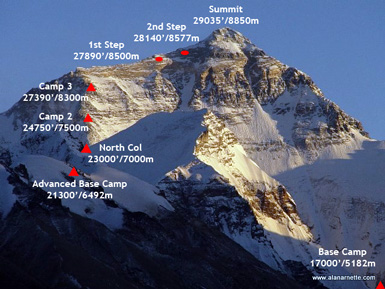
As almost all the teams wind down their efforts on the South side of Everest, try over 100 climbers are in full season on the North. There are at least 10 teams on the Tibet side ranging from two people to the largest team, 7 Summits Club with 19 climbers. This also makes them the largest team on Everest for 2014. Politics Climbing on the North side is a bit different from the south in many ways. When you a permit it includes not only the right to climb the mountain but also transportation and lodging from either Lhasa or Zhangmu  on the border with Nepal. A driver takes responsibility for you hired by the China-Tibet Mountaineering Association (CTMA) and looks after you until you get to Chinese Base Camp at the literal end of the road near the base of Everest. While this may seem nice and organized, it is all about control. The CTMA controls the climbing and Beijing controls the CTMA. A curious development for 2014 is that the Chinese government out of Beijing suddenly began refusing Americans entry visas for climbing. This stopped several Everest climbers plus some on other Tibetan 8000m expeditions like Shishapangma. No clear reason was given. This also eliminated any possibility of Americans moving from the South to the North when the South side issues effectively closed the mountain. Climbing The ropes on the North side are now set by a team of Tibetans who have been trained at the climbing school in Lhasa and are under the supervision of the CTMA. Most teams also use Tibetans to support their climb. There is a high price to bring Nepali Sherpa over to Tibet, as in several thousands of dollars on top of their individual salaries, food, gear, etc. thus financially encouraging teams to use Tibetans instead of Nepali Sherpa climbers. All this said, there are still teams with Sherpas climbing today on the North side. Several of them had relatives and close friends killed on the April 18th serac release but have chosen to continue climbing. The normal climb schedule on the North is similar to the South with a series of acclimatization rotations over a few weeks, then wait for the weather window and go for the summit. The schedule is somewhat paced by the progress of the rope fixing team. The North is measurably colder, windier and dustier than on the South. Often there is less snow making the climbing more difficult with crampons on narrow and steep rock surfaces. There is no objective danger exactly like the Khumbu Icefall with the West Shoulder of Everest but in 1922, 7 Sherpa were killed at the North Col from an avalanche. Historically it has been less expensive to climb from the North, but that is no longer the case as it is similar in price to the South. However, this has attracted budget climbers who did not want to use supplemental oxygen thus there have been a fair number of deaths of climbing in this style over the years on the North. The south side (Nepal) remains more popular with 4416 summits while the north (Tibet) has 2455 summits. Overall 264 people (161 westerners and 103 Sherpas) have died on Everest from 1924 to 2013, 156 on the Nepal side and 108 from Tibet. Of course, Reinhold Messner used the North side for his 1980 true, and only true solo, unsupported, no supplemental oxygen ascent of Everest. Currently Currently, it appears almost everyone is at Advanced Base Camp looking to spend a night or take a day climb to the North Col. I will track and report on their progress through the end of the season. Usually teams on the North have not updated blogs, used social media to the same extent as on the South so it has been hard to track them. But 72 year-old Bill Burke has returned and is doing a nice job of keeping us updated. He is with Asian Trekking. Also, 7 Summits Club always posts great pictures and keeps us informed as does SummitClimb. Another group is the first Everest climbers from Malta. Robert Smith, Adventure Peaks made this post: Yesterday the team climbed to the North Col of Everest at 7050 metres in good style. Despite trying weather conditions, with strong gusting winds and blowing spindrift, everyone made it to our objective for Rotation 1 on the mountain. Seb went a stage further carrying an overnight pack up the fixed lines, and spent the night on the North Col, as part of his acclimitisation to climb Everest without oxygen. He is currently on his way down and we will re-group here before descending further. Today we are heading back down the trail to Base Camp, an easier day but still 6-8 hours walking. Everyone is looking forward to the relative comfort of Base Camp with a lower altitude. The North Col was a new high point for everyone in the group, at 7000m higher than any mountains on any other continent. We are all looking forward to a rest period before our next rotation, and meeting the other Adventure Peaks team who are coming here to climb Lapka Ri. South Update It seems there are at least three teams still at the base camp on the south side: Chinese, Russian and an American science team attempting Lhotse. It is very unclear if the Icefall Doctors are still there even though the Ministry said they should stay and help anyone who wants to climb. John All with the science team posted on Facebook: For now, we wait. We are creating alliances between people who cannot afford to sacrifice the ten’s of thousands of dollars it took to get here – Soldiers for the Summit, a Russian team, a Chinese team – and perhaps as part of a consortium, the ACSP will be allowed to climb and gather the data that will help us better understand glacier dynamics and hopefully avert future tragedy.  The dreadful

Everest 2014: Violence, Threats, Intimidation

Teams are packing on the Nepal side and still climbing on the North as the aftermath of the Sherpa tragedy slowly winds down. A few small teams remain at the Nepal Everest Base Camp holding onto a tiny bit of hope for a chance to climb this year, but it is quickly slipping away. There is a report that a Russian team is still there wanting to climb. If anyone can do it without support it will be these tough climbers. Some news outlets are reporting on another avalanche. It is important to remember that avalanches occur all the time on these big mountains, daily. Most everyone who spends anytime at Everest Base Camp can get footage of slips off Pumori or the Lo Lha Pass above EBC. This is not news or anything unusual. On the North side, teams are now at Advanced Base Camp on their first acclimatization rotations. 72 year-old American, Bill Burke, reports all is well. Other reports say the weather is good. The Triple 8 team on Cho Oyu is making good progress and hope to summit in early May. They continue to look at ways to keep their dream of summiting Everest alive.  South Side Update – Violence and Intimidation In spite of a last minute press release from Nepal’s Ministry of Tourism on Thursday declaring the mountain open and welcome to all climbers, all the major teams whose Sherpa support is required to fix the ropes to the summit choose to leave.  The last few teams that had largest resources, Altitude Junkies, Himex and Asian Trekking ended their efforts late Thursday. Greg Paul with Himex made this revealing post on what really happened. I have mentioned threats and violence but this paints the picture well: It has been 7 days since the devastating avalanche. 5 days ago my group finished their acclimatization cycle on Lobuche peak and returned to Everest base camp. We attended the memorial for the 16 Sherpas who perished. Unfortunately the ceremony was “hijacked” at the end by some Nepalese pseudo guides that are not from the Khumbu Valley and who have Maoist roots. They incite other Sherpas to bully and use violence to get their way. Their purpose seems less about honoring those who died and more focused on getting power/influence. Intimidation has been their primary means to accomplish their power grab. Over the last few days the large expeditions have been canceling their season like falling dominos. First, it was the expeditions that had lost Sherpas that cancelled…which is very understandable. The remaining expedition leaders determined that the icefall was safe and that avalanches were no more prone that any normal year. They also felt that the mourning period had been adequate and climbing Everest would not dishonor those who died. Additionally, they know better than any one that the Sherpas sole source of income come from these expeditions. However, the militant group of violence prone out-of-towners wanted to capitalize on the situation to get long needed concessions from the Nepalase government. They felt closing Everest for the season would get everyone’s attention. First we heard that expeditions would be allowed to climb if they wanted. In reality, the Sherpas on the teams were told their legs would be broken if they took members onto Everest. Expeditions were told to leave base camp within days or they would be forcibly removed. These guys use sticks, stones and machetes to get their way so this was not very comforting news. Another startling perspective comes from Tim Mosedale. This is a long but worthwhile read. Time and again the Sherpas have stated that their argument is not with the Westerners and there is no animosity towards us. Their beef is with the government. They are sorry that we are caught in this tangled web on the sidelines but at the same time we (and the mountain) are being used as political leverage to get what they want. Obviously everyone wants better working conditions for the Sherpas but by holding us to ransom they are controlling the situation. In addition to the shattered lives for the families of the fallen Sherpa, there are also shattered dreams. 18 year-old Alex Staniforth probably summed it up : It’s with bitter disbelief and immense disappointment to confirm my Everest 2014 expedition is over. I am utterly gutted- I cannot pretend otherwise.  Sadly this is entirely due to civil strife and politics- circumstances fully beyond our control. Our expedition leaders fought very hard and decided we would persevere until the very end unlike most of the other teams, in the hope this very frustrating and difficult situation would be resolved. Sadly as other teams pulled out the strength in numbers disappeared and the pointless politics got no further. This morning Henry Todd, our base camp manager told us we too had no option but to head down. I will never forget those gut wrenching words. Shutting Down A huge issue now in how to get all the equipment they had already carried to Camps 1 and 2 in the Western Cwm back down given the issues withe the Icefall. Eric Simonson, IMG, posted this update: In what may be a precedent-setting move, the Ministry has now granted permits for gear flights to the Western Cwm. IMG has teamed up with seven other Everest teams to charter a B3 helicopter tomorrow to insert a team of sherpas at Camps 1 and 2. There are now four companies in Nepal that operate this more powerful turbo-charged version of the AS350. For IMG, we plan to send Phunuru and Chewang to Camp 2 and Kami and Karma Rita to Camp 1. Their mission will be to finish dismantling those camps and get all the gear either sent down to Base Camp by helicopter or secured for next year’s climb.  The maximum payload for one flight to/from Camp 1 will be about 200 kilos and to/from Camp 2 will be about 100 kilos, depending on the fuel load, temperature, wind, and