Denali 2026 Coverage: Podcast with Summiteer – John Bartolic

The Denali 2026 season is well underway, with a dated climber report as of June 1, 2026, of 513 climbers, mainly on the West Buttress route. 97 climbers have completed their trips, and 381 are left to check in and begin their climbs. One team that did summit was one from American Alpine Institute and Summit Coach client, John Bartlic
John, a Southwest Airlines pilot living in Dallas, Texas, is relatively new to mountaineering, with a Rainier summit last year and a Pico de Orizaba summit a few months ago. His next includes Kilimanjaro and Everest. We discussed everything from motivation, training, gear, clothing and weather to logistics and had a special remembrance of Mayor Stubbs of Talkeetna, Alaska, who died in 2017. I met Stubbs in 2007 on a climb. #Denali2026
If you would like to be notified when my memoir, “Hard or Impossible? Summiting K2 for Ida is available – I’m still looking for an agent. Complete the form at the bottom of this introduction page: https://www.alanarnette.com/memoir
Live from Denali Summit with Garrett Madison
Live from Denali Summit with Garrett Madison in a season of the lowest summit numbers in history from the summit of Denali on June 14, 2025. It’s been a very cold year, as documented by the Rangers: # Denali 2025
Rainier 2015: Summit and Fun
This trip report is for my climb of Mt. Rainier in Washington State, Washington. At 14,409 feet, it is the highest volcano in the lower 48 states of the US and the most popular way of training for higher Himalayan peaks. I summited with friends on July 8, 2015. I rolled over in my sleeping bag at 10:30 pm on July 7, 2015, hearing voices over the wind flapping the tent against me. It was time to climb Mt. Rainier. My close friend Barry Johnson had set this objective a year ago and trained diligently to get prepared. Fresh off my tragic experience attempting Lhotse in Nepal only two months earlier, I had committed to climbing with my friend but now had serious second thoughts about getting back onto the snow slopes. I hedged my decision for weeks. Barry waited for me to decide but had already assembled a solid team. As the aftermath of the deadly earthquake that took almost 9,000 lives in Nepal and our team doctor at Everest Base Camp quieted, I finally made the decision I needed to climb again, not only for Barry but for myself. This would be my third climb of Rainier, with summits in 2004 and 2012, so I knew to sit on the left side of the airplane as we flew from Denver to Seattle. About 30 minutes before landing, the huge volcano appeared on schedule. I’m always amazed at the sight of Mt. Rainier from the air—it is large, foreboding, snow-covered, and well, it demands respect that seems to be waning for all mountains across the planet. While Barry got our rental car, I retrieved our two duffel bags. We had compared gear lists for weeks with those of our teammates. We were determined to keep the weight down as we knew it was a short trip but a long summit day in potentially difficult snow conditions. One of Barry’s pilot friends, Terry and his partner, Lisa, met us at a tiny motel in Enumclaw that night. We had a fun dinner in town and, the following day drove to the ranger station at the White River entrance. There, we met up with our fifth member, Sarah, an impressive 26-year-old just starting her career as a guide for RMI on Rainier. This was not a guided climb but a group of friends with a common goal. Hiking In We confirmed our permit and listened carefully as the Ranger spoke of open crevasses, climbers punching through snow bridges and soft snow conditions. Oh, and bears and foxes. We left prepared but thoughtful of what was to come. Barry was typical, blasting out Rush songs with no warning whatsoever. At the parking lot for the Glacier Basin trail, we spread our gear out to look for duplication but also to make sure we had the essentials: wands, rope, harness, pickets, screws – everything needed to attempt this 14,409’ hill of snow safely. We packed up and headed up the trail. I’m always impressed with the enormous vertical trees surrounding Rainier. Each one has a story to tell, their trunks strong and seemingly impervious to the winds. The small streams cross the trail with the single-minded objective of joining up with a larger flow down below. But as we made the first of several switchbacks, we were greeted with a prize: Rainier, with all her glory, emerged from behind the forest. The Emmons Glacier stood out, as did the Winthrop, Liberty Cap and the summit. The crevasses were visible from here, looking like a heap of jumbled ice cubes, cracks and lines that dared the brain to make sense of them, but more to the point, dared the climber to test them. We arrived at Glacier Basin camp in a couple of hours. We had purposely set a relaxed schedule, spreading the entire climb from start to finish over four days. We were not out to prove anything with speed, times or bragging rights. Our team objective was to summit, but our objectives varied greatly. Lisa wanted to get to Camp Schurman to relax and reflect, but not to summit. Terry, like Barry, wanted to make his first summit of Rainier to test themselves for perhaps bigger climbs one day. Sarah wanted to climb with friends, not as a junior guide under the ever-present eye of members and senior guides. I wanted to reconnect with the sport I love, my passion. I wanted to hear my crampons crunch in the snow, watch the sunrise, and feel the cold wind against my cheeks. I wanted to climb. And I wanted to see my friend summit and then return home to tell his family of his experience with the wide eyes of a child who had just done something special. To Camp Schurman After an uneventful night at Glacier Basin, we packed up and made our way to the base of the Inter Glacier—the gateway for this route. Only about 25% of all climbing on Rainier is done by the Winthrop-Emmons route, but it accounts for half of the deaths due to the dangerous crevasses. With this in mind, we began our climb with an eye to the crevices. The ranger had told us there was one large open crevasse about halfway up. Making decent time ascending the glacier, we soon crested the Inter near Camp Curtis. We took time for a long break and a huge lunch—we were in absolutely no hurry and enjoyed the views and the company. Lisa was generous with her gouda cheese, naan bread and salami. We took full advantage of her generosity! Soon, we moved on and slipped a short distance down the scree-filled dirt hillside to the Emmons Glacier. Terry flaked out the climbing rope, and soon, we were roped up as a five-person team. Barry took the lead. I clipped in behind my friend, Sarah, who took the back. We came to our first snow bridge, Barry’s and Lisa’s first ever. With care and smiles, we
Denali FAQ

These are FAQ from my three Denali climbs
Denali Home
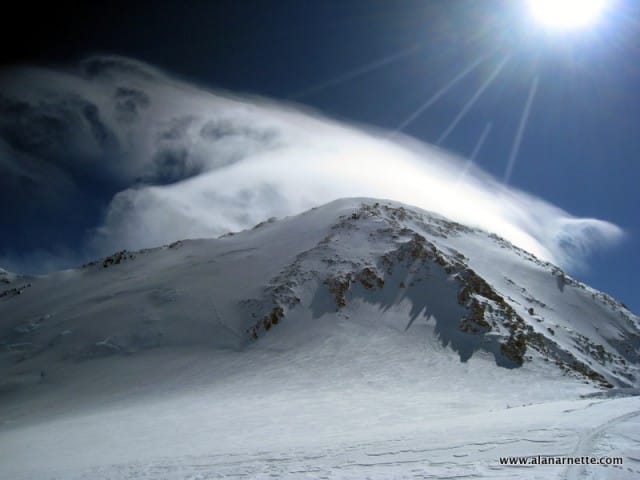
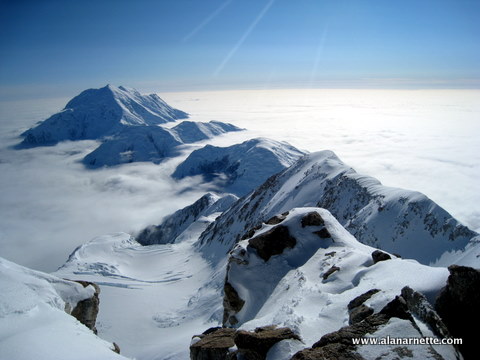
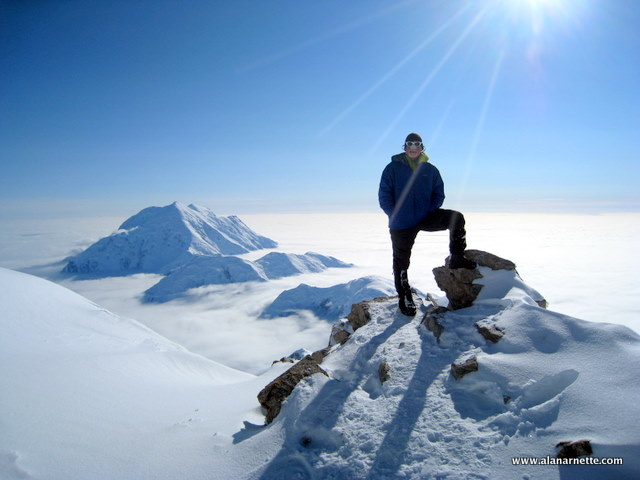
North America: Denali (20,320’/6194m) Denali is the native American name for the mountain. In 1980, in honor of President McKinley, the National Park Service named the surrounding park Denali National Park. In 2015, the mountain’s name was officially changed to Denali. It is in central Alaska – 300 miles South of the Arctic Circle and 200 miles East of the Bearing Sea. Denali offers some of the largest vertical gain of any mountain on Earth. With base camp at 7,200′ and the summit at 20,310′, this 13,110′ gain over twelve miles is larger than Cho Oyu (8,407) or even Everest (10,535). The biggest threat to Denali is the weather. It is well known for socking you in for days with high winds and snow. 45,411 climbers have attempted Denali, with 23,426 summiting, a 52% success rate. Almost 125 have died, including 11 in 1992. The second highest mountain in North America is Mt. Logan in Canada’s Yukon, at 19,551’/5959m, 385 miles southeast of Denali. Similar to Denali, Logan is a vast massif with eleven peaks. Logan is believed to have the largest base circumference of any mountain. The normal route is straightforward, but the weather is a significant problem for Logan, as it is for Denali, in addition to being so remote. Here’s a look at the summit stats for the popular West Buttress route from 2000 to 2024, along with the most popular summit day: Denali West Buttress Route source: National Park Service Year Total Summits % Top Summit Date # 2024 523 50 2023 308 30 2022 745 70 2021 490 52 2020 CLOSED FOR COVID 2019 793 65 2018 463 44 June 8 67 2017 461 41 May 31 54 2016 647 60 June 16 83 2015 589 57 June 15 87 2014 404 35 June 4 99 2013 729 68 May 27 56 2012 460 40 May 27 56 2011 623 55 May 27 & 30 45 2010 630 56 June 21 54 2009 649 60 June 7 77 2008 652 58 May 30 91 2007 513 47 June 12 77 2006 545 52 May 29 50 2005 716 59 June 15 101 2004 628 54 June 4 71 2003 556 58 June 12 115 2002 575 53 June 13 56 2001 670 60 June 4 69 2000 556 53 June 3 71 These are some quick facts from the NPS for 2024: Climbers from the USA: 639 (64% of the total of both Denali and Foraker registrants) US climbers came from all over, with representation from 46 of the 50 states, plus the District of Columbia. Consistent with past years, most US climbers came from the following four states: Washington State (95), Alaska (81), Colorado (79) and California (36). International climbers: 362 (36% of total) Denali National Park welcomed international climbers from 51 countries this year. Once again, the top was Canada (40), followed by the United Kingdom (38), Poland (20), and China, India, and Japan, each with 17. Average trip length: The average trip length (regardless of outcome) for non-guided groups was 14 days, with guided Denali climbs averaging 17 days. Isolating just the climbers who reached the summit increased the statistic to 20 days. Average age Submission of a climber’s age is now optional when applying for a Denali permit. Based on the individuals who did disclose their age this season, the average age for male climbers was 39, while women averaged 36 years old. The youngest climber was 15, and the oldest was 75. Women climbers Women comprised 16% of climbers on Denali and Foraker, or 161 individuals—down from 2023 when 197 women (19% of the total) attempted Denali and Foraker. Denali Resources I have climbed on Denali three times. You can read about my climbs through these links: Denali Home Denali FAQ Denali 2011 Denali 2007 Denali 2001
Denali 2011 Trip Report

My third attempt on Denali, the highest in North America as part of my 7 Summmits for Alzheimer’s campaign in 2011.
Denali 2007 Trip Report

This is a very personal, detailed and sometimes graphic report. It chronicles my attempt on Denali in June 2007. My intent is to bring readers into my world of high-altitude mountaineering by showing the incredible rewards, the obvious dangers and what happens when the human body hits the wall. Remember to click on any picture in the report to enlarge it then use the back arrow to return to the report. Denali 2007 was the first of four climbs for my return to Mt. Everest: Memories are Everything® journey. I aimed to raise $100,000 for the Cure Alzheimer’s Fund (CAF) by using the Denali, Shishapangma, Orizaba, and Everest climbs. My hope was/is to summit each peak and raise awareness and money through real-time dispatches sent directly from each Peak. I left Denver International Airport for Anchorage on June 10, 2007. With Everest in the plans, Denali was almost an afterthought for my journey – a familiar climb designed to test my body once again against the rigors of high altitude. I was there in 2001 and was turned back by poor weather at Denali Pass or 18,200’. I was confident I could make the climb, weather permitting. My only concern was the heavy loads involved: 120 lbs split between my pack and sled that needed to be hauled up almost 2 miles purely through my strength. Hey, I am 50 years old! The week before I left, I worked closely with the CAF’s Tim and Katie to coordinate both websites to post my dispatches and receive donations marked for the Memories Are Everything® fund. My training was as good as it would be, thanks to some challenging climbs in the Colorado Mountains with my partners Patrick and Robert. Leaving Colorado, I felt confident, strong and nervous about the year-long commitment I had publicly announced. What if I failed? What if I didn’t summit this “familiar” climb? What if… I met my guides and teammates at the Alaska Mountaineering School (AMS) on June 12 in Talkeetna, Alaska. I selected AMS due to its reputation as a solid guiding company with an excellent record of safety and success and its focus on the basics. I felt this reputation would attract more competent climbers, enhance my chances of success, and, more importantly, deliver an overall positive experience. Christian March was the lead guide. A young man of 27 years, he shook my hand with an air of confidence and gave orders on what to do and how to do it. I liked him immediately. Next, I met his assistant, Leighan, an impressive 26-year-old native Alaskan who oozed with personality. She gave immediate life to the team. Soon, the other five climbers arrived at the old house AMS had converted into their offices. They were a diverse group, including a father-son pair, a banker, a tattoo studio owner and a British law enforcement officer. Most had good mountaineering experience, and all were eager to summit Denali. Thus, the team was set. Scheduled to fly out the next day, we rushed to check our gear and review some basic glacier travel skills. But the weather in June 2007 had been challenging. Colder than normal temperatures and high winds had reduced the usual 50% summit rate to a very low 33%. And it continued. Our flight to the Kahiltna Glacier was delayed for two days. We rushed to the airstrip twice to load the DeHavilland Beaver Turboprop, but we were told the flight was canceled. So we bided our time in the township of Talkeetna by doing more “classes,” as AMS calls their review of skills, and scrambling at the last minute to find a place to spend the night. We also enjoyed the sights and entertainment of the local bars and restaurants. Remember that Talkeetna has one main road – paved, that is – and is straight out of the television series Northern Exposure. It’s a great place, to be sure. Finally, we got the word on June 14th, we would be flown to the glacier. The flight is one of the best I have ever taken in my mountaineering travels. Second only to the landings at Lukla, Nepal, in the late 1990s when the landing strip was dirt with Yaks crossing it and pilots who chatted casually as the plane appeared to be on a direct collision course with the steep mountain side! But this flight, smoothly operated by Paul Roderick, the owner of Talkeetna Air Taxi, was more like a scheduled commercial flight – no wait – better. We rose to about 10,000’ over the Alaskan tundra as we approached the Alaskan range. Mounts Denali, Foraker and Hunter stood proudly above the rest of the snow-covered mountains in the range. Another plane passed by a quarter of a mile away with sightseers. I thought about the fact that their journey would end in half an hour, ours in 21 days. “500 feet,” announced the comforting female voice of the automated flight systems as we flew over a high mountain pass. Paul banked the Beaver to the right as we approached the “landing strip.” Memories of my 2001 climb came back, and I felt the adrenaline flow as we made the steep descent and abrupt landing on the hard-packed ice. I had made it back. Now, all I had to do was climb Denali and get home safely. Due to poor weather, over 200 climbers were stranded for several days. So, as the plane spun around, we saw a refugee camp of climbers with the 100-yard stare in their eyes, drooling at our tiny 8-person plane. I was slightly afraid of a rush to take it over, but the National Park Service (NPS) has Rangers at the base camp (BC) to organize flights in and out. All quite civilized, as my British friend would say. Our first order of business was to unload our gear from the airplane—a 60-lb pack each, over 500 lbs of food, three tents, stoves, fuel, and God knows
Denali 2001 Trip Report

Denali is in central Alaska – 300 miles South of the Arctic Circle and 200 miles East of the Bearing Sea. In July 2001, I flew from Denver to Anchorage, drove to Talkeetna, and took a bush plane to land on the Kahiltna Glacier to begin the climb using the West Buttress route. Denali offers some of the largest vertical gain of any mountain on Earth. With base camp at 7,200′ and the summit at 20,310′, this 13,110′ gain over twelve miles is larger than Cho Oyu (8,407) or even Everest (10,535). The biggest threat with Denali is the weather. It is well known for socking you in for days with high winds and snow, and this trip was no exception. We had pristine weather until we reached the High Camp at 17,000, when a front moved in, pummeling us with high winds, cold temperatures and blizzard conditions. The National Park Service issued a rare “evacuate the upper mountain” warning just as we arrived. We stayed a few more days, hoping for a break, but it was not to be. The trip up from base camp at 7,200′ was easy and straightforward. I found the sleds not to be as big of an issue as many people said by balancing my load between the sled and my pack. We followed the normal schedule of establishing camps and caches so that we climbed high and slept low. This way, we moved about 1,000′ a day from 7,200′ to 16,200′ in about 8 days. After arriving at base camp on day 1, we set up tents, dug a 6-foot cache and prepared for a short night. Up at 3:00 AM, we packed all our gear and moved camp up the Kahiltna glacier to 7,800′. The next few days were spent moving gear by sled and pack to caches at 10,100′ up Ski Hill, then to the base of Motorcycle Hill at 13,300′ and finally around Windy Corner to 13,800. We returned to the previous camp each night before moving beyond the previous day’s cache to a higher camp. When we reached the basin camp at 14,200, everyone was in high spirits. In fact, everyone was feeling so good that we skipped a scheduled rest day and climbed the 2,000′ headwall to establish the next cache at 16,200. With the weather and our health holding, we moved camp the next day to the High Camp at 17,200. This was the longest, most difficult day thus far for most of us. Once at High Camp, some people began to feel the effects of the high altitude. Symptoms ranged from mild headaches and lethargy to severe headaches, nausea and a lack of motivation to continue. It was very disappointing, given how well everyone had been feeling. We attempted a summit bid the following day since the weather was deteriorating quickly, and we knew it may be now or never for us. We made it to Denali Pass, where we were met with gusts of 60 mph, snow and extreme cold. When Bill Allen, owner of Mountain Trip and our guide, saw a lenticular on Foraker and another forming directly above us on Denali summit, he called the climb, and we returned to High Camp. The next day, we sat outside in our tents with a blizzard howling. A few of us were prepared to attempt the summit again the next day, but with high clouds, plumes flowing from the ridge, and forecasts for more of the same, we decided to return to base and make this trip to the mountain. Upon returning down the ridge to the basin camp, I hit a spot of soft snow with my right foot and hurt my knee when I twisted between my self-arrest and crampons, catching into the loose snow. It appeared to be an ACL tear but ended up being a severe strain, and nothing was torn. My trip down the fixed lines of the headwall was slow and painful. The following day’s 7,000′ return to base camp was the longest day of the climb. I had incredible support from my teammates – thanks, guys! While coming within 2,000′ of the summit was disappointing, we had a great time, and everyone gave it their best. I was very pleased with how my body behaved once again at high altitudes, especially to the heavy loads. Before this climb, I knew I could control two critical variables: conditioning and attitude, but not the weather. In this case, two out of three were not good enough to make the summit. Next time! Denali Resources I have climbed on Denali three times. You can read about my climbs through these links: Denali Home Denali FAQ Denali 2011 Denali 2007 Denali 2001