Autumn 2022 Himalayan Season: Mass on Manaslu – Rope to True Summit

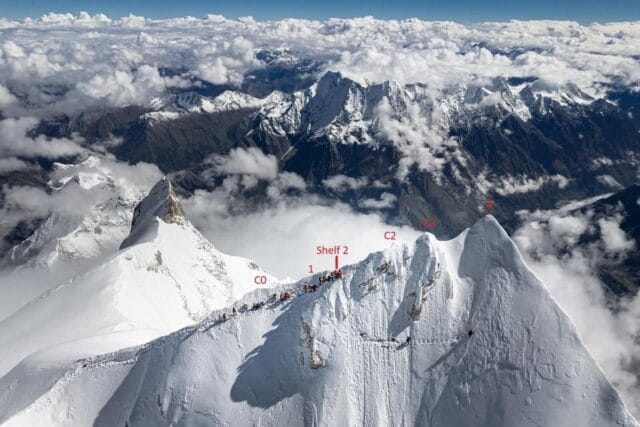
The fixed ropes are now to the true summit of Manaslu. As expected, Manaslu is overrun with clients and a greater number of support climbers. Thus far, the Nepal government has issued 394 permits to foreigners, so considering a 1:1.5 support ratio, that puts close to 600 people on the peak, with more to come.
In an interesting twist, a few climbers who climbed all fourteen of the 8000ers are returning to Manaslu to correct the “sins” of the past by tagging the true summit. I don’t expect all of the people on Manaslu to attempt the true summit unless the conditions are extremely safe, or for example, a boot path is created that allows beginner 8000er climbers to simply follow a trail. Most will be content to tag the fore summit and move on to other 8000ers next spring.
Autumn 2022 Himalayan Season: Manaslu and More!
Repost due to error in first post. My apologies
The autumn climbing season is underway, with most of the attention on Nepal’s Manaslu, oft acknowledged as one of the more “attainable” 8000ers. However, many things changed last year when one team showed an alternate route to the true summit, thus turning scores of climber’s previous claims on their heels, including my own.
With an expected record crowd on Manalsu, I hope we don’t see a repeat of this spring’s and summer’s poor practices with respect to trash, excessive support, and excessive supplemental oxygen on Manaslu. However, with so much demand for these 8000ers, nothing surprises me anymore.
For many, the allure of the 8000ers is gone, as interest in following masses of inexperienced people led by massive support leaves a sour taste for many avid climbing fans. In many ways, the 8000ers have become like Kilimanjaro, Denali, Aconcagua, or the rest of the Seven Summits, attracting too many people seduced by summit promises, low prices, and rock-star style leaders. I fear we are only one unexpected situation be it weather, ques or competence from a major tragedy on the big peaks. That said, if you have the skills and experience plus choose the right team, route, and season, climbing these beasts will change your life for the better.
Manaslu 2013: Final Trip Report
Part of every big climb is to document it with a complete trip report, pictures, frequently asked questions and perhaps a video. All this is now complete and posted on my main site. These are the links: Manaslu 2013 Trip Report and Video Picture Gallery Frequently Asked Questions Expedition Dispatches If I were to summarize my experience, I would have to say it was one of the more satisfying expeditions I have undertaken. I felt very well prepared as a result of my training but also felt I was able to apply my previous 8000m experiences in a way that I had not been able to in the past. I was extremely pleased with Phil Crampton and Altitude Junkies. They provided the right amount of support without being overbearing. And their food was amazing. I did not loose weight for the first time on a big climb. People always ask what’s next. Well, to be honest, I don’t know. I have dreams and will see if I can make them real but if I only climb here in Colorado, that will be fine – there are many peaks I have not touched, routes to be explored and skills to be developed. I understand how fortunate I have been to have climbed where and what I have. Finally, while the objective is to climb a mountain, my teammates made this climb especially enjoyable. Please enjoy a few pictures below. As always, I want to ask that if you enjoyed following my climb, please consider making a donation to one of the Alzheimer’s non-profits. 100% to them and nothing ever to me. OK, take a visit to the report and pictures. I hope you enjoy them as much as I enjoyed making them. Let me know what you think. Climb On! Alan Memories are Everything
Manaslu 2013: Summit Report
Thanks to everyone for following my climb of the world’s 8th highest peak, healing Manaslu at 26, thumb 759 feet or 8156 meters. I summited the true summit at 9:40AM on September 25, 2013 after leaving the high Camp at 3:10AM. The time included waiting for almost 1:30 minutes for the final rope to be fixed to the true summit. The true summit of Manaslu is the absolute scariest spot I have ever climbed. It consisted of a narrow cornice with soft edges that dropped off over 3,000 feet. As I made my final steps to the true summit, my left foot pushed off a small section of the cornice. I watched as the snow fell gently down the sharp rock and snow wall. It was a moment that caused my heart to skip a beat, my lungs to stop and a sense of history, purpose, focus and resolution that garnered all my attention. The overall climb of Manaslu was shocking. Trust me, it is not an “easy” 8000 meter mountain. The climb between Camp 1 and 2 was technical, meaning ice axes, steep (60 degree) snow climbs and rappels that required all my years of experience. The climb between Camp 3 and 4 was unbelievable steep with over 400 meters (1200 feet) of snow slopes combined with some steep snow climbs. It took me five hours but for some climbers it was a 12 hour day. The route in 2013 was extremely different than in 2012. The avalanches had changed the terrain, the glacier had moved sharply. All this required the Sherpas, primarily from Himex and Altitude Junkies, to work hard to fix a safe route to the upper mountain. In the end, it was done but took on a new level of difficulty not seen on Manaslu in years. I am very proud of our team. Those who summited demonstrated experience and determination. Those who didn’t, learned a great deal about themselves and extreme mountaineering that will serve them well on future climbs. For me I continued to learn about how to set and accomplish hard goals, take care of myself and the struggles of reaching one of the highest mountains on Earth. These lessons apply to my daily life as well and to those Alzheimer’s caregivers. I had the opportunity to speak at length with many mountaineers such as Phil Crampton of Altitude Junkies, Russell Brice of Himex and Purba Tashi Sherpa, the world renowned Himex Climbing Sidar, Chhang Dawa Sherpa, who recently completed climbing all 14 of the 8000m mountains and now runs Seven Summit Treks plus Tunc Fundik, Turkey’s top climber. It was interesting to discuss the change in mountaineering, the Sherpa culture and, of course, Manaslu this season with these experts. I will post my interviews at a later date. As always thanks to those who contributed to the Alzheimer’s non-profits, Your donations go 100% to the non-profit and never to fund my climbs. Thank you. I’m sorry that my dispatches came to an abrupt halt. There were technical issue that I could not resolve while on the mountain. For now I will take to easy in Kathmandu before returning home. The full summit report and more pictures is now available. Climb On!AlanMemories are Everything
Manaslu 2013 Audio Dispatch
This is a new audio dispatch from Alan Arnette as I climb the 8000m mountain Manaslu in Nepal. Climb On! Alan Memories are Everything
Manaslu 2013 Audio Dispatch
This is a new audio dispatch from Alan Arnette as I climb the 8000m mountain Manaslu in Nepal. Climb On! Alan Memories are Everything
Manaslu 2013 – Leaving for the Summit
Weather is often the most unpredictable part of an 8000m expedition other than health. You can control some factors around health but for weather, well not so much. We went to sleep on Thursday night to a light rain that developed into a full on storm throughout the night. Many times I awoke to a heavy onslaught of rain on my tent walls as I was lying there wondering what was happening high above us on Manaslu. On Friday morning, the answer became clear. It snowed about a foot at Camp 1 and twice that much at Camp 2. A French team at C2 made a hasty re to Base Camp and others postponed all movement due to avalanche and dangerous route conditions. As much as everyone was concerned, this was very normal for any large mountain much less on Manaslu notorious for bad weather. Over breakfast we adjusted our minds to the notion that we would be waiting at least a week for this new snow to settle and taking into account that another storm was predicted for Tuesday. It rained all day on Friday. We huddled in our tents sleeping, reading or moping. It was a dark and dreary day. But then around 5:00PM on Friday, Russell Brice paid our camp a visit. He and Phil Crampton work very closely together coordinating, route fixing, Sherpa and member rotations. They also compare weather forecasts. Phil’s from the US and Russ’ from Switzerland. There was a change! The new forecast showed the next weather wave not occurring until September 26 or 27. This meant if we left on September 21st we could do an orderly climb through the four camps and summit on September 25. Another forecast from a Belgium service confirmed the long window then yet another update from Michael Fagin in the US extended the good period to 7 days. We were back on!! The Altitude Junkies Sherpas went up this morning to pull the lines out of the snow, repair a fallen ladder and break trail back to camp 2. Tomorrow, the Himex Sherpas will continue to work to camp 4 thus opening the route for summit bids. We are all busy packing for the summit push this morning, Saturday September 21. The plan is to spend one night each at Camps 1, 2, 3 and 4 then leaving for the summit in the early morning hours of September 25. We will return to Camp 2 or even all the way back to Base Camp the same day depending on weather and health. I will do my to post a very brief audio dispatch on this site from each camp and the summit but the communications have been difficult this year so always remember that no news is good news. Also the final authority on our expedition is from the Altitude Junkies official site and not mine. I will have no way of responding to any email, or comments on my blog, Facebook or Twitter until I return to Kathmandu but please leave comments. The last 36 hours has been a case study in climbing big mountains. We have had contradicting information, incorrect on-mountain reports, direct sightings that create confusion, the wave of up and down emotions, different coping mechanisms and everything else that goes with setting a difficult goal and getting close. We have gone through the oxygen systems, spent time getting to know our individual Personal Sherpas and reviewing exactly what we need for a safe summit attempt. We are all in excellent health and better spirits. The team dynamics are some for the I have seen on one of these big expeditions. If for some reason, the weather turns bad, we have time for a second attempt but right now it looks great for a summit next Wednesday, Nepal time. This is what we do. This is what I do, climb mountains. I have a nervous flutter in my belly. This will be my first real test after Everest, over two years ago. I am two years older. Manaslu’s route conditions are as difficult as the Sherpas have seen in the least six years. I know this will be hard but not impossible. Once again, I draw strength from using my climbs to send a message of hope, need and urgency for Alzheimer’s. My goal is to stand on the true summit, not the fore-summit. This means crossing a narrow cornice or snow ridge of about 20 feet. Yes, short but significant in the mountaineering world. I will do everything I can to reach that goal without putting Passang, my Sherpa partner, in danger. Whew. Time has come. To my followers, thanks for your ongoing support for my climbing and Alzheimer’s causes. To my climbing partners – well you know. And for my family. I miss you and love you deeply. mulu Climb On! Alan Memories are Everything
Manaslu 2013 – Dramatic Changes
The thin white nylon rope snaked straight up, the footpath went directly ahead rounding an icy corner before gaining elevation. I looked around for guidance on the route to Camp 2 on Manaslu but found myself alone; no teammates, Sherpas, guides from other teams – no one around. I was alone and needed to continue climbing this 8th highest peak on Earth. Manaslu is a different mountain in 2013. The low snowfall has left the previous route fraught with crevasses. The fixed line from last year is drawn tight a hundred feet in the air with aluminum pickets swinging in the wind. Movement of the glacier and snow had changed what was known. The Sherpas had to work very hard to find a new route through a labyrinth of house sized ice blocks, frozen icy walls and steep snow slopes between Camps 1 and 2. This section is known as the technical crux of the normal route and it was living up to its reputation. Even long time Sherpas shook their head in amazement at the difference in the route this year. As I looked at my options, I choose to follow the rope. The footpath ended on a thin sheet of ice creating a deadly snow bridge over a bottomless crevasse. The gully was a better option. The climb was steep, perhaps 60 degrees which in climbing terms is steep. The snow was already mushy at 10AM this morning. We were one of the first teams to do an acclimatization rotation to Camp 2 so there were no steps kicked into the narrow gully. I took my jumar off my harness and attached it to the rope as I simultaneously kicked the front points of my crampons into whatever I could gain on this narrow, one hundred foot tall snow gully. I kept my 70cm, long handled ice axe out using it as another grip. I wished for my two short handled axes I used back in Colorado for ice climbing. Step by step I gained elevation, my breathing increasing as I was quickly passing 20,000 foot in attitude. My pack was loaded with my down suit, sleeping bag, pads, food and water. It was a load that emphasized that I had taken the right approach to training the previous six months by climbing my 14ers with 30 to 40 pound packs. As I crested the top of the gully, I paused and looked behind. I wondered how it would feel in a week or so when we returned for the summit climb. The route continued in a teasing series of steep up-climbs followed by a brief plateau. The route switchbacked painfully, showing no mercy. More shorter gullies required a repeat of the initial “bottleneck” section in this area often called the Hourglass. In what had taken three hours in previous years was taking climbers five, six even eight hours in 2013. I settled into my 8000 meter pace trying to find a steady rhythm, a pace that made progress but did not tax my cardio beyond its capacity. My mind went into a place between subtle awareness and a subconscious autopilot. The clouds formed quickly then dissipated bringing out a harsh sun that told me to take off my shell jacket. But just as quickly they returned along with a slight breeze that made me glad I had it on. I followed the rope, clipping in with my carabiner as I hopped over countless crevasses of varying widths. I was climbing this mountain, not hiking. It felt good. It felt real. Climbers from various teams spotted the white mountainside ahead and behind me now. I lost track of my five teammates. As I took a break to finish off my one liter of water, I looked around. The view revealed high Himalayan mountains in all directions. Snow covered, sharp summits, long ridges; the variety of mountains offered so many more climbing challenges than this one popular peak. Many climbers were using Manaslu as a warmup for Everest. In many ways, this section was more difficult than anything they would experience on the world’s highest peak. Once again I crested a slope but this time was greeted by a single yellow tent, a classic, a Bibler. I went past it to gain yet another crest but this time saw more tents – a pair of lines with 20 tents in all. They belonged to Himex. Ours was on a ridge slightly higher revealing an unobstructed view of Manaslu’s South Pinnacle and the route to the higher camps – three and four – the route to the summit. I dropped my pack heavily on the snow. Phil Crampton greeted me. Paul was already there. It had taken me five hours. I felt good as I sat on my pack to remove my crampons. Phil congratulated me as Paul had made a brew to replenish my empty bottle. I returned the favor for my following teammates a bit later in the afternoon. Phil then gave an ominous warning. “Do not walk around here in your boot liners. It is icy at night and if you slip you will fall into that crevasse.” He said pointing downslope to a huge open crack nestled between steep snow covered walls. “There is a body in the crevasse from last years avalanche.” He paused and stared. The next two nights went slowly as my body reacted to the reduced oxygen content. I shared a tent with PK. We took turns melting snow to rehydrate meals, for hot drinks or just simple drinking water. Each pot took over 30 minutes to melt at this altitude. Around sunrise and sunset the winds would pick up. The midday heat inside, and outside, the tent was tortuous. There was no escape, the only choice was to strip to the bare essentials, sip water and stick a bare foot or hand outside the tent into the cold snow. With the sunset, a welcome cold enveloped the tent. Down jackets
Manaslu 2013 – Camp 1 Success
The first test of a Himalayan expedition is the climb to Camp 1. This is when you know if you trained hard enough, you are taking care of yourself and what the mountain is saying. Our climb to tag Camp 1 was successful on all counts. Everyone did well. I was pleased with my own performance and felt that my endless summer of climbing Colorado 14, cheap 000 foot mountains was a good investment. We left Base Camp around 6:45 AM on September 11. The route was obvious as other teams and Sherpas had already been to Camp 1 and in fact have Camp 2 established. The glacier was extremely dry. The crevasses were obvious. I was surprised at the depth of many of them, a constant reminder that there are no “easy” 8000 meter mountains and we must always remain aware and sharp. We reached Crampon Point after an hour of steady walking on rock and slabs. There we switched to snow travel. With crampons on and harnesses attached to the thin nylon safety line, we moved higher. The slope was kind never gaining more than 20 degrees but the final slope increased slightly as did the altitude reminding us of where we were and this was not a simple walk. We carried sleeping bags or down suits on this trip and left them in a tent at Camp 1. Our next trip will be to spend a night there and move on to Camp 2 for at least one more night. Thus far the weather continues to be predictable – low clouds all day with rain in the afternoon. But at Camp 1 we were above the clouds providing some astonishing views. I must admit, that the upper slopes of Manaslu look sharp and dangerous with hanging seracs. Our route should avoid these dangers but the avalanche of 2012 is a content reminder that climbing in these conditions can be unpredictable. All this said, it is exhilarating and feeds the mountaineer inside of me. After our quick 5 hour round trip to Camp 1, the Altitude Junkies Sherpas played the Himex Sherpas in a few games of volleyball. Yes, Himex has a volleyball court setup in their camp, a one minute walk from ours, complete with net and lines. A large group of spectators gathered in the damp mist to watch Himex take the match in a convincing style. Phil Crampton was our only Westerner to play while Russell Brice walked through the crowd offering candy bars. All in all a lot of fun on a dreary day! Our team continues to do well with spirited conversation during meals, shared anticipation of future climbs and an ever growing missing of family and home. In this spirit, Paul wants to wish Kate a happy 13th birthday. I’ll provide another update probably early next week after our Camp 2 rotation. Climb On! Alan Memories are Everything
Manaslu 2013 – Base Camp Life
Base Camp for any long expedition becomes home away from home. You establish walking routes between tents, viewing positions of the high mountain, and meeting spots with other teams. Your tent becomes your private re, and the dining tent is the common area. We arrived on Saturday and have spent the last couple of days getting settled. We had our Puja today, September 10, and will go for a short day climb to Camp 1 on the 11th. I am quite pleased with our excellent Altitude Junkies Base Camp. Sitting on the rock moraine of a receding glacier, we have the usual assortment of tents: sleeping, dining, cooking but there are also two dedicated toilet/shower tents with on-demand hot water and sit down toilet. I took a hot shower yesterday, my first since leaving Kathmandu and can report it was excellent. I’m currently writing this update in the communication tent complete with table, chairs, lights, solar and 12 volt battery access for power. Phil provides four laptops. There are multiple Bgans, hi-speed devices that connect laptops to satellites for internet and email access. Phil charges us at his cost with no markup. All this works well but is still a bit expensive so everyone limits their activity to emails or, for me, a dispatch of two :), no surfing the internet. It is the nicest communications setup I have had on an expedition. We also have a huge tent used to store the group gear, food and our duffle bags so our sleeping tents stay clean and uncluttered. While those of you not familiar with expedition base camps may laugh at all this, others will recognize these luxuries as not often seen on Himalayan expeditions. All things considered, it is a very comfortable setup and allows us to stay focused on the climb through good nutrition, hydration, hygiene and rest. We are surrounded by high rock walls some covered in glacial ice. An occasional avalanche creates a loud bang causing everyone to stare in earnest but they are far enough away so as not to present a danger to Base Camp. The view of Manaslu’s iconic east pinnacle dominates the view to the west. The true summit remains hidden away but we can spot our high route and where our Camp 4 will be located high on the snow covered ridge. We are sharing the overall area with many other expeditions including five from Japan (quite normal for Manaslu), a small two person duo from Slovakia, a British Army team and a rather large group from Russell Brice’s Himalayan Experience. There are fewer teams than in 2012 with many returning to Cho Oyu as their autumn Himalayan expedition. But Cho Oyu remains uncertain each year with the Chinese politics so Manaslu in Nepal seems more reliable. Both Manaslu and Cho Oyu are often used by aspiring Everest climbers for training and of course they are two of only 14 8000 meter mountains on the planet. As usual with most expeditions, there has been drama. All teams hire local porters from Sama Goan to ferry gear to Base Camp. While still a mystery, some of our group gear including a down jacket, oxygen masks and a solar panel went missing on the trip up. Of serious concern, some of the fixed rope just above Base Camp put up by HImex was removed. Phil Crampton and Russell Brice went down to Sama from Base Camp to meet with the village elders. They reported a productive meeting and the elders understood the seriousness of trust and the implication for future business. The missing rope was found and the search is on for the other gear. None of the missing items will put our climb at risk and Phil has spares. Manaslu is known for bad weather and thus far it is living up to its reputation. Each day at Base Camp we have seen low clouds, mist and heavy downpours. This is expected and should slow around mid month when we start the serious climbing. I spite of this we are remaining active. Yesterday, Paul, Louis and I went for a short walk gaining about 300 meters above base camp. It is what is termed an active rest day designed to keep our red blood cells production on track. We had our Puja this morning in a mix of rain and snow. A younger Lama hiked up from Sama Goan to conduct the ceremony. It was quite longer and more detailed than I have previously experienced. This was on the request of the Sherpas after last year’s problems on the mountains. If you are not familiar with a Puja, it is a ceremony where the Lama chants from centuries old Tibetan prayer books to the sounds of a drum and cymbals. Everyone gathers around a rock chorten adorned with figures made from sampa, or wheat powder. There are a series of events when everyone tosses sampa and rice three times into the air towards the mountain. We also brought all our climbing gear to the ceremony: crampons, ice ax, harness and boots to be blessed. The overall purpose of the ceremony is to ask permission to climb, for forgiveness for harming the mountain with our sharp tools and for overall safety for the team. It is a serious ceremony for the Sherpas and an opportunity for us to respect their beliefs. The word on mountain conditions is favorable. The route seems to be in good shape. In fact the track used by the spring expeditions is still visible through a spotting telescope. Many of you know that just last year at this time eleven people were killed by an avalanche at Camp 3. The serac that collapsed last year triggering the deadly avalanche appears quiet as seen from Base Camp. Rock is now visible where previously there was deep snow thus it is believed to no longer present a danger. There has been little new snow over the monsoon so the lower