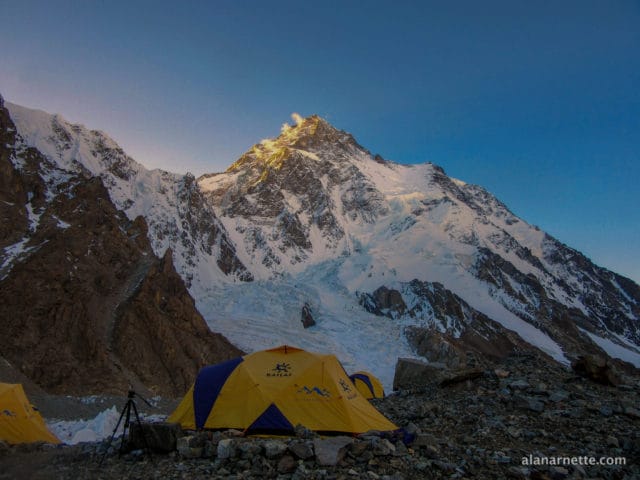
2018/19 Winter K2: Climbers Enroute, Controversy in Antarctic, Colorado Perfect

The K2 teams are on their way to Pakistan for their winter attempts but not without problems already. K2: Kazakhstan, Russia and Kyrgyzstan Team First up is an international group, made up of climbers from Kazakhstan, Russia and Kyrgyzstan. They are already having financial issues according to the website Russian Climb and reduced the team size from 11 to 7: Despite comprehensive efforts, the guys could not find money for all originally claimed eleven members. Therefore, the team will go to Karakorum in a reduced composition. There will be seven of them.. Vassiliy Pivtsov is still the expedition leader and Basil Pivtsov (Kazakhstan) is the head of the expedition and the team captain. Artem Brown (Russia) is listed as the project organizer. The rest of the team now includes: Abildayev Novel (Russia), Roman Abildaev (Russia), Michael Danichkin (Kyrgyzstan), Mikhail Danichkin (Kyrgyzstan), Tursunali Aubakirov (Kazakhstan), Tursunov Aubakirov (Kazakhstan), Dmitry Ants (Kazakhstan), Dmitry Muraviov (Kazakhstan), Konstantin Shepelin (Russia), Konstantin Shepelin (Russia) It’s reported they climbed together above 7,000-meters for the “Winter Snow leopard” program, and the team leader Vassily Pivtsov has climbed all 14 highest peaks of the world without the use of supplemental oxygen. They plan to arrive in Islamabad no later than January 1, 2019 and climb the traditional Abruzzi route. You can follow them on Instagram but Russian Climb is the best source. K2: Spanish/Galician Team The second team is lead by Alex Txikon who has already arrived in Kathmandu according recent social media posts. There he is meeting with his Sherpa support team. He will be climbing with his long time friend and partner Felix Criado from Galicia, Spain and now two additional teammates: Polish climbers Marek Klonowski and Paweł Dunaj. They will have a strong team of eight Sherpas with them in support including Nuri Sherpa, Chhepal Sherpa, Geljen Sherpa, Hallung Sherpa and Pasang Sherpa. He has not announced what route they will use, Abruzzi or Česen or even the East Face. The pair attempted K2 in 2013 but stopped just above Camp 2 at 6,900-meters. You can follow their movements on Alex’s GPS tracker, Twitter, Instagram, and Facebook. Winter Nanga Parbat In a vague series of reports, Daniele Nardi with unnamed partners will attempt a new route on Nanga Parbat. We know have more clarity saying that Italian climber Daniele Nardi and British Thomas Ballard with their two Pakistani team members Rehmatullah Baig and Karim Hayat according to Pakistan Mountain News. This will be his fifth attempt on NB. Alex Txikon, Simone Moro and Ali Sadpara made the first winter summit on February 26, 2016. Their logistics organizer, Jasmin Tours,reports: A 2 members team supported by 2 Pakistani high altitude climbers led by Daniele Nordi is in Islamabad to make another Winter attempt on Nanga Parbat. They are scheduled to be at base Camp on January 1. Nadri was quoted: “a lot of people ask me about Nanga Parbat in winter, I am not going exactly for Nanga Parbat but to complete new route in winter along Mummery Spur in alpine style, so our first objective is to complete this route up to 7000 meters and after this climb to reach the top. In the past I tried to complete this route but I couldn’t finish it, so this is the real enthusiasm to go there”. He also jumped in on the “When does winter end” debate saying “… winter ends on 28th of February, March is not winter its spring, but I am not hardliner to discard accents made in mid of march or earlier, yes for the future it’s good to consider some specific dates for winter.” NB 2017 Rescue Award The American Alpine Club has said they will award Dennis Urubko, Adam Bielecki, Jaroslaw Botor and Piotrek Tomala the David A. Sowles Award, which recognizes “unselfish devotion at personal risk or sacrifice of a major objective, in going to the assistance of fellow climbers imperiled in the mountains.” The ceremony will be at their annual benefit dinner on March 9 in San Francisco, California. In January 2018, the four climbers left their winter K2 attempt to save Elizabeth Revol on Nanga Parba. She was climbing with Tomek Mackiewicz, who died during the descent. Winter Manaslu Simone Moro and Pemba Gyalje Sherpa will be attempting Manaslu via the normal route in alpine style after acclimatizing on Mera Peak. Winter Alaska American climber Lonnie Dupre, well known for his amazing attempts to summti Denali in true winter is back at it again with a winter attempt on nearby Mt. Hunter. An Antartica “Unassisted” Record? With great fanfare, American Colin O’Brady, finished his 54-day Antarctic traverse, solo, unassisted, and unsupported journey to the adulation of the adventure world. It was an amazing accomplishment for this 33 year-old who pulled a 136Kg/300lb sledge from one coast to Antartica to the South Pole then to another costal point. The total journey was 1,487km/923 miles. He beat fellow racer, British Army Captain Lou Rudd by 2 days. This was an amazing achievement worthy of all the press both adventurers are receiving but now there is a hitch. Explorersweb is suggesting he was assisted given he traveled on the McMurdo-South Pole Highway, or the South Pole Overland Traverse Road (SPOT), a flattened trail groomed by tractors towing heavy sledges carrying personnel and supplies from McMurdo Station to the South Pole. Obviously traveling on groomed ice vs the uneven and often impossible sastrugi (wind built ice formations) makes the entire journey much easier, and faster. They quote veteran polar guide Eric Philips ““It is a highway, [that] more than doubles someone’s speed and negates the need for navigation. An expedition cannot be classed as unassisted if someone is skiing on a road.” Explorersweb, a keen follower of polar expeditions goes on to question if they really made traverse: Furthermore, both shortened their route significantly by calling a halt at the beginning of the Ross Ice Shelf: which their famous predecessors from the Golden Age of Antarctic Exploration — and some strong modern travelers — did not. Borge Ousland’s 1996-7 crossing of Antarctica is often called “assisted” because he used a kite part of the way. However, his route covered the entire Ross Ice Shelf and was 1,000km