Injuries on Everest
The last summit window was heralded as a great success by many teams. However it was not without incidents and many were not reported. EverestER, the base camp medical facility on the south posted a very revealing report on this summit window. And there are other reports on both sides from this season. First from the south and EverestEr: Approximately 90 people reached the summit of Everest in the last few days, a rough total of Sherpas and foreigners. Congratulations to all for getting down alive, summit or no summit. There were no fatalities. Along with summit bids, however, comes frostbite. The exposure to higher winds and lower temperatures on summit day is substantial. In addition, it’s hard to stay hydrated on summit day. Most frostbite results from unanticipated exposure, such as a forced bivouac, or delays due to accidents on the mountain or becoming immobilized from trauma or exhaustion. A climber who can’t move for any reason high on Everest is in great danger of frostbite, as well as hypothermia. The extreme hypoxia itself contributes to frostbite risk in addition to the freezing temperatures. Hypoxia diminishes the normal vasodilation that flushes the fingers with warm blood in response to getting cold. In addition, hypoxic brains can lead to poor decision making. Hydration is difficult when all water has to be made from ice, and cold water may not be appetizing in these conditions. I think it’s surprising we don’t see more frostbite. The high-quality equipment is no doubt one reason for this. What the Brits in the 20’s would have given for high-tech lightweight double boots and modern gloves and mitts! Another factor is today’s climber not having to remove gloves for tying knots, fixing ropes, handling stove fuel, etc, since the Sherpas do all these things. The guided member is also handed large mugs of tea or other liquids in camp and filled water bottles for the summit hike. The most serious frostbite so far this season was in a climber who made the very poor decision to sleep just below the South Col, feeling too exhausted to make it the last 100 meters to camp. He slept on a rock, apparently attached to the fixed line, and somehow lost the mitt on his right hand during the night. He was climbing alone, his “teammates” apparently unaware of his location and he had no Sherpa support. Amazingly, he survived the night out without a tent, sleeping bag, stove to make water or any help. In the morning, he ascended to Camp 4 on the South Col and there received help in starting back down. His mind was obviously not working well; he was stumbling and confused, the main symptoms of high altitude cerebral edema. An Argentinean woman and two Spanish women must have seemed like angels to him – they assisted him down to safety without regard to their own schedules; others helped as well. He was still a bit confused when he arrived in our camp in the early evening. Physical exam showed severe frostbite to his hands, right more than left, and to his ears, but no frostbite of the toes, a testimonial to the quality of his foot gear. We soaked his hands in warm water with Betadine, bandaged them with sterile gauze, and started him on ibuprofen, an anti-inflammatory drug helpful for frostbite. There is actually little more we can do for frostbite ment here at base camp. (The ment is within 24 hours of injury in a specialized center.) The next morning a helicopter whisked him to Kathmandu. The picture shows dark-colored fingers without blisters, indicating the tissue is without circulation and will likely require some amputation. Blisters are a good sign, indicative of live tissue underneath the skin. The next day we had 3 more cases of severe frostbite. As usual, they were related to questionable decision making, hypoxia and dehydration. One climber decided to stop at the Balcony, on the way up, at about 27,700 ft. He was moving too slow and was very fatigued. He decided to wait for his teammates while they continued on to the summit. They returned 5 to 6 hours later. This man could have very easily descended, since ropes are fixed all the way from the Balcony to near his tent on the south Col. His self-imposed immobilization cost him most of his toes and one finger. See the picture below. The blister on the left great toe is a good prognostic sign, but blisters are absent on the other toes. Unless promptly ed, subsequent care rarely makes a difference in outcome. That is, once the tissue is frozen and then thawed spontaneously on the mountain as the climber descends, the damage is done, and the result is already determined. The one thing doctors can do is to help prevent complications such as infection and give the tissue the chance of healing. Since prehospital ment is essentially futile, prevention is absolutely critical. Meticulous attention to keeping socks and gloves dry, staying hydrated, avoiding unnecessary stops and delays, and the use of electronic or chemical heaters are all strategies to prevent frostbite. This post submitted by Dr Peter Hackett And on the North, these reports. Bill Fischer posted a debrief on his last few days on the north side this year. He left the expedition with eye problems. As I have said before, I thoroughly enjoyed Bill’s posts. He was candid, funny and had the courage to tell it like he saw it. In particular, I like this excerpt for his last post, the Blog of the Day: While I am very sad that I wasn’t able to reach my goal of 26,000 ft and then the summit I realize that I made the right decision to come off the mountain. It is tough for me to realize that my body won’t accept going higher than 20,000 ft but that is the way it is. It isn’t possible for me to go back and try
Everest is Buzzing with Activity for Next Window
Excitement is building once again for more summits as team after team left Base Camp for camp 2 on the south and ABC on the north. Their enthusiasm, however, was tempered by talk of monsoons in India; more on that in a moment. There were talks of additional summits for Tuesday, May 18th, but nothing has been reported. As the weekend summiters return to base camp on the south, more details are coming in of summits. First up is on the north, Julio Bird’s wife Maribel sent me this email: I just talked to Julio. He reached the top on May 17th at 7:00 am. He is now resting at Camp 2 and will move to BC soon. It took them 14 hours from Camp 2 to the summit. Apparently he was the first Westerner to summit from the North. I don’t have the details but he said “I was the first”. Our connection was not the . He climbed with Sherpas, Lhakpa Gelu and Lhopsang and the large rope fixing team. His climbing partners, Bill Fischer and 70 year-old Japanese Hoshino Kohei both had left the expedition earlier with minor health issues. To add an international flavor to my coverage,I want to highlight climbers from countries who do not usually receive a lot of western media coverage: The Indian team of Mountaineering Association of Krishnagar (MAK) reported in with some interesting news about the weather on the descent. Apparently they made their summit from C3, not the South Col: … 17th May at 7.45 am, their summitteers being Shri Basanta Singha Roy (aged 47 years) and Shri Debasish Biswas They had been guided by Pemba Sherpa and Pasan Sherpa who had summitted Mount Everest several times before. They had made the ascent from the Nepal side and had started from camp no. 3 towards the summit at 9 pm on the night of 16th May and finally reached summit at 7.45 am on 17th May, 2010. While on their descent to camp no.3 yesterday, the duo had run into a terrible blizzard. Nepalese cyclist Pushkar Shah summitted Mount Everest on Monday(18th May, 2010) morning. On his expedition, Shah had taken along flags of 150 countries he had visited. He had cycled through all the countries. Two Colombians, Nelson Cardona and Rafael Avila, toped out on Monday morning. Of note, Cardona had wanted to climb in 2007, but lost his right leg while training for the climb thus used a prosthesis on his successful summit this year. Talk about determination!! Basanta Singha Roy and Debabrata Biswas, two members of the first civilian expedition from West Bengal by ‘Mountaineers Association of Krishnanagar’, also summitted. Looking forward now, Adventure Consultants’ Mike Roberts has a very informative update describing their climb to C2 on the south. he noted about 150 people heading higher and the recent warm temps are melting out the lower Icefall and heating up the Western Cwm. They left base camp at 2:00 AM to minimize danger: Today’s early morning wakeup ritual was fairly typical: sleep deprivation; grunting rather than talking; bad humor; suppressed appetite; Ang Tsering praying with his Tibetan rosary beads; hugging the heater for all it’s worth; icefall and summit nerves kicking in; chuck in the odd throw-up for good measure (Tony, you got to hate that); and by 2.00am everyone was rolling clockwise around our puja altar and throwing rice three times for success, safety and luck. Caroline, thanks for getting up at that ghastly hour to see us off and for your wicked summit success art work! As climbers leave for their summit bid, the Sherpas light juniper boughs that produce a thick smoke. On mornings like today with so many teams leaving, base camp has a cloud of smoke. You walk up to the alter with the smoke, and wave the smoke over yourself three times. Standing still for a moment, you go deep in thought about the upcoming effort – it is a very private personal moment. And then you swiftly leave your base camp home knowing the next week will be the toughest physical, and perhaps mental, challenge of your life. North teams are also in full motion with Adventure Dynamics and the first wave of 7 Summits Club already to the North Col. Young Jordan Romero has been there a couple of days now. The world’s media has caught on to this year’s search for the Mallory & Irvine camera from 1924. Multiple reports are quoting Duncan Chessell. “I was at North Col (7050m) last week and the wind was 150kp/h and it was stripping snow off the mountain which has been there for many years,” he said in his latest message from Everest base camp on Tuesday. There is now bare rock exposed which has been deeply covered for decades in the most likely areas where Andrew Irvine’s body may be. It is my intention to search those areas en route to the summit and take this rare opportunity to find him and, perhaps, the missing cameras. I have studied this matter very closely and am now very familiar with Mt Everest. I believe we have a good chance of finding something.” As regular Everest followers know, this has become an annual event and this year there is a mystery team making a serious effort to look for the camera and Ivine’s body building on previous years, if not decades, of work. Most keep their effort low key and avoid publicity. For friends and family monitoring this upcoming summit bid, an interesting story. The wife of a climber on last weekend’s summit push told me she had not heard from her husband for over 30 hours, the last time he called he said he was 10 hours for the summit. Now she was worried. He was an independent climber so there was no home office to contact. Eventually she heard from him and he was fine, in fact had summited safely. It seems, his phone batteries had died. So
Climbing in Place
With yesterday’s fresh snow, teams were content to take a day or so to let it settle. Unlike expeditions on Denali where you are stuck for a week at the 14 camp or High Camp in your tent or snow cave, on Everest, climbers have the luxury of large tents, folding chairs and tables. And at Base camp, heaters! … One more item to note, Tim Ripple tells us that Nepal Telecom has turned on coverage for Everest. When first announced they said it would reach the summit but let’s wait for confirmation before making that claim.
North Col Avalanche (updated)
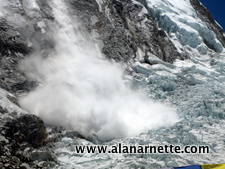
There was a large avalanche near the North Col on Monday, Tibet time. Before going further, remember that breaking news of accidents from Everest, especially from the north side, in almost every case is inaccurate. The early reports from multiple teams are contradictory. Some say it was a rock fall but most eyewitness are saying it was a large serac or cornice that collapsed near the fixed ropes.
The Realities of Everest
The north has become quite busy in spite of some difficult weather, meanwhile on the south, climber after climber has slept at camp 3 – their ticket to the summit – and are back at the lower camps.
Everest 2010 Weekend Update March 28
And the season begins. This week, climbers started arriving in Kathmandu. Some immediately tried to get to Lukla, without success, and others tried to get into Tibet, without success. Another normal beginning to the season.