Monsoon Watch

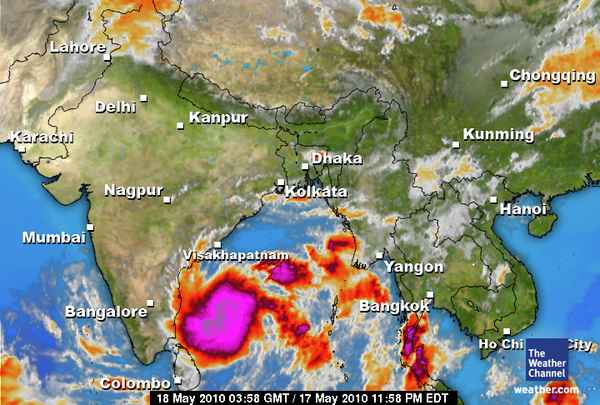
A huge wave of climbers on both sides of Everest have moved to their respective Advanced Base Camps. Many have declared a summit day of May 22nd but are monitoring the weather closely. This season is beginning to look identical to 2009 when bad weather basically shut Everest down around May 23rd and eventually delayed departures from base camps by almost week due to the heavy snow. Leaders who were there last year want to avoid a repeat, try especially on summit night. Mountain Trip, led by Scott Woolums with climbers Cindy Abbott and Paul & Denise Fejtek are looking at this weekend but have not pinned down a summit date. They explain: We are still confident that the decrease in winds forecast over the 22, 23, 24 will hold a good summit day for us. But we also have our Quiji board, tarot cards and our lucky dice! We are not being elusive with exactly when we are going, its just as the date gets closer, the forecasts become much more accurate. To say we are going say on the 24th would be reckless as things are changing rapidly by the day. One factor that will play a big role over the next week is a large tropical depression that’s formed in the Bay of Bengal and basically is heading our way. We may see precip and cloud from this as early as the 21st. This is the same type of storm that shut the mountain down last year with a lot of snow! Way to early to predict what will happen with this, but we are watching closely. On the north, an identical situation. Gabriel Filippi made this plan: I am getting ready for the summit push. I will leave around noon, and climb to camp 1 (7100m) hoping for the weather to hold. Strong winds are in the forecast until Friday night, and snow moves in on Saturday. Therefore, I am aiming to be at the last camp for the very small window during the night of the 21 to the 22, where no wind and no snow are expected. Clearly, things can change fast on a mountain, and the very notion of prediction is almost ironic. I will stay alert…. and optimistic! Looking at the weather that is playing a huge role in summit plans; IMG’s Eric Simonson posted this update on their blog that a monsoon in the Bay of Bengal is forming and moving north towards Everest. Eric posted: We are tracking tropical cyclone Laila in the Bay of Bengal. Our longtime IMG weather forecaster Michael Fagin (www.everestweather.com) forwards us this satellite photo (courtesy of Meteorological Forecasting Division, Government of Nepal). As this storm moves north, we are hoping it will be pushed east by the jet stream, missing the Everest area! So we might see a rush to the top similar to last year, 2009. Regular followers will remember that Himex actually sent their team up a bit before schedule to miss the heavy stuff. Summit night of May 22, 2009 was a tough one with stiff winds and snowfall. Dave Hahn commented last year on his summit night as the cyclone brought huge changes to Everest (remember this was 2009, not this year): We passed the other climbing teams, one by one, as we went up the face in the night and just as dawn was beginning to the East we overtook a final team at 28,000 ft and felt fully in control of our pace and destiny as we took on the South Summit. As daylight came on, I knew it was one of the prettiest mornings I’d seen from up high. But I didn’t reach for my camera. The morning was pretty because there were clouds at many levels and in many directions. I didn’t take pictures for the same reason I wouldn’t if I saw a large tiger coming my way with fangs barred. It was clear that our good weather window was closing and we needed to move fast and hard if we wanted to squeeze in a summit. We felt the full force of the winds as we crested the South Summit, but all were strong and all nodded their heads when I pointed across the crazy traverse topping the Kangshung and Southwest Faces and leading to the Hillary Step and the summit. We went for it, but even before we’d scrambled up the Hillary Step, clouds had covered the mountaintop. Visibility was poor at 6:45 AM when we stepped up to the summit. Most of us kept our packs on, knowing our stay would be short. It was not a day for photos and flags… just a few handshakes and hugs and we were out of there. We made quick time back down through the storm to high camp. Lucky. You can read Dave’s excellent description of how the cyclone’s impact hit Base Camp last year. Of course it can snow all it wants once the climbers are down! Many teams on the south are looking to start their summit bid on Friday, May 21s which would have them on top Saturday morning, May 22nd between 6:00 AM to 10:00AM, normally. Apa Sherpa 21st Chad Kellogg 22nd Jordan Romero May 23rd Alpine Ascents 22nd Adventure Consultants-22nd Altitude Junkies 22nd IMG 22nd, 23rd Adventure Dynamics 23rd 7 Summits Club 22nd, 23rd The only team still holding their cards close to their vest is Himex which is normal operating procedure for them. You can see the latest radar image for Cyclone Laila aka 01B through this link that the feeder bands are approaching Nepal. It is not time to worry, but it is time to pick up the pace a bit. Climb On! Alan
Climbers Climbing plus Avalanche Update
News travels quickly on Everest. Teams on both sides are sadden by the avalanche incident and have a heightened awareness of the dangers of high-altitude mountaineering. However, they push on knowing that danger comes with the sport. For teams on the north is has been a difficult few days with the avalanche on the North Col. The missing climber is László Várkonyi is a well known Hungarian climber. I contacted Ang Tshering Sherpa who is the Founder and Chairman of Asian Trekking who provided them with logistical support. He sent me this immediate reply for which we deeply thank him:
Interview with Cindy Abbott: Climbing Against Time
The human spirit is an amazing creature. Somehow, climbing big mountains brings it out. Cindy Abbott is no exception. With a broken leg on Aconcagua, she hobbled down from the high camps to be helicopter out, had surgery and was climbing again seven weeks later. Now she is going to Everest. Oh and she has a rare disease that baffles doctors to this day. Cindy has the disease Limited Wegener’s Granulomatosis or WG. The Mayo Clinic describes it as an uncommon disorder that causes inflammation of blood vessels, which in turn restricts blood flow to various organs including kidneys, lungs and upper respiratory tract. What causes WG is uncertain, but it’s not an infection nor is it a type of cancer. Without ment, it can be fatal, most commonly from kidney failure. Cindy’s symptoms started with vision problems resulting in blindness in one eye. Through a series of test, WG was diagnosed and today she is under ment – and focused on a goal – before it is too late. She made this startling declaration to her University Newspaper “That’s why I want to climb Mt. Everest now,” Abbott said. “My immune system is down from the immunosuppressant medication I’m taking to control the disease and I don’t know how much longer I have. I want to live life to its fullest.” Cindy, 51, has a Master of Science degree in Kinesiology with a focus on Sports Psychology and Exercise Physiology and teaches Personal Health at California State University, Fullerton. It was while watching Everest: Beyond the Limit that her goal was launched for climbing Everest. Together with 7 Summits guide, Scott Woolums, they developed the plan and now Cindy has climbed many mountains including Aconcagua, Kilimanjaro, Rainier, Elbrus, Peak Lenin and her local training peak, Mt. Baldy, near her home in California. So what drives a person with a rare disease to go to Everest complete with all the risks and difficulties. Cindy took some time from her training to speak with me. I am sure you will find her story simply inspirational. Q: Your commitment to this climb is huge – risk, loans, time away from family. What are you hoping to achieve with your climb? There are several objectives: the first being the climbing of the world’s highest mountain. Unlike some climbers who have multiple opportunities to summit Mt. Everest, this will be my one and only chance. Both during and after the Mt. Everest climb, another focus is to raise rare disease awareness and funding for research. Having gone for over 10 years with an undiagnosed/misdiagnosed disease that was damaging my body is a terrible experience for both the person and the family members. If I can help one person get diagnosed and ed before the disease does its damage; then, summit or not, I will have accomplished an important goal. Making the decision to go public and launch my blog was difficult because I am a very private person, but the opportunity to help by sharing my story out-weighed the privacy issue. Since going public, I believe my climbing has already had an inspirational affect. I have received many positive and supportive comments from both healthy people and people with WG. Here is a comment from Doug Thomas, he has WG: Cindy- You have been quite an inspiration to me, certainly, but to others on the WG Support Website because you are taking life by the horns, Wegener’s Granulomatosis or not. Many times, people with WG listen to negative voices around them, ing into the notion that life ends with the and prognosis of this disease. (WG is an auto-immune disease where your immune system goes into high gear and destroys your vascular system, small and medium vessels at least, and, for one person in ten, is a death sentence. Oh yes! You will have this disease the rest of your life!) You show how the disease and prognosis need to be dealt with, certainly, but that nothing is outside the realm of possibility, even climbing the tallest terrestrial feature on earth! While each Weggie has a different experience with the disease (a short list of 109 symptoms…), each Weggie can take your example and find his or her own Mt. Everest to “climb”. Q: Of all the activities to raise awareness for WG, why climbing and why Everest? Why climbing? I have always been an avid outdoor adventurer with SCUBA diving as my main sport. As part of a safari and diving vacation in 2006, my husband and I decided to climb Mt. Kilimanjaro in 2006 and I discovered a whole new world. Now, several years and mountains later, I cannot express the feeling I get when I climb to that next higher camp or stand on a summit of a mountain: the beauty, the challenge, and the personal satisfaction. Climbing, as you can read from Doug’s comment, is emblematic of the challenges people with WG deal with on a daily basis: For some, climbing a flight of stairs is their mountain. Why Everest? In the spring of 2007 I watched Discovery Channel’s Everest: Beyond the Limit and decided I wanted to climb the world’s highest mountain. I contacted Scott Woolums and ask if he would train me. We made arrangements to start by climbing Mt. Aconcagua in December of 2007. In August of 2007 I was diagnosed with Wegener’s Granulomatosis and started a medication ment program. My decision to train for Mt. Everest was made prior to my . After the , I decided to use this climb to help draw attention to NORD (National Organization for Rare Diseases) and the Vasculitis Foundation and by doing so – help other people. Q: No doubt what you are attempting is unique and dangerous given your condition. How does you immediate family feel about this effort? After almost 25 years together my sole-mate and husband, Larry, was not surprised by my decision: although he admittedly did not understand it. Larry put everything he wanted