Staying Safe on Colorado’s Deadly 14ers
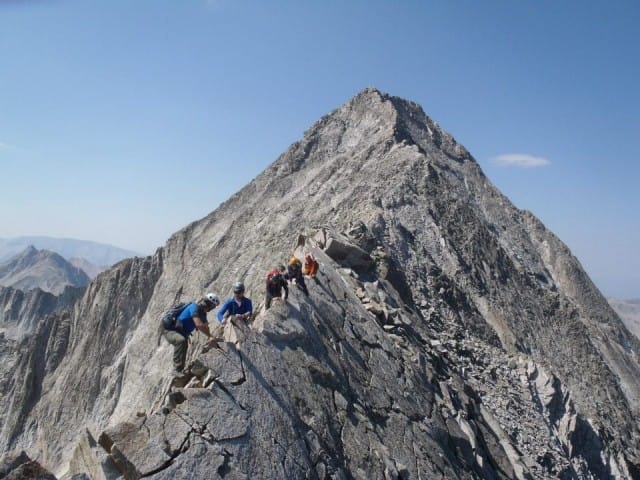
Capital Peak Knife Edge

2017 is proving to be a deadly summer in the Colorado mountains above 14,000 feet aka the 14ers. Thus far 8 10 now 11 as of 4 September 2017 people have died across the state. Hiking and climbing in the Colorado Rocky Mountains is supposed to be fun, not deadly. Most accidents and death happen when a person lacks the experience or exercises poor judgment. Take your time, learn the basic, follow the known rules and have fun. Certainly things can happen beyond your control as I experienced earlier this year when a gust of wind knocked me over at 11,000 feet on Twin Sisters Peak, a walk up outside of Estes Park. I broke my leg in three places and was rescued by search and rescue. I could have avoided the entire incident by not going out that day, but that defeats the purpose of being in nature for me. Also, I was training for an 8000 meter peak a few months later. 14ers Colorado is blessed with the Rocky Mountains running south to north across the state. Depending on how you count them, there are between 53 and 58 mountains over 14,000 feet (4,266 meters) in height but only 53 are noted as ’14ers’. To qualify as a 14er the peak must be 300 feet higher than the saddle of an adjacent peak. A notable exception is North Maroon Peak so 54 has become the ‘official’ number. On the popular climbing site 14ers.com member TravellingMatt made this chart: It is estimated that over 3,000 people have summited all of them. Before I get into the deaths, let me express my condolences to the families, friends and teammates of those lost. Deadly Capitol Peak – 5 Deaths Capitol Peak is well known as one of the most difficult 14ers by the standard route. The members of 14ers.com rank it as the most difficult followed by Little Bear Peak, Pyramid, North Maroon Peak, Crestone Needle and Sunlight Peak. In late August 2017, Ryan Marcil, 26, and Carlin Brightwell, 27 both of Vail, apparently fell to their deaths near the summit of Capitol Peak. It is presumed they were involved in a rockslide according to sheriff’s office reports. In July 2017, Jake Lord , 25, of Parker, Colorado, died after a boulder he was climbing over came loose causing him to fall between 160 and 330 feet off the ridge between Daly Saddle and K2. His climbing partner was behind him and had him in sight. In August, Jeremey Shull, 35, of Parker Colorado also fell just before the notorious Knife Edge ridge. He was out of sight of his climbing partners. Yesterday, August 27, 2017, another person, name not released but 21 years-old was found after he fell taking the non standard route down near the knife edge. The Aspen Times reported that he got separated from his climbing partner after a dispute Saturday on how to descend from the Capitol Peak summit and later fell 600 to 700 feet to his death. They went on to say “Deputy Anthony Todaro said the department received a call at 8:45 a.m. Sunday from Brandon Wilhelm of Pine who said he and his friend reached the summit about 3 p.m. Saturday, but on the descent they became separated at the Knife Edge when they argued about the route.” According to the Aspen Times, since 2000, 18 people have lost their lives including the five this year on Capitol peak This is my report on climbing it for the first of three times back in 2009. Maroon Bells- 2 deaths On May 27, 2017 Jeffrey Bushroe, 27, a soldier at Fort Carson died of hypothermia. The Pitkin County Coroner’s Office said he had fallen and several visible injuries to his head and leg. Rei Hwa Lee, 57, Littleton , Colorado was found on August 8. She was found at 12,600 feet and it was assumed she had fallen. Blanca Peak – 1 death 27 year-old Barney Criz from Seguin Texas died from an apparent rock fall between Blanca and Lake Como, maybe a little higher than Crater Lake according to the County Sheriff. Witnesses heard rocks sliding and then saw the body of the man who had fallen per this report. The incident occurred on 29 July 2017. Mount Princeton – 1 death Matthew Wayne Lackey, 31, Boulder Colorado free fell 40 feet after a boulder he was holding onto came loose. Other climbers were near him when the incident occurred. Challenger Point A climber on 4 September 2017 was reported descending Challenger about 150′ down, lost footing and fell into a bit of a feeder gully that dumped into snow couloir. source: Custer Country Search and Rescue Longs Peak – 1 Death Pawel Abramczyk, 39, of Thornton, Colorado  apparently fell to his death in a section known as the Loft. it was snow filled in March 2017. He decided to turn back near the top of the Loft and became separated from his climbing party. In October 2016, 61 year Scott Corliss slipped on ice in the Narrows section of the Keyhole Route and fell 100 to 150 feet to his death. Three people died on Longs Peak in 2014, and a Montana man’s body was found at the bottom of Lambs Slide in October 2015. About 62 people have died on Longs with falls representing 60% of the casualties. There were eight deaths from falls off the extremely technical Diamond, followed by six off the Ledges on the Keyhole route then five off the Narrows according to The Coloradoan.     How to Stay Safe There are several straightforward ways to reduce your risk, but there is never a 100% way to stay safe while hiking, climbing driving or living. Experience Take a class at REI or CMS to gain basic skills and begin to build trusted partners to hike, camp and climb with. Start on the the easy, straightforward 14ers like Grays, Torreys and Quandary before you move up to the harder ones. Understand the ‘3 points of contact’ technique where you only have a

Interview with Gerry Roach – Mr. 14er (and more)

In the climbing world there are a few people who uniquely stand out: Messner, Viesturs, Moro, House, and many more – you know the names. And then there are those climbers who have forgotten more climbs than most people have attempted. They may not have been the most difficult or garnered the fame but they were climbs nonetheless. Gerry Roach of Colorado has a lock on this category. If you live (or climb) in Colorado you know him from his famous guide book simply called Colorado’s Fourteeners: from hikes to climbs. It is the premier guide book for all things 14ers describing 250 routes in sufficient detail for most people to make the summit. In total, he has authored 15 books. But who is this guy and what is he up to these days? First a bit of background. Gerry’s early years were flavored with international experiences starting with a year in France at age 7 with his family. Soon they moved to Boulder, Colorado – a rock climbing mecca even in the 1950’s. He started climbing rocks and mountains and flew a plane before he drove a car. His love affair with the international life continued after graduating from the University of Washington in 1964 with a degree in math when Gerry served as a teacher in the Peace Corps in Bhubaneshwar, India not long after the Peace Corps was formed. Today, more than 60 years of travel and mountaineering, Gerry has explored and lived in dozens of countries and been on more than 30 major expeditions. In addition to pursuing a career as a computer scientist, he found time to run a university outdoor program and teach Outward Bound in Colorado and Alaska. After climbing Mount Everest in 1983, Gerry went on to become the second person to climb the highest peak on each of the 7 continents in 1985. In 2003, Gerry became the first person to climb every major peak over 16,000 feet in North America. Gerry received the Sierra Club’s coveted Farquhar lifetime achievement award for mountaineering in 2005 and the Colorado Mountain Club’s rare Ellingwood Golden Ice Ax Award in 2006. Gerry is not alone in his ventures. His wife, Jennifer, has climbed over 1000 Colorado peaks including all the 14ers and all 637 13ers. She is the co-author on several of the guide books. Q: How are you spending you time these days? I’m not retired, I just can’t get a job anymore. That line started out as a joke, but has turned out to be true.  So, I’m writing, climbing, and organizing trips (see www.earthviewadventures.com). Q: How often do you get out and climb today? Every week Q: Will there be a print update of your famous Colorado 14ers guidebook? Yes. It’s in progress now and should be available in paper for the 2011 climbing season. I’m also working on an online version that will be available sooner. Q: People know you for the Colorado 14ers but you have a love of the 13ers as well. Can you tell us a bit about your 13ers? I’m close to finishing the famous long list of all 637 Colorado ranked peaks over 13,000 feet. I consider the list to be a bank account of great outings, and I’ll be a bit sad to actually finish the list. I’ll set the record for having taken the longest to complete the list. When people complain about the crowded 14ers, I tell them to climb obscure 13ers. We typically go all day without seeing anyone. Q: Your guidebooks have a huge number of routes in such detail, over what period did you climb all those routes? I started accumulating the route information in the 1950s. I climb every peak or rock in my guides, but there are still a few spots I haven’t touched. Q: Longs Peak is special to you. Why does it stand out? I started out as a rock climber and gravitated naturally to routes on Longs’ east face. That’s where I found my feet as an alpine climber. Back then, the Diamond had not been climbed and there was a lot of mystery on the face. Q: What do you think about climbing records these days: speed, ski, disabilities, etc. Is there a place for these in climbing? There will always be a need for speed – it’s the American way. I enjoy watching the records progress. Extreme activities in the mountains are fine as long as they don’t hurt the environment or other people. There are wilderness regulations that limit group size and organized events, and some activities aren’t appropriate. The trend seems to be for individual efforts, which are fine. Q: What are your thoughts on PLBs and cell phone in the wilderness. Any thoughts on the debate relative to the deaths on Mt. Hood and thus requiring PLBs to be carried by all climbers? PLBs (and Sat phones) are a nice bit of modern technology. You can use it or ignore it as you choose. I used a PLB to help save a life in Mexico, and was quite impressed with the system. Requiring them is another issue. Being old school, I think we should always be free to get lost. Just don’t expect to be rescued. Q: Any desire to ever return to one the the 7 Summits? Well, I have. I’ve done Denali three times, Aconcagua twice and Kilimanjaro twice. I was also high on Everest twice – South Col in 1976 and summit in 1983.  I’d like to go back and do the north side of Elbrus. Q: Do you have a favorite lesson from all your climbs? The answer to the question, WHO CLIMBS UP is in my book Transcendent Summits. See www.transcendent-summits.com This is just a pointer to the long answer. For short answers I like: “Gravity never sleeps” “Physics Wins” “Geologic time includes now” Q: You summited Everest in 1983. If you were to summit today, how would the feeling compare to that first summit? Good question. It would be different for sure. In 1976, we were the only team