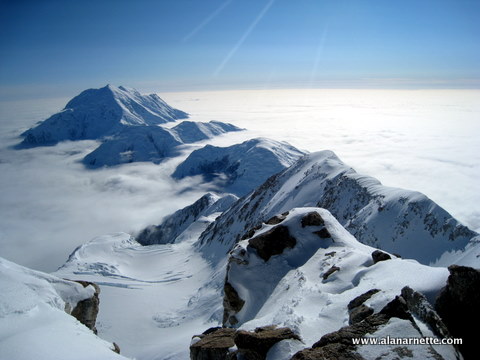
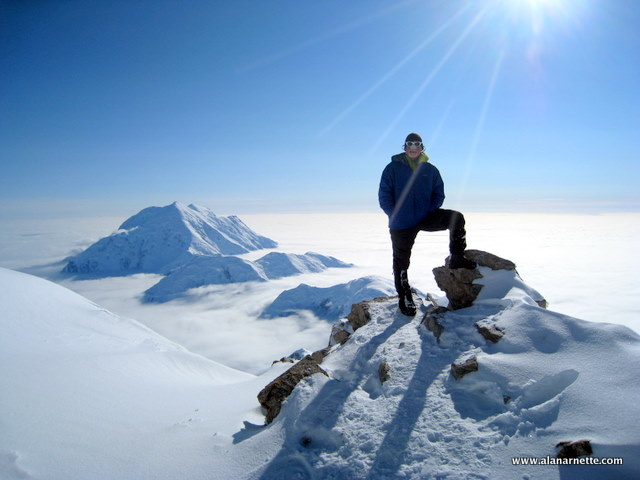
Live from Denali Summit with Garrett Madison
Live from Denali Summit with Garrett Madison in a season of the lowest summit numbers in history from the summit of Denali on June 14, 2025. It’s been a very cold year, as documented by the Rangers: # Denali 2025
PODCAST: with Jost Kobusch’s Solo, Winter 2023 Denali Summit
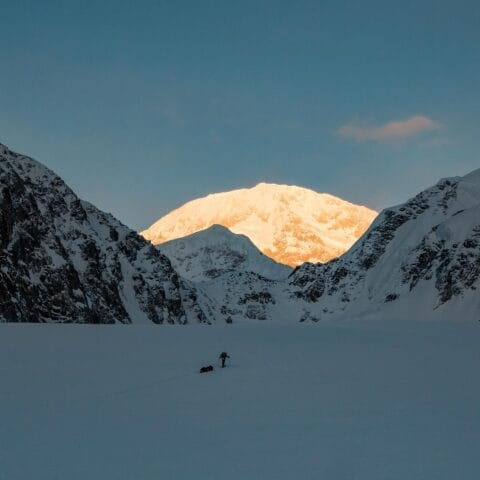
PODCAST: German Alpinist Jost Kobusch became only the third person to complete a solo winter Denali Summit successfully. He summited on Sunday, February 19, 2023, around 3:00 am. I caught up with him at his home in Chamonix, France, only a few weeks after his summit. Jost style is to climb alone during a season that few other people would choose. He climbs completely unsupported and often on the most difficult routes. On Denali, he summited via the Messner Couloir.
We cover route, gear, weather, what he learned, and his plans for another Everest West Ridge climb in late 2023. Jost is doing a several-part series on his Facebook page, including his clothing, footwear, handwear and face wear. Visit and follow to learn more about how he pulled this feat off. I think you’ll enjoy meeting this 30-year-old climber.
Denali 2021: Season RoundUp

The 2021 climbing season on North America’s highest peak, Denali, is nearing the end. I take a look at some “fun facts” and how this season has progressed.
Climbing News: Mont Maudit (Blanc) Tragedy, Difficult Denali, Karakorum Drama
Just back from my own climb of Peru’s Alpamayo, no I wanted to post a quick recap of recent news for the climbing world with success, dramas and death. Let’s start with some good news. Denali Success British climbers Nick Bullock and Andy Houseman showed Denali is not a simple walk up by making a rare repeat of the Slovak Direct route in an incredible 84 hours, First climbed in 1984 by Slovakians Blajez Adam, Tono Krizo and Franticek Korl; they took 11 days and the route has only been repeated five other times. The record of 60 hours set by Mark Twight, Scott Backes and Steve House was in 2000 using a single push. The Slovak Direct takes a circuitous route on Denali’s South Face. It uses part of the West Buttress approach, Cassin Ridge and having 10,000 foot gain, requires 58 pitches, some at 5.10 rock of world-class climbing. Congratulations to these climbers on a great feat. Denali Re For mere mortals, climbing the West Buttress has been difficult this season. Once again the end of the season proved to be too tough for many teams. Heavy late season snows (up to 3 feet at the 14,000′ camp) stalled efforts to go higher. With time, food and fuel running low many teams were forced to give up. I know this feeling because it was exactly this scenario that stopped my attempt one year ago to the date. Only a small Danish team and a Dave Hahn led RMI team remain. Even the Rangers have gone. While statics show a equal amount of success for late seasons (June 15 starts onward), perhaps the changes in the climate have made it more difficult. If I ever go back to McKinley I will not start in June! The National Park Service website shows an usually low number of summits this year at 492 or a 44% summit percentage, the lowest in 13 years. Here’s a look at the summit stats for the popular West Buttress route since 2000 with the most popular summit day: Denali West Buttress Route source: National Park Service Year Total Summits % Top Summit Date # 2012 492 44% 2011 623 55% June 6 66 2010 630 56 June 21 54 2009 649 60 June 7 77 2008 652 58 May 30 91 2007 513 47 June 12 77 2006 545 52 May 29 50 2005 716 59 June 15 101 2004 628 54 June 4 71 2003 556 58 June 12 115 2002 575 53 June 13 56 2001 670 60 June 4 69 2000 556 53 June 3 71 Nanga Parbat Drama An ambitious effort on the worlds 9th highest mountain, Nanga Parbat (8125m) left some feeling a bit empty. A team of six, Cathy O’Dowd, Sandy Allen, Rick Allan, Lahkpa Nuru Sherpa, Lhakpa Rangdu Sherpa and Lhakpa Zarok Sherpa, attempted the very difficult and treacherous Mazeno Ridge only to be stopped short at the base of the summit pyramid by heavy snows and dwindling supplies after 11 days on the summit push. The ridge is more than 10 km (6 miles) long requiring crossing eight 7000 meter (23000 ft) peaks along the route and has never been completed as one climb. It is the longest ridge on any 8000m mountain. Their expedition website is an excellent resource and very well done. Their last message said the team split with climbers Rick and Sandy pushing on and O’Dowd turning back. Gasherbrum II/Broad Peak/K2 Several teams are making good progress on Broad Peak and we can expect summit attempts this upcoming week. Al Hancock is doing a nice job of documenting his effort. I reached Camp 2 on my 2006 Broad Peak expedition so can appreciate this progress. Reaching the true summit of Broad requires a dangerous traverse of the summit ridge so conditions will dictate what happens next. On Gasherbrum II, look for as many as 20 climbers to go for the summit around July 16. Over on K2, teams are making progress with Camp 1 established. Mont Maudit Tragedy On one of the most popular routes, 3 Mont Blancs, to the highest peak in Western Europe, Mont Blanc; an avalanche off Mount Maudit took 9 climbers early on July 13. The 16 inch slab avalanche hit without warning or even noise as reported by survivors. The dead included three climbers from the U.K., three from Germany, two from Spain and one from Switzerland. Fourteen other climbers were injured. And on Saturday, June 14, two more climbers died after being trapped on the Dôme du Goûter and hit by a storm. I have personally climbed this route three times and know this section well. It is common to go as fast as humanly possible through this section given the impending uncertainty. What initiated the slide is still unknown. The alps had experienced warm temperatures and rain recently. Each year, over 50 climbers are killed on Mont Blanc with 8 in one accident in 2008 and 9 in 1994. It is one of the most popular mountains in all of Europe with over 20,000 reaching the summit annually. One of the climbers lost was 55 year-old British climb Roger Payne. He made first ascents of routes in the Alps and climbed there every year from 1977. He took part in more than 20 expeditions to high and difficult peaks across the Karakoram and Himalaya – from K2 to little-known mountains on the borders of Sikkim, and Sichuan in China – as well as North and South America. He was a past General Secretary of the British Mountaineering Club. It has already been a deadly year in the Alps with 20 deaths: Mont Maudit (9), Lagginhorn (5), Eiger (2), Dôme du Goûter (2), Dent Blanch (1) and Wetterhorn (1) My sincere condolences to all who lost family, teammates, and friends. This is a video of the Mont Maudit rescue from Reuters: Climb On! Alan Memories are Everything
Climbing News: Denali and Hood Deaths, Karakorum Season Starts
It has been a difficult few days in the mountains with several deaths that are hard to understand. On the heels of 10 Everest deaths this season, the media has taken more than a casual interest in these climbing deaths. Interestingly however, they have not attracted the same frenzied calls for regulations, drugstore limits or boycotts that the deaths on Everest encouraged. Four Killed on Denali The largest event was reported on Mt. McKinley aka Denali where on June 14, 2012 four Japanese climbers were caught in an avalanche in an area not known for deadly events. They were descending a slope named Motorcycle Hill, which is about a 35 degree angle, when the slide began. They tried to outrun it but the snow caught them as the climbers slipped down the snow ladened slope. All five climbers were traveling on the same rope, not uncommon. It is presumed they were pushed into into a deep crevasse from the avalanche. One of the climbers, 69 year-old Hitoshi Ogi was able to climb out of the crevasse but his four teammates apparently died in the fall. They were Yoshiaki Kato, 64, Masako Suda, 50, Michiko Suzuki 56, and 63-year-old Tamao Suzuki, 63. This was the first attempt of Denali for any on the team. It is assumed they had not summited due to poor weather earlier in the week. This is somewhat of a mystery in that Motorcycle Hill, while a bit steep is a well known part of the normal route on Denali’s West Buttress trade route. While avalanches can occur on this slope, they are not overly common. What happened to the climbers is unclear but it was reported their rope broke, very unusual, and they could not stop the slide. The slide started at 11,800′, was 200′ wide and 800′ long. The debris pile was 3 to 4 feet. I have climbed up and down this same slope many times and have never seen signs of avalanche danger. However, 2012 has been a high snow year with dangerous winds and temps all season reducing the normal 50+% summit percentage down into the mid 30% range. When fresh snow occurs on this route, the standard process is to wait a day or two for it to settle and consolidate before climbing. But this technique is used for more deadly areas such as the Autobahn just above the 17,000′ High Camp or perhaps near Windy Corner. Both of these locations have seen avalanche related deaths in the past. This one is the first on Motorcycle Hill. Another avalanche was reported a few days earlier but much higher on the mountain with no incident. A two day search was conducted including aerial and dog teams plus an exploration of the crevasse that Ogi fell into but yielded no success. My condolences to their friends and family. These deaths bring the total to six on Denali this season. Mt. Hood On Mt. Hood, 11,237′, in Oregon last Thursday, June 15 a very experienced climber, Mark Cartier, 56, of Portland fell to his death near the summit. It was reported he fell near 11,000 foot level into the area known as the Hogsback for a 1,000′. It is unclear what started the fall. He was climbing solo in excellent conditions. I have climbed in that exact area and can attest that can be tricky. We climbed roped and one of our members fell but we were able to arrest his fall. This is the second climbing death this season on Hood. I appreciate this balanced report by Portland’s KWCN of the death: Karakorum News In other climbing news the Karakorum season is underway with several teams attempting the big 8000 meter mountains of the Gasherbrum (s), Broad Peak and of course K2. One climber to watch is Canadian Al Hancock who is climbing Broad Peak first to acclimatize then hoping to make short order of K2. This technique is a perennial favorite for some operators but rarely results in a K2 summit. Also follow Brad Jackson who is blogging via his Facebook page as he attempts Broad Peak. An interesting storyline is from Swedish climber Anneli Wester who wants to pitch her tent and sleep on the summit of Gasherbrum II K2 continues to be on one of the most difficult 8000m climbs in the world. There are around 10 expeditions on K2 this summer. A courageous winter effort by a very strong Russian team did not summit this past winter. Climb On! Alan Memories are Everything
Denali FAQ

These are FAQ from my three Denali climbs
Denali Home
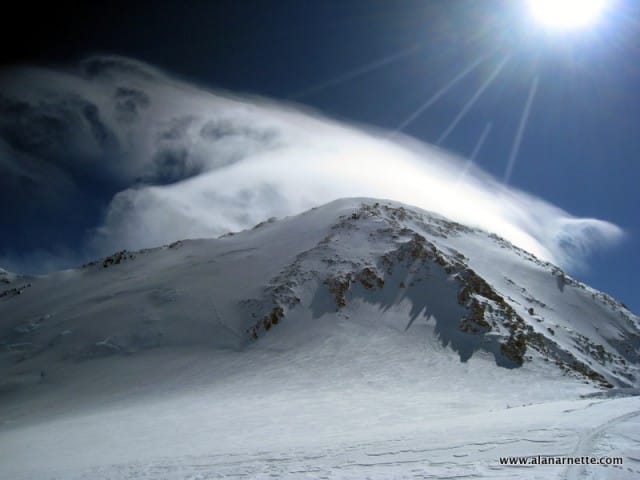
North America: Denali (20,320’/6194m) Denali is the native American name for the mountain. In 1980, in honor of President McKinley, the National Park Service named the surrounding park Denali National Park. In 2015, the mountain’s name was officially changed to Denali. It is in central Alaska – 300 miles South of the Arctic Circle and 200 miles East of the Bearing Sea. Denali offers some of the largest vertical gain of any mountain on Earth. With base camp at 7,200′ and the summit at 20,310′, this 13,110′ gain over twelve miles is larger than Cho Oyu (8,407) or even Everest (10,535). The biggest threat to Denali is the weather. It is well known for socking you in for days with high winds and snow. 45,411 climbers have attempted Denali, with 23,426 summiting, a 52% success rate. Almost 125 have died, including 11 in 1992. The second highest mountain in North America is Mt. Logan in Canada’s Yukon, at 19,551’/5959m, 385 miles southeast of Denali. Similar to Denali, Logan is a vast massif with eleven peaks. Logan is believed to have the largest base circumference of any mountain. The normal route is straightforward, but the weather is a significant problem for Logan, as it is for Denali, in addition to being so remote. Here’s a look at the summit stats for the popular West Buttress route from 2000 to 2024, along with the most popular summit day: Denali West Buttress Route source: National Park Service Year Total Summits % Top Summit Date # 2024 523 50 2023 308 30 2022 745 70 2021 490 52 2020 CLOSED FOR COVID 2019 793 65 2018 463 44 June 8 67 2017 461 41 May 31 54 2016 647 60 June 16 83 2015 589 57 June 15 87 2014 404 35 June 4 99 2013 729 68 May 27 56 2012 460 40 May 27 56 2011 623 55 May 27 & 30 45 2010 630 56 June 21 54 2009 649 60 June 7 77 2008 652 58 May 30 91 2007 513 47 June 12 77 2006 545 52 May 29 50 2005 716 59 June 15 101 2004 628 54 June 4 71 2003 556 58 June 12 115 2002 575 53 June 13 56 2001 670 60 June 4 69 2000 556 53 June 3 71 These are some quick facts from the NPS for 2024: Climbers from the USA: 639 (64% of the total of both Denali and Foraker registrants) US climbers came from all over, with representation from 46 of the 50 states, plus the District of Columbia. Consistent with past years, most US climbers came from the following four states: Washington State (95), Alaska (81), Colorado (79) and California (36). International climbers: 362 (36% of total) Denali National Park welcomed international climbers from 51 countries this year. Once again, the top was Canada (40), followed by the United Kingdom (38), Poland (20), and China, India, and Japan, each with 17. Average trip length: The average trip length (regardless of outcome) for non-guided groups was 14 days, with guided Denali climbs averaging 17 days. Isolating just the climbers who reached the summit increased the statistic to 20 days. Average age Submission of a climber’s age is now optional when applying for a Denali permit. Based on the individuals who did disclose their age this season, the average age for male climbers was 39, while women averaged 36 years old. The youngest climber was 15, and the oldest was 75. Women climbers Women comprised 16% of climbers on Denali and Foraker, or 161 individuals—down from 2023 when 197 women (19% of the total) attempted Denali and Foraker. Denali Resources I have climbed on Denali three times. You can read about my climbs through these links: Denali Home Denali FAQ Denali 2011 Denali 2007 Denali 2001
Denali 2011 Trip Report

My third attempt on Denali, the highest in North America as part of my 7 Summmits for Alzheimer’s campaign in 2011.
Denali 2007 Trip Report

This is a very personal, detailed and sometimes graphic report. It chronicles my attempt on Denali in June 2007. My intent is to bring readers into my world of high-altitude mountaineering by showing the incredible rewards, the obvious dangers and what happens when the human body hits the wall. Remember to click on any picture in the report to enlarge it then use the back arrow to return to the report. Denali 2007 was the first of four climbs for my return to Mt. Everest: Memories are Everything® journey. I aimed to raise $100,000 for the Cure Alzheimer’s Fund (CAF) by using the Denali, Shishapangma, Orizaba, and Everest climbs. My hope was/is to summit each peak and raise awareness and money through real-time dispatches sent directly from each Peak. I left Denver International Airport for Anchorage on June 10, 2007. With Everest in the plans, Denali was almost an afterthought for my journey – a familiar climb designed to test my body once again against the rigors of high altitude. I was there in 2001 and was turned back by poor weather at Denali Pass or 18,200’. I was confident I could make the climb, weather permitting. My only concern was the heavy loads involved: 120 lbs split between my pack and sled that needed to be hauled up almost 2 miles purely through my strength. Hey, I am 50 years old! The week before I left, I worked closely with the CAF’s Tim and Katie to coordinate both websites to post my dispatches and receive donations marked for the Memories Are Everything® fund. My training was as good as it would be, thanks to some challenging climbs in the Colorado Mountains with my partners Patrick and Robert. Leaving Colorado, I felt confident, strong and nervous about the year-long commitment I had publicly announced. What if I failed? What if I didn’t summit this “familiar” climb? What if… I met my guides and teammates at the Alaska Mountaineering School (AMS) on June 12 in Talkeetna, Alaska. I selected AMS due to its reputation as a solid guiding company with an excellent record of safety and success and its focus on the basics. I felt this reputation would attract more competent climbers, enhance my chances of success, and, more importantly, deliver an overall positive experience. Christian March was the lead guide. A young man of 27 years, he shook my hand with an air of confidence and gave orders on what to do and how to do it. I liked him immediately. Next, I met his assistant, Leighan, an impressive 26-year-old native Alaskan who oozed with personality. She gave immediate life to the team. Soon, the other five climbers arrived at the old house AMS had converted into their offices. They were a diverse group, including a father-son pair, a banker, a tattoo studio owner and a British law enforcement officer. Most had good mountaineering experience, and all were eager to summit Denali. Thus, the team was set. Scheduled to fly out the next day, we rushed to check our gear and review some basic glacier travel skills. But the weather in June 2007 had been challenging. Colder than normal temperatures and high winds had reduced the usual 50% summit rate to a very low 33%. And it continued. Our flight to the Kahiltna Glacier was delayed for two days. We rushed to the airstrip twice to load the DeHavilland Beaver Turboprop, but we were told the flight was canceled. So we bided our time in the township of Talkeetna by doing more “classes,” as AMS calls their review of skills, and scrambling at the last minute to find a place to spend the night. We also enjoyed the sights and entertainment of the local bars and restaurants. Remember that Talkeetna has one main road – paved, that is – and is straight out of the television series Northern Exposure. It’s a great place, to be sure. Finally, we got the word on June 14th, we would be flown to the glacier. The flight is one of the best I have ever taken in my mountaineering travels. Second only to the landings at Lukla, Nepal, in the late 1990s when the landing strip was dirt with Yaks crossing it and pilots who chatted casually as the plane appeared to be on a direct collision course with the steep mountain side! But this flight, smoothly operated by Paul Roderick, the owner of Talkeetna Air Taxi, was more like a scheduled commercial flight – no wait – better. We rose to about 10,000’ over the Alaskan tundra as we approached the Alaskan range. Mounts Denali, Foraker and Hunter stood proudly above the rest of the snow-covered mountains in the range. Another plane passed by a quarter of a mile away with sightseers. I thought about the fact that their journey would end in half an hour, ours in 21 days. “500 feet,” announced the comforting female voice of the automated flight systems as we flew over a high mountain pass. Paul banked the Beaver to the right as we approached the “landing strip.” Memories of my 2001 climb came back, and I felt the adrenaline flow as we made the steep descent and abrupt landing on the hard-packed ice. I had made it back. Now, all I had to do was climb Denali and get home safely. Due to poor weather, over 200 climbers were stranded for several days. So, as the plane spun around, we saw a refugee camp of climbers with the 100-yard stare in their eyes, drooling at our tiny 8-person plane. I was slightly afraid of a rush to take it over, but the National Park Service (NPS) has Rangers at the base camp (BC) to organize flights in and out. All quite civilized, as my British friend would say. Our first order of business was to unload our gear from the airplane—a 60-lb pack each, over 500 lbs of food, three tents, stoves, fuel, and God knows
Denali 2001 Trip Report

Denali is in central Alaska – 300 miles South of the Arctic Circle and 200 miles East of the Bearing Sea. In July 2001, I flew from Denver to Anchorage, drove to Talkeetna, and took a bush plane to land on the Kahiltna Glacier to begin the climb using the West Buttress route. Denali offers some of the largest vertical gain of any mountain on Earth. With base camp at 7,200′ and the summit at 20,310′, this 13,110′ gain over twelve miles is larger than Cho Oyu (8,407) or even Everest (10,535). The biggest threat with Denali is the weather. It is well known for socking you in for days with high winds and snow, and this trip was no exception. We had pristine weather until we reached the High Camp at 17,000, when a front moved in, pummeling us with high winds, cold temperatures and blizzard conditions. The National Park Service issued a rare “evacuate the upper mountain” warning just as we arrived. We stayed a few more days, hoping for a break, but it was not to be. The trip up from base camp at 7,200′ was easy and straightforward. I found the sleds not to be as big of an issue as many people said by balancing my load between the sled and my pack. We followed the normal schedule of establishing camps and caches so that we climbed high and slept low. This way, we moved about 1,000′ a day from 7,200′ to 16,200′ in about 8 days. After arriving at base camp on day 1, we set up tents, dug a 6-foot cache and prepared for a short night. Up at 3:00 AM, we packed all our gear and moved camp up the Kahiltna glacier to 7,800′. The next few days were spent moving gear by sled and pack to caches at 10,100′ up Ski Hill, then to the base of Motorcycle Hill at 13,300′ and finally around Windy Corner to 13,800. We returned to the previous camp each night before moving beyond the previous day’s cache to a higher camp. When we reached the basin camp at 14,200, everyone was in high spirits. In fact, everyone was feeling so good that we skipped a scheduled rest day and climbed the 2,000′ headwall to establish the next cache at 16,200. With the weather and our health holding, we moved camp the next day to the High Camp at 17,200. This was the longest, most difficult day thus far for most of us. Once at High Camp, some people began to feel the effects of the high altitude. Symptoms ranged from mild headaches and lethargy to severe headaches, nausea and a lack of motivation to continue. It was very disappointing, given how well everyone had been feeling. We attempted a summit bid the following day since the weather was deteriorating quickly, and we knew it may be now or never for us. We made it to Denali Pass, where we were met with gusts of 60 mph, snow and extreme cold. When Bill Allen, owner of Mountain Trip and our guide, saw a lenticular on Foraker and another forming directly above us on Denali summit, he called the climb, and we returned to High Camp. The next day, we sat outside in our tents with a blizzard howling. A few of us were prepared to attempt the summit again the next day, but with high clouds, plumes flowing from the ridge, and forecasts for more of the same, we decided to return to base and make this trip to the mountain. Upon returning down the ridge to the basin camp, I hit a spot of soft snow with my right foot and hurt my knee when I twisted between my self-arrest and crampons, catching into the loose snow. It appeared to be an ACL tear but ended up being a severe strain, and nothing was torn. My trip down the fixed lines of the headwall was slow and painful. The following day’s 7,000′ return to base camp was the longest day of the climb. I had incredible support from my teammates – thanks, guys! While coming within 2,000′ of the summit was disappointing, we had a great time, and everyone gave it their best. I was very pleased with how my body behaved once again at high altitudes, especially to the heavy loads. Before this climb, I knew I could control two critical variables: conditioning and attitude, but not the weather. In this case, two out of three were not good enough to make the summit. Next time! Denali Resources I have climbed on Denali three times. You can read about my climbs through these links: Denali Home Denali FAQ Denali 2011 Denali 2007 Denali 2001