Miss Elizabeth Hawley Dies at 95

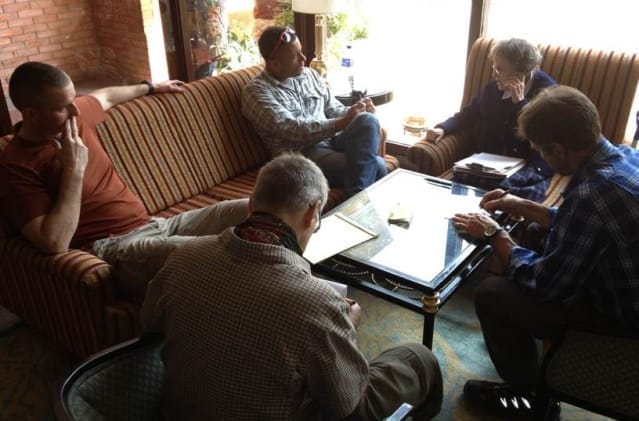
A legend in mountaineering who never climbed a single peak, passed away in Kathmandu yesterday at age 95. Miss Elizabeth Hawley was a legend. Full stop. I met her several times in Kathmandu, most recently after my 2013 climb of Manaslu. She was feisty, curious and smart. The first time I met her was in 1998. I was in Kathmandu on my way to climb Cho Oyu when I was told by the clerk in my hotel that I had a phone call. “Who would be calling me here?” I asked myself. “This is Elizabeth Hawley. What is your full name, where do you live? How old are you?” She fired off in rapid succession. Pausing, I gently asked, “Who are you again?” With a huff of indigence, she simply said “Elizabeth Hawley”. And that was that! I answered her questions politely and hung up not knowing I had just spoken with a legend as famous as Hillary or Messner. Miss Hawley’s tireless work resulted in the Himalayan Database, a compilation of records for all expeditions that have climbed in the Nepalese Himalaya. The data cover all expeditions from 1905 through 2017 to more than 450 significant Nepalese peaks. While she has conducted interviews for several years, her echo was strong. Billi Bierling took over the day to day activities and will continue the work of the HDB along with Richard Salsbury and team. Richard Salsbury sent out this message: It is with great sadness that we announce the passing of Elizabeth Hawley, who died on January 26, 2018 at the CIWEC Clinic in Kathmandu after a short illness. She will be greatly missed. The Himalayan Database will carry on under the leadership of her long-time assistant Billi Bierling. With sincere regards from the Himalaya Database team, Billi Bierling Richard Salisbury Jeevan Shrestha Rodolphe Popier Tobias Pantel Lisa Choegyal And Billie Bierling posted on her Facebook page: I am very saddened to announce that after a short battle in hospital, Elizabeth Hawley has left us. Personally, I cannot put it into words how much this amazing woman has meant to me, how much she has taught me and how much I will miss her in my life. Thanks Miss Hawley for having shared so much of your life with me, for allowing me to get to know you so well and to become your friend. I treasure all the moments we spent together – even the ones when I irritated you for not spelling a name correctly or being too late for our meeting…or having badly brushed hair! I feel very privileged to have spent all that time with you. We will try and keep up Miss Hawley’s work but of course today the Himalayan climbing world has lost one of its most important pillars. You will be missed, Miss Hawley. Keeper of the Mountains Trailer from Allison Otto on Vimeo. The Himalayan Database is now free and can be downloaded from their website. If your name is not in their database, then you didn’t summit! I have three posts about Liz and the HDB: The Himalayan Database is now free with interviews with Billie Bieling and Richard Salsbury My last interview by Liz for Manaslu 2013 An exhaustive interview with Richard Salsbury – Everest by the Numbers Thank you, Liz for all you have done. Rest in Peace. Climb On! Alan Memories are Everything
Himalayan Database Now Free!

In a major strategic change, the Bible of Himalayan climbs will now be free and available for download to anyone after November 1, 2017 in late November 2017 from their website. The Himalayan Database (HDB) has been the final word on whether a climber summited one of the high peaks in Nepal and Tibet for over half a century. Created by Ms. Elizabeth Hawley and turned into a searchable database by Richard Salisbury, the HDB became an invaluable research tool for climbers, historians and journalist. The HDB is a compilation of records for all expeditions that have climbed in the Nepalese Himalaya. The data cover all expeditions from 1905 through present day for more than 340 significant Nepalese peaks. Also included are expeditions to both sides of border peaks such as Everest, Cho Oyu, Makalu and Kangchenjunga as well as to some smaller border peaks. Data on expeditions to trekking peaks are included for early attempts, first ascents and major accidents. The database is searchable by peak, climber, expedition, nationality, season, mortality rates and causes and more. There are selected preset reports plus the capability for custom searches and analyses. I interviewed Richard in 2013 to explore his role as the data base curator and publisher of the CD version. Richard is a retired computer analyst who specialized in databases while at the University of Michigan. The interview covers a lot of topics and provides interesting insights into Everest statistics and her climbers. I met Elizabeth Hawley, aka Liz or Ms. Hawley, in 1999 before a climb of Cho Oyu. She lived up to her reputation with sharp questioning and a no-nonsense style both then and again in 2013 before my climb of Manaslu. Now with Ms. Hawley entering her mid 90’s, long time assistant Billi Bierling has taken over the primary role of gathering data from climbers. With the database going free, I asked Billi for some background and Richard on what might change in the new version. AA:When did the HDB begin? BB: Miss Elizabeth Hawley started archiving expeditions with the first American Everest expedition in 1963. She covered it for Reuters. She found the work and interviews interesting and carried on. However the actual Himalayan Database was created when Richard Salisbury approached Miss Hawley after climbing Annapurna 4 in 1991 and proposed the digitalization of the data for her. It took around 10 years for two Nepali ladies to feed in the data and in 2004 The Himalayan Database was released on a CD Rom. AA:How did Ms. Hawley do all the interviews alone for so many years? BB: At the beginning it was easy as there were only a few expeditions per year. She actually went to the airport in her beetle (there were only a few international flights per week), checked out the passengers coming off the plane and she approached those wearing obvious mountaineering boots. So it was possible to do for a long time. She did have some helpers and I know in the 90s there was an American girl who helped her but as life so often does, she had to go back to the states. I think Jeevan Shrestha started helping her in 2000 and I came in 2004. There were some other people involved but mostly only for a season or two but now we seem to have a solid team of Jeevan Shrestha, Rodolphe Popier and Tobias Pantel. AA:Any guess how many climbers/teams you interviewed just this Autumn? BB: About 130 expeditions… mainly to Manaslu and Ama Dablam … but also to more interesting peaks such as Nangpai Gosum and Burke Khang AA:Who is the primary user of the HDB? BB: Mountaineers looking for a new route or want to repeat one; people who want to be the first of something get in touch with us to check; journalists who need data for their stories; people like you or Eberhard Jurgalski to check facts .. or people who are just fascinated by the data. AA:Will Richard Salisbury continue on the team? And what is his role now? BB: Richard IS the Himalayan Database. Without him we wouldn’t have what we have. He has dedicated his later life to the database and he does all the data entry, created the online version, compensates our helpers to cover their expenses and for me he is the hub of our work, even though he is not in Kathmandu. So yes he will continue as we need him and wouldn’t have the Himalayan Database without him. At this point, I spoke with Richard and took some of the our 2013 interview: AA:How do you work together with Ms. Hawley in Kathmandu and you in Michigan? RS: We have a system set up where we can both work independently on our own copies of the database. Then periodically I reconcile the changes we have both made to the database by using a program that compares our changes and merges them into a new combined/updated database. Where we have conflicting changes, the program allows me to select the proper updates for the new database. I also travel to Kathmandu twice a year in April and October so that we can further discuss conflicting, unclear or missing information. Visiting Liz during the two principle climbing seasons also gives me a chance to meet many of the team leaders. AA: Richard, I had heard that the HDB was going to be taken over by the American Alpine Club. Obviously this didn’t happen. Can you tell us why? RS: There was never a plan for the AAC to completely take over the HDB. The AAC is interested in providing access to the data as they did with the publication of the original version in 2004, but they do not want to take over the data collection efforts. To continue with the data collection, the HDB was reorganized into a non-profit organization this last summer. By being a non-profit we are hoping to attract some sponsorship so that we can reimburse the data collectors in Kathmandu for
Everest 2013: Interview with Richard Salisbury, Behind the Summit Numbers
This interview with Richard Salisbury is one of an ongoing series I do each season with Everest climbers. In addition to regular climbers, there occasionally I get the chance to speak with those important figures behind the scenes, I welcome suggestions for anyone climbing in 2013 I should interview. Now here’s Richard: Richard Salisbury was as much of an unknown name to me as Elizabeth Hawley in 1998. I was in Kathmandu on my way to climb Cho Oyu when I was told by the clerk in my hotel that I had a phone call. “Who would be calling me here?” I asked myself. “This is Elizabeth Hawley. What is your full name, where do you live? How old are you?” She fired off in rapid succession. Pausing, I gently asked “Who are you again?” With a huff of indigence she simply said “Elizabeth Hawley”. And that was that! I answered her questions politely and hung up not knowing I had just spoken with a legend as famous as Hillary or Messner. Miss Hawley went to Kathmandu some 50 years ago and never left. As a journalist for Reuters she reported on climbs for various news services and the American Alpine Journal, Climb, Vertical and other magazines. Not only has she earned the respect (and fear) of climbers she is also sought out as a resource on routes and “beta” for the mountains. But there is much more to this story. The man behind the numbers is quiet, unassuming and virtually invisible. Richard Salisbury is the brains behind the Himalayan Database. Richard is a retired computer analyst who specialized in databases while at the University of Michigan. A climber himself, he met Ms. Hawley on one of his trips and the rest is history. Each year, Richard takes all the first hand interviews and tirelessly updates the database. To be clear, if you are not in the Himalayan Database, then your summit claim is suspect or unknown. Today, if you have a question about the number of summits, who was first, records, or any obscure question, the answer is within the Himalayan Database. Used by climbers, expedition operators and news media as well as by universities and physicians for research, the database is available for in CD-format. Summiter and fatality lists for recent seasons are freely available on-line at the Himalayan Database web site. A companion book, The Himalaya by the Numbers, A Statistical Analysis of Mountaineering in the Nepal Himalaya, summarizes much of information in the database and is available in printed format from bookstores. I caught up with Richard as he returned from Nepal to discuss the upcoming season, the numbers and, of course, his relationship with the famous Liz. Please meet Richard Salisbury: Q: Let?s start by getting to know you a bit better. You have trekked and climbed in the Himalayas for 25 years. Do you have a favorite area or climb? I have especially liked the Khumbu regions due to many Sherpa friends living in Namche and the western regions where I led treks in the early 1990s into the Upper Dolpo and Mustang regions when they were first opened for trekking. I got into climbing in the early 1980s when I took a two-week alpine course in Washington in order to get the skills to lead trekking groups in Nepal over some of the high-pass routes such as Tashi Laptsa, Sherpani Col, West Col and Amphu Laptsa. Q: When was your last trip? My last big mountain climb was to Annapurna IV in 1991, my last trek as a guide was to Upper Dolpo in 1993, and my last visit to Khumbu was in 2003. All of my recent trips to Nepal have been to Kathmandu to work with Liz Hawley. Q: Can you tell us how you met Ms. Hawley? In 1991 I was leading an Annapurna IV expedition, so Liz Hawley came to interview me as the leader. She brought her notes for Annapurna IV to show me and I had an Excel spreadsheet to show her on which I had calculated the minimal, average and maximum days from reaching BC to summit (as a planning tool for determining the optimal amount of supplies to bring). After reviewing what we both had, I suggested that she consider publishing her information as a database. She told me that she already had a Nepali working on this. But a year later she contacted me saying that the Nepali had gone to graduate school in Arkansas and was not likely to return to Nepal any time soon, and wanted to know if I was still interested in helping her produce a database. So we started our collaboration in 1992. We hired a Nepali woman half-time to start entering the data in autumn 1992. The amount of information she had from interviewing almost all of the teams that had climbed since 1963 was massive. The data entry job was finally finished in 2004 when the American Alpine Club published the Himalayan Database. Q: How do you work together with her in Kathmandu and you in Michigan? We have a system set up where we can both work independently on our own copies of the database. Then periodically I reconcile the changes we have both made to the database by using a program that compares our changes and merges them into a new combined/updated database. Where we have conflicting changes, the program allows me to select the proper updates for the new database. I also travel to Kathmandu twice a year in April and October so that we can further discuss conflicting, unclear or missing information. Visiting Liz during the two principle climbing seasons also gives me a chance to meet many of the team leaders. Q: The Himalayan database, both book and CD, is a massive effort. How long did it take to write ‘The Himalaya by the Numbers’ book published in 2007 and will there be another book? The first e-book edition of ‘The Himalaya