Monsoon Watch

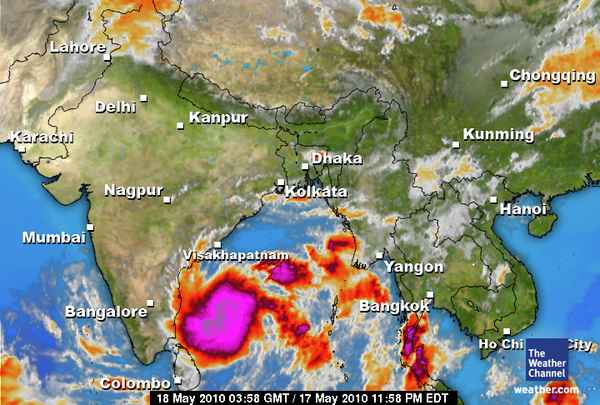
A huge wave of climbers on both sides of Everest have moved to their respective Advanced Base Camps. Many have declared a summit day of May 22nd but are monitoring the weather closely. This season is beginning to look identical to 2009 when bad weather basically shut Everest down around May 23rd and eventually delayed departures from base camps by almost week due to the heavy snow. Leaders who were there last year want to avoid a repeat, try especially on summit night. Mountain Trip, led by Scott Woolums with climbers Cindy Abbott and Paul & Denise Fejtek are looking at this weekend but have not pinned down a summit date. They explain: We are still confident that the decrease in winds forecast over the 22, 23, 24 will hold a good summit day for us. But we also have our Quiji board, tarot cards and our lucky dice! We are not being elusive with exactly when we are going, its just as the date gets closer, the forecasts become much more accurate. To say we are going say on the 24th would be reckless as things are changing rapidly by the day. One factor that will play a big role over the next week is a large tropical depression that’s formed in the Bay of Bengal and basically is heading our way. We may see precip and cloud from this as early as the 21st. This is the same type of storm that shut the mountain down last year with a lot of snow! Way to early to predict what will happen with this, but we are watching closely. On the north, an identical situation. Gabriel Filippi made this plan: I am getting ready for the summit push.  I will leave around noon, and climb to camp 1 (7100m) hoping for the weather to hold.  Strong winds are in the forecast until Friday night, and snow moves in on Saturday. Therefore, I am aiming to be at the last camp for the very small window during the night of the 21 to the 22, where no wind and no snow are expected.  Clearly, things can change fast on a mountain, and the very notion of  prediction is almost ironic.  I will stay alert…. and optimistic! Looking at the weather that is playing a huge role in summit plans; IMG’s Eric Simonson posted this update on their blog that a monsoon in the Bay of Bengal is forming and moving north towards Everest. Eric posted: We are tracking tropical cyclone Laila in the Bay of Bengal. Our longtime IMG weather forecaster Michael Fagin (www.everestweather.com) forwards us this satellite photo (courtesy of Meteorological Forecasting Division, Government of Nepal). As this storm moves north, we are hoping it will be pushed east by the jet stream, missing the Everest area! So we might see a rush to the top similar to last year, 2009. Regular followers will remember that Himex actually sent their team up a bit before schedule to miss the heavy stuff. Summit night of May 22, 2009 was a tough one with stiff winds and snowfall. Dave Hahn commented last year on his summit night as the cyclone brought huge changes to Everest (remember this was 2009, not this year): We passed the other climbing teams, one by one, as we went up the face in the night and just as dawn was beginning to the East we overtook a final team at 28,000 ft and felt fully in control of our pace and destiny as we took on the South Summit.  As daylight came on, I knew it was one of the prettiest mornings I’d seen from up high.  But I didn’t reach for my camera.  The morning was pretty because there were clouds at many levels and in many directions.  I didn’t take pictures for the same reason I wouldn’t if I saw a large tiger coming my way with fangs barred. It was clear that our good weather window was closing and we needed to move fast and hard if we wanted to squeeze in a summit.  We felt the full force of the winds as we crested the South Summit, but all were strong and all nodded their heads when I pointed across the crazy traverse topping the Kangshung and Southwest Faces and leading to the Hillary Step and the summit.  We went for it, but even before we’d scrambled up the Hillary Step, clouds had covered the mountaintop.  Visibility was poor at 6:45 AM when we stepped up to the summit.  Most of us kept our packs on, knowing our stay would be short.  It was not a day for photos and flags… just a few handshakes and hugs and we were out of there.  We made quick time back down through the storm to high camp.  Lucky. You can read Dave’s excellent description of how the cyclone’s impact hit Base Camp last year. Of course it can snow all it wants once the climbers are down! Many teams on the south are  looking to start their summit bid on Friday, May 21s which would have them on top Saturday morning, May 22nd between 6:00 AM to 10:00AM, normally. Apa Sherpa 21st Chad Kellogg 22nd Jordan Romero May 23rd Alpine Ascents 22nd Adventure Consultants-22nd Altitude Junkies 22nd IMG 22nd, 23rd Adventure Dynamics 23rd 7 Summits Club 22nd, 23rd The only team still holding their cards close to their vest is Himex which is normal operating procedure for them. You can see the latest radar image for Cyclone Laila aka 01B through this link that the feeder bands are approaching Nepal. It is not time to worry, but it is time to pick up the pace a bit. Climb On! Alan

South Teams Racing Against the Weather for Summits

The summit push is on and the south is pushing hard. Teams are at camp 3, Sherpas are at the South Col with tents and oxygen ready for the summit push. If the weather window holds, per some forecasts, teams should arrive at the South Col mid-day Saturday, Nepal time and start their summit bids later that evening, May 15th. This would have summits on Sunday morning, May 16th starting perhaps as early as 6:00Am. Of course all of this assumes the winds die down enough for them to climb. The competition continues and now is a bit ugly with feelings of deceit designed to trick the competitors. The Sky Climber team down at base camp report Carina Räihä at the South Col prepared to go for the summit anytime and Anne-Mari Hyryläinen has climbed to Camp 3.

South Side Update from IMG’s Eric Simonson

Last week we looked at the north side of Everest for 2010, look now let’s have a quick look at the south for 2010 through the eyes of IMG’s Eric Simonson. As many know, IMG is one of the largest operators on Everest and the other highest peaks around world. They were featured on the Discovery Channel’s Everest: Beyond the Limit in Season 3, which aired in late December. By my count we are approaching over 20 teams for spring so it will be quite crowded. Safety is always the primary concern of climbers and operators so I wanted to see if there are any plans to address the notorious bottleneck sections like the Yellow Band and the Hillary Step. Also with so many large (and experienced) operators now focusing on the south side,  would they begin to work more closely on route fixing similar to what had been done on the north side earlier last decade. Last year, we saw instability in the Icefall that produced not only drama for television but serious angst with the climbers and most importantly and tragically,  took  the life of Lhakpa Nuru Sherpa. I think it is important to note that the Icefall has always been a dangerous section and avalanches happen almost every year. 2009 just saw some climbers in the wrong spot at the wrong time through no fault of their own. I recently posted an interview with Walter Laserer who was struck by the 2009 avalanche. With climbers getting their minds wrapped around leaving for Nepal in a few weeks, I appreciate Eric taking some time to give us this update: Q: How is your 2010 Season looking thus far? We are looking good for 2010, the IMG Everest trip is essentially full.  I could put one more person on the Hybrid program, but that is about it.  We have a couple people doing Lhotse too.  Looking forward to another good season! Q: You now offer several types of climbs ranging from base camp services to limited guiding to full guiding. What is your thinking behind these offers? We learned a long time ago that not everyone wants the same thing.  Some people want a western guide and some want a Sherpa guide.  Our Hybrid program is a little bit of both!  We are trying to provide good service at a fair price, meet the needs of our customers, and take good care of our IMG guides and Sherpas. Q: How was your experience with the Tigress/Discovery Channel filming last year? Were you pleased with the final result? We worked great on the mountain with the Tigress camera crew, they did an excellent job.  Ed, Jaime, Matt, Mark, Christy all worked their butts off getting the footage. I was impressed with their hard work. After the climb I had absolutely nothing to do with Discovery and the production side, so I was wondering what the show was going to be like.  I was pleased with the final product, and the feedback I have received has been positive. Q: Some teams seem to be avoiding the Icefall. What is IMG’s attitude towards using other areas to acclimatize thus reducing trips through the Icefall? We have been going down to Lobuche Peak for many years as a warm up climb, and that is a good way to get some acclimatization prior to the first trip up the Icefall. However, I still think you need to do a couple rotations up the Icefall and on up to Camp 2 and 3, prior to summit bids. The Sherpas do dozens of trips up and down the Icefall, so I don’t think doing three roundtrips through the Icefall is unreasonable for the members to do.  Plus, every time people go up on a rotation they get stronger and faster, it’s a fact. Q: In 2009, bolts were put in the Yellow Band to increase speed and improve safety. Any other plans to accommodate the crowds and remove bottlenecks for 2010? The Yellow Band bolts replaced some nasty old pitons that had been used up there for fixed rope anchors, so that was a big improvement, with both up and down ropes installed. For 2010 I just bought 10,000 meters of fixed rope on behalf of a consortium of outfitters.  Russell deserves credit for getting the ball rolling on this and we now have most of the western outfitters on board. The challenge now is to get the Kathmandu operators on board too, but with the support of Ang Jangbu, Dawa Stephen, Tamding, and other key players I think that we’ll hit the tipping point soon on this. Again, this will be a big improvement. We figure that for $100 per western climber we can fix high quality rope, the hardware and oxygen for the fixing team, and pay the sherpas who work so hard up high to get the rope in.  We’ll have an up-rope and down-rope in all the bottleneck places for smoother traffic in both directions.  It should really help to make the route safer for both the Sherpas and climbers. Q: Any other thoughts on Everest this spring? I think everyone is getting the message that it is in our interest to work together.  For 2010 we will be trying to get more teams to haul their poop down from Camp 2.  Everest is looking cleaner and cleaner every year, it is definitely improving. Prospective Everest climbers need to be asking their outfitters about how they deal with their waste.  Also, how they staff and pay their Sherpas teams.  Teams with understaffed (and often underpaid) sherpa teams are the same ones that leave a lot of the trash, because they don’t have the horsepower to clean up their mess. Thanks Eric. As always, we wish you and your Sherpas and climbers a safe and successful season. Climb On! Alan