Everest/Lhotse 2016: A Mid-Season Update

Sunset and moonrise over Everest West ShoulderSunset and moonrise over Everest West Shoulder

Everest 2016 is developing into a ‘normal’ season. As we enter the last week of April, climbers are working hard to get their acclimatization programs in before the traditional poor early May weather but based on this year current weather, that may or may not happen. I’m starting to sound like a professional meteorologists! 🙂 There are 32 teams at Everest Base Camp with 287 Everest permits issued and some number of Lhotse and Nuptse permits as well. The non-Everest permits are a bit misleading as anyone who wants to enter the Icefall or just go to Camp 2 needs a permit for that maximum altitude but may have no intention of trying to climb that mountain. Overall, the Everest numbers are down about 15% and trekking in the Khumbu, down 40%. Numbers from Tibet are not available. For what’s it worth, I estimate about 200 foreigners on that side this year, up a bit from previous years. A Welcome Change I’ll get to my own experiences in a moment but this is starting to feel like a regular season. The last time we had one was arguably in 2011. Of course in 2014, there was the avalanche followed by the Sherpas strike to get improved conditions from the Nepal Government, then there was last year’s earthquake. In 2012, Russell Brice made the unprecedented decision to cancel his entire season fearing a release of the hanging serac over the Khumbu Icefall and in 2013, there was the silly fight between a few Sherpas and Simone Moro over who had the right to be on the Lhotse Face while the Sherpas were fixing the route. Climbing from the North side aka Tibet, while lacking some of the geophysical events has still had its share of issues re-enforcing that climbing from Tibet is never a sure thing. The Chinese seem to refuse permits at random with no explanation, they closed all of Tibet to climbing in 2015 after the earthquake thus stopping all Everest summits that year and this year, teams have had a frustrating time just getting into China with unexplained border closures. In any event, 2013 was the last time we saw significant and legitimate summits on Everest from Nepal and 2014 from Tibet. History aside, everyone I’ve spoken with this year from porters, Sherpas, climbers to operators are eager for a ‘no-drama’ year and thus far they have gotten their wishes. A Warm Season The most popular conversation around base camp are the warm temperatures. Of course this is not an Everest phenomena as 2016 is starting off as one of the hottest on record for the planet. This is my sixth time at EBC and I have never seen so much running water at base camp in April. Of course the fear is that with the warm temps, the potential for hanging seracs to release, rock fall and avalanche danger is higher, but thus far that has not materialized.  In speaking with Russell Brice, who has been climbing and guiding on Everest since 1987, he suggested the lack of snow this past winter combined with the warm temps are causing the seracs to ‘lay back’ or to have less of an overhanging profile thus releases are less likely to occur. Of course he adds the disclaimer that no one ever knows for certain what might happen. There certainly has been a lot of activity off Nuptse, which overlooks the Icefall and base camp, but there seems to be only one small area that release many times a day. Everest Base Camp is in kind of an amphitheater at the end of a long valley and the beginning of the downhill turn for the Khumbu Glacier, thus any sound is greatly amplified. I can tell you that I am awoken several times a night by a small, insignificant release that sounds like the entire mountain is coming down! There have been a few small releases onto the Khumbu Icefall but nothing that has put any climbers in danger … thus far. Every year since the Icefall has been climbed, serac releases have been reported so this is nothing new. However, the temperatures have changed some teams climbing strategy with earlier start times and fewer rotations. Many teams will enter the Icefall at 1:00 am in order to climb in the night when the sun is not heating up the seracs or the ice pinnacles that decorate the Icefall become unstable. Once the suns hits the Icefall around 10:00 am, it heats up dramatically becoming very uncomfortable plus, in theory, increases the objective danger. Where are the Ladders? There are fewer ladders in the Khumbu Icefall this year, perhaps less than seven crossings as compared to 20 or more in previous years. While some cite the earthquake as changing the terrain, the Icefall Doctors have moved the route away from the hanging seracs off Everest’s West Shoulder and towards Nuptse to minimize the objective danger. The route through the lower section of the Icefall is now more direct but requires some true climbing on a couple of steep sections. Some people have found this too difficult and have abandoned their climbs. When I was there a few days ago, a bottleneck occurred with 15 climbers, mostly Sherpas with loads, waiting ly in the dark for their turn to climb this short section. I suspect the Doctors will put a ladder in this area soon. Towards the top of the Icefall there are the usual vertical ladders to lead to the Western Cwm proper. The route from Camp 1 to Camp 2 is a zig-zag maze avoiding the usual crevasses crossing. It was taking over four hours to make the journey about an hour longer than usual. Reports now have it that the Docs have put in a few crossings to shorten the journey. All this said, this section is on a moving glacier – from base camp to Camp 2 – the Khumbu Glacier that can move up to

Everest/Lhotse 2016: Into the Cwm for First Rotation
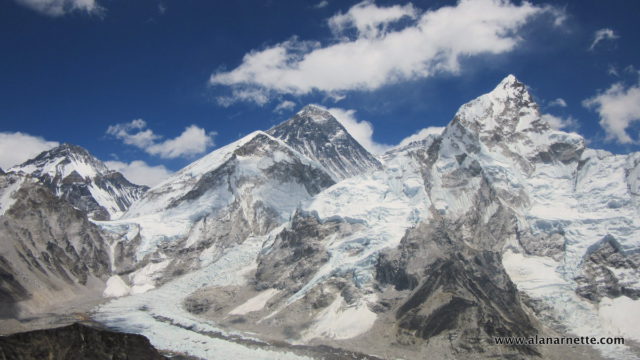
Everest View from Kala Patar

Time has come to leave Everest Base Camp for our team’s acclimatization rotation to Camp 1 and Camp 2 in the Western Cwm. The purpose for this is to naturally change our blood chemistry to better deal with the lower level of oxygen molecules available at the higher altitudes. The available oxygen at base camp is half that of sea level and on the summit of Everest, it drops to one -third. Using supplemental oxygen reduces the effective altitude felt by the body by about 1, 000 meters so acclimatizing is key to climbing any large mountain. We will leave tonight at 1:00 am and travel through the Khumbu Icefall in the dark of night when the temperatures are the coldest to minimize exposure to the moving ice and hanging seracs that have threatened climbers in the Icefall for decades. Many teams have already made this journey this year with no issues. We will spend one night at Camp1 and three or four at Camp 2. During this time we will climb up the Lhotse Face, perhaps as high as Camp 3 at 23,500, but not spend the night as some other teams do. On my previous climbs of Everest (note I am climbing Lhotse this year -not Everest), I have spent a miserable night at C3. It was considered “paying your dues” in the old school mantra of “climb high, sleep low” approach to acclimatization. While some expeditions still try to get that night in at C3, others feel it is too much of an energy drain and the short time at that altitude does not really accomplish much in terms of acclimatization. Personally, I think this is extremely individual and there is no blanket rule. However, I can say that by reaching 7000 meters or higher before heading to the summit later, is a huge boost in confidence so there is value. Early reports have the Lhotse Face very icy and hard. The route is expected to swing to the climber’s right near the base and avoid the rock-fall prone face. This is similar to 2012 that also had a dry winter and is the same route used by the first Everest summit team in 1953. The jet stream has moved back on top of Everest the last couple of days, all the way down to the mid-7000-meter level. As I write this at EBC, the winds are gusty. Teams at C2 are reporting strong cold winds. I will try to post an audio dispatch via satellite phone during the next 5 or 6 days since there is no internet connection up there (thank goodness 🙂 )  I’ll post a  complete report upon my return. All is on schedule for Everest south right now. The teams on Tibet have just arrived and appear to be running a week or so late but this should not be a problem as the season runs later on that side as they do not have to deal with the melting Icefall. It’s way too early to predict when the first summits may occur, but historically May 19-  21 has been the top few days on the south. Finally, April 25 is the one year anniversary of the Nepal avalanche that killed over 9000 and made millions homeless. I was walking to Camp 2 in the Western Cwm last year when it hit. As I climb tomorrow, the day will not be lost on me and millions of others around the world. Climb On! Alan Memories are Everything

Everest/Lhotse 2016: Gear Ferried into Western Cwm as Safety Move
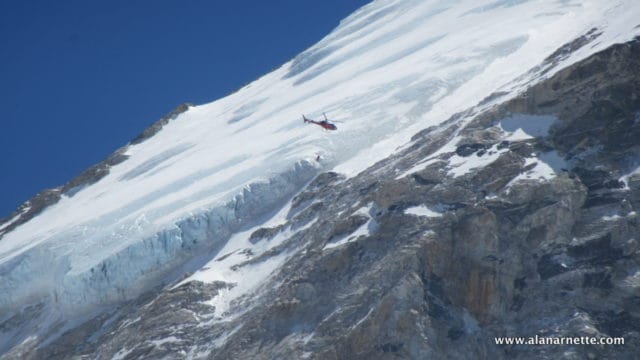
Ferrying summit rope to Camp 1 for Everest 2016

A bit of Everest history happening right now, 10:00 am April 23, 2016 Nepal time. Summit rope fixing gear (rope, anchors, oxygen for the Sherpas above the South Col) is being long-lined to Camp 1 by helicopters – all approved by the Government.  It has taken six trips by the helicopter plus a spotter in a separate helicopter to deliver the gear. No climbers or Sherpas were transported. This will save 87 Sherpa loads and potentially lives if there is another serac release or other natural disaster in the Icefall. As my regular readers know from this season, the temperatures at Everest Base camp have been quite warm this year, similar to what climbers experienced on K2 last summer where no one sumitted due to snow conditions. While I don’t expect that (no summits this year) for Everest/Lhotse, most people are concerned about the  conditions on the Lhotse Face and when passing thru the Khumbu Icefall. I took this video of running water on the “main street” of base camp a couple days ago in base camp. This is what you usually see in late May. While some may see this as a slippery slope to ferrying climbers into the Western Cwm and by passing climbing the Khumbu Icefall, for ?#?everest2016?, this is all about safety for the Sherpas. I can report first hand that the Sherpas are pleased with this decision. Not as a defense of potentially flying climbers into the Cwm to bypass the Icefall but more as a sense of perspective, looking at the world’s mountains there is precedent for such moves. On Denali climbers used to hike in via the Woodrow glacier trek vs flying onto the Kahiltna today. On Mont Blanc, almost everyone now uses the téléphérique to the Aiguille du Midi for the more popular routes. And some people actually fly to 14K on Aconcagua these days ….. Not saying it is right or wrong just that this seems to be the evolution when the “approach” becomes too “inconvenient”, difficult or dangerous. Of course, everest is viewed totally differently than any other mountain. If you are curious as to why continue the Everest/Lhotse 2016 season at all, most operators feel the seracs above the Icefall are “laying back” so while there is still risk and it makes sense to take all precautions, by climbing in the middle of the night, objective danger can be minimized (hopefully). Our team will leave base camp at 1:00 am for our acclimatization rotation to Camps 1 and 2. That said – there is always danger and that is part of climbing, especially on Everest. Of course, if there is another large avalanche onto the Icefall or into the Cwm or the Lhotse Face is thwart with rockfall – all bets are off for some and we may see expeditions cancel like Russell Brice did in 2012. No doubt, there is an air of apprehension here, you would be ill-informed to feel otherwise. Seeing the helicopters fly by – six times – brings the reality home. Climb On! Alan Memories are Everything  

Everest/Lhotse 2016: Everest ER to the Aid of All

Everest ER 2016

For the past 13 seasons a team of volunteers from across the globe have come to Everest Base Camp on the Nepal side to give aid to anyone in need. All they ask is for each climber with a permit to pay $100 and not only are their medical needs met but also entire team is covered from Sherpas to cooks to porters. Quite a deal! For 2016 the team includes: Tatiana Havryliuk (New York) Tash Burley (Aviemore, Scotland) Yogesh Subedi (Kathmandu) I caught up with them at their camp for an update: Dr. Luanne Freer founded the in 2003 it runs primarily off donations. You can read more and support the at everester.org Everest News In other news, a few teams have spent the night at Camp 2. Travel through the Khumbu Icefall is reported mostly smooth while the trek from Camp 1 to Camp 2 in the Western Cwm is reported to take 4 hours, about an hour or more than in previous years. This is due to a zig-zag route and very few ladders. In fact there are reported to be under 7 total ladder crossings from Base Camp to Camp 2. Usually, there are around 20 to 30. As I walked around Base Camp this morning, I met many people from previous years.  It seems no one is in a hurry to get higher on the mountain until the ropes are fixed to Camp 3. Overall, most teams seem confident to make only one rotation to camp 2 and perhaps a touch of Camp 3 as the high temps have everyone eager to reduce the trips thru the Icefall for members and especially Sherpas. The Nepal Government is doing what is always seem to do with finalizing the helicopter flights in that each day it is expected but something delays it from occurring. Hopefully April 23 is the day for the flights of the summit rope and gear to camp 1 in the Col. See my previous post for more details. Finally, I noted that Seven Summits Treks has a Chinese team of 25 at their camp. It seems that to climb Everest from China for a Chinese National, they must have submitted – not climbed but summited- an 8000 meter mountain before paying US$60,000 to join a Chinese team that attempts it from the Tibet side. OK, and as for today’s weather – a bit overcast and cool. It is breezy at times. We had snow last night but nothing significant. Alzheimer’s I cimb and report on Everest in honor of Ida Arnette who lost her life to Alzheimers in 2009. You can read more about our story and make a doation at  http://www.alanarnette.com/alzheimer/memoriesareeverything.php • NO CURE, always Fatal • No easy, inexpensive method of early detection • 3rd leading cause of death in the US • New case every 68 seconds, 4 seconds worldwide • Impacts more than 5+m in US, 25m+ worldwide • Devastating financial burden on families • Depression higher for caregivers • Issues are increasing rapidly as population ages Climb On! Alan Memories are Everything

Everest/Lhotse 2016: Nepal Approves Major Safety Change for Everest
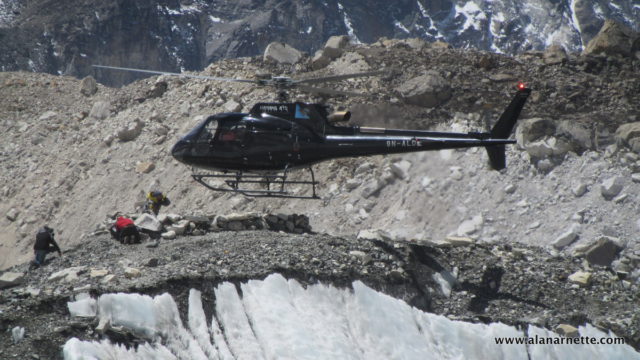
Helicopter Everest 2016

The Nepal Ministry of Tourism who manages Everest and other Nepali peaks often makes announcements that seemingly have no foundation in reality, for example putting a ladder on the Hillary Step or stopping climbers with disabilities from climbing from Nepal so it’s curious that one of the most significant changes since Everest was first summited in 1953 has been approved with no fanfare. As I reported last week, through the work by the Expedition Operators Association (EAO), the Ministry has approved using helicopters to ferry gear to Camp 1 in the Western Cwm this spring 2016 climbing season. No climbers or support staff will be helicoptered into the Cwm. Specifically the gear is limited to only ropes, anchors and oxygen used by the rope fixing team to get the safety line from Camp 2 to the summit. In the past this gear was carried on the backs of Sherpas thru the Icefall. It is estimated the helicopter lift will eliminate 87 loads this year. This is extremely significant as the temperatures this spring have been higher than usual creating a level of concern about climbing thru the Icefall. To be clear, no significant avalanches have occurred onto the Icefall as of this post and most operators are continuing with their programs as they have for decades. However, any reduction for the Sherpas who make more carries thru the Icefall than foreigners is welcomed news by all. Most sherpas will go thru the Icefall about 18 times while foreigners will do less than 6 but these numbers are very operator dependent. As of this post’s date, there are teams already at Camp 1 in the Western Cwm, and some will continue to Camp 2 for a few nights before retuning to base camp. The route thru the Icefall is a bit more difficult than last year in the lower sections and about the same up high, but the Icefall Doctors are continuously fine tuning the route as the Icefall moves about a meter, or 3 feet, each day thus moving ladders and ropes. As I walk thru base camp, there continues to be an air of optimism that this will be a no-drama year. Climbers seem to have internalized that the dangers are real and everyone needs to be highly aware and move fast thru the dangerous areas. Personally, I continue to be concerned about the level of experience of the average climber, both Sherpa and foreigner, this year as I was last year. The route up the Lhotse Face is expected to return to the 1953 path which starts to the climber’s right at the bergschrund instead of going directly up the center of the Face. It was used in 2012 for similar reasons. This is primarily due to a low snowfall winter that is assumed to have left the Face dry and more prone to rockfall. But again, once the rope fixing teams get there, the final decision will be made as to where to place the route. The route to the summit will be fixed by Sherpas in a joint effort of many teams. The Icefall Doctors stop fixing the route at Camp 2 and the commercial teams then take over. Over on the Tibet side, the route is fixed from ABC to the summit by the China Tibet Mountaineering Association (CTMA) each year. For many years it was set by Himex until they moved to the South in 2008. Speaking of the North, the first teams are starting to arrive with 7 Summits Club at Chinese Base Camp today. Others are in transit, escorted by their CTMA liaison. So, it is April 21 and there is progress on both sides. We have a long time to go. Everest summits traditionally begin around mid May on the South and a bit later on the North. Lhotse summits perhaps a few days earlier than Everest. Teams are working hard to acclimatize at Camps 1 and 2, with a few reducing their rotation to only one due to the high temps in order to reduced trips thru the Icefall. Others are sticking to their long time schedule of multiple rotations and a night at Camp 3 on the Lhotse Face. The Sherpas are setting up the high camps aided by a lot of gear that was left there from the shortened 2014 and 2015 seasons. And of course, the helicopter lift is welcomed news for anyone concerned about trips thru the Icefall. Thanks and well done by the EAO and the Nepal Government for this change. The gear should be moved any day now. By the way, it is overcast and cold this afternoon! Climb On! Alan Memories are Everything Latest Everest News – Thursday April 21, 2016 First teams arrive at China Base Camp Helicopters to take fixed line gear used for summit (not people) to camp 1 thus reducing Sherpas loads by about 87 First Westerners spend nights in the Western Cwm Camp 2 established Icefall route is a bit more difficult than in 2015 Alan is in Everest Base Camp and has gone into Icefall once. EverestLink is working well this year, Ncell is spotty Weather continues to be quite warm, more like late May than mid April Some concern with warm temps and impact on climbing conditions in the Icefall. Many teams limiting rotations thru Icefall to as few as possible due to high temps No major avalanches reported onto Icefall 279 Everest permits have been issued to 31 different teams as of April 10 per Himalayan In 2015, the Ministry of Tourism reported 319 individuals with Everest permits and 96 for Lhotse. 109 climbers from 2014 used their permits in 2015.

Everest/Lhotse 2016: Sacred Birds and Kala Patar

Himalayan SnowcockHimalayan Snowcock

Trying climb an 8000 meter mountain is like building a house while living in it and waiting for the roof to be installed. Today, we awoke to another perfect Himalayan morning with clear skies and unseasonably warm temperatures. While other teams race to get to Camp 1 for their acclimatization rotations, we are comfortable taking a slow and approach before leaving for a 5 day rotation to Camps 1 and 2.  But to be clear, we are not just sitting around. You must work your body at base camp before leaving for a rotation. In that spirit, Kami and I along with teammate, 30 year-old Barbara from Guatemala took a nice hike to the summit of Kala Patar (KP) today. It is 5643 meters or 18,513 feet. Many of my readers have been there on climbs or Khumbu treks. My first visit was on my 1997 trek to Everest Base Camp (EBC). After trekking for many days in the side valleys like Goyko, we eventually got closer to EBC, but first we wanted to summit Kala Patar for unprecedented views of Everest from Nepal. It is really a large hill and has nice worn path to the top that today hosts a weather station along with a plethora of prayer flags. Anyone who has made it this far can make it to the top but a nice young man stood near the base, horse in hand, ready to sell rides to the top for a reasonable 350 rupee! In any event, Kami, Barbara and I took a very different approach leaving our tents at Everest Base Camp for a cross country traverse across the desolate terrain of the upper Khumbu. The land is hard packed, dense with peat, void of grass. Rock and boulders decorate the landscape requiring a random scramble just to remind you that you are not at home. After a while we intersected the main trail to KP and joined a surprisingly few trekkers.  For many who came here, KP is their “Everest”. We slowly overcame the final few hundred feet to reach the summit. Big smiles, cameras and videos were abundant. One young man from the UK asked Kami to take his picture with his iPhone. Kami obliged, squatting then kneeing and almost lying on his side to get the subject in the frame with Everest in the background. “Me and Everest.” The trekker declared with a huge smile. We shook his hand and asked him to take our picture. As we returned to EBC, we passed the memorial for Rob Hall, who died in 1996 Everest. We took a moment to talk a bit about what had happened. Much to my surprise, I learned that Kami, who is is the older brother of Ang Dorge well know as being there in 1996, was also there! He was also working for Adventure Consultants and was with a member at the South Summit before turning around that season. He was at the South Col as the disaster unfolded. I’ve climbed three times with Ang Dorge and four with Kami and that Kami was there had never come up. The Sherpas tend not to talk about these kind of things … Finally we came across the sacred bird of Nepal, the Himalayan Snowcock, a kind of a big chicken, I first saw these beautiful birds at Ama Dablam Base Camp in 2000. I thought they were cute until their relentless cackling went on non-stop for two weeks!. Sacred or not, I bet they would taste good!!!! kidding, please no letters!!!! OK, so we will spend another few days at base camp. The weather has returned to more normal with clear morning and snowy afternoons, but the temps are still above normal. We hear avalanches all the time off Nuptse but the West Shoulder of Nuptse and the ridge between Lintgren and Pumori seems stable. We hope this continues and all climbers have safe passage thru the Icefall as well as on the route on the North. Clim On! Alan Memories are Everything

Everest/Lhotse 2016: Sherpa Training for Saftey and Longetivity
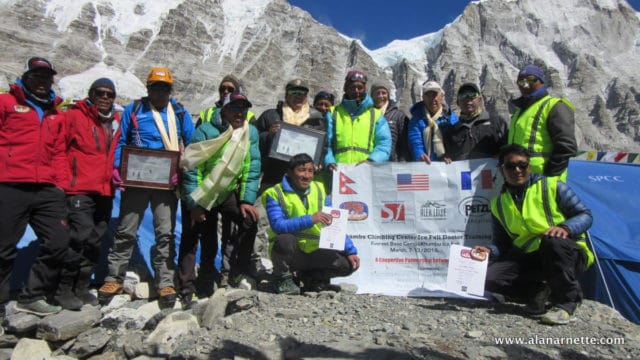
Icefall Doctors GraduationIcefall Doctors Graduation

A common question about Everest is how to make it safer. With over 30 deaths just in the past two years, climbers, Sherpas and families of both often ponder what can be done. Most deaths can be prevented in the big mountains by having appropriate experience, making good decisions or climbing with experienced partners. But the big picture is having the proper skills can prevent many accidents. This is where the Khumbu Climbing Center (KCC), founded by the Alex Lowe Charitable Foundation (ALCF) comes into play. Founded in 2003, their mission statement reads: to increase the safety margin of Nepali climbers and high altitude workers by encouraging responsible climbing practices in a supportive and community-based program. Lack of Experience Requires More Sherpa Training One of the emerging issues with climbing Everest and other Nepali peaks is providing the appropriate support for the level of experience the current generation of members have. The days of national teams that train together for a year before arriving on Everest – North or South – is long gone. Today’s representative member usually has a climb, not necessarily a summit, of a 5000 to 7000 meter mountain. Popular peaks mentioned by today’s Everest climbers include: Island Peak, Kilimanjaro and for some Denali and Aconcagua. While the Nepal Ministry of Tourism has suggested Everest climbers have a summit for 6500 meter, that requirement is not enforced. Another requirement often overlooked is that each foreigner must climb with a Sherpa Guide, but there is no requirement for their experience. The guide companies, both Nepali and Western often take members based on business reasons and not experience. These dynamics are not going to change anytime soon and with ever lower prices, Everest will see more inexperienced members each season. Khumbu Climbing Center The KCC, based in Phortse is trying to change all of this with a world-class training programs for the mountain worker community. While the Sherpa ethnicity dominates the classes, they are open to everyone and have even had a few participants from Pakistan. I had the pleasure of spending a lot of time with Conrad Anker, who represents the ALCF for the KCC over the past few days here at Everest Base Camp. Conrad, who leads the North Face Climbing team, has been working with the KCC to build a permanent location for their training programs.  The training takes place the last two weeks of January and the first week of February each year for 80 students usually 18 to 25 year-old. The class are divided into four sections: basic climbing skills, including knots, rock climbing, ice climbing and basic first aid. There is also an English language segment. They have trained over 1000 men and women since 2003. Each student must pay their own small tuition and insurance or find a sponsor. In early March 2016, they did a special course at Everest Base camp for 12 Sherpas who specialize in building the route through the Khumbu Icefall to Camp 2 for Everest, Lhotse and Nuptse climbers. I was invited this morning to their graduation ceremony at Everest Base Camp. Dedicated Training Facilities Conrad told me a permanent KCC building is critical to the overall program as there have been other programs that were started but stopped after a year or less. With a building to house, classrooms, a climbing wall, video room and the training facilities, the longevity of the program will be secured. By placing it is Phortse, the home of many Everest summers and climbers, it will make the training available to those throughout the Khumbu who will have the most impact on the Everest climbing community. The instructors include former graduates of the program plus foreigners that volunteer. For example Dr. Luann Freer of the Everest Base Camp Er has taught the medical segment. Other instructors have included Pete Athens. But building a strong local presence both in terms of skills and instruction is key to the longevity Conrad mentions. This year three Sherpas served as instructors: Phu Nuru, DaNuru and Panuru Sherpa. The program has been funded the ALCF with major contributions from The North Face, Jon Krakauer and individuals from around the world especially from Chile. The KCC is run totally by Nepalis and they make up the board. Foreigners serve as advisors. I sat down with one of the local principles in running the building, Tenzing Sherpa and who is also a Sherpa Guide. He also runs the electric co-op for Phortse.  I asked the 20 something Sherpa why the training was important compared to the older generation of Sherpas who have been guiding on Everest for decades. “We are learning techniques such as how to build an equalized anchor systems, proper knots or crevasse rescue systems plus learning the signs of altitude sickness. This make our job safer and the mountains safer for the members.” Locally Run Conrad emphasized the need for the KCC to be run by locals and not from a foreign country in order to build long term commitment. He said the families of the students appreciate that their father or son is receiving professional training and not just climbing the mountain with no education. The KCC Building will cost several hundreds of thousands of dollars. Fund raising has been a full time job for some since the inception in 2009. While in mid construction last year, the earthquake set back the time table but now it is hoped to be completed by 2017. The building was a brainchild of climber and architect Chris Bergum . He funded a graduate student program at the Montana State University School of Architecture led by Professor Mike Everts to design a world class building that would be earthquake resistant, use local materials, adhere to local design (for example, toilets are outside) and serve as a centerpiece for training for decades to come. Great Paul of the Salt Lake City based Momentum Gym is helping to raise funds for a state of art climbing wall in cooperation with Noah Bigwood.

Everest/Lhotse 2016: Tears Right Below the Surface

Everest Base Camp 2016

April 18, 2014 at 6:35 am, a small section of a long standing feature on the West Shoulder of Everest, aka an objective hazard, released onto the Khumbu Icefall. 16 Sherpas were killed in a moment as tons of ice and snow fell, leaving the mountain workers with few options and nowhere to hide. For today, two years later, there is no climbing on Mt. Everest. No Sherpas, no foreigners – everyone is in solemn unity remembering where they were that day, and who they lost. “The tears are right below the surface.” Russell Brice, Himex, told me this morning while standing on the trail that defines main street of Everest Base Camp. Brice’s words and emotions could have come from any Everest operator – foreign or Nepali. Many lost long time employees, friends and in many cases, family. There is no chasm between the operators or agencies. They speak in quiet tones about great climbers, young and old Sherpa Guides. They talk about their base camp doctors or the cameraman trying to record what makes Everest so special. Avalanches know no profession, no nationality. They are random and often fatal. Brice and others – western and Nepali – are back in 2016. When asked why, he simply says “It’s the right thing to do.” The cynical will bring into the conversation how much Sherpas are paid, the profit margins and the tired old line about Sherpa exploitation by western operators. If you ask the Sherpas, they will acknowledge the danger and the income that comes from guiding. They are pleased that about 300 foreigners are climbing Everest in 2016. That were worried that the bad publicity around Everest after the fights in 2013, the avalanches in 2014, earthquake in 2015 and the embargo in 2016 would scare away tourism. They may have been right about the trekkers as they are scarce but the climbers continue to come to the world’s highest mountain – whatever their motivation. The team I’m with, Altitude Junkies, hired 13 climbing Sherpas, 7 cooks and countless porters. We stayed in Kathmandu hotels and ate in Kathmandu restaurants. As we trekked towards base camp we stayed in teahouses, ate our meals there. The medical, life and rescue insurance fees goes to Nepali companies. Our gear was transported from Kathmandu to the Khumbu on Nepali owned airlines. Local porters carried them further up valley. Yes, the $11,000 Everest permit fee goes to the government and the western and Nepali companies earn a profit however a large part of the revenue, both direct and indirect that a climber pays, goes right back into Nepal. This is why Brice, and other operators are back. They know that what they do goes beyond helping members stand on a summit. Today’s remembrance is not a justification for climbing. It is not a marketing ploy to attract more climbers or sympathy. It is not an opportunity for another “adventure” magazine to sell advertising based on reciting decades old myths that are no longer valid. However, to be clear, not much has changed for the mountain workers other than increased life insurance. But the fault lies not with Western Operators as is often cited – in fact they have supported their staffs in levels high above the non-enforced laws. The fault lies with the Nepali Ministry of Tourism which has had three different Ministers in the last 12 months, not unusual. A fractured government and a diverse ethnic population prevents further progress for the Sherpa people, and others who work in mountains. The Sherpa people are viewed as already having a lucrative lifestyle and incomes by the rest of Nepal. These views generate jealousy and stalls further advances in safety and wages by the Ministry of Tourism. But these facts are ignored and the complexities are real. A solution is not simple. Yes, climbers can stop climbing Everest, but what would that accomplish and who would suffer the most? While in Kathmandu, I met with Kami Sherpa’s son. I summited Everest and K2 with Kami and stood side by side in the Western Cwm during last year’s earthquake Kami’s son, Mingma, is an impressive young man. He is now 21 and has one year left to obtain his Electrical Engineering degree in Kathmandu. He hopes to work for a hydroelectric company. Mingma said he wanted to be a mountain guide like his Grandfather, father and second oldest brother but Kami wouldn’t let him. He said he liked the idea of adventure. Interestingly, his mountain guide brother makes fun of Mingma for going to school and not earning as much money as he does guiding …. His two sisters also go to school in Kathmandu. One wants to be a doctor, the other is majoring in Hospitality Management.  By the way, Mingma’s English is perfect. He was born in the stone house where Kami and Lhapka live today, like all his brothers and sisters. He went to grades 1-5 in Pangboche then to the Hillary school in Kumjung to grade 7. When Kami sent him to boarding school in Kathmandu, they dropped him back to grade 5 because his English was so poor. He went on to graduate high school and is now at the university. The pressure is huge for them to stay in the Khumbu  and make a few quick dollars guiding for 2-4  months a year but Kami wanted a better life for his younger children – and he is seeing that come true. Mingma’s tuition is about US$2,000 a year, his sisters about $600 each. Most Sherpas employed by western guide companies will make about $5,000 guiding this spring, the low-end Nepali guide companies will pay their staff half or less for the same work Kami’s hard work is benefiting his children. He has the same dream as parents everywhere – for their children to have a better life than they do. Today is a day of memories. A day where a family in Portse, Pangboche or Thame remembers their fallen

Everest/Lhotse 2016: First Trip into the Khumbu Icefall
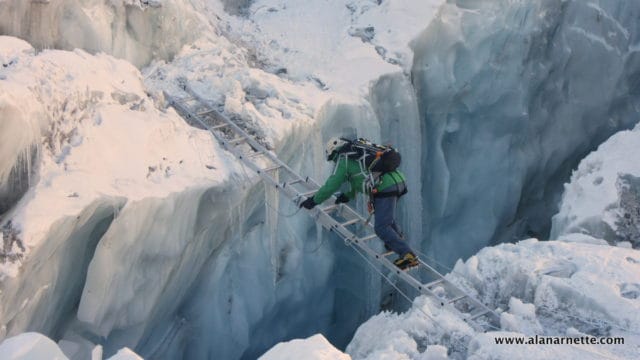
Kami climbing in the Khumbu Icefall 2016

Today our Altitude Junkies team, along with a few other teams, made the first sortie into the Khumbu Icefall. We got up at 4:30 am and left our base camp at 6:00 am passing by the puja alter with smoldering juniper boughs sending smoke into the air. I paused for a moment to take it all in and to acknowledge where I was and what I was doing. It took us about 20 minutes to reach Crampon Point but we kept going higher before we actually put our crampons and harnesses on. The sun was lighting up the terrain and Pumori, as usual, stood out with her snow covered summit brightly lit. Our objective was to go fairly high up but not to Camp 1. This was not a race, not a test but rather a part of our acclimatization process. We carried only water and layers, nothing heavy. Personally, and everyone has a different perspective of the route, I found the lower section of the Icefall significantly more difficult than in previous years, especially 2015. There were sections that required actual climbing, not just walking on pulling on the fixed line with a jumar (a mechanical device that has teeth oriented so you can go up but catches on the rope in case of a fall).  The route is put in and maintained by the Icefall Doctors. They started working the route almost a month ago so this is tedious and dangerous work. I climbed with Kami and we only crossed two ladders. We reached about 18,300 feet or 1,000 above Everest Base Camp before the sun poked over Lhotse and the temps went from reasonable to ridiculous. The warm heat of the sun also makes the Icefall much more dangerous as the fragile seracs can fall over at any moment – with no warning.  Happy with our progress we turned back for the comfort and safety of base camp. We will spend the next few days resting before heading up for our only rotation to Camp 1 and then Camp 2 before our summit push. This is an aggressive approach that I will talk more about in future posts. April 18, will be a solemn day of remembrance for the Sherpas who died in the Icefall in 2014. There will be no climbing that day. As Kami I were headed down, a rock slide occurred on a nearby peak once again reminding us of where we are and that nothing is safe in the high mountains. So a critical milestone in our plan. More to come. Climb On! Alan Memories are Everything     Latest Everest News – Sunday April 17, 2016 Sherpas are making are taking loads to Camp 2 now Icefall route is a bit more diffcult than in 2015 China continues to delay North teams, some are flying to Lhasa.  First climbs into Icefall for foreigners began April 15 Alan is in Everest Base Camp and has gone into Icefall once. Both Ncell and EverestLink are working well this year Weather continues to be quite warm, more like late May than mid April Some concern with warm temps and impact on climbing conditions but upper mountain seems stable, for now. Climbing routes not crowded at all 279 Everest permits have been issued to 31 different teams as of April 10 per Himalayan In 2015, the Ministry of Tourism reported 319 individuals with Everest permits and 96 for Lhotse. 109 climbers from 2014 used their permits in 2015.  

Everest/Lhotse 2016: Season Update

Alan at Puja

This is a summary of the Everest 2016 as of April 15, 2016 along with my own observations from Everest Base Camp as I am here climbing Lhotse with Kami Sherpa as part of the Altitude Junkies team. Please remember that I climb and do these dispatches all to raise awareness and research fund for Alzheimer’s. Please visit this page for more information. It has been a week since we arrived at Everest Base Camp. Time actually flies by even though we have done very little! The idea is to rest and let your body adjust to new altitude – 17, 300 feet or 5273 meters by taking what are called ‘active rest days’. This way you can accelerate the process thus on different days we hiked up to 18,000’ and then to 18,700’ on the flanks of Pumori.We were rewarded with great views of both sides fo Everest as you can see in the following gallery.     The weather has been warm, almost like late May but there have been no reports of difficulties in the Icefall or in the western Cwm by the Sherpas. In fact some reports have Camp 2 at 21,500 feet quite cold at -4F/-20C.  In my tent it usually reaches about 17F at night, so I’m appreciating my down sleeping bag! Right now, I am in the Altitude Junkies dining tent in short sleeves, with a temp around 65F at EBC. Base Camp has slowly filled up and is spread out like I have never seen, This my 6th time at EBC, not including a visit in 1997. There is one main path that serves as a main street for both people and pack animals. There are about 30 teams here that range from two people to over 100. Each camp is like an ink blot that spread onto the adjunct ones, it’s difficult to tell the difference given everyone uses the same yellow big tents and sleeping tents from the usual suspects of climbing gear: North Face, Mountain Hardwear, Ozark, etc.   The helicopter traffic has been slower than usual. Not sure if this is due to fewer people getting sick or limited budgets. But it is usual to have about ten helicopter landings a day. There are three pads built across EBC. Everyone stops and watches the choppers slowly fly by, make a lazy loop and gently land on the rock landing pad. They leave their rotors spinning as the loads and people get on and off. We have a great view of the Icefall from base camp. It looks a bit less jumbled than last year. The Icefall Doctors reports about 20 crossings in the Icefall and only a couple in the Western Cwm. Some Sherpas are reporting the routes is bit more difficult than in 2015. Today, Friday April 15, there a lot of Sherpas from many teams in the Icefall. Our Altitude Junkies 14 Sherpas left camp at 2:00 am and made it to Camp 2. They will only make one more carry leveraging the gear left at Camp 2 in 2014 and 2015. We will go half way up the Icefall tomorrow and all on our rotation to Camps 1 and 2 next week. More on that in a later post. Like many teams, we had our Puja yesterday. A Lama walked in from Dengboche to conduct the ceremony. He chanted Tibet prayers for our permission to climb, safety for the climbers and forgiveness for damaging the mountain with our sharp crampons and ice axes. All our Sherpas and members joined the ceremony sitting quietly next to the Lama. We threw rice in the air, spread barley powder on one another’s face to symbolize old age (the Sherpas say 105 years-old!).                 About half way thru the ceremony, the Sherpas hung the prayer flags from a long pole attached to the Puja alter across put base camp. With each wisp of wind the prayers printed on the red, yellow, green, blue and white flags (that symbolize the elements of earth) are sent to the Mountain Gods. At the end of the ceremony, the Sherpas break out the rum, beer and chang – a Sherpa moonshine. We all laugh with each sip of the ceremonial beverages and politely say no, no, no only to have your cup refilled. Everything comes to a fun end with Sherpa line dancing! So, Everest 2016 is going well. We hear avalanches off Pumori and Nuptse each night. We look at the Icefall with awe and respect. We look at each other with dreams and confidence. As we were climbing up Pumori, a medium avalanche came off Nuptse, well away from any path or camp. It was quite the blow and a reminder that these are wild mountains that are never tamed or conquered. Climb On! Alan Memories are Everything