Everest 2013: Can I be Rescued on Everest?

A common question for Everest climbers is if they can be rescued. Yes helicopters are available but with huge risks. I look at the options as we prepare for Everest 2013. In this world of instant communication, even from the summit of Everest, search some people believe rescues are easy and available on the high mountains. Nothing could be farther from the truth. When a climber gets sick there are generally three options: on your own, help from others or helicopter rescue. If the climber needs assistance, it generally falls on the Sherpas to help. Strong expedition guides also sometimes contribute. Manpower I have seen climbers with snow blindness short roped by Sherpas down the Lhotse Face. This is a technique where the climber is tied to another climber, sometimes in front and behind to guide him or her lower. The climber is able to walk on their own but needs significant help. It is slow, cumbersome and dangerous. I have also seen climbers dragged down steep faces using their sleeping bags or in rare occasions, a canvas sled. Again, this takes enormous manpower to keep the individual going straight, or carried over crevasses or bumps. If the grip is lost, the climber risk more injury or even death by dropping into a crevasse. It can take five to ten Sherpas to safely lower someone on Everest. In 2012, it took a dedicated team of seven Sherpas, two days to retrieve the body of Shirya Shah-Klorfine after she died between the South Col (Camp 4) and the Balcony. She was helicoptered back to Kathmandu from Camp 2 at a reported cost of $25,000. Helicopters Helicopter are available but only from some camps on a huge mountain like Everest. There are no helicopter rescues available on the north side of Everest as the Chinese prohibit helicopters flying over Everest or to Base Camp. In the “old” days, 2008 and earlier, the Nepal Army was the dominate provider of helicopter services for climbing expeditions. It was dangerous, difficult, expensive and took a lot of work to arrange an evacuation. Today, a private company, Fishtail Air, has taken over many of the evacuations with their four helicopter fleet. While not a tourist flight in Hawaii, it is slightly safer and much easier and more reliable than the Army. The Army still helps with large load transport. I wrote an article in 2010 on Fishtail that examines helicopter services in Nepal. Today they land at Camp 2 (21,000’/6400m) in the Western Cwm, but not higher. Depending on where the helicopter flights starts and fly to, it costs between USD$4,000 to $20,000 per flight and is very weather dependent. In 2012, 30 people were helicoptered from Base Camp to Lukla at a cost of $4,000 each due to illness. Most climbers have rescue insurance to cover the costs but insurance companies are getting wary of this coverage. 1996 Rescue Helicopter rescue on Everest came to the world’s attention during the 1996 disaster. In his book, Into Thin Air, Jon Krakauer detailed the daring rescue of climbers at the top of the Icefall at 19,800?. Nepal pilot and army captain, KC Madan, became a hero with his rescue of Beck Weathers and Makalu Gau via a stripped down helicopter, a B-2 Squirrel A-Star Ecuriel helicopter, that barely flew in the thin air of the Western Cwm. Today, the helicopters are more advanced. Fishtail air in Kathmandu worked on new techniques with Switzerland’s Air Zermatt’s who has a track record of rescue operations have saved many lives in Europe.  Helicopters can fly higher than the summit of Everest but landing to take on a passenger or body is dangerous. In some cases a special technique is used. Air Zermatt is also known as an expert in conducting Human Sling Operations, a difficult aerial rescue maneuver involving dropping an expert mountain guide at an inaccessible point to lift stranded people using ropes. In 2005, Eurocopter claimed a helicopter landing on the summit of Everest. It was a serial Ecureuil/AStar AS 350 B3 piloted by the Eurocopter X test pilot Didier Delsalle. They reported landing on the summit for 2 minutes before returning to Lukla. According to an interview with climber and helicopter pilot Simone Moro, the Fishtail helicopters are rated to reach an altitude of 23,051’/7026m but have flown as high as 7400m. This would be between Camp 3 and the South Col on Everest. As of 2012, the highest Fishtail will go for a rescue or body recovery is Camp 2 at 21,000’/6400m. The terrain is a contributing factor with a flat, stable area free of crevasses required. The Lhotse Face is steep and icy. Crashes It is easy to be lulled into thinking helicopters are a safe and easy, albeit expensive, way of getting to the high camps. But as I reported in November 2010, one of the Fishtail helicopters crashed performing a rescue on nearby Ama Dablam (22,349′ /6812 m). There have been two other crashes of the Fishtail helicopters. On Ama Dablam two climbers needed help. One was successfully snatched from the mountain side and as the helicopter was returning for the second climber, it crashed. It appeared to “fall out of the sky”, according to eye-witnesses. In 1973, an Italian Army helicopter crashed around 20,670’/6300m. Wreckage from that crash was only removed in 2011 after the Khumbu Icefall took it lower. There have been multiple deadly helicopter crashes at Everest Base Camp including 1997, 2003, 2005 and 2007. Ignoring all the risks, many climbers use helicopters to fly in and out of Everest Base Camp. While tempting at the end of a long season, they miss what I think is one of the parts of an Everest climb, the Khumbu trek. Climb On!AlanMemories are Everything

Helicopter Crash on Ama Dablam – Huge Loss
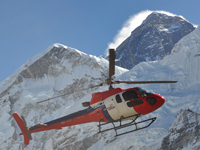
A helicopter owned by Fishtail Air has crashed on Ama Dablam while rescuing two Japanese climbers above 16, salve 000′ according to multiple Asian news reports. It was on the north side of Ama Dablam, there not the normal Southwest route taken by the vast majority of all teams. This is a huge loss on many levels. The pilot, Sabin Basnet, and engineer, Purna Awale were both killed. Basnet was the pilot who made the record setting Everest rescues this past spring with one evac from Camp 2 at 21,000′. Basnet was very experienced with over 4,500 hours of flying various types of helicopters. Basnet also made history when he piloted the world’s highest ever rescue mission, airlifting three sick Spanish climbers from Mount Annapurna. The news reports say the Chopper crashed after rescuing one of the climbers who was taken by to Ama Dablam BC. The accident happened as they returned for the second climb. There was no current update on his status. A conflicting report says had rescued both climbers and brought them down to Lukla and had returned to the mountain when it appeared to “fall out of the sky”, according to eye-witnesses. As I wrote in May 2010, Fishtail Air brought new capability to high mountain rescues in the Himalaya utilizing techniques developed in the European Alps. Fishtail Air has a fleet of five helicopters, including four  Ecureuils, two of them high-performance aircraft for high altitude rescue. Helicopter crashes are not uncommon in the high mountains and especially on Everest where there have been multiple deadly helicopter crashes at Everest Base Camp including 1997, 2003, 2005 and 2007. And many in the climbing community feel the high-altitude rescue opportunity invites climbers to take unnecessary risks. renowned high-altitude physician, Dr. Peter Hacket, told me of the rescues this past spring that in his opinion “… helicopter requests from base camp were totally out of control, many were unnecessary.” My condolences to the families and friends of Mr. Basnet and Awale.

Helicopter Rescues in Everest’s Western Cwm?

With several teams targeting Sunday, May 16th as a summit window, the question of rescues often comes to mind; especially if the weather looks marginal as this one does. Followers of Everest know that rescues are difficult and sometimes impossible above base camp or 17,500′. In his book, Into Thin Air, Jon Krakurer details the daring rescue of climbers at the top of the Icefall at 19,800′. Now a new service from Fishtail Air is underway that designers are confident can rescue climbers deep in the Western Cwm, well above 19,500′. While an experiment this season, it has already proven to save lives on other high peaks.