Russell Brice Continues to Guide, but with Caveats
Last week, I made a post about Russell Brice’s public statement that he will “hang up the guiding boots.” In that post I also hoped this was an emotional reaction to cancelling his second expedition on K2 in three years. Well we now have the answer. Brice to “Stay” Russell Brice, stung by his decision to stop his K2 expedition this season when another team went on to summit, wrote a heartfelt description of exactly why he made the decision to end the summit push on K2 and summed up his newsletter with these startling statements: So once again it would appear that I have made a bad judgment call, and should really be still on the hill. I came here at the request of my members because they put their trust in me. I took this on as an honor but also as a great challenge to deal with this mountain. I have failed, it is time for me to give up this game. I have enjoyed the experiences along the way, it has not made me rich or have a stable home life, but I have managed to see many parts of the world and meet many interesting people along the way. It’s time to hang up the guiding boots and put my own personal boots on. He now clarifies his intent. He said he is not leaving guiding altogether but rather planning to spend less time at base camp. He posted in his recent newsletter (emphasis is mine): And of course I need to discuss my flippant comment that I would hang up my boots. Thanks for all of you who have sent supporting messages, they are all appreciated. It is nice to know that people appreciate my work, but you do not have to live in a tent, wake up early every morning, make life dependent decisions, then work a full day, and be on call 24/7 for half a year at a time, living on basic food, in a different culture which is often rather vague with objectives but full of bureaucracy. So far this year I have been at home for less than 16 days, I have spent over 100 nights in a tent, have done more than 25 international flights and effectively have had no days off from work. I used to be 25 once, and enjoyed this life, but now I am 65 and as much as one may want, the body just does not perform the same, and trying to keep up with those who are half my age is challenging and fun, but it takes its toll. I did not intend to imply that I was leaving the industry – it is my way of life, maybe I intended to suggest that I might be spending less time at BC than I have in the past. There is plenty of exciting news to come with further development of Himex and our operations, and I need to spend more time in a real office rather than a tent office on the side of a mountain. Maybe the view will not be so great, but at least the air conditioning and temperature control might work a bit more reliably. Thanks again for all the support. Next week I will be back in Kathmandu to start our Manaslu trip with Richie Hunter as guide. Himex Changes? As you read, Russ teases that there are other changes afoot for Himex. It is well known within the close climbing community that he has wanted to sell Himex for quite a while, including to one of his guides at one point but they had a falling out and the deal evaporated. So, I will not be surprised to see Russ bring on a financial partner and Russ take more of a back office role similar to how Eric Simonson runs his Everest expeditions from the US while Greg Vernovage and Ang Jangbu Sherpa are at base camp or Todd Burleson’s Alpine Ascents who lives in Alaska and rarely goes to base camp. Russ has cultivated excellent guides with Richie Hunter, Mark Woodward, Shinji Tamura, and Hiro Kuraoka plus his long time Sherpa Sirdar, Phurba Tashi who is tied with Apa Sherpa for most Everest summits at 21, who is now content to lead the climbing team from base camp as well. No matter, change is always a constant in the climbing community. It is rare to see companies last more than a few years as guides tire, the competition is tough, the pay and working conditions are difficult and the risk is real when you take on daily decisions of life and death. As always, I wish Russ the best, no matter his role. Climb On! Alan Memories are Everything
Russell Brice Announces End of Guiding Career – Update

UPDATE: It appears that Russell Brice’s comments last update from K2 left us with an incorrect impression. He now clarifies his intent that he is not leaving guiding altogether but rather spending less time at base camp. He now says (emphasis is mine): And of course I need to discuss my flippant comment that I would hang up my boots. Thanks for all of you who have sent supporting messages, they are all appreciated. It is nice to know that people appreciate my work, but you do not have to live in a tent, wake up early every morning, make life dependent decisions, then work a full day, and be on call 24/7 for half a year at a time, living on basic food, in a different culture which is often rather vague with objectives but full of bureaucracy. So far this year I have been at home for less than 16 days, I have spent over 100 nights in a tent, have done more than 25 international flights and effectively have had no days off from work. I used to be 25 once, and enjoyed this life, but now I am 65 and as much as one may want, the body just does not perform the same, and trying to keep up with those who are half my age is challenging and fun, but it takes its toll. I did not intend to imply that I was leaving the industry – it is my way of life, maybe I intended to suggest that I might be spending less time at BC than I have in the past. There is plenty of exciting news to come with further development of Himex and our operations, and I need to spend more time in a real office rather than a tent office on the side of a mountain. Maybe the view will not be so great, but at least the air conditioning and temperature control might work a bit more reliably. Thanks again for all the support. Next week I will be back in Kathmandu to start our Manaslu trip with Richie Hunter as guide. Original post: This was part of the exciting news that K2 was summited on 28 July 2017 but I believe it deserves a separate post In a heartbreaking newsletter long time high altitude guide Russell Bruce announced he is ending his guiding career. I hope this is a moment of regret and will not hold. A Leader Brice’s first commercial expedition to Everest was on the north side in 1994. He personally has 14 summits of 8,000m mountains, including two Everest summits under his belt. He summited Aconcagua at age 64. One climb few remember was in 1988 attempt via the never before climbed Three Pinnacles on Everest’s northeast ridge. He knows what he is talking about. Russ’ Himex team was on K2 in 2015, the Česen route, without a summit. Last year he subcontracted his K2 team to another operator who also didn’t summit. In 2012, he made a gutsy and controversial decision to end his Everest expedition one month early when the hanging serac above the Khumbu Icefall threatened to collapse. It didn’t that year and hundreds went on to summit but two years later later it did taking 18 Sherpa lives in the collapse. Russ was never afraid to make a hard decision if he thought lives were at risk Russ is a logistic expert and an leader in advocating safety for members and moreover, his staff. He was instrumental in getting the Nepal government’s approval to use helicopters to ferry loads to the Western Cwm on Everest this eliminating hundreds of Sherpa trips thru the Icefall. He is always willing to use his resources to help a climber in trouble, even if that climber was independent or on another team. He tried in vain to save David Sharp who died on the north side of Everest in 2006. Ironically he was widely, and unfairly in my opinion, criticized. You can read my complete interview with him at this link Himex Base Camp Russ was known for having the absolute best camp at Everest, or on any of his trip. I profiled his Everest Base Camp in 2012. I opened it this way: I’ve been in many base camps but I knew I was somewhere special when I was told “… and this is our garbage tent.” Welcome to Everest Base Camp, Russell Brice style. In 2011 while climbing Everest, I spent the afternoon with Brice getting to know this man and how he runs his expedition base camps. Let’s just say, it’s different. Most expeditions will promote their excellent base camp facilities and talk of gourmet food, individual tents, and clean kitchens. Today, this is the ante to play the game and let me say from the start that many operators take great pride in their base camps, and rightfully so. With guided expeditions becoming more competitive along with soaring prices, climbers are starting to expect more, sometimes unrealistically so. You read the complete post here. K2 2017 Russ prides himself in reading weather forecast and giving his member the best, safest opportunity to summit and get back safely. It was this study of the facts that lead him to cancel this year’s K2 attempt. He posted: After studying the weather very closely, and some intensive discussion between members, guides and Sherpa’s we decided to call the expedition off. We cannot see any clear weather to follow up even if we did work hard and got the route to C4 on 26 and 27 as there is another front of bad weather expected on 28 and 29. This brought differences of opinion, should we postpone our departure arrangements and wait for better weather or should we pull our departure date forward and leave as soon as we can clear the mountain. Most were in favor of pulling departure date forward. It is always interesting to see that those with the most money
Everest 2017: Russell Brice “Old School” Prepares for Another Season

Russell Brice is a legend on Everest. He came to notoriety on the Discovery Channel’s “Everest Beyond the Limits” series about 10 years ago. But few people know that Russ is a world-class climber in his own right. Born in New Zealand in 1952, he now lives in London. He started climbing as a young boy in New Zealand and soon found his way to the Himalayas and Alps. Back in 2011, I sat down with Russ for a long conversation. Since then we have had many such opportunities to talk about his climbing experiences, Everest, trends and dangers including last year during my Lhotse attempt. When I asked Brice about the Discovery series he told me he wished he had not done these shows, they had not helped his business. He felt they were edited for drama and reflected poorly on some individuals. The David Sharp incident came to mind as we discussed the pros and cons of global exposure. Brice made it clear that he did more than any other expedition operator would have to try to save Mr. Sharp given he was not a Himex member. He sent his own Sherpas back up the North side in 2006 with oxygen, he took Sherpas away from his own climbers on their summit bid to provide assistance and he met with Mr. Sharp’s parents in London to return his personal items at his own expense. Brice, looked at his shoes as he told me these stories, sighing occasionally. It reminded me of the saying the no good deed goes unpunished. We spoke of death on the mountain and while he has seen many deaths of personal friends while climbing, he had experienced only one death in all his years of guiding, a junior Sherpa in 2006 from altitude sickness. Again, he became reflective as he spoke. He told me of sending two of his members back home early on an expedition after heart conditions surfaced. I asked Brice if he felt like he was God sometimes – “Not God, but these people pay me to give them a chance to climb Everest and not die. And I take that responsibility seriously.” He responded. I moved on to ask him about the evolution of climbing Everest. Brice’s first commercial expedition to Everest was on the north side in 1994. He personally has 14 summits of 8,000m mountains, including two Everest summits under his belt. He summited Aconcagua a few months ago at age 64. One climb few remember was in 1988 attempt via the never before climbed Three Pinnacles on Everest’s northeast ridge. He knows what he is talking about. I asked about the location of camps on the north side, the acclimatization schedule most teams use today and the routes we all use. He surprised me with his candid answer of “we made it up as we went along early on the north side.” I was expecting something more analytical. He said of the high camps on the north side, they ended up where they are because that was where the Sherpas ran out of line, or out of daylight. They moved a bit over time but are basically in the same spots that Mallory and Irvine used in 1924. Today, he prides himself on looking for new ways to climb Everest, such as using Lobuche for acclimatization. His Base Camp is legendary with the Tiger Dome tent complete with a big screen TV and espresso machine. In 2012 I did a post on how he runs his camps and why his members love it and are willing to pay a premium for hs expertise. So, whats up for 2017 with Mr. Brice and how does he feel about all the new trends being publicized in the financial press on how to take short cuts to summit Everest. Q: What are your expectations of the season – crowds, weather, surprises from the Nepal Government (Ministry of Tourism – MoT)? I think that success on Everest last year was very important to regain confidence from climbers that the mountain was as safe as it ever can be, and that the route had not changed drastically, so I suspect that it will be busy on the mountain again, especially from the many new local Nepal companies. I see that the monsoon has already started to form so I will not be surprised if we have warm general temperatures on the mountain again this year. I personally feel that the freezing level is getting higher (in altitude) every year, hence we are seeing some radical changes in snow pack and ice formations. Something that we as mountaineers around the world need to be aware of and take note that routes are changing and so our decision making also needs to take note of this. Who knows what the MoT will be like this year, as the people there change so often, and in fact now the government is on an eight month rotation, so we have very little idea of who might be in charge. We will see !!! Of note is that Foreign Operators have at last been accepted as Associate Members to the Expedition Operators Association (EOA) in Nepal. I also heard that the SPCC Icefall Doctors are aiming to fix the Icefall earlier this year, which will hopefully mean that we can fix the summit rope earlier and that we can have an earlier summit period. What we are all concerned about is that by the end of May all the protection equipment is melting out on the route through the icefall, so we have many complaints from climbers about safety (but of course not much help in replacing gear). Q: What changes are you asking the MoT for Everest 2017? Such as using helicopters to ferry gear into the Cwm. We as the EOA have been asking the MoT for permission to fly all the rope fixing gear to C1 so as to avoid 78 Sherpa loads through the Icefall for several years. Last year we finally received this permission
Everest 2012 Starts with a Dual Summit Reenactment
Well it is Everest 2012 time! We are starting to see more information on blogs, ed interviews and through press releases as teams go into their final preparations. Many climbers will leave their home countries next week. Everest Base Camp IMG posted that their annual shipment of oxygen bottles and tons of supplies are already in Kathmandu and some already on its way to Everest Base Camp (EBC). As usual Sherpas have already gone to EBC to stake out their space on the moving glacier. If you were to go there today, you would see rocks with painted team names and perhaps some piled up to mark their territory – all an annual tradition. Some teams want to be as close to the Icefall as possible to reduce the transit time in and out of the ‘fall and others want to be as far away as possible to ensure a quiet environment with less traffic from yaks, trekkers and other climbers. In 2011, I found it interesting that Himex had their base camp as far away as possible, in fact actually on dirt, not the glacier yet has another small storage tent near Crampon Point where they stored their ice axes, helmets and crampons to make the short trek as convenient as possible for their members. The West Ridge Reenactment The Eddie Bauer/First Ascent team will be there as usual this year. Since their launch several years ago, their marketing continues to be focused around their small, tight knit group of sponsored climbers including Dave Hahn, who will be going for his record 14th Everest summit in 2012. In a press release today, they announced two different climbs, on different routes in a re-enactment of the 1963 feat. First will be a standard South Col effort with Hahn, Leif Whittaker and Melissa Arnot. Then a much more ambitious and rarely attempted, much less accomplished, climb of the West Ridge by Jake Norton, Brent Bishop, Charley Mace and David Morton. This is a pure professional team of experienced climbers however the risks are still real with the West Ridge representing some of the most difficult climbing on Everest. For background on this route, Croatian mountaineer, Stipe Boži?’s documented his 1979 climb of the West Ridge on this link. It is a great story with some amazing photos. Walking with the Wounded Another expedition that will receive a lot of press will be the British Walking with the Wounded team climbing with Himex. Their site has a nice series of interviews with the team, wounded servicemen. Their patron is UK’s Prince Harry who was rumored to climb with them but will only be there in spirit after going to the north pole with the team last year. Of course these type of expeditions will get a lot of publicity, by design, but as always the individuals trying set their own records will provide the drama. The north side looks to be interesting with many teams returning now that it looks more politically stable and of course the south will resemble a beehive. I thought 2011 would have been a quiet year with the global economy suffering but there were 537 summits in 2011, 371 south, 166 north by 525 different climbers; so 2012 might surpass those totals with things looking up all over. Gasherbrum I Update On a very sad note, it is looking very discouraging for the three western climbers and the Pakistan porter now missing on Pakistan’s Gasherbrum I since Friday at noon. The weather has prevented launching helicopter search efforts. They were attempting a new route, in winter in the Karakourm. Their loss has overshadowed the success of a Polish team which did summit a few days earlier thus setting a record. Climb On! Alan Memories are Everything
Everest Base Camp – Himex Style
I’ve been in many base camps but I knew I was somewhere special when I was told “… and this is our garbage tent.” Welcome to Everest Base Camp, Russell Brice style. In 2011 while climbing Everest, I spent the afternoon with Brice getting to know this man and how he runs his expedition base camps. Let’s just say, it’s different. Most expeditions will promote their excellent base camp facilities and talk of gourmet food, individual tents, and clean kitchens. Today, this is the ante to play the game and let me say from the start that many operators take great pride in their base camps, and rightfully so. With guided expeditions becoming more competitive along with soaring prices, climbers are starting to expect more, sometimes unrealistically so. Everest Base Camp A base camp is just that, the camp where you are based for an expedition. In this sense, you want it to be comfortable, clean and convenient. A place where you can recharge after a difficult acclimatization climb or regroup after a summit bid. A place you literally call your home away from home. Most expeditions will offer dedicated tents for dining, cooking, sleeping, showers and toilets. Then they may add communications, medical and storage tents. Almost all will heat the dining tent with a propane heater and provide power for lights from solar panels supplemented by a generator. The next level up is when there is a “social tent” where climbers can hang out and relax on comfortable chairs or even some kind of sofa, believe it or not. And then the entertainment: stereos, and flat screen TVs with DVD’s for movie night. Finally we reach a crescendo with an open bar and espresso machines. Yes, all this at 17,000 feet surrounded by rock, dirt and ice. Himex Base Camp Brice came over to our camp one snowy afternoon in May 2011 and over lunch invited me to tour his base camp . He never expected me to write this article but with so much attention on Everest these days, I thought my readers would enjoy seeing an inside look at how he runs an Everest Base Camp. As I took the tour with Brice, he took great pride in showing me his version of the expected amenities. It was one of the most impressive camps I had ever seen in over 30 major expeditions. It was set up with military precision and 5 Star hotel cleanliness and service. Cooking, Eating, Sleeping and More Each climber had a private 3 man sleeping tent that provided more than enough room to spread gear out and sleep comfortably on thick mats. They were lined up in a straight line suggesting a laser was used to align the tents. The kitchen was a very large yellow canopy that covered stainless steel tables, dutch ovens, and food prep stations. The dirt floor was covered by a nylon tarp. So far nice but not unique amongst the top operators, I mentioned to Brice. His response: “The dirt floor is covered by a nylon tarp then insulation followed by outdoor carpet. Actually this is quite different from other operators. Others have a stone floor as it makes it much easier for cooks to tip water / fat etc on the floor rather than taking it outside. By having carpet means that cooks cannot do this, so hygiene is improved and it makes it safer and more easy for the cooks whilst cooking.” The dining tent was another large and long yellow canopy that Brice had custom made for his expeditions. A long table was covered in a plastic table cloth, plastic flowers adorned the table next to well organized condiments all sitting on top of indoor/outdoor carpeting. Comfortable chairs with padded cushions lined the perimeter of the table; a sturdy heater in the corner stood by for the cold evening. Several light bulbs hung from the ceiling to provide light, powered from solar panels. Brice prides himself on not using a generator unless absolutely necessary such as for charging a film crew’s batteries overnight. Sherpas arrive in mid March, well before the members, to set all this up so when the members arrive they can focus on, well enjoying base camp. The toilet tent was the nicest I had ever seen, and I say that with sincere appreciation. Another large yellow tent, actually there were two tents – a mens and a ladies – with sit down toilets (a urinal in the mens), and carpeted floor. A sink for hand washing was in each restroom. Another separate, rather large tent provided room for propane heated on-demand hot water showering. A chair and hooks were conveniently located inside the tent to accommodate changing clothes. The Sherpas also had it nice with more yellow tents smartly lined up housing four to six persons per tent. Oh, and about that garbage tent. Well, you guessed it, another large yellow version that housed all the kitchen scraps and trash generated by modern climbers stored in plastic bags outside the reach of ravens, yaks and yetis. As with all Everest Nepal side expeditions, this trash is taken down valley and burned or buried like in a modern city. The Dome But the Pièce de résistance for Brice was his social tent aka the Pleasure Dome, White Pod or Tiger Dome (winning!). Again, many expeditions will use a dome from Mountain Hardwear for a similar feeling, but there is more to this than nylon. The Dome, made by White Pod, was literally an extremely large round domed tent maybe 50 feet across and 20 feet high with clear plastic floor to ceiling windows serving as a window to watch the world passing by. You entered through a small wooden entry room, a foyer so to speak, to prevent the cold and snow from spoiling the interior ambiance. The day I visited, most of his members were at the higher camps on Everest so the base camp staff were taking
Everest 2011 Approaches
I know I am busy with my preparations for Everest in a little over a month and so are many others. There is a never ending series of tasks from planning to packing and of course training. I am pleased that I am making contact with many of my future teammates and fellow climbers. It looks to be a great season. A few items of interest I thought I would highlight. EverestER Anyone who has climbed on Everest’s Nepal (South) side in the past decade knows that EverestER is THE place when health issues arise. Dr. Luanne Freer runs it with volunteer doctors. She just sent me this update Hello Everest Nuptse and Lhotse-bound expeditions! YES the Everest base camp medical will be on the mountain this year for our 9th season. We will continue to ask for $100 per Non-Nepali staff and climbers in base camp, which will cover all doc consultations for each donating member. IF your entire team signs up, we will include unlimited consultations for all of your team Nepalis at no charge! As in past years, we will charge a low fee for medications, oxygen and hospitalization as used. NEW in 2011: we’ve added a 3rd doctor to our staff, a Nepali physician, which will go a long way to providing even better care for our Nepali friends in base camp. (Sometimes, the nuances of Nepali language don’t translate!) We have been funding this for the past 9 years from our US nonprofit (the $100/climber doesn’t come close to covering the expenses unless all non-Nepali folks in EBC sign up.) We continue to try to create an enduring system to fund the fairly, but in the meantime, we appreciate the support of the climbing community on a voluntary basis. We hope to see a mandatory subsidy solution soon, but in the meantime, when you go to apply for your permit, please put in a plug for paying a fee for the . If they know you’ll be behind a fixed subsidy, please let them know that you see it as a big advantage to climbing on the Nepal side (maybe it’s not the only reason you don’t climb from Tibet, but if reliable and cost effective medical care is even a part of that decision, please speak up!) We appreciate your support! Expedition leaders or independent climbers can now make donations online before leaving home! Go to www.EverestER.org and hit the gold donate button, then pay by secure credit card $100 for each non-Nepali team member who will be at base camp. Then send an email to everestdoc@gmail.com with a list of everyone you’ve paid for. If you prefer to pay by check, make it out to HRA-USA and sent to PO Box 365 Gallatin Gateway, MT 59730 but make sure we receive it by March 10. Then if you can provide us with a list of your Nepali staff once you get to EBC we’d appreciate that too. See you on the rockpile soon, and thanks for your support. If you’d like us to send you a list of suggested medications for your climbers to bring along to minimize their costs in EBC, we’re happy to do so – just let us know. Luanne Freer, MD Founder/director, Everest ER Namaste! Everest ER www.EverestER.org Summit Success Rate A common question is what is the summit success rate for Everest? Well, kudos to Russell Brice who has posted his company, Himalayan Experience aka Himex’s, success rate. I applaud him for his transparency in publishing these statistics. You can download his complete table via this link where he lists all of his guided climbs since 1994. Overall he has put 311 people on the summit including Sherpas, guides and members for a 49% overall success rate. To understand recent success rates and representative of the higher numbers modern climbers will experience, I looked at a subset from 2001 to 2010: Everest 2001-2010 Average % High # Low # Members 70% (112) 72% (23) 2009 40% (2) 2002 Guides 79% (31) 100% (7) 2009 40% (0) 2002 Sherpas 85% (147) 117% (14) 2003 57% (2) 2002 Total 74% (290) Communications Another hot topic right now are the cell phones on Everest’s south side. As I reported a few months ago, Ncell has put new towers along the Khumbu creating quite the stir amongst trekkers and climbers that they could phone home while on expedition. Well not so fast. Explorersweb HumanEdge Technology team did an in-depth analysis and concluded that sat phones will still be necessary for those requiring reliable communications. You can read the entire article via this link. This is the quote: TeliaSonera’s Press Officer Iréne Krohn in Sweden told ExplorersWeb in an email that “climbers should definitely continue to bring their satellite phones on the climb.” Exweb has a very good article just posted on expedition technology – a good read for anyone going to Everest this year; or anytime. For the record, I am bringing my sat phone! OK, that’s all for now. I will be updating and posting here a few favorite articles over the next weeks including an overview of routes, gear and training. Climb On! Alan
Focus on Everest
Teams are all over Everest today, no some climbing; other stuck. High winds on both sides made progress difficult and sometimes impossible for some teams as they continue to push hard to avoid the impending weather. It is snowing at Base Camp on the south and the winds are pummeling the north side; stopping some teams only as high as the North Col. This from 7 Summits Club: The first group of expedition 7 Summits Club is blocked at the North Col (7000 m) by strong winds. For the second day, no one could go up. Sherpas, who were unable to carry loads to the upper camps, are also sitting in the tents. The second group remains in the camp ABC. Waiting on Everest, tedious, anxious – it is a heavy need. The main thing is not to get sick, save a form. Wind is expected to become moderate already the next night. However, in the coming days are expected with snowfalls. Would it be a good window for climb ? But a report just in shows Jordan Romeo’s SPOT tracker as having them at camp 2. Gabriel Filippi is proobably there as well based on his last dispatch: Violent gusts are beating at the summit right now. Still, I am going to attempt a climb to camp 2 (7900m) since the winds are calmer under 8500m. I am leaving in a few minutes, and if i can move in these conditions, Lhakpa will come to meet me later. It is pure pleasure to work with him again: he was with me on the summit in 2005. Always positive and ready, his superhuman strenght and his energy motivate me to the core. On the south, some teams are moving up as shown by this from Adventure Consultants: As I write this the Adventure Consultants’ Team are settling in for the night at Camp Three. When the team arrived early this afternoon they were experiencing gusts of up to 40 knots – not to be taken lightly at 7350m! However, Mike and Ang Dorjee have informed me that the winds are dropping and our forecasts support this continuing trend. Cyclone Laila, in the Bay of Bengal, is already threatening to add some excitement to the mix but current reports still suggest a dependable decrease in summit winds tomorrow night. But the winds did stop some teams. This in from Paul Fejtek with Mountain Trip: Unfortunately, the wind-swept snow blowing high above, and a new weather forecast received this morning, factored in to a decision by Scott to turn us around. He said during his last 5 Everest expeditions he has never seen wind this strong. We were disappointed to be sure to lose a day but feeling much more secure that our tents won’t blow away here at Camp 2 rather than up at Camp 3. However, the looming concern on everybody’s mind is the rapidly approaching end of the summit window. Every year near the end of May the monsoon arrives effectively shutting down the mountain. Last year this occurred on May 25th. Our new plan, assuming no more weather delays should put us at the South Col with a shot at the summit on May 23rd. I thought that some teams may wait out the threat of the cyclone and look for a very late summit in late May or early June; however this may not be the case as even Himex is moving quickly after skipping the first window: Russell opted for a bigger weather window and after having given his famous ’30 percent’ speech, the members, guides and Sherpas were off to Camp 2 in the wee hours of Tuesday morning. You might now wonder, what the famous ’30 percent’ speech is. Well, it is Russell’s ‘lecture’ to remind his members that once they get to the summit, they are only half way up. “You need to preserve some of your energy as you will still need 30 percent of your strength for the descent. Getting to the top is only halfway,” he always emphasises. Even Apa Sherpa is moving quicker than planned and in now on his way to the South Col. It seems everyone is taking this weather seriously with a huge number focusing on Friday night for their push with Saturday morning summits. It is clear the high routes are full of climbers right now – a true conga line if there ever was one on Everest. Perhaps 100 to 200 climbers (members and Sherpas) all attached to the fixed ropes between camps. And they are almost all on supplemental oxygen for the first time this season. For most of these climbers, they will be experiencing the use of supplemental oxygen for the first time ever. Climbers of other 8000m mountains like Cho Oyu, would have valuable experience but most will struggle the first few hours to get comfortable with the system. These days almost all the climbers use supplemental oxygen. The primary benefit is to help the body feel warmer, not make them feel like they are at sea-level. At a flow of 2lpm, an average rate for most climbers, it will only make a 3,000′ difference. In other words, using O’s at 28,000, the body still feels like it is at 25,000′. Climbers will sleep on Os during the summit push starting at C3 and climb with it to the South Col (similar camps on the north). Many of this week’s dispatches spoke of reviewing the oxygen systems. There are three basic parts: bottle, regulator and mask. While the bottles come in different sizes, most weigh around 6lbs each; larger ones up to 15lbs. They last about 6 hours at 2 lpm flow; 15 hours for larger sizes. The average summit bid usually takes between 12 to 16 hours thus the need for two to three bottles. But if you use a high flow or take longer, then more bottles may be required. Also, obviously, if a climber use oxygen going up, they
Everest 2010 Weekend Update May 9 (updated)
This was a busy week on Everest with the first summits for the 2010 season along with a risky gamble. And several accidents and, sadly, a reported death on nearby Lhotse. A team of nine Sherpas fixed the ropes to the summit on the south side. They included Sherpas from IMG, Alpine Ascents and Himex. One western guide who was doing route work high on the mountain also joined them to the summit. Over on the north, it is an entirely different story. According to teams, the ropes are currently fixed only to camp 3 or about 27,300′, far short of the summit and thus stopping most summit attempts. The weather has been difficult this year. As usual, the north receives more snow and wind than the south and increases the difficultly of climbing on that side. It appears no summits attempts until May 11th when the winds could begin to ease but more likely it will be a few days later than that.
Climbing for a Cause
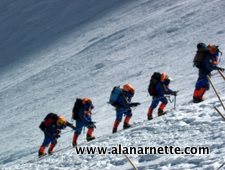
As we spend the last day of April monitoring the climbers on both sides of Everest, I thought it would be good to look at their motivations. Climbing historians know of the famous 1923 George Mallory quote, “Because it’s there” but others have more personal reasons. The primary action on both sides right now is working on their acclimatization through rotations to from low to high camps.
Avalanche Update and Icefall Incident (updated)
UPDATE: In a statement by climber David Klein on expeditions.hu, he and his partner Laszlo Várkonyi were involved in the avalanche and Laszlo is still missing. Original story: I received an email overnight from Duncan Chessell of Chessell Adventures. He is leading an expedition along with Adventure Dynamics on the north. Jamie McGuinness of Project Himalaya, passed through Duncan a first hand account of yesterday’s accident on the North Col. Over on the south, the Icefall continues to be tricky with a small incident that did not hurt any climbers but created a period of anxiety.