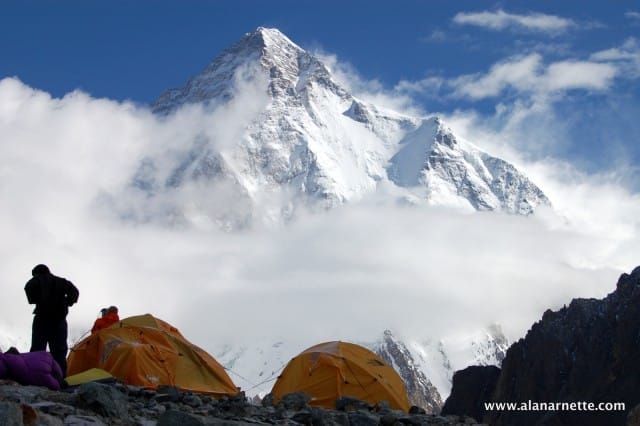
K2 2017 Season Coverage

Using my experience of my successful summit of K2 in 2014 and covering the action in 2015 and 2016, I will once again be covering the 2017 K2 climbing season from my home in Colorado this year. I try to do it the same style as my annual Everest coverage but information is much more difficult to obtain from Northern Pakistan than Nepal. I’ll do my best to throw in occasional coverage for climbers on Broad Peak and Gasherbrum I and II. As always, I use my Blog to gain awareness for Alzheimer’s and if you appreciate my coverage, please consider a donation. The Savage Mountain As I covered in a post a couple of years ago, “Why K2 will not become Everest“, K2 is a totally different climbing experience requiring a different set of skills and experience. It is the second highest mountain in the world at 28,251’/8611m. The climbing is technical – meaning you are using feet and hands to climb; the exposure is extreme – meaning if you fall you will most likely die; and the weather is extreme – meaning it is less predictable due to it proximity to other nearby mountains. It is common to have very different conditions on K2 than on Broad Peak or the Gasherbrum only a few miles away. The number reason listed for death is “disappearance” suggesting the climber fell in a highly exposed area, was blown away by winds or buried in an avalanche. These are not bravado or ego based comments on my part given I have summited both peaks, but my effort to help readers understand that K2 is in a different league than the 8000ers. Just because you summited Everest, doesn’t mean you are ready for K2. If you attempt K2, you must accept that dying is a real possibility. It is well documented that K2 sees significantly more deaths than Everest. Thru 2017, I estimate 8,250 summits with 290 deaths on Everest – 3.5% compared to 355 summits with 82 deaths on K2 – 23%. Annapurna remains the most delay 8000er. While some will quibble with these statistics, it is a measure of risk. Years with No K2 Summits From 1986 to 2016, there were 12 years with no summits. From 2009 to 2016, there were only three years with summits – 2011 only from the Chinese side, and 2012 and 2014 each with about 40 – 50 people summiting – record breaking years as a result of a week of excellent and rare summit conditions. Everest went from 1974 to 2014 with summits every year – 40 straight years! Teams I will not be keeping a location table like I do for Everest given the lack of detailed information but these are a few of the teams on K2 this year. Himalayan Experience (Himex) Furtenbach Adventures Dreamers Destination Adventure Tours Pakistan Karakorum Tours Pakistan If you have a team and want coverage, please contact me. Also, Raheel Adnan has a great site for all things Karakorum. A few of the climbers are back after being stopped the last two years. Himex was there last year and British-American Vanessa O’Brien is back for the third year in a row. Vanessa has become a bit of a celebrity in Pakistan thru building a good relationship with the local press. She and her team were highlighted in this recent article in the Tribune Experess. These are the teams with climbing permits for the Karakorum this summer in Pakistan. Keep in mind that all foreign operators must use a local Pakistani owned and operated company to obtain permits. Also they have been required to hire Pakistani High Altitude Porters and discouraged from bringing Sherpas from Nepal/Tibet to support their teams, however many teams do albeit at a higher expense. The Easy Part of Climbing K2 Every K2 from Pakistan starts in Islamabad. This year it appears about 50 foreigners streamed into Islamabad to begin their journey to K2 Base Camp. Many are almost there this weekend. Most teams try to fly directly to Skardu via a daily Pakistan International Airline flight, but due to regular bad weather in Skardu, it is canceled 20% of the time and very delayed another 25%. Thus some teams are forced to take the 30 hour, 2 day drive along the very dangerous Karakorum Highway. Russell Brice reported on his initial journey: We all arrived into Islamabad on 12 and then attempted to fly to Skardu on 14, however the weather suddenly changed and so when we were just 15km away from our destination we had to return to Islamabad. We were met at the airport by our bus that was then to take us on a 9 hour journey to a mountain resort which we were beyond the attention to even know the name of at 01.30 in the morning. The same morning we were up at 05.00 and started our next part of the journey at 06.00 travelling over the Babusar Pass at over 4,000m and then continuing on the Silk Highway winding our way around a twisty narrow road with a large drop into the river below. After another 15 hours in the bus we were all pleased to reach Skardu late last night. Many of the teams arrive at Skardu and stay at the time honored Concordia Motel, enjoying Internet (slow) and evening cookouts (fantastic) with great views of the Indus River. It is here that you begin to feel like you might be a climber and not a tourist as most every climber in the Karakorum stays there, chatting, sharing dreams and talking mountains. Once they being the trek to their base camps, most teams will take 8 days hike up the Baltoro Glacier enjoying some spectacular views anywhere in the mountains. Gasherbrum I/II At 26,362’/8035m. GII is often considered the most attainable of the Karakoram’s 8000ers. There have been about 340 summits of GI and 935 of GII. Karakorum Tours Pakistan has a small team of Americans and Spanish climbers in 2017. Nanga Parbat The ‘Killer Mountain’ has a deadly