autumn Himalayan Climbing Update 4 – Bad Weather, Summits Soon

My last update spoke of the legendary excellent autumn weather but predictably, teams are now experiencing heavy snow that has any thoughts of summit pushes on hold … for a few days. Most teams have spent multiple nights high above their base camps and feel ready to make their summit pushes when the conditions allow. Also a new First Ascent attempt was announced by Bill Burke and a new route on Manalsu is underway. But before I do an update on the various mountains,  some extremely sad news to report as the Sherpa and Spanish climbing communities both lost members this week. Apparently a landslide off the steep hillsides that surround the trek to Manaslu gave way. This area was hit very hard by the spring 2015 earthquake. The Nepali Times reported: The deceased Nepalis have been identified as 30-year-old Tsering Sherpa, 35-year-old Dorje Lama of Kathmandu and 32-year-old Ranjana Basnet of Okhaldhunga. The name and nationality of the foreigner who died along with the three Nepalis are yet to be confirmed, according to Gorkha’s Chief District Officer Narayan Prasad Bhatta. Dorjee Lama Sherpa was well-known throughout Nepal as he was the President of the Nepal National Mountain Guide Association (NNMGA). My sincere condolences to all their friends and families. Cho Oyu The world’s sixth highest peak at 26,907’/8201m is always popular attracting hundreds of climbers each autumn season. It is the most summited, after Everest, of all the 8000 meter mountains with 3,331 summits thru 2014 according to the Himalayan Database. UPDATE: Cho Oyu was hit with heavy snow the past few days causing many teams to stay put in base camp or even return quickly from their high camp rotations. Ben Jones of Alpine Ascents gives us a good idea of what is happening. They are now back in base camp waiting out the weather. Lapka Rita, mentioned in Ben’s update, was with me on K2 in 2014  an amazingly strong and kind person: Yesterday was a hard day getting to Camp 2. We actually made great time at a slow but consistent pace. Slow is a relative term at these altitudes. We also have the added benefit of at least a foot or more of new snow in the last few days. For the most part the trail was broken by many Sherpa and some climbers ahead of us, but it was windy so most of the trail was filling back in as we climbed. Lakpa Rita Sherpa and our three other Sherpa’s (Kami, Ang Nuru, and Nima Tenzing) were working hard carrying loads and breaking trail. As the day went on and the conditions deteriorated, and when most other Sherpa’s had decided to turn around, Lakpa Rita Sherpa was there once again to lead the way and to show the safe way up slopes that were being loaded with snow. Lakpa Rita is one of the strongest people I have ever seen in the mountains and always a pleasure working with him. Once I arrived to Camp 2 with our climbers Lakpa had plenty of hot water waiting for us. Exhausted he still had a smile on his face, really the only thing you can do after a long tiring day in the mountains at altitude. Ben posted this picture on his Facebook page: Manaslu Similar to Cho Oyu, Manaslu is regarded as attainable and in recent years has seen a dramatic increase in traffic. Seven Summits Treks, the now dominate Nepali owned and based guide service, posted they have 130 members and Sherpas for the 2016 season including a 60 member Chinese team. This is astounding in that in the year ever, 2011, Manaslu saw 140 total summits. Since 1956, Manaslu has had 980 total summits. UPDATE:  Teams are reporting they have completed their acclimatization rotations during the previous period of good weather. Now they are holding tight as this current front passes by, but leaving a fair amount of snow up high. Look for summit pushes starting a few days. Meanwhile, Russell Brice is not very happy with the performance of other teams on manaslu this year per this update in his recent newsletter: There are many teams here who have no Sherpas and are attempting to climb independently, but I see very few of these climbers actually contributing to any work on the route that we are all using. Actually I see that many of these teams do not have any communications (radios or satellite phones) they have no weather forecasting, and very little medical equipment. Of course they are all climbing Manaslu without Sherpa assistance, and no oxygen. But I notice that they do not hesitate to come asking us for weather forecasts, medical assistance from my Doctor, to use our satellite communications and even our heaters. They also all come to us complaining about the rope fixing. New Route on Manaslu Alberto Zerain & Mariano Galván are attempting a new route on Manaslu. According to Desnivel, “it is a line that ascends a spur on the left of the direct route of Urubko and Samoilov” They have completed their acclimatization and are ready for their summit push, weather permitting. Dhaulagiri From early repots Altitude Junkies reamins the only team on this 8000er this autumn season. At 26,794’/8167m, Dhaulagiri was considered to be a hard peak to climb but nowadays is considered as in the lower half of the 8000er list. The normal route has some short technical sections and some avalanche danger, but overall it’s a quite straight forward climb. 469 climbers have reached the summit thru 2014. UPDATE: Phil Crampton reports that conditions continue to be excellent but no updates since the last front moved thru: The Sherpas tried to fix the ropes up to Camp 3, but due to such a dry season, there are several large crevasses which have opened up. There is little snow and the glacier is melting. We have 6 ladders coming from Kathmandu and our porters will have to bring them up from Marpha. Shishapangma Shish is the world’s lowest 8000 meter peak at 8027 meters or 26,335 feet. It is also the only 8000er totally within Tibet.

autumn Himalayan Climbing Update 3 – Great Weather
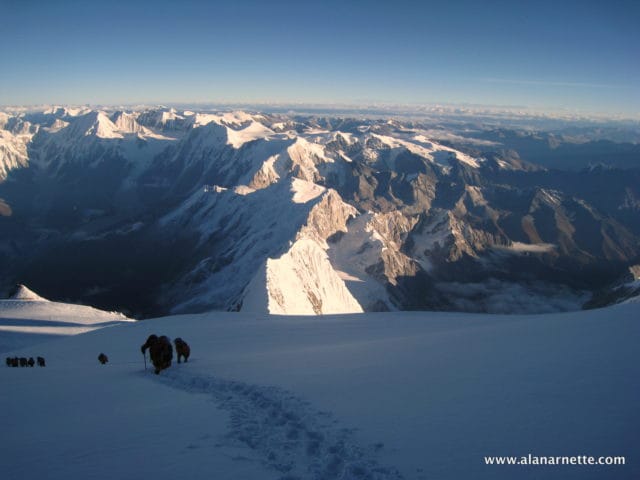
Manaslu 2013 view

Finally the legendary excellent autumn weather has arrived on the world’s highest peaks. Team and climbers alike are reporting “bluebird” days with clear skies and no wind. This makes even the hardest acclimatization day a joy. Most commercial teams focus on Everest in the spring because it is usually a two month event and takes advantage of ever increasing longer days and little to no precip as the calendar advance towards summer. But autumn is a different scenario with ever shorting days and the potential for heavy snow always a possibility. However, just like the last two weeks of May, the last week of September and early October usually see fantastic conditions in the Himalaya. The Himalayan Times‘s Rajan Pokhrel reported that the Nepal Ministry of Tourism issued 277 climbing permits for 19 Nepali mountains this autumn with Manaslu dwarfing the others with more than 148 climbers representing 16 expeditions. I suspect this portends that Everest will be overwhelmed next spring (2017) as many use Manaslu and Cho Oyu as training for Everest. So with that, lets do a run down on who is where in Nepal and Tibet. Tenzing and Hillary Peaks Canadian Elia Saikaly and Pasang Kaji Sherpa are attempting a first ascent on two recently opened points along the ridge between Cho Oyu and Gyachung Kang.  They were previously called Ngozumba I and III but renamed Tenzing Peak (7,916 m) and Hillary Peak (7,681 m) and opened for climbing. Update: They are moving towards their base camp now. Saikaly is filming the attempt for an 5 part series that is showing online.       Cho Oyu The world’s sixth highest peak at 26,907’/8201m is always popular attracting hundreds of climbers each autumn season. It is the most summited, after Everest, of all the 8000 meter mountains with 3,331 summits thru 2014 according to the Himalayan Database. UPDATE: Cho Oyu is enjoying a period of great weather. I see that teams are now putting in a Camp 1.5 – that is a camp between the traditional C1 and C2. Have not heard the reason for this as the distance is not that far for an 8000er. Adventure Consultants comments on the two sections of Cho that give some people problems: There are two technical cruxes to the standard route on Cho Oyu; The Ice Cliff at about 6800m and the Yellow Band, a prominent rock layer that bisects the Himalaya at about 7500m. In 1951 Edmund Hillary tried an (illegal) ascent of Cho Oyu that was stopped by the Ice Cliff. One of our Italian friends described the ice cliff “as ten minutes of terror”. Our arrival at the ice cliff coincided with a member of another team losing control on rappel and going upside down. Another member of the same team then got stuck descending on the yellow rope, which is the up line. I tried to instruct a Frenchman on how to rappel – while his Sherpa was without question the most amicable and friendly guy on the hill. Fun and games and all the while we progressively climbed up looking for the daunting crux that never came. Of course we had the advantage of a top rope. The steep terrain sure is hard work on what was another record breaking altitude day for Kai and Roxane. Ben Jones made this outstanding video introducing his Alpine Ascents  (AAI) team. Simply put, I love this. Well done Ben!! II cannot show it on my site but visit this link     Manaslu Similar to Cho Oyu, Manaslu is regarded as attainable and in recent years has seen a dramatic increase in traffic. Seven Summits Treks, the now dominate Nepali owned and based guide service, posted they have 130 members and Sherpas for the 2016 season. This is astounding in that in the year ever, 2011, Manaslu saw 140 total summits. Since 1956, Manaslu has had 980 total summits. UPDATE:  The Seven Summits Treks team is looking at summiting the first week of October – right on schedule. Arnold Coster notes they had some snow at C1 a couple of days ago and held tight to let it settle. This a picture I took in 2013 of the Himalayas as we made our summit push – it is stunningly beautiful up there.   Dhaulagiri From early repots Altitude Junkies reamins the only team on this 8000er this autumn season. At 26,794’/8167m, Dhaulagiri was considered to be a hard peak to climb but nowadays is considered as in the lower half of the 8000er list. The normal route has some short technical sections and some avalanche danger, but overall it’s a quite straight forward climb. 469 climbers have reached the summit thru 2014. UPDATE: Phil Crampton reports in that conditions continue to be excellent: The weather has been fantastic and insane. Yesterday, there wasn’t a cloud in the sky and absolutely no wind. It was one of the weather days I have ever had in 20 or so years in the Himalayas. It felt however about 125 degrees F on the glacier. On the 17th, we went up to Camp 1. On the 18th, we went up to Camp 2. Some of the group stayed overnight, others came back down. Our Sherpas are still fixing rope on higher camps and trying to finish before any bad weather sets in. We are now still doing load carries on the hill. Our goal will be to try to summit sometime between the 25th and 30th of September. Shishapangma Shish is the world’s lowest 8000 meter peak at 8027 meters or 26,335 feet. It is also the only 8000er totally within Tibet. It is one of the 8000ers with a checkered history of people claiming the summit but only reaching the fore-summit. The last bit is across a sharp ridge that is avi prone so some people call it good at the fore-summit. RMI has a team on Shisha this season and is putting in the work now: Our second rotation begins tomorrow with a move to Depot Camp, followed by a return to Camp 1 at 20,000’, and finally up to Camp 2 near

autumn Himalayan Climbing Update 2 – Jornet Cancels Everest

Kilian Jornet has ended his speed attempt on Everest from Tibet citing “dangerous” conditions. Meanwhile the only other climber from that side, Japanese Nobukazu Kuriki, remains at base camp also noting that Everest is covered with deep snow this autumn. He remains optimistic that he can still make an attempt. The monsoon seems to be hanging on a bit longer this year bringing snow to Everest but rain to the other base camps. Teams on the other peaks are making good progress with acclimatization rotations to the higher camps. But before I get to those, a couple of new efforts have been reported since my last update. Speed and First Ascents First While not Everest, which “would be a bit of a walk in the park” according to Canadian Elia Saikaly; he and Pasang Kaji Sherpa are attempting a first ascent on two recently opened points along the ridge between Cho Oyu and Gyachung Kang.  They were previously called Ngozumba I and III but renamed Tenzing Peak (7,916 m) and Hillary Peak (7,681 m) and opened for climbing. Nepal has been opening new peaks, 104 in 2014, for legal climbing over the past few years to promote tourism and perhaps shift climbers away from Everest due to overcrowding. Today there are 414 peaks available for climbing permits However there is some controvesery about some of the newly opened peaks Nepal. Climber Damien Gildea noted: … it’s not about altitude, it’s about Prominence, which is often considered a measure of how significant a peak is, and correspondingly how worthwhile a climbing challenge it is. Tenzing has just 170m of Prominence, or 2.14% of its height. Hillary, at 124m, or 1.6%, is even less significant. A general rule for the Himalaya & Karakoram is that 6-8% is needed for a peak to be classified as a mountain. In toponymic and geographic terms, these government inventions fall well short. Saikaly counters: For us: it’s not about how high. We’ve been to the top of Everest. Myself twice, PK, 4 times. It’s not about the altitude, it’s not about the difficulty, it’s about the depth of the idea and the meaning of the project. It’s about the symbolism. In no way whatsoever do we put ourselves in a category anywhere near Sir Edmund Hillary and Tenzing Norgay, but it is our belief that seeing PK stand up there on behalf of all Sherpas will mean something profound for him, for us and for his community. Hopefully for many others as well. A third member of the team, Gabriel Filippi, was injured early in the expedition and has returned home. Saikaly will be filming the attempt for an 8 part series that will be shown on Discovery Canada. Speed Over on Cho Oyu, Alpenglow Expeditions owner, Adrian Ballinger and his partner Emily Harrington are spending September around their Lake Tahoe home running and hiking then spending the night in altitude tents. At the very last minute, they plan to fly to Tibet and speed climb Cho Oyu hoping to get it all done in two weeks. Ballinger has been making his mark in the guiding industry with his “rapid ascent” climbs that cut the time spent away from home by half for some climbs. He charges twice the going rate ($85,000 vs $40,000 on Everest North and $31,000 vs $14,900 on Cho Oyu) for this advantage attracting people who want to climb the big mountains but don’t have a lot of time. While criticized by some as missing the point of climbing, Harrington told me:  I don’t agree though that people on accelerated trips are missing out, or rushing the climb – I actually think it’s quite the opposite. When I go climbing, I like to do just that – climb. I love having big days, moving well, and trying hard. Most of the time I’d rather go climb something in a day than break it up into several, because it’s just more fun that way.  I don’t feel like I’m rushing with this approach, but rather I’ve figured out that I like climbing and dislike the downtime in between. From my understanding the faster programs on Everest allow a climber to do just that – climb more and rest/acclimatize/trek less and thus the trip is shorter, which is good as well I guess for people with families, job restraints, etc. I was at Everest basecamp for nearly 2 months in 2012 and honestly I could have done with less time, and I still feel like I would have felt the same joy and satisfaction from the trip. But that’s just me. In my opinion the people signing up for these trips are not necessarily racing to bag Everest, and I don’t think it’s accurate to believe that their experience will be less enjoyable or valuable to them. It’s just different. Ballinger’s Cho Oyu attempt comes on the heels of his no O’s Everest climb this past spring where he turned back due to cold and fatigue. Alpenglow has other climbers on Cho Oyu guided by a different guide than Ballinger this autumn. Cho Oyu The world’s sixth highest peak at 26,907’/8201m is always popular attracting hundreds of climbers each autumn season. It is the most summited, after Everest, of all the 8000 meter mountains with 3,331 summits thru 2014 according to the Himalayan Database. UPDATE: It is getting crowed as expected on this popular 800er. Teams reported at Advanced base Camp include: Adventure Consultants Alpine Ascents International Aplenglow International Mountain Guides SummitClimb 7 Summits Club Most are already on their acclimatization rotations having spent a night or two at Camp 1 at 21,000 feet. Billi Bierling reports: At c1 @ 6400m after having negotiated the infamous killer slope, which was not as bad as expected. Feeling strong and so does everyone else. Billi is referring to a 1,000 foot steep scree (loose pebble) hillside that serves as the troll to Camp 1. Manaslu Similar to Cho Oyu, Manaslu is regarded as attainable and in recent years has seen a dramatic increase in traffic. Seven Summits Treks, the now dominate Nepali owned

autumn Himalayan Climbing Update 1

Well, really not a lot to report – I know what you’re thinking – that I would never be a journalist for an outdoor magazine with this as my opening line. Maybe this headline should have read “Amazing News from Early Himalayan Climbs – No News!” lol 🙂 Actually there is some news plus two new expeditions to announce. Cho Oyu The world’s sixth highest peak at 26,907’/8201m is always popular attracting hundreds of climbers each autumn season. It is the most summited, after Everest, of all the 8000 meter mountains with 3,331 summits thru 2014 according to the Himalayan Database. UPDATE: Many teams have now reached Advanced Base Camp, which some call the highest altitude of any 8000 meter base camp at 18,500 feet. Adventure Consultants reports in including wifi available at ABC: Everyone made it through their first night at ABC in good shape. Whew!  We awoke to swirling mist and filtered sun revealing and obscuring magnificent scenery. Our camp is peaceful and set in a sheltered reclusive moraine bowl. By late morning it was snowing. A good day for reading and letting one’s body gain equilibrium for the hard toil ahead. Folks were happy to be connected on wifi. It is way too early to determine what the snow conditions are like above 7000 meters. The climbers are starting their first rotations to C1 this week. As I reported earlier, the usual suspects of Adventure Consultants, Alpine Ascents (AAI), Asian Trekking, IMG , SummitClimb are all there. Manaslu Similar to Cho Oyu, Manaslu is regarded as attainable and in recent years has seen a dramatic increase in traffic. Seven Summits Treks, the now dominate Nepali owned and based guide service, posted they have 130 members and Sherpas for the 2016 season. This is astounding in that in the year ever, 2011, Manaslu saw 140 total summits. Since 1956, Manaslu has had 980 total summits. UPDATE: Russel Brice, Himalayan Experience reports heavy rain at base camp which is somewhat normal for this 8000er: I write from a very wet rainy Manaslu Base Camp, so what is new. This is our 9th trip to Manaslu and we have always apart from last year managed to fly into Samagon on the program date of 29 Aug. Maybe this is too early but I still feel that we need to be right on the heels of the monsoon so as we are ready for the very short weather envelope for the summit. This year we all managed to fly by helicopter to Samagon where we had 4 days with very little rain as we did our normal acclimatisation treks. Samagon continues to see so much new house construction, so I suspect that the economy there is doing OK, although I am surprised as we still need to send our loads over the Larkya Pass from the adjacent Marvangdi valley rather than coming straight up the Budh Kandaki water shed. I really see that this difficult trail needs to be reopened after last year’s earthquake in order to support the local inhabitants who have invested in lodges so as to support trekkers who do the Manaslu Circuit trek. I understand that it is taking time to rebuild this trail in the lower Kandaki which is not surprising considering the steepness of the mountain slopes on either side of the river.   Dhaulagiri From early repots Altitude Junkies appears to be the only team on this 8000er this autumn season. At 26,794’/8167m, Dhaulagiri was considered to be a hard peak to climb but nowadays is considered as in the lower half of the 8000er list. The normal route has some short technical sections and some avalanche danger, but overall it’s a quite straight forward climb. 469 climbers have reached the summit thru 2014. UPDATE: Phil Crampton reports the team has finally reached base camp after multiple delays and rain but the weather is good now The team reached base camp on September 8. The all important Puja ceremony will be held on Monday, September 12. After that, the work will begin and the rope fixing will start. The plan will be to create a new route to Camp 1, due to the dry snow conditions. We are still the only team here. Of note, they will not have satellite access with their BGAN modem as the mountain blocks direct line of sight. Everest There are no reported teams attempting Everest from Nepal this second half of 2016 but two climbers are on the north side. Kilian Jornet As I previously reported, Spanish speed climber Kilian Jornet will attempt to set a speed record by climbing from the Rongbuk Monastery (Tibet) to the summit in a single push. He expects to take around 20 hours to summit and about 35 hours to descend. Kilian and his three partners are already in Tibet. UPDATE: He has been in the base camp area now for a couple of weeks continuing to acclimatize before his attempt. He reported recently: Hi all! we continue with the acclimatization. There’s a lot of snow, but everything is ok! Nobukazu Kuriki As I posted a few weeks ago, Japanese climber, Nobukazu Kuriki, is climbing from the north side. He is now at base camp. He posted recently: This morning’s advanced base strong wrapped in gas out for visibility, I’m afraid of heights adaptation to leave after it is changed to tomorrow. Still monsoon new year. This is his sixth autumn (post-monsoon), no O’s, climbing alone, attempt on Everest. His previous try have been met with drama and injury. He has lost nine fingers on Everest in 2012 during a thwarted attempt on the West Ridge of Everest. In 2015, he reached a bit above the South Col before deep snow forced him to stop. Climbing alone is his “style” of climbing. He has climbs of McKinley (2004), Aconcagua, Elbrus, Kilimanjaro all in 2005 and Carstensz Pyramid in 2006. Plus these 8000m climbs: Cho Oyu (2007), Manaslu (2008), and Dhaulagiri (2009). He attempted Annapurna last spring without a summit due to weather. These are the two new expeditions recently announced: autumn Broad Peak Attempt. Altitude Pakistan reports that  Oscar Cadiach will (re)attempt Broad Peak in

autumn Himalayan Climbing Begins

If it is early September, it must mean a migration to the big mountains of Tibet and Nepal. Today, multiple teams are reported en-route or arriving at their Base Camps of Cho Oyu, Dhaulagiri, Manaslu, Ama Dablam and even Everest. Cho Oyu The world’s sixth highest peak at 26,907’/8201m is always popular attracting hundreds of climbers each autumn season. It is the most summited, after Everest, of all the 8000 meter mountains with 3,331 summits thru 2014 according to the Himalayan Database. It is generally regarded as one of the most “attainable” 8000 meter peaks with a straight forward climb to a huge flat summit and a dramatic view of Everest. However, in recent years, the success rate has dropped dramatically due to avalanche danger and generally poor snow conditions. Also the Chinese government has made getting to Cho Oyu a gamble with random border closures and unannounced bans on climbing due to fears of protests involving Tibet. There were zero summits on Cho Oyu last year after China closed all of Tibet to climbing after the spring earthquake. For 2016 everything seems back to a more normal environment. Cho Oyu is a popular expedition run by the major commercial guide companies like Adventure Consultants, Alpine Ascents (AAI), Asian Trekking, IMG and Seven Summits Treks. AAI reports in: We arrived at Chinese Basecamp today to a new elevation of 16,100ft. The drive from Tingri only took about an hour and a half and they are working hard to pave the whole road to CBC! We were greeted by our great Sherpa and Nepali staff here and had a great second breakfast cooked by Gopal. The rest of the day we ate and hydrated, and took a walk down the road towards the mountains. It was a little windy today with a few sprinkles of rain but overall a pretty nice day. Tomorrow we will go on another hike, gaining some elevation to further acclimatize. Manaslu Similar to Cho Oyu, Manaslu is regarded as attainable and in recent years has seen a dramatic increase in traffic. Seven Summits Treks, the now dominate Nepali owned and based guide service, posted they have 130 members and Sherpas for the 2016 season. This is astounding in that in the year ever, 2011, Manaslu saw 140 total summits. Since 1956, Manaslu has had 980 total summits. Himalayan Experience is also running a trip there along with several other western companies. Himex has been guiding Manaslu since 2008. Due to the crowds however, long time operator, Altitude Junkies will not be on Manaslu for the first time since 2008. They have shifted their autumn climb to Dhaulagiri and even more telling is that Phil Crampton, owner of the Junkies, has left Everest all together due to the crowds. Dhaulagiri From early repots Altitude Junkies appears to be the only team on this 8000er this autumn season. At 26,794’/8167m, Dhaulagiri was considered to be a hard peak to climb but nowadays is considered as in the lower half of the 8000er list. The normal route has some short technical sections and some avalanche danger, but overall it’s a quite straight forward climb. 469 climbers have reached the summit thru 2014. Phil Crampton reports the team is on their way having to navigate some logistics challenges including landslides, rains and flight delays. We had hoped to reach Marpha tonight but with the flight delay and another landside between Beni and Marpha, we have decided to spend the night at Beni and make an early morning start. We will have to change vehicles en-route and we expect to have to walk for around three hours from the drop off to the pick up area. Hopefully we will be with our Sherpa staff tomorrow evening. Everest There are no reported teams attempting Everest from Nepal this second half of 2016 but two climbers are on the north side. Kilian Jornet As I previously reported, Spanish speed climber Kilian Jornet will attempt to set a speed record by climbing from the Rongbuk Monastery (Tibet) to the summit in a single push. He expects to take around 20 hours to summit and about 35 hours to descend. Kilian and his three partners are already in Tibet. He has been in the base camp area now for a couple of weeks continuing to acclimatize before his attempt.   Nobukazu Kuriki As I posted a few weeks ago, Japanese climber, Nobukazu Kuriki, is climbing from the north side. He is now at base camp. This is his sixth autumn (post-monsoon), no O’s, climbing alone, attempt on Everest. His previous try have been met with drama and injury. He has lost nine fingers on Everest in 2012 during a thwarted attempt on the West Ridge of Everest. In 2015, he reached a bit above the South Col before deep snow forced him to stop. Climbing alone is his “style” of climbing. He has climbs of McKinley (2004), Aconcagua, Elbrus, Kilimanjaro all in 2005 and Carstensz Pyramid in 2006. Plus these 8000m climbs: Cho Oyu (2007), Manaslu (2008), and Dhaulagiri (2009). He attempted Annapurna last spring without a summit due to weather. Mountain Deaths In sad news over the weekend, the search was called off for US climbers Kyle Dempster and Scott Adamson who were attempting the very difficult and technical Ogre II in Pakistan. They had not been seen for over 12 days when their headlamps were sighted half way up the 22,900’/6980m peak. My condolences to their family and friends. Best of luck to all this autumn season. Climb On! Alan Memories are Everything

The Back Story on Manaslu 2015 – Summits, Res, Death
In the autumn of 2015, some of the world’s 8000 meter guides stopped their Manaslu expeditions due to risks that crossed their comfort zone but others continued and summited. One person died and another had to be rescued. Why do some stop, others continue and why did one person die? Manaslu, the world’s 8th highest peak at 26,759’/8156m has become a solid choice for those wanting to get experience on an 8000 meter mountain. It is located in Nepal about 40 miles east of Annapurna, 150 miles west of Everest and 80 miles northwest of Kathmandu. Manaslu is accessible, the route is usually straight forward, albeit with a few technical sections, and has a good track record for summit success. Through 2013, Manaslu had seen 903 summits. But it has a history of avalanches and deaths. In 2012, 11 climbers were killed by an avalanche that hit directly on Camp 3 where many teams were sleeping. In 1972 15 members of a South Korean expedition were killed by an avalanche, 10 were tragically Sherpa. In total, 79 people have died on Manaslu. 2015 Earthquake In 2015, the Chinese had closed Tibet to climbing since the April Nepal earthquake had damaged many roads in the region and, perhaps, made climbing too dangerous. This created a problem for many commercial teams who offered autumn climbs of Cho Oyu and Shishapangma each year thus they switched to Manaslu. 106 climbers were registered to climb in 2015. Fixing the Mountain Two commercial teams have been going to Manaslu since 2008, Russel Brice’s Himalayan Experience aka Himex and Phil Crampton’s Altitude Junkies (AJ). Each year, they have taken the lead of establishing the route with fixed ropes and ladders and coordinating with all the other teams who were content to let them take the lead and follow later. For this, all the climbers were asked to pay around $150 each for ropes, anchors and labor. Another well respected, long time Manaslu commercial team, Adventure Consultants switched from Cho Oyu and was on the mountain with their MD, Guy Cotter. This was their third season there. Other teams who had switched from Cho Oyu included SummitClimb, Amical and Seven Summits Treks. Mixed Weather The season began with unusually good weather. I know from personal experience having summited Manaslu in 2013, the region in early autumn still gets a lot of monsoonal rain and base camp can receive several feet of snow at one time. In early September, the AJ and Himex Sherpas made good progress fixing the route to Camp 2 thus allowing climbers from all teams to get a jump on the acclimatization programs. By September, the weather took a turn for the worse. Heavy snow, high winds pummeled the upper mountain and base camp was hit with snow and rain. The bad weather continued for a week with a few small breaks but another huge storm was on the way. Teams used the breaks to make quick trips to Camp 2 but no one had made it higher when the next storm hit. By late September AJ had put in 33 man days to fix ropes, Himex 31 and Seven Summits Treks, 7. Perhaps an omen, a Himex Sherpa fell through a snow bridge into a crevasse and was evacuated to Kathmandu. Some leaders started to worry that Manaslu was too dangerous to climb this year. Open Crevasses, Near Misses This was not an unusual weather pattern for Manaslu, or for many of the world’s highest peaks so teams were prepared to thread the needle and be aggressive. With that philosophy, Himex, AJ left for their summit bid on September 23rd but ran into trouble. Phil Crampton posted this update: The guys made great progress fixing through the seracs and the blue ice section and then headed for camp four. Unfortunately, this is where things started to go wrong. They encountered waist deep snow, which left them unable to place safe anchors for the fixed rope. Many Sherpas from both the Junkies and Himex were carrying camp four loads and were following the rope fixers when one of these Sherpas fell into a hidden crevasse. The crevasse opened up to 4 meters wide and about 100 meters long, spanning the entire route, basically cutting off the Sherpas ahead of the crevasse. The Sherpa who fell around 10 meters into the slot was extracted, and then the Sherpas had the task of getting back over the crevasse. They found a way but the snowbridge they crossed was unstable to say the least. Whilst traversing the slot to descend, they triggered a small avalanche that did not harm them but gave them a fright. I am glad to say that the Sherpa who fell into the crevasse was not badly injured and made it down safely to base camp. He is now back in Kathmandu. The following day another team’s Sherpas were collecting loads from the high point and were exposed to another slab avalanche which luckily missed harming them. Cancelled Expeditions Russell Brice made the decision to cancel his expedition: We have been witnessing the various avalanches and the three different weak layers on our indicator slopes. I am sure that the small bowl that is just below the troublesome crevasse will release as soon as people start climbing this and pull the rope out. That will probably not be such a big deal as it may not be big enough to hurt people. But it this then triggers the bowl above which is also loading at the moment, then there is the possibility of a major calamity. Or like in 2012 if a small serac falls and then triggers these slabs then we for sure will have major problems if there are climbers on the slopes. I might be wrong, but I really cannot put my Sherpas or members into such a position. If we could see a chance to climb later in the week we would stay, but there is no such chance, and I do not want to be pushed into danger just because of this small weather window. Soon, Junkies made the same decision. Adventure Consultants’ Guy Cotter told me in

Avalanche Kills 11 on Nepal’s Manaslu – Update 5: Summary

A deadly avalanche occurred on Manaslu in Nepal at 4:30AM on Sunday, September 23 killing at least a reported 9 climbers with another 6 missing. Another 10 climbers were impacted but escaped. It occurred at the 7000 meter (22,960′) level with the slide hitting Camp 3. News reports say that most of the victims were Nepal, Spanish, Italian, German and several French. One Canadian climbers was in the missing. There were about 25 climbers in the area at the time of the avalanche all preparing for their summit push. Reports from teams on the mountains say that the avalanche blast destroyed many tents at Camp 2 but there were no serious injures. As always, be wary of many of the reports given it is still early, and details are often incorrect and many of the witness are in shock. No names are available. There were 30 teams with about 231 members, climbing Manaslu, an unusually high number due to the closure of the China/Nepal boarder preventing teams from reaching Cho Oyu, popular for climbers to test themselves at high altitude or on training for Everest. At 8,156m (26,670′), Manaslu has become a popular alternative to Cho Oyu after organizers have had difficult getting reliable logistics and permits to climb Cho Oyu. Being entirely within Nepal, the logistics are slightly easier although the climb itself is a bit more difficult. Manaslu is located in western Nepal about 60 miles northwest from Kathmandu in a very different region than Everest Manaslu is known as one of the less technically demanding 8000m mountains and is viewed as a precursor for Everest much in the same way as Cho Oyu. But the weather is always difficult on Manaslu and 2012 has seen extremely deep snow with heavy snowfall all last week locking the teams down in their base camps. There have been less than 350 summits but about 55 deaths making Manaslu a deadly climb. That said, 15 of those deaths were on a South Korean expedition in 1972 and of those, 10 were tragically Sherpa. For comparison, Cho Oyu has seen about 2000 people summit it with about 50 deaths. Almost all the regular teams climbing Everest had expeditions on Manaslu this season. The deaths and injures seems have been mostly on European teams located at Camp 3. The following teams have checked in via their blogs: IMG: all members safe at camp 2 Alpine Ascents: all members safe at camp 2 : all members and staff safe at camp 1 or base camp Adventure Peaks: all safe Jagged Globe: all safe Himalayan Experience (Himex): all safe This report noted that the injured had already been helicoptered to Kathmandu hospitals including several Nepal Sherpas, 3 French, and 2 Germans. The poor weather was returning last Sunday thus slowing rescue and recovery efforts. However pilots have reported locating bodies from the air. More details as solid information is available. My sincere condolences to families, teammates and friends of the fallen. Update 5: Summary The avalanche was caused by a large serac releasing above Camp 3 at 7,400m. This triggered a slab avalanche which hit Camp 3 directly and impacted Camp 2 with a severe wind blast. It appears that many of the 11 killed were in their tents, most sleeping, at Camp 3 around 4:45AM Sunday September 23, 2012 Nepal time. The avalanche debris was spread from 7,400m to 6,300m. Rescue efforts started immediately with teams climbing up from Camps 1 and 2. Russell Brice reports on his recent blog post that he became a defacto rescue co-coordinator and called Kathmandu for helicopter assistance. A B3 high altitude helicopter from Simrik Air arrived at 9:45 and began evacuation of the injured climbers. There were 18 total flights that day with 14 evacuations. 31 people were caught in the avalanche. 8 bodies were recovered and 3 are listed as missing and presumed dead (see update 3.1 below). The severity of the avalanche was driven by heavy snow the previous week, some reports put the snow depth at 6 feet of fresh powder. The remaining teams are mixed in their plans with some individual members leaving, some entire teams (estimated at 10 or more), including IMG, AAI and Jagged Globe. Some remaining to continue climbing. However, reports mention difficult conditions on the upper mountain, with high winds and, of course, the fixed line will have to be reset or replaced. My deepest condolences for the families of the victims, their teammates and friends. Update 4.1 The search has ended Monday in Nepal for any survivors according to French mountaineering officials out of Chamonix. They stated that six of the victims were French nationals. If confirmed this would bring the death toll to 11. Jagged Globe reports that the avalanche was 300m wide and 1000m long, Several teams remain committed to attempting a summit. Phil Crampton of Altitude Junkies has posted a first person report from Camp 2 where he and his team were hit by the avalanche blast. Visit his site for a picture of Camp 2 after the avalanche. Today the remaining bodies have been removed from the mountain by three different helicopters. Hopefully this is the end of the tragedy that struck us yesterday morning at 4.30 am. All of our team members and Sherpas are safe at base camp. Several of us suffered cuts, bruises and concussions but nothing serious. We consider ourselves very lucky indeed. We placed our camp two in the same position as we have done on all our previous expeditions. The campsite is protected from avalanche debris by a large crevasse which collects anything that slides. Due to the force of this avalanche we were protected from debris but the blast from the huge slide destroyed our campsite. At 4.25 am I was awake fiddling with a awkward sleeping bag zipper. I had just laid back down and then at 4.30 am I was struck in the head by some avalanche debris and then Kevin and I were catapulted

summer Climbing Plans

Durango & Silverton Train

It is spring time in Colorado as evidence by deep snowfall that melts away the next day. So it is time to finalize my plans for summer climbs. My priority is to compete the Colorado 14ers. But also, I want to grab a few California 14ers and perhaps something big in the Fall. I have climbed 48 of the 54 Colorado 14ers. But of course the list is actually 58 so I need to climb 58! Confused? Well here is the explanation from my 14ers page

Himalayan 2009 Fall Updates

The Fall 2009 Himalayan season continues with teams on Cho Oyu, ambulance Manaslu, capsule Shishapangma and Everest. It is still early in most team’s acclimatization schedules. For example, prescription IMG’s Cho Oyu team has spent only one night at Camp 1 and Altitude Junkies have just reached base camp on Manaslu. I believe there are only two teams on Everest is Fall, a Basque and an Indo Tibetan Border Police team who is attempting to ski down from the summit. The weather has relaxed a bit with no reports of heavy snowfall or high winds – but you know what they say about weather! Many teams have had their Pujas to ask the mountain Gods for permission and forgiveness to climb the mountain. At least the lowest high camp is established and Sherpa are hauling more tents, sometimes oxygen, food and more to the mid-level camps. We should look for summit bids in late September. As usual, I find individuals who posts have the most introspective and revealing accounts. My good friend, Jim Davidson is on Cho Oyu with IMG and posted this recent update after his climb to Camp 1 at 21,00′: It was tough going. I had felt sick all day. My stomach problem had cleared up, but I had picked up the cold/cough/virus going around. So I was suffering and slow. At 20,000 feet I had to take 2 breaths per step. At 20,500 feet, three breaths per step. Any faster and I went anaerobic. It was a sufferfest. He is one of the strongest climbers I know and will do well. Climb On Jim! Some teams and individuals with blogs to monitor include: Cho Oyu: Alpine Ascents Adventure Consultants IMG Jagged Globe Jim Davidson Summit Climb Manaslu: Altitude Junkies Himalayan Experience Shishapangma: Andrew Lock Nick Rice Everest spring 2009 Follow-up Bill Burke, the oldest American to summit Everest just sent out a sad follow-up from the spring season. Again, my sincere condolences to Lhakpa Nuru friends and family. Bill’s message: As you know from my expedition reports, the first death on Mt. Everest this season was Lhakpa Nuru, our Sherpa, who died in an avalanche in the Khumbu Icefall. Here is a message I just received from Dawa Steven, the Managing Director of Asian Trekking: Dear Friends, I hope this email finds you all well. Yesterday, we received a call from the Sirdar of an Expedition on Everest who had reached base camp a few days ago. They informed us that they spotted the body of Lhakpa Nuru in the icefall. They couldnt give us any further details but said with certainty that it is Lhakpa Nuru. Today, we sent up 4 sherpas under the leadership of Naga Dorje to retrieve the body. They will reach Base camp tomorrow morning. I am taking Lhakpa’s widow with me to Khumbu and help with the arrangements of the funeral. Unfotunately our flights were cancelled this morning due to the weather in Lukla. We hope to fly tomorrow! Though its difficult for his family to have old wounds opened again, I hope that having a proper puja and cremation will give them the needed closure and bring peace to Lhakpa’s soul. If anyone would like to contribute to help Lhakpa’s young family, their bank details are: Himalayan Bank, Thamel. A/C holder: Urgen Tenzing Sherpa (The account is in his Son’s name) A/C No. 01902302580011 SWIFT No: HIMANPKA Please let me know if you make any contributions and I will follow it up from here. Thanks to many of you who have already contributed. I will keep you informed you about the retrieval and the funeral. Best Wishes, Dawa Steven Good luck and safe climbing to all the teams this Fall. Climb On! Alan