Everest 2025:Remembering The Day Nepal Shook–10 Years Later
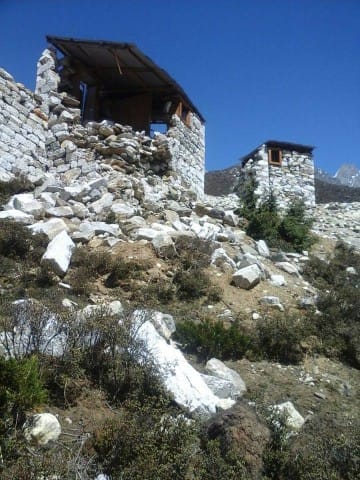
April 25 is always a difficult day in Nepal. This year, 2025, marks the tenth anniversary of the deadly 7.8 magnitude earthquake that occurred in Nepal, taking 9,000 lives, including 19 at Everest Base Camp. I’m sure there will be many services, memorials, and simple, quiet moments to honor those who died and keep their memories alive.
In current news, a multi-ladder crossing collapsed in the lower Khumbu Icefall, which is not unusual. The Icefall Docs have already fixed the crossing. However, some climbers will have a day off from going to C1 to acclimate. Most are still in EBC anyway. A few teams have begun their trail to the Chinese Base Camp on the Tibet side. So, no big update today on what’s happening on Everest, other than everything seems to be progressing according to traditional schedule, with teams on both sides on their acclimatization rotations. I’ll get back to the regular updates for the Weekend update.
I wrote this narrative a few years ago about my experience that day. I was going between Camp 1 and Camp 2 when the quake hit. It’s a moment in my life that I will never forget. Now for this memory. #everest2025
Everest 2019:Remembering The Day Nepal Shook

April 25 is always a difficult day in Nepal. This year, 2019, marks the fourth anniversary of the deadly 7.8 magnitude earthquake that occurred in Nepal taking 9,000 lives, including 19 at Everest Base Camp. I’m sure there will be many services, memorials and simple quiet moments to honor those who died, and keep their memories alive. I wrote this narrative a few years ago about my own experience that day. I was going between Camp 1 and Camp 2 when the quake hit. It’s a moment in my life, I will never forget. So no big update today on what’s happening on Everest other than everything seems to be progressing according to traditional schedule with teams on both sides on their acclimatization rotations. I’ll get back to the regular updates tomorrow. Now for this memory: Some memories are so etched into your essence, that they will never go away and they will always be clear. The day my mom asked me “Now, who are you again?” The day I met Di and publicly committed to her in our backyard three years later. The day the Khumbu Glacier dropped by inches under my feet while hearing the roar of avalanches all around me. Yes, Memories are Everything. Three years ago today, at 11:56 am April 25th, 2015, a 7.8 magnitude earthquake hit in Nepal taking 9,000 lives, including 19 at Everest Base Camp. A Short Walk I awoke on May 25, 2015 at Camp 1 with the rest of the Madison Mountaineering Everest/Lhotse team. As usual for the first trip through the Icefall, we were all adjusting to the high altitude and a tough night at 19,500 feet. Louie, my fellow Lhotse climber and tent-mate, said “Glad we are only going to Camp 2 today, it’ll be a short walk.” His South African accent coming through strongly. Louie and I had summited Manaslu together in 2013 and had become good friends even though we were separated by half a planet. We packed our -20 degree down sleeping bags along with the rest of our gear into our packs, wiggled into our climbing harnesses, tighten the chinstrap on our helmets and started walking towards Lhotse. The clouds and fog soon covered up what is an amazing view of Everest, Lhotse and Nuptse defining the Western Cwm. But I had been there so many times that I felt like every detail was in my body and went on enjoying a light breeze and the occasional flake of snow on my face. Progress is always a bit slow in the lower sections of the Western Cwm as you crawl in and climb out of several shallow crevasses. But even this small amount of work takes its toll at these altitudes. The team bunched up, all clipped into the fixed rope. Kami was in the lead with me following closely behind, as always, when I heard a loud pop and crash to my left. I looked towards Everest’s West Shoulder but only saw the flat white light of a dense fog. A breath later, another loud crash, this time to my right off Nuptse. “Avalanches?” I told myself, but two, with one after the other and with such high energy? Then I felt it. The snow and ice covered ground of the Khumbu Glacier dropped by two inches. “Whoa.” I said out loud to no-one. About that time, my mind was running fast, processing all the incoming signals, trying to make sense of a scary and confusing environment. Then it happened again – the ground shook and dropped another inch. Then it all made sense “EARTHQUAKE!” Garrett yelled out “Put your buff over your mouth and nose.” His years of mountain experience told him we needed to protect ourselves from the incoming avalanche blast that was a certainty from one of the two nearby avalanches, if not both. I adopted the stance to fight a fast approaching tiger, legs shoulder width apart, focusing on maintaining my balance and low center of gravity not sure what would happen next. But then as quickly as the cacophony of sounds, shakes and uncertainty came upon us, it went eerily silent. It was clear that I had no control over my present or my future. We regained our composure and picked up the pace to Camp 2 where we would have shelter and food. The Sherpas were already there having established the camp a few days ago. Garrett took off fast leaving the team in the hands of the assistant guides. Base Camp has been Devastated Sitting in the dining tent about an hour later, the radio was full of chatter. Most of it in Sherpa or Nepali, but one voice came through clearly, and in English “Base Camp has been devastated.” And with that, I knew this was not a small localized event but something much larger in scope. The Sherpas began talking amongst themselves. There had been a large earthquake near Kathmandu. Village after village was destroyed, including those in the Khumbu. The Sherpas desperately tried to use their phones to call home, but the entire cell network was down. I offered my satellite phone but those calls didn’t connect given the local NCELL network was down. We sat in the dining tent silent, listening to the radio for any clue. I heard chatter around some guides trying to climb through the Icefall. “Base, we just had another strong aftershock so we are getting out of here ASAP before something comes down us.” The word was the ladders had fallen into crevasses and the Icefall was now impassable. Sitting at 21,500 feet in the Western Cwm, we might as well have been on Mars. As the situation set in, we discussed various options. Risk down-climbing through the Icefall not knowing if the deep crevasses could be crossed with ladders missing. Wait until the Icefall Doctors could repair the route but with such a strong earthquake, aftershocks were a certainty and they could be extremely violent and strong.
Everest 2018: The Day Nepal Shook

Some memories are so etched into your essence, that they will never go away and they will always be clear. The day my mom asked me “Now, who are you again?” The day I met Di and publicly committed to her in our backyard three years later. The day the Khumbu Glacier dropped by inches under my feet while hearing the roar of avalanches all around me. Yes, Memories are Everything. Three years ago today, at 11:56 am April 25th, 2015, a 7.8 magnitude earthquake hit in Nepal taking 9,000 lives, including 19 at Everest Base Camp. A Short Walk I awoke on May 25, 2015 at Camp 1 with the rest of the Madison Mountaineering Everest/Lhotse team. As usual for the first trip through the Icefall, we were all adjusting to the high altitude and a tough night at 19,500 feet. Louie, my fellow Lhotse climber and tent-mate, said “Glad we are only going to Camp 2 today, it’ll be a short walk.” His South African accent coming through strongly. Louie and I had summited Manaslu together in 2013 and had become good friends even though we were separated by half a planet. We packed our -20 degree down sleeping bags along with the rest of our gear into our packs, wiggled into our climbing harnesses, tighten the chinstrap on our helmets and started walking towards Lhotse. The clouds and fog soon covered up what is an amazing view of Everest, Lhotse and Nuptse defining the Western Cwm. But I had been there so many times that I felt like every detail was in my body and went on enjoying a light breeze and the occasional flake of snow on my face. Progress is always a bit slow in the lower sections of the Western Cwm as you crawl in and climb out of several shallow crevasses. But even this small amount of work takes its toll at these altitudes. The team bunched up, all clipped into the fixed rope. Kami was in the lead with me following closely behind, as always, when I heard a loud pop and crash to my left. I looked towards Everest’s West Shoulder but only saw the flat white light of a dense fog. A breath later, another loud crash, this time to my right off Nuptse. “Avalanches?” I told myself, but two, with one after the other and with such high energy? Then I felt it. The snow and ice covered ground of the Khumbu Glacier dropped by two inches. “Whoa.” I said out loud to no-one. About that time, my mind was running fast, processing all the incoming signals, trying to make sense of a scary and confusing environment. Then it happened again – the ground shook and dropped another inch. Then it all made sense “EARTHQUAKE!” Garrett yelled out “Put your buff over your mouth and nose.” His years of mountain experience told him we needed to protect ourselves from the incoming avalanche blast that was a certainty from one of the two nearby avalanches, if not both. I adopted the stance to fight a fast approaching tiger, legs shoulder width apart, focusing on maintaining my balance and low center of gravity not sure what would happen next. But then as quickly as the cacophony of sounds, shakes and uncertainty came upon us, it went eerily silent. It was clear that I had no control over my present or my future. We regained our composure and picked up the pace to Camp 2 where we would have shelter and food. The Sherpas were already there having established the camp a few days ago. Garrett took off fast leaving the team in the hands of the assistant guides. Base Camp has been Devastated Sitting in the dining tent about an hour later, the radio was full of chatter. Most of it in Sherpa or Nepali, but one voice came through clearly, and in English “Base Camp has been devastated.” And with that, I knew this was not a small localized event but something much larger in scope. The Sherpas began talking amongst themselves. There had been a large earthquake near Kathmandu. Village after village was destroyed, including those in the Khumbu. The Sherpas desperately tried to use their phones to call home, but the entire cell network was down. I offered my satellite phone but those calls didn’t connect given the local NCELL network was down. We sat in the dining tent silent, listening to the radio for any clue. I heard chatter around some guides trying to climb through the Icefall. “Base, we just had another strong aftershock so we are getting out of here ASAP before something comes down us.” The word was the ladders had fallen into crevasses and the Icefall was now impassable. Sitting at 21,500 feet in the Western Cwm, we might as well have been on Mars. As the situation set in, we discussed various options. Risk down-climbing through the Icefall not knowing if the deep crevasses could be crossed with ladders missing. Wait until the Icefall Doctors could repair the route but with such a strong earthquake, aftershocks were a certainty and they could be extremely violent and strong. The final option was to see if the helicopters that had been visiting base camp several times a day could somehow muster a rescue mission for the 150 climbers, most of which are Sherpas who desperately needed to get home to help their families. Garret was nowhere to be found so Assistant Guide Conan Bliss was handling communications and passing on critical information, soon we would understand why. As the afternoon of April 25, 2015 continued, one by one everyone gathered in the dining tent, mostly to support one another. It was at this point around 4 in the afternoon that Conan simply said; “Eve has been critically injured.” The tent went silent. Tears began to flow as we internalized that one of the most gentle persons I had ever met, Marisa Eve Girawong, had
Nepal 2015 Earthquake Update
The crisis in Nepal after the earthquake continues with over 8, 800 dead, 22,000 injured, 500,000 homes severely damaged, 3 million homeless. Aftershocks continue to this day and will for a long time thus scaring people, and further damaging homes. According to the Nepal government, the country is looking at losses estimated at about $10 billion—nearly half of its gross domestic product of $19.2 billion Two organizations—Global Shelter Cluster and the REACH Initiative—surveyed about 1,680 households in the 14 districts that were worst affected by the earthquake, about their living conditions after the earthquake. The United Nations estimates that 2.8 million people were displaced after the earthquake and its aftershocks flattened their homes. Quick Facts: 72% said they had to leave their homes because of the aftershocks. 90% of the households surveyed across districts reported some kind of damage following the earthquake. Most of the buildings built from stone were flattened 60% of the households surveyed said they had begun to build temporary shelters 69% of the households reported a significant decline in income following the earthquake as most relied on subsistence gardening and their livestock to earn money. 31% of households have no source of energy after the earthquake. 21% of those surveyed believed they would be protected during the monsoon 31% of the households said quality of water has declined high risk of the spread of the hepatitis E, largely because of contaminated water and food supplies. 11% of the respondents reporting that they don’t have access to any toilet facilities 70% of the households said they were receiving public information by word-of-mouth 40% of households reported that they don’t have access to education facilities 10% reporting that they did not have any access to health services See the full survey here. To help, I suggest donating to thee organization where 100% of your money will go directly to the earthquake victims. Dzi Himalayan Stove Project Pangoboche Rebuilding Fund Alan