Autumn 2025: Deadly Season Across the Himalaya

yalung-ri-peak

The 2025 Himalayan Autumn climbing has been a deadly one with multiple deaths across several mountains. Similarly, several events occurred in the Alps, taking five lives. Authorities had warned strongly about heavy snow in the Himalaya and advised climbers and trekkers to pause all activity for a few days.

Autumn 2025: Dire Weather for Himalays Ahead, Everest NF Ski Descent Film Teaser

Jim Morrison on Everest North Face

Authorities and meteorologists are issuing dire warnings for climbers and trekkers in Nepal’s Himalayas. Seizing the opportunity to pre-market the documentary of Jim Morrison’s legendary ski descent down Everest’s North Face, National Geographic released a short teaser revealing the scale and courage it took to complete this feat. A Russian team opens a new route on Manaslu.

The recent heavy snowfall across both sides of Everest created a host of false and poorly written and researched articles about “stranded climbers on Everest.” The only climbers on Everest were the NatGeo ski team and they were never stranded. Many teams of seasonal trekkers were stranded in Tibet’s Kama (or Karma) Valley, east of Mount Everest, but all were rescued by local villagers and SARs teams. Bottom line is there was drama but nothing to get seriously worked up over.

As the Himalayan season winds down climbing action picks up on Puncak Jaya or Carstensz Pyramid on the island of New Guinea, Kilimanjaro, Antartica’s Vinson Massif and around the New Years, Argentina’s Aconcagua.

Autumn 2025: Everest NF Ski Descent, Everest Legend Death and More

While teams summited Cho Oyu, the world’s sixth-highest peak, a fifty-year-old American skied down the North Face of Mt. Everest. An Everest 1953 legend has passed away.

The recent heavy snowfall across both sides of Everest created a host of false and poorly written and researched articles about “stranded climbers on Everest.” The only climbers on Everest were the NatGeo ski team and they were never stranded. Many teams of seasonal trekkers were stranded in Tibet’s Kama (or Karma) Valley, east of Mount Everest, but all were rescued by local villagers and SARs teams. Bottom line is there was drama but nothing to get seriously worked up over.

As the Himalayan season winds down climbing action picks up on Puncak Jaya or Carstensz Pyramid on the island of New Guinea, Kilimanjaro, Antartica’s Vinson Massif and around the New Years, Argentina’s Aconcagua.

Autumn 2025: Stranded Tourists, Manaslu Summits and More

Stranded Trekkers in Tibet October 2025

Somewhat surprisingly for this time of year, a massive snowstorm hit Southern Tibet, stranding tourists but not climbers. However, one climber died on a Nepal trekking peak. The storm moved on, allowing climbers to continue. Prior to the storm, excellent weather enabled hundreds of Manslu summit and nice progress on the other peaks. There is a ski attempt on the north side of Everest.

Autumn 2025: Everest Ski Descent and Manaslu Records
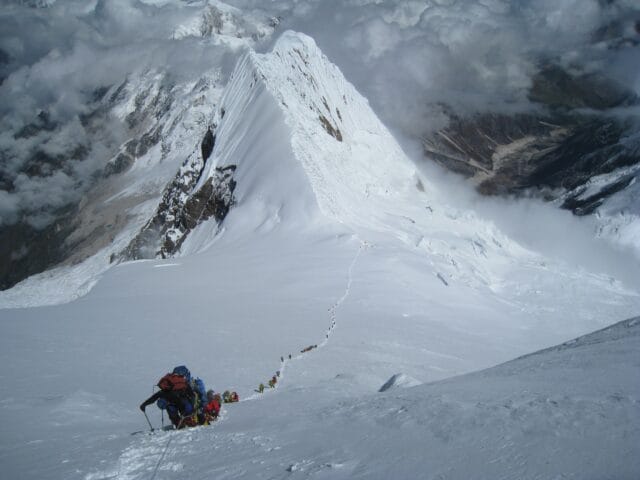
Manalsu between C4 and C3 in 2013 by Alan Arnette

With excellent weather and hordes of climbers with massive support, records are being broken across the Himalayas. First, there was a no O’s ski descent from Everest’s summit, then multiple speed and the youngest summits on Manaslu. Climbing continues across the 8000ers. So far, 457 climbers from 47 expedition teams—including 347 men and 110 women—have received permits. On Manaslu, at least 170 members were supported by 187 Sherpas, totalling 357 summits, with more to come.

How Many 8000-meter Mountains are There?

Nepal continues to try to expand the number of 8000-meter mountains from 8 to 14, but it’s not their decision. It will take approval from the International Mountaineering and Climbing Federation (UIAA) to become official; even then, I doubt it will generate a sea change in the 8000er world.

Does Ecuador Replace Nepal for Best 20,000-foot Climbs?

I just returned from a rewarding trip to Ecuador to climb three of their volcanoes. I went with US-based, Mountain Madness. While this was my seventh trip to South America, it was my first to Ecuador and now I see what I’ve been missing! I’ve been climbing and going to Nepal 13 times since 1997. As anyone who has read my blogs knows, Nepal is close to my heart for many reasons. However, Ecuador was so impressive, Nepal may have to share the top spot. In evaluating the two countries for trekking and climbing, both have pros and cons and in this post, I want to explore them. However, before I get accused of being enamored by the new shiny penny, let me add that I felt the same way about Nepal after my first visit and still do. Red Tape Ecuador makes visiting easy, at least for Americans. I spent less than 4 minutes going through customs – no visa, no paperwork, no fees whereas in Nepal it continues to be a jumble of desks, fees, and paperwork where I plan on 30 minutes to an hour, standing in long hot lines just to pay to enter the country. Verdict: Ecuador by far. Climbing permits are another area that Ecuador takes with no competition. Nepal charges for almost any activity in their country as a means of revenue. After all, tourism is one of their largest revenue sources but on my last visit in October 2018, I noticed more and more fees as I trekked the Khumbu. Ecuador, with their rich oil reserves, only charge guides a small fee ~$100 annually for access to all parks and no fee to their guests. Finally, Ecuador uses the US dollar as their currency, so no money exchange at banks or on the street for those with dollars. The prices felt fair to me and in fact a bargain for most items. Nepal’s Rupee swings in value and requires an extra yak to carry enough of the paper to fund a trek to EBC. When I first went to Nepal in 1997, everything was 100 rupees, now it’s 1,000 rupees. Politics and Climbing Ecuador certainly has had its share of political problems over the decades, as has Nepal but both are improving in this area with Ecuador well ahead. Today they have a stable democratically elected government.  Nepal continues to have wild swings in ideology, inconsistent policies and corruption. Even after the parliament declared in 2007 that Nepal was a federal republic, the government remains in flux with the head of ministries often being political appointees thus creating serious inconsistencies in government policies as each new minister seems to ignore the previous minister’s decisions.  In comparison, the climbing policies feel consistent in Ecuador, perhaps due to few rules. However, there is a lot of criticism that climbing above 5,000-meters requires a guide. But Nepal’s mountaineering and trekking policies are like a magic eight-ball. Spin it to see what today’s rules are.   The Peaks Just to mention a few of the popular climbs around 20,000-feet/6,000-meters, Nepal calls these “trekking peaks” and include: Island Peak (Imja Tse), Mera, Lobuche East. In Ecuador the most poplar volcanoes at this elevation include Chimborazo, Cotopaxi and Cayambe. Of course, I would be remiss not mention that some of these are active volcanoes and can be closed to climbing for safety reason as Cotopaxi was for two years and reopened in late 2017. Climbing The biggest mountain wins! By that measure Nepal has Everest and Ecuador has Chimborazo. Setting aside the argument of which one pokes into the atmosphere higher, both countries are blessed with geography. Nepal has eight of the fourteen 8000-meter peaks and Ecuador has 27 volcanoes on the mainland and another 7 on the Galapagos Islands.  If you want an 8000-meter peak, Nepal wins, and also for 6,000-meter peaks with 297 but not all are open for climbing. But for an aspiring climber seeking to test themselves on snow, ice, steep slopes at 20,000-feet/6,000-meters Ecuador offers a lot. The climbing is convenient, accessible and affordable. You can sleep in a comfortable hacienda or Refugio, leave at midnight and be back sipping coffee by mid-morning with a solid summit. In Nepal, you might be able to stay at a teahouse but most likely will leave and return to a tent. In addition to the permit fees Nepal charges (which require the use of a middle man agency with fee), you need to fly (or walk for days) to reach Lukla then trek more plus pay a trash deposit (I had to put down $500 for my Island Peak climb of just Kami and myself) and hire a guide – a lot of red-tape that Ecuador doesn’t require. All this said, for me, trekking in Nepal is half of the enjoyment and as I always say, “it will change your life.” So not all bad, just not as convenient as Ecuador if climbing is your primary goal. Ecuador, being on the equator sandwiched between the Pacific ocean and the Amazon Rain Forest does have a bit of variable weather that can close in unexpectedly. On Cayambe, we got hit with hoarfrost or rime ice about halfway up making us human popsicles and ending the climb that day. As for rescues, Ecuador doesn’t have the fleet of “for-hire” rescue helicopters that Nepal does nor does it have the current scam of guides putting drops into trekker’s water to make them sick and then skimming off the proceeds from evacuation companies along with the chopper company and hospitals. All of this is acting as a pox on any credibility the Nepal tourism industry has and should be warning for anyone going to Nepal that there are alternatives – especially when or if evacuation/insurance companies stop covering Nepal travel. Guides Well, first off, who is a guide? Someone with 200 summits or a person with an IFMGA/UIAGM certification? Both countries have a lot of both types.  In my

Helping Nepal: Himalayan Stove Project
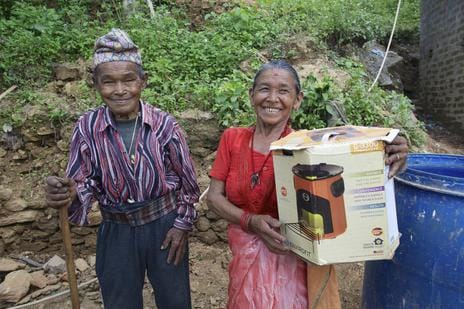
Himalayan Stove Project

Like so many of my readers, George Basch made a trip to Nepal that changed his life forever. Today he is the “Chief Cook” of the non-profit Himalayan Stove Project. They provide clean cook stoves to thousands throughout Nepal and are truly changing lives. You can help by funding a stove for only $150 that will reduce pollution and improve lives for generations to come. If you make a donation before November 28, 2017, it will be doubled. Through the Fall of 2017 they have delivered almost 4,000 stoves have impacted the lives of more than 40,000 people. George Basch I’ve gotten to know George over the past few years – a true Saint of a man if there ever was. His motives are pure, energy tireless and results unquestionable. At a young 81, George, lives in Taos but travels the world following his passion. He recently brought on an Executive Director, Pam Johnston to help build the HSP into the future. George will still be involved as ever but I know will appreciate her help. In addition, George has had long time help in Nepal to deliver the stoves.  Jai Rajbhandari and his family live in Swayambhunath and make the final mile possible. Global Support George’s first exposure to Nepal came in 2001 as he accompanied and supported from Base Camp blind climber Erik Weihenmayer on his historic summit of Mt. Everest. He went back in 2009 and began the HSP in 2011. George said he was shocked at the amount of smoke within the Sherpas’ homes that came from the open cooking fires. This became deeply personal to George as he had been looking for a way to honor his son, Paul, whom committed suicide in 1998. The clean cook stoves are made by Fort Collins, Colorado based non-profit company Envirofit. They have delivered over 1 million stoves worldwide since their founding in 2003. The Himalayan Stove Project is one of their distributors and solely focuses on putting the clean cook stoves in Nepal at no costs to the families. George’s tireless efforts have resulted in support from the biggest names in the climbing industry including adidas Outdoor, The North Face, Eddie Bauer, Kahtoola, MSR and individuals like Yvon Chouinard founder of Patagonia, Conrad Anker, Sir Chris Bonington, Jimmy Chin, Dave Hahn, Tom Hornbein, Reinhold Messner, Doug Scott. All contribute to helping HSP with publicity and funding. Last year, Kit DesLauriers and Tenzing Gyalzen Sherpa helped truck and trek several dozens Envirofit clean burning cookstoves into family homes in the Makalu Valley.   In April 2018,  Pam is going back, along with Carina Ahlqvist, the highly accomplished Swedish mountaineer, to check on those stoves that were placed last year and also to bring more to the area. But the need is huge. You may wonder just how big of a problem is ‘Household Air Pollution’. Well it kills more people than malaria, HIV/AIDS and tuberculosis combined – 4.3 million annual deaths worldwide. For those of you who have visited Nepal, you probably saw the problem up close, most likely in a crowded teahouse at sunset when the stove was fired up for heat. Your eyes watered, your lungs burned a bit and soon you went to your sleeping room to escape. The families throughout Nepal don’t have an escape and this has become a way of life for too many. The problems are not only inside but outside as well. Anyone who has been to Kathmandu understands the severe problem with air pollution. It is estimated 3 million people die each year from outside air pollution. Clean Cook Stoves address this problem by reducing household air pollution by 90% and reducing 75% of the wood collected for cooking – all by burning wood more efficiently. This not only improves air quality but also results in less erosion and flooding by keeping the forests in tact. Donate Today George has set an ambitious goal that matches the scale of this problem. He wants to raise $1,168,800 and deliver 11,000 stoves changing the lives of 40,000 more people. Your donation will be doubled if you act before November 28, 2017. Please join the team. I have. Climb On! Alan Memories are Everything