Rainier 2015: Summit and Fun
This trip report is for my climb of Mt. Rainier in Washington State, Washington. At 14,409 feet, it is the highest volcano in the lower 48 states of the US and the most popular way of training for higher Himalayan peaks. I summited with friends on July 8, 2015. I rolled over in my sleeping bag at 10:30 pm on July 7, 2015, hearing voices over the wind flapping the tent against me. It was time to climb Mt. Rainier. My close friend Barry Johnson had set this objective a year ago and trained diligently to get prepared. Fresh off my tragic experience attempting Lhotse in Nepal only two months earlier, I had committed to climbing with my friend but now had serious second thoughts about getting back onto the snow slopes. I hedged my decision for weeks. Barry waited for me to decide but had already assembled a solid team. As the aftermath of the deadly earthquake that took almost 9,000 lives in Nepal and our team doctor at Everest Base Camp quieted, I finally made the decision I needed to climb again, not only for Barry but for myself. This would be my third climb of Rainier, with summits in 2004 and 2012, so I knew to sit on the left side of the airplane as we flew from Denver to Seattle. About 30 minutes before landing, the huge volcano appeared on schedule. I’m always amazed at the sight of Mt. Rainier from the air—it is large, foreboding, snow-covered, and well, it demands respect that seems to be waning for all mountains across the planet. While Barry got our rental car, I retrieved our two duffel bags. We had compared gear lists for weeks with those of our teammates. We were determined to keep the weight down as we knew it was a short trip but a long summit day in potentially difficult snow conditions. One of Barry’s pilot friends, Terry and his partner, Lisa, met us at a tiny motel in Enumclaw that night. We had a fun dinner in town and, the following day drove to the ranger station at the White River entrance. There, we met up with our fifth member, Sarah, an impressive 26-year-old just starting her career as a guide for RMI on Rainier. This was not a guided climb but a group of friends with a common goal. Hiking In We confirmed our permit and listened carefully as the Ranger spoke of open crevasses, climbers punching through snow bridges and soft snow conditions. Oh, and bears and foxes. We left prepared but thoughtful of what was to come. Barry was typical, blasting out Rush songs with no warning whatsoever. At the parking lot for the Glacier Basin trail, we spread our gear out to look for duplication but also to make sure we had the essentials: wands, rope, harness, pickets, screws – everything needed to attempt this 14,409’ hill of snow safely. We packed up and headed up the trail. I’m always impressed with the enormous vertical trees surrounding Rainier. Each one has a story to tell, their trunks strong and seemingly impervious to the winds. The small streams cross the trail with the single-minded objective of joining up with a larger flow down below. But as we made the first of several switchbacks, we were greeted with a prize: Rainier, with all her glory, emerged from behind the forest. The Emmons Glacier stood out, as did the Winthrop, Liberty Cap and the summit. The crevasses were visible from here, looking like a heap of jumbled ice cubes, cracks and lines that dared the brain to make sense of them, but more to the point, dared the climber to test them. We arrived at Glacier Basin camp in a couple of hours. We had purposely set a relaxed schedule, spreading the entire climb from start to finish over four days. We were not out to prove anything with speed, times or bragging rights. Our team objective was to summit, but our objectives varied greatly. Lisa wanted to get to Camp Schurman to relax and reflect, but not to summit. Terry, like Barry, wanted to make his first summit of Rainier to test themselves for perhaps bigger climbs one day. Sarah wanted to climb with friends, not as a junior guide under the ever-present eye of members and senior guides. I wanted to reconnect with the sport I love, my passion. I wanted to hear my crampons crunch in the snow, watch the sunrise, and feel the cold wind against my cheeks. I wanted to climb. And I wanted to see my friend summit and then return home to tell his family of his experience with the wide eyes of a child who had just done something special. To Camp Schurman After an uneventful night at Glacier Basin, we packed up and made our way to the base of the Inter Glacier—the gateway for this route. Only about 25% of all climbing on Rainier is done by the Winthrop-Emmons route, but it accounts for half of the deaths due to the dangerous crevasses. With this in mind, we began our climb with an eye to the crevices. The ranger had told us there was one large open crevasse about halfway up. Making decent time ascending the glacier, we soon crested the Inter near Camp Curtis. We took time for a long break and a huge lunch—we were in absolutely no hurry and enjoyed the views and the company. Lisa was generous with her gouda cheese, naan bread and salami. We took full advantage of her generosity! Soon, we moved on and slipped a short distance down the scree-filled dirt hillside to the Emmons Glacier. Terry flaked out the climbing rope, and soon, we were roped up as a five-person team. Barry took the lead. I clipped in behind my friend, Sarah, who took the back. We came to our first snow bridge, Barry’s and Lisa’s first ever. With care and smiles, we
Ben Nevis Trip Report

Ben Nevis
Scottish Highlands
4,409 feet/1344 meters
Trip Report March 5, 2012
Vinson Trip Report

Antarctica 16,067′,4897 meters Summited December 9, 2010 7 Summits Climb for Alzheimer’s Pristine and perfect—Antarctica. I am unsure how else to describe my experience climbing her highest peak, Mt. Vinson. As this was the first of my 7 Summits Climb for Alzheimer’s, where I am raising awareness and money for research, it was critical to have a good start. And it was. I left the US just before Thanksgiving 2010 to meet Phil Ershler, co-owner of International Mountain Guides, and the rest of our team. The uneventful 30-hour journey followed the South American coastline, with a few plane changes along the way. There was a sense of excitement as we landed in one of the most remote cities in the world, Punta Arenas, Chile. I met two team members at the airport and shared a taxi to the hotel, where I met the rest. Excellent first impressions created confidence that this would be a good trip. The Preliminaries First on the agenda was a briefing with Antarctica Logistics and Expeditions, ALE. The room held about 50 people with various objectives—visit the South Pole, ski the last degree, visit an Emperor Penguin colony or climb mountains. Our common bond was a love of adventure and a sense of appreciation for being able to visit the “Last Place on Earth.” The two-hour briefing covered many details but honed in on our responsibilities to protect Antarctica. We left the meeting with a heightened awareness and anticipation of when the big Russian jet would depart. And that may be the common theme of all polar adventures. You see, it takes a specialized aircraft, unique flying skills, uncanny weather forecasting capability and agreeable weather just to start the journey. Thus, we were told to be prepared to leave our hotel on a two-hour notice, fully dressed in our -40F clothing. Every expedition is full of rumors, usually of a death on the mountain, an unexpected summit push or some petty politics. But we had none of that. One topic dominated our conversation from start to finish – wheels up time. Today or tomorrow? I just heard the winds are too high, or a front is moving in. What if we can’t get out for another week – and on and on? The keyword is patience. Polar travel is a case study of human traits we seek, and few achieve. However, everything aligned, and we learned that the Russian jet would depart Punta at 5:00 PM on November 27th. Flying to Antarctica That Russian jet – what a piece of machinery. Specifically, it is an IIyushin IL-76. Designed by the Soviets in 1967, it was built to service the remote areas of the old USSR. Today, it is used around the world for heavy lifting. With four massive engines, a back-loading ramp that trucks can drive onto and sparse interior furnishings, it carries everything from machinery to other planes to water for firefighting – and sometimes Antarctic mountain climbers. ALE leases the IL, as it is nicked named, from November through January to service their Base Camp named Union Glacier. They and previous companies have flown various specialized aircraft to Antarctica since 1983 using the prior base of Patriot Hills. However, weather delays caused them to search for a more stable area like the new Union Glacier site. In reality, all these locations are simply GPS coordinates on the ice. The key feature is a long strip of natural solid blue ice, void of cracks, holes or crevasses, enabling the big IL to land and take off reliably. So it was that we left Punta approximately on time for the 4:05 flight to Union. The flight was an exercise in organized chaos as 50 adventurers, dressed in full down, boarded the jet and took our seats three abreast, violating one another’s personal space with clunky boots and puffy down jackets. But given that the inside of the IL was marginally heated, no one complained. And we were going to Antarctica! The in-flight service consisted of receiving a cotton wad to plug our ears due to the lack of insulation inside the IL from the engine noise. Once in flight, we were served a piece of cheese between two slices of white bread and a cookie. I felt like I was in a scene from The Hunt for Red October as the Russian crew looked on. As midnight approached the sparse crew prepared us for landing with a quick walk through checking seat belts, yes there were seat belts! The only windows were attached to the emergency exit doors, so I had no sense of how close we were to the ground until I craned my neck to see the tip of a high mountain – snow-covered. My heart jumped. A solid thud marked our arrival, along with the even louder noise of all four engines in reverse thruster mode – no brakes on the ice. We coasted to a stop on the 3-mile runway. As soon as the doors opened, we knew we had arrived. Walking like penguins, we waddled our way to the door, down the metal stairs and onto the ice. My first step on the Antarctic continent was a moment, a memory, forever stored. The air was crisp. The sky was a turquoise blue. The sun hovered just above the surrounding mountain peaks of the Heritage Range of the Ellsworth Mountains. It was midnight. Union Glacier Met by the Union Glacier Base Camp team, we rode in a wooden sled loaded with food bags, portable walls, mattresses and backpacks pulled by a snow-cat on treads. It was a chilly introduction as we made the 5 miles to Union Glacier base camp proper. Since this was the first entire season after moving from Patriot Hills, the staff was still establishing Camp, but we were ushered into a long, narrow WeatherPort structure complete with solid floor, table, and chairs but no heat. A buffet of lasagna and bread was offered and received. Of
Kosciuszko Trip Report

Australia 7,310 feet/2229 meters Summited October 27, 2011 7 Summits Climb for Alzheimer’s With a tip of my hat to Dick Bass, who started all the 7 Summits stuff, I wanted to include Kosciuszko in my project. I had summited Carstensz on October 22, 2011, and flew immediately to Sydney, focused on completing my 8th of the 7 Summits climbs in one year. Arriving in a bit of a haze, I rented a car to leave Sydney and rest up for a couple of days before going to Kosciuszko. However, once on the road, I kept driving thoroughly, enjoying the vast countryside of the New South Wales (NSW) area of eastern Australia. Drive Left I kept saying out loud, “Look right, drive left,” to cope with the swapped lane driving. I reached a small tourist town that served as a gateway to the Snowy Mountain area and asked for information about Kosciuszko at the information center. The polite woman behind the counter told me it was snow-covered, I needed snow shoes, and I would probably not make it. I smiled and politely thanked them. The next stop was more encouraging, as I bought my entrance ticket to the Kosciuszko National Park. This time, I was told that many people climb it daily, and the route is a bit snow-covered. The summit proper was heavily corniced, preventing the usual approach, so everyone went straight up. I liked this scenario better! I continued to the ski village of Thredbo and found a great studio apartment for one night; it even included Wi-Fi. As I looked out my window towards the ski lifts, however, low clouds covered the tops of the mountains. I knew the weather could be a problem, with many fellow climbers telling me that Kosciuszko proved the most difficult of all the 7 Summits, but I was unsure if that was a joke. Some said they were getting lost in dense fog, and others were experiencing high winds and blowing snow. So I went to bed wary. A Perfect Day The following day, the skies were as if someone had taken glass cleaner to the skies—pure blue, no clouds and temperatures in the high 30sF. I had considered taking the slightly longer route from Charlotte Pass rather than the ski lift from Thredbo. Still, in the end, the ski lift won out, and I bought my lift ticket and boarded it at the opening time of 9:00 AM along with a large group of international students. I relaxed on the short ride up, reflecting on the culture shock of being in the jungles of New Guinea only three days earlier. This was my eighth climb, and I had been gone from home for almost seven of the last eleven months. But I was eager to stand on the summit of Australia’s highest peak on the mainland and looked anxiously ahead as the lift stopped. It was an 8-mile round trip with an elevation gain from 6,354′ to 7,310′. The route was more than obvious—a raised metal grated boardwalk had been installed for the majority of the walk. Over 100,000 people a year do this walk, so the walkway was constructed to protect the fragile tundra. A few other people soon joined the walk, and I made good progress towards Kosciuszko. It became visible about halfway. I was surprised at how large it looked, even from a distance. It was a classic, smooth mound standing high over the surrounding area. Completely snow-covered, I could understand how some people might go astray in harsh weather, but the day was beyond perfect. 8 Summits of the 7 Summits I reached the end of the boardwalk, where the Kosciuszko Walk merged with the trail from Charlotte Pass, which started at 6,026′. All that was left was to gain the summit by going straight up the snowy mountainside. I was glad I had worn my jacket and gloves. It was a bit chilly, with a light breeze off the snow, but I stood on the summit in a few minutes. It had taken a little over an hour—the shortest summit climb of all eight by far! I asked some of my fellow summiteers to take my picture while standing on the rock marker; it seemed everyone was doing this. I called for the eighth time from these climbs and posted an audio dispatch to my blog. Then I sat down on a big rock and looked around. The first summit was Mt. Vinson in Antarctica on December 9th, 2010. This was the last summit on October 25, 2011. I had made every summit except Denali, which was stopped by weather, 3100′ short of the summit. But it was OK. I have been able to send our Alzheimer’s message of hope, need and urgency from each continent, reaching over 12 million people and raising money for research, awareness and caregivers. It had been a good year. Kosciuszko Resources: 2011 Summit Climb Report Kosciuszko Dispatches Kosciuszko FAQ 7 Summits Climb for Alzheimer’s In late 2010, I launched the 7 Summits for Alzheimer’s campaign, where I wanted to climb all seven (eight) of the Seven Summits in one year. The first summit was Vinson in Antarctica on December 9th, 2010. This was the last summit on October 25, 2011. I had made every summit except Denali, which was stopped by weather, 3100′ short of the summit. I have been able to send our Alzheimer’s message of hope, need and urgency from each continent, reaching over 12 million people and raising money for research, awareness and caregivers. In 2025, I will continue to dedicate my climbing and public presence to honoring my mom, Ida, and raising research funds for Alzheimer’s nonprofits. Please consider a donation today.
Kilimanjaro Trip Report

One of my 7 Summits for Alzheimer’s climb – Africa’s Kilimanjaro and a safari.
Kilimanjaro Home

One of my 7 Summits for Alzheimer’s climb – Africa’s Kilimanjaro and a safari.
Elbrus Trip Report

Trip report from my August 11, 2011 Elrubs summit.
Denali 2011 Trip Report
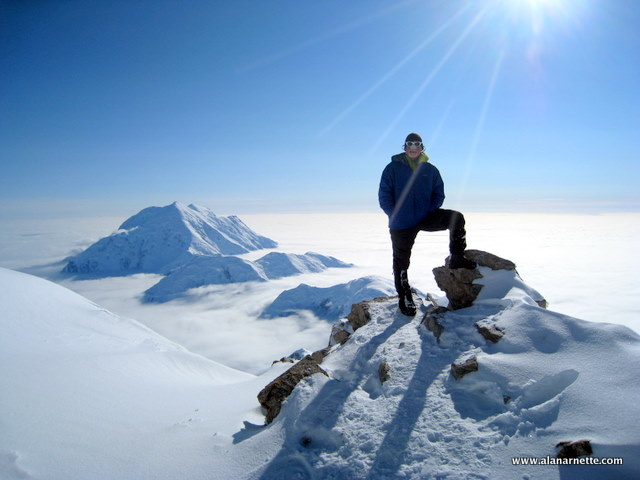
My third attempt on Denali, the highest in North America as part of my 7 Summmits for Alzheimer’s campaign in 2011.
Orizaba

A trip report from climbing Mexico’s Orizaba, 8,880 feet/5,754 meters in 2008.
Denali 2007 Trip Report

This is a very personal, detailed and sometimes graphic report. It chronicles my attempt on Denali in June 2007. My intent is to bring readers into my world of high-altitude mountaineering by showing the incredible rewards, the obvious dangers and what happens when the human body hits the wall. Remember to click on any picture in the report to enlarge it then use the back arrow to return to the report. Denali 2007 was the first of four climbs for my return to Mt. Everest: Memories are Everything® journey. I aimed to raise $100,000 for the Cure Alzheimer’s Fund (CAF) by using the Denali, Shishapangma, Orizaba, and Everest climbs. My hope was/is to summit each peak and raise awareness and money through real-time dispatches sent directly from each Peak. I left Denver International Airport for Anchorage on June 10, 2007. With Everest in the plans, Denali was almost an afterthought for my journey – a familiar climb designed to test my body once again against the rigors of high altitude. I was there in 2001 and was turned back by poor weather at Denali Pass or 18,200’. I was confident I could make the climb, weather permitting. My only concern was the heavy loads involved: 120 lbs split between my pack and sled that needed to be hauled up almost 2 miles purely through my strength. Hey, I am 50 years old! The week before I left, I worked closely with the CAF’s Tim and Katie to coordinate both websites to post my dispatches and receive donations marked for the Memories Are Everything® fund. My training was as good as it would be, thanks to some challenging climbs in the Colorado Mountains with my partners Patrick and Robert. Leaving Colorado, I felt confident, strong and nervous about the year-long commitment I had publicly announced. What if I failed? What if I didn’t summit this “familiar” climb? What if… I met my guides and teammates at the Alaska Mountaineering School (AMS) on June 12 in Talkeetna, Alaska. I selected AMS due to its reputation as a solid guiding company with an excellent record of safety and success and its focus on the basics. I felt this reputation would attract more competent climbers, enhance my chances of success, and, more importantly, deliver an overall positive experience. Christian March was the lead guide. A young man of 27 years, he shook my hand with an air of confidence and gave orders on what to do and how to do it. I liked him immediately. Next, I met his assistant, Leighan, an impressive 26-year-old native Alaskan who oozed with personality. She gave immediate life to the team. Soon, the other five climbers arrived at the old house AMS had converted into their offices. They were a diverse group, including a father-son pair, a banker, a tattoo studio owner and a British law enforcement officer. Most had good mountaineering experience, and all were eager to summit Denali. Thus, the team was set. Scheduled to fly out the next day, we rushed to check our gear and review some basic glacier travel skills. But the weather in June 2007 had been challenging. Colder than normal temperatures and high winds had reduced the usual 50% summit rate to a very low 33%. And it continued. Our flight to the Kahiltna Glacier was delayed for two days. We rushed to the airstrip twice to load the DeHavilland Beaver Turboprop, but we were told the flight was canceled. So we bided our time in the township of Talkeetna by doing more “classes,” as AMS calls their review of skills, and scrambling at the last minute to find a place to spend the night. We also enjoyed the sights and entertainment of the local bars and restaurants. Remember that Talkeetna has one main road – paved, that is – and is straight out of the television series Northern Exposure. It’s a great place, to be sure. Finally, we got the word on June 14th, we would be flown to the glacier. The flight is one of the best I have ever taken in my mountaineering travels. Second only to the landings at Lukla, Nepal, in the late 1990s when the landing strip was dirt with Yaks crossing it and pilots who chatted casually as the plane appeared to be on a direct collision course with the steep mountain side! But this flight, smoothly operated by Paul Roderick, the owner of Talkeetna Air Taxi, was more like a scheduled commercial flight – no wait – better. We rose to about 10,000’ over the Alaskan tundra as we approached the Alaskan range. Mounts Denali, Foraker and Hunter stood proudly above the rest of the snow-covered mountains in the range. Another plane passed by a quarter of a mile away with sightseers. I thought about the fact that their journey would end in half an hour, ours in 21 days. “500 feet,” announced the comforting female voice of the automated flight systems as we flew over a high mountain pass. Paul banked the Beaver to the right as we approached the “landing strip.” Memories of my 2001 climb came back, and I felt the adrenaline flow as we made the steep descent and abrupt landing on the hard-packed ice. I had made it back. Now, all I had to do was climb Denali and get home safely. Due to poor weather, over 200 climbers were stranded for several days. So, as the plane spun around, we saw a refugee camp of climbers with the 100-yard stare in their eyes, drooling at our tiny 8-person plane. I was slightly afraid of a rush to take it over, but the National Park Service (NPS) has Rangers at the base camp (BC) to organize flights in and out. All quite civilized, as my British friend would say. Our first order of business was to unload our gear from the airplane—a 60-lb pack each, over 500 lbs of food, three tents, stoves, fuel, and God knows