
Over the past two years, Nepal’s government and the Ministry of Culture, Tourism, and Civil Aviation have been working on a sweeping Tourism Bill that includes new rules for casinos, hospitality, and mountaineering. The key proposed rule for Everest mountaineers is the requirement to have summited a 7,000-meter-or-higher peak in Nepal before receiving an Everest permit.
Tourism Bill 2081 has not been approved. You can check its current status at this link, where it is listed as ‘Discussion in Committee’ as of July 2026. Note that the date uses 2082, which, in the Gregorian calendar, spans from mid-April 2025 to mid-April 2026.
Moving Through Approval Phases
The Upper House has passed the bill, but it still needs approval by the Lower House and the President’s signature. If passed, the ministry wants to enact it for the 2027 spring season. The Kathmandu-based newspaper, The Tourism Times, reported:
“A meeting of the House of Representatives on July 8 unanimously decided to forward the Tourism Bill to the International Relations and Tourism Committee for clause-wise discussion before passing it from the HoR. The House unanimously accepted the minister’s proposal, allowing the committee to expedite discussion of the bill. The House will approve the Bill again once it is sent back by the committee after final discussion. Once the House passes the Bill, the 1978 Tourism Act will be replaced by the new one, following the presidential approval.”
Opinions differ on whether this law will be passed as is, with many hoping the “in Nepal” requirement is changed to “worldwide” or that specific peaks are included, such as any 8000-meter mountain, Aconcagua, Ama Dablam, Peak Lenin, Mount Kun, and others. Stop and consider that if you had summited K2, or Nanga Parbat, but not a 7000 m+ in Nepal, you would not be allowed to attempt Everest. Nepal has 72 peaks above 7,000 meters, but not all are open for climbing. Nepali guides have been marketing this requirement as if it’s already in place and promoting climbs of Himlung Himal – 7,126m, Baruntse – 7,129m, Tilicho Peak – 7,134m, Putha Hiunchuli – 7,246m, Nuptse – 7,861m, and Annapurna South – 7,219m, among others. Phur Gelje Sherpa, President of the Nepal Mountaineering Association further pushed “Not only 7,000m peaks, but climbers can also attempt any of Nepal’s six other 8,000m peaks.”
Other New Rules
Some of the other new rules impacting mountaineering in all of Nepal’s peaks include:
- Expeditions would need to prepare a formal climbing plan. If the team or any member intends to set a record, that record attempt must be included in the climbing plan.
- If an expedition is abandoned or the permit is canceled, the royalty generally would not be refunded, though the Department may adjust the royalty in certain cases.
- Teams must use the route specified in their permit. To use another route, they must apply for route approval.
- The expedition must take the approved number of Sirdars, climbing guides, and support staff.
- Before mountaineering activities begin, the trekking agency managing the expedition must arrange insurance for expedition members, the liaison officer, the sirdar, the climbing guides, and the support staff.
- Agencies must bring back expedition goods and materials to a place designated by the Department. After a climbing season, the Department must arrange the collection and management of waste generated during expeditions.
- The bill would create an Environmental Protection and Mountaineer Welfare Fund. Money from mountain-cleaning fees and contributions from climbers, expedition teams, people, or organizations may go into this fund.
- After the expedition, the team must submit a report to the Department with evidence of reaching the peak, including photos and other available proof. The Department must verify the summit using the report, summit photos, and, where available, modern technology before issuing certificates.
- Unauthorized climbing or major responsibility violations may result in a ban from climbing Nepal’s mountains for up to ten years, a fine of up to twice the royalty amount, or both. A foreigner may face similar penalties and may also be barred from entering Nepal for up to five years.
Impact
Let me be clear. Half of Mt. Everest is located in and controlled by Nepal, the other half by China. They are obviously free to manage the mountain in any way they deem appropriate. While outsiders may have opinions, including me, it’s up to them what rules they create and enforce, just as the US National Park Service manages Denali, Aconcagua in Argentina and others around the globe. Note that for decades, or even centuries, Nepal was a closed country where outsiders were not permitted to enter, let alone climb mountains.
Having a prerequisite climb for Everest has been tried before. In the late 1990s, alarmed by the deaths and bad press, they imposed a 6,500-meter requirement, but after severe pushback from operators who feared their foreign business would dry up, the requirement was quickly removed and remained so for almost thirty years.
I love the concept, it’s just the implementation that matters.
Climb On!
Alan
Memories are Everything
The Podcast on alanarnette.com
You can listen to #everest2026 podcasts on Spotify, Apple, Breaker, Pocket Casts, Anchor, and more. Just search for “alan arnette” on your favorite podcast platform.
Receive Notification of Alan Arnette’s Memoir
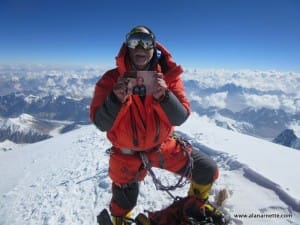
A surge of debilitating fatigue overtook me. My shoulders drooped. I stared at my yellow boots, crushed by disappointment. I had trained hard for K2 and tried to anticipate every scenario, but now I was failing, and there was nothing I could do.
Closing my eyes, I was powerless, hopeless, and ready to surrender to the mountain. Everything I wanted—the summit, a safe return, my vow to my mother—was slipping away.
My ice axe fell onto the snow.
Staring at the small yellowish spot illuminated by my headlamp on the snow, it was over, and, oddly, I didn’t care.
It was 12:30 a.m. on July 27, 2014—my fifty-eighth birthday.
If you would like to be notified when my memoir, “Hard or Impossible? Summiting K2 for Ida” is available. Complete the form at the bottom of this introduction page.