Everest 2014: Everest Nepal Functionally Closed: The Big Picture – Update 4
Note and Update 4: Changed the headline of this post to be more accurate as the mountain is not “officially” closed whatever that means. That said, all the major teams have left leaving a few tiny ones and perhaps the Russians but who knows how they will climb with no support in the Icefall. Not impossible but very, incredibly difficult and time is running out with the monsoon season approach at the end of May. Not a lot of time to acclimatize. This situation has been the most difficult I have ever covered about Everest since 2002. There are lies, manipulation, misdirection, confusion … I did my to keep track of it and apologize when I got it wrong, but corrected it as soon I found out. I have updated this post by striking through the incorrect parts as of April 27, 2014. Also, I have added emphasis on the subtle points that deserve more attention. But this statement I stand by: My view is Everest is like an airport with the terminal open but the runways closed. Update 3: The final large #Everest2014 teams that might have climbed declare the end: Himex and Altitude Junkies. Update2: I knew this would happen and I apologize. The Ministry of Tourism issued a press release saying the mountain is open and everyone is welcome to climb. (see at bottom of this post). Teams are packing even after this release. The future climbing plans all have to do with the Icefall Doctors and if they will stay and mange the route through the icefall. They have been threatened, their families have been threatened if they stay and they have told other teams they are leaving. This could change if the military comes in but it still leaves their families at risk. I have heard of no teams planning to climb and at least 10 have said they are leaving officially including: AC, AAI, IMG, JG, AT – these are the largest teams with the most Sherpa who do all the real work, without them, the season is over. The remaining wild card is Himex and Altitude Junkies who have not said anything official but it would be tough for them to go on their own, but not impossible. Update 1: Of note, just as I published this, a few people said the mountain had not been closed and we still have not seen official statements from some remaining teams including Himex, Altitude Junkies and Asian Trekking. I guess there is always a tiny chance something might change … this is how it goes on Everest. Original Post: A representative from Nepal’s Ministry finally came to Everest Base Camp on Thursday April 24, 2014 after several teams announced they were ending their seasons to officially close say Everest is open and everyone is welcome climbing from Nepal. He made an offer to honor climbing permits for five years. Even without this ‘official’ closure, the mountain was effectively shut down anyway. The reasons are a bit more complicated than a sound bite or headline. And the long term implications are unknown, real and frankly disturbing for mountaineering in general. In this post, I’ll try to provide the big picture based on my knowledge of the situation at Everest, my own experiences and my own judgment. These are my opinions and no one else’s. There are three reasons that brought a halt to the Everest 2014 season from Nepal: safety, respect and money. Let’s look at them individually before looking at the future. Safety The ice serac that collapsed on April 18 had been identified as an objective hazard for years. In fact it has released ice into the Khumbu Icefall almost every season in recent memory. In 2012 it narrowly missed many climbers. But knowing about it and doing something about are two different things. It is simply impossible to ‘remove’ the danger so all you can do is try to avoid it. This year, the Icefall Doctors took the route more to the center than they had for years tying to anticipate a collapse. Sadly it was not far enough. This is also difficult as taking it too far away from the West Shoulder moves the route closer to Nuptse which also has seracs and avalanche danger. Plus that side of the Icefall has very deep and dangerous crevasses. So no good solution exist. The Icefall itself seems to be more unstable, especially the upper part where it tips over from the Western Cwm. In this area, the ice blocks are huge, teetering and ready to collapse at any moment without notice. Again, there is little to do about this only to get through the area as fast as possible. So when you put all of this together, given the recent collapse, it was reasonable for everyone to be wary of returning to this area right now. In the end, many people , but not all, felt it was simply too dangerous to keep climbing and there are no real alternatives this late in the season such as using helicopters to bypass the Icefall. Respect Mount Everest is a sacred mountain to the people of Tibet and Nepal, with special significance to the Sherpa people. The Tibetans call Everest, Chomolungma or mother goddess of the universe. The Nepalese call Everest, Sagarmatha, goddess of the sky. When you summit Everest you do not stand on the very top as it would be disrespectful so you claim the summit a couple of steps lower. Many in the Sherpa community feel Chomolungma is angry and saying not to climb this year. With 16 Sherpa deaths in an area every person would have to pass through to reach the Western Cwm, there is a matter of respect for the fallen. There are still missing Sherpa who have not been found in that area, presumably. Out of respect for the mountain and for their fellow Sherpa, some in the community felt it would be disrespectful to continue climbing this year.
Everest 2014: Season Near End from Nepal – Update 1
International Mountain Guides, IMG, who has the largest team climbing from the south side of Everest has ended their season. While there has been no official comment from the other large teams including Asian Trekking, Himex and Altitude Junkies, the IMG decision most likely ends all attempts from the south. Climbing is still occurring on the North side of Everest and other Himalayan mountains. IMG fields a very large team of Sherpa who are key in fixing the line to the summit. Without their support, other teams would struggle to find the manpower, although it would still be possible with excellent cooperation. However, time is running out to attempt a summit. This is the IMG statement: IMG leaders Greg Vernovage and Ang Jangbu Sherpa have been forced to end the expedition due to the perilous conditions resulting from the April 18 Icefall avalanche. After several days of intense meetings at Base Camp and in Kathmandu among climbers, sherpas, and representatives from the Ministry of Tourism, no agreement was reached on restarting the 2014 Everest climbing season. The Icefall route is currently unsafe for climbing without repairs by the Icefall doctors, who will not be able to resume their work this season. We have explored every option and can find no way to safely continue the expedition. The IMG team will be starting down valley in the next few days, with some trekking and some hitching rides by helicopter. They are joined by climbers from other expedition teams that had also been waiting at Base Camp and have also been forced to end their climbs. A meeting was held with government officials in Kathmandu on Wednesday resulting in an agreement to send a high level official to base camp to discuss the situation. The Nepal government has said they would put a team of officials at EBC this year but reports are the officials never appeared at base camp furthering distrust with the Sherpa community. Also, the Ministry agreed to allow helicopters to ferry supplies to Camp 1 for 2014 and perhaps beyond. Climbers are posting their personal status and in general have mixed emotions of support for the Sherpas while watching their own dreams fade away. I’m told there is not unity within the Sherpa community and this is driven by a few young, very vocal climbing Sherpas who are using the media very well. The primary reasons for the Sherpa’ discontent range from increased pay and life insurance for all Sherpa, support for families of climbing Sherpa killed on Everest to having an equal position along side commercial guides to showing respect for the victims of last week’s serac fall. Also, many people, Sherpa to Western Guides felt the Icefall was unsafe this year. The clock is ticking for teams to properly acclimatize due to no climbing this week. By this time in April, most climbers would have spent several nights at Camp 2, 21,500′, and be preparing to spend that important night at Camp 3 on the Lhotse Face. Usually, the first summits are by the Sherpa rope fixing team in early May. But they would have had the ropes, anchors and supplies already positioned by this time at Camp 2 and nothing has been carried there as of today. Addendum and Update – Current reports from Tibet side shows no issue, team climbing and are at Advanced Base Camp – Lhotse climbers are impacted as they use same route and support as Everest climbers – North side teams are unaffected and good progress. There will be Everest summits in 2014 – Peak Freaks cancels season and cast doubt on their future Everest expeditions – Alpenglow has canceled their season asking members not to fly to Nepal. – A small segment of the Sherpa loosely associated with the Maoist at EBC had threatened other Sherpa and their families if they did not go along. There are many questions about if the Sherpa still get paid and if members get refunds. It depends is the answer as it varies from each team. Every team will manage paying Sherpas differently. Most are paid on a per carry/load basis so no carries, no pay. Others get a flat salary, others get a daily rate. Some teams have offered to pay them in full no matter what happens. For many long time teams, Sherpa are family and they are taken care of climb or not … As for refunds, in general, members do not receive refunds regardless of circumstances. In 2012 when Himex canceled their season, there were no refunds but discounts on future climbs. Almost all the money is spent up front on supplies, permits, transportation, labor so very little is left at this point. The next question is the long term impact on climbing Everest. Time will tell but I expect prices to go up based on the increased Sherpa compensation, less Sherpas to be hired as a result of using helicopters and higher member prices, fewer climbers due to higher prices and the increased awareness of the risks. But, in the past after a difficult year, there were more climbers that next year. But 2014 was not a normal ‘difficult’ year Remember teams are still on the north side. It is unclear if the Sherpa on that side will quit as well. Many teams use Tibetan staff for their support due to Chinese rules. I will update this post as more reliable information becomes available. Climb On! Alan Memories are Everything
Everest 2014: My Relationship with “my” Sherpa
An editorial As the Everest 2104 season remains in limbo, Sherpas are at home reflecting on their collective loss and worried about their future. Climbers are at base camp processing a range of emotions, from guilt to lost dreams. Families are simply worried about their loved ones. This tragedy has no simple answers. It is not about money, safety, or anything more than the human condition. Anyone who professes to know the answer has not been there, and those who’ve been there don’t know what the future holds. Opinions and positions based on morality are just as valid as those based on experience. This diversity of thought fuels debate, develops solutions and brings people together. It is only a polarized position that doesn’t allow for movement, stifles progress and creates conflict. No one has the only answer. I have climbed the Himalaya eight times, four on Everest, all with Sherpas from the solo Khumbu area. My relationship with them has ranged from a simple hello to a lifelong friendship based on mutual respect. I would like to briefly tell you about my Everest 2011 climb and Kami Sherpa. Kami was 47 years old at the time. He had five children. His oldest son, like his father, was an Everest guide working for IMG. His second son was a monk at the Tengboche Monastery. He and his wife had two daughters and a son in boarding school in Kathmandu. His full name was Kami Sherpa (Ang Chhiring Sherpa – Pangboche). His mother changed it to Kami after an infant illness, believing the illness would not return if she changed his name. Kami’s father was an Everest guide, a profession he spoke of with great pride. Kami had seen people die on the mountains, including relatives, including on Everest. Our climb was one of his many on Everest. He had already made it to the top 12 previous times and had climbed other 8000m peaks, including K2. One day, we climbed from Camp 2 towards the West Ridge for “exercise”. Who climbs towards the West Ridge of Everest for a workout? Well, Kami did, and he dragged me along. We slowly made progress until Kami saw my struggle. We stopped and looked back towards Nuptse, the Western Cwm and the top of the Khumbu Icefall; Pumori’s snow cone summit loomed to the East. Regaining my breath, I took in the view. I was awestruck even though I had seen this view during my three previous climbs on Everest. “This is beautiful Kami.” I said as a question. “Yes” was his reply. “What do your think when you look at this?” A shoulder shrug came, followed by “It’s a job.” Deflated by his answer, I followed him back to Camp 2. “It’s a job”. Yes, it was a job that provided for his family. It was a job. When I first met Kami, he impressed me immediately. Arriving at Everest Base Camp, Jangbu, IMG’s Base Camp leader, called out my name as I approached. “Alan, I want you to meet your Personal Sherpa, Kami.” He shook my hand firmly and confidently as we walked together towards my tent. I felt a bit uncomfortable as he seemed so eager to please and take care of me, even in the first few minutes. I silently asked if this was about getting a summit tip or something else. Yes, he was getting paid, actually the highest wage for a climbing Sherpa, given that he was a Personal Sherpa, meaning he would be by my side the entire climb. I had climbed with a Sherpa before, but not like this. It didn’t take long for my cynicism to be replaced with total respect. This was not about money. Yes, he was doing a job, but Kami cared about me. Back at Camp 2, I went to my tent after eating dinner. I didn’t feel well. Lying in my -20F down sleeping bag, my stomach turned. I tasted dinner in my throat. I fell asleep only to wake up with a start an hour later. Hurtling to the tent door, I vomited everything into the vestibule. Wiping the remnants from my mouth and sweat from my forehead, I told my tentmate, “Well, that was fun.” The rest of the night was uncomfortable. We were scheduled to return to Base Camp after this acclimatization rotation and wanted to leave early to go through the Icefall before it got too hot, creating more instability. Kami came over to our tent and unzipped the door. Seeing my vomit on the ground, he looked at me with concern; his eyes betrayed his “job. “ , “Are you OK, Alan?” he asked. I told him what happened and that I felt OK now. With a sadness in his eyes and voice, he simply replied, “You should have called out for me.” It was then that I knew that Kami was not doing a “job; he cared about me as a person. On our summit bid, we passed under the ice serac on Everest’s West Shoulder for the fourth time. As we left the area named “Popcorn,” Kami reminded me to move fast. We clipped into the thin white nylon rope that served as a guide and safety line and increased our pace. It was hard, even after acclimatizing. The pace Kami set was strong. I knew he was worried, so I pressed as hard as I could for as long as I could. Once out of the danger zone, we stopped for a break. With my chest heaving from the stress, I glanced toward the serac. Looking at Kami, also breathing heavily, I knew he knew. This was the reality of climbing Everest. As we neared the summit of Everest, the sun introduced itself with a tiny thin line over Bhutan. It was cold, -20F, and windy, maybe 20 mph. I was fourth in line that morning with my teammates Mirjam and Sherpa Minga ahead. Kami was in front of me. We had
Everest 2014: Season Still Uncertain
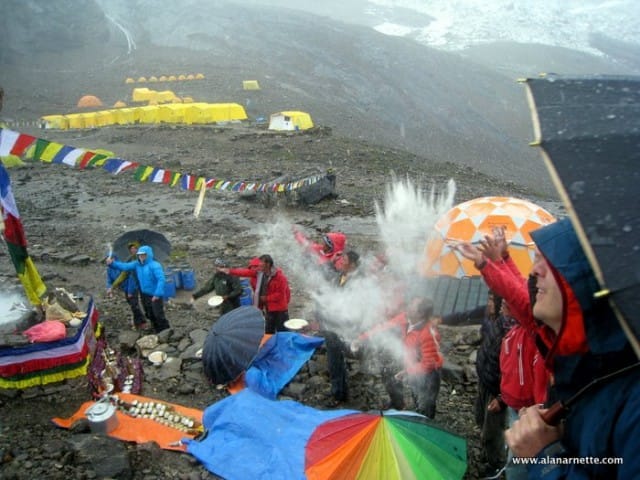
The Ministry of Tourism has agreed to many of the Sherpa demands but this is far from over as to the future of the 2014 season, the benefits for the Sherpa and the future of climbing in Nepal. Climbing continues on the north side. Reports are coming in that a few Sherpa are stirring up the emotions at base camp demanding all Sherpa to stop climbing for the season. In addition, one report posted via Reuters on the New York Times has Lama Geshi telling the Sherpa “…. they should not go to the summit because more will die” I spoke directly with a contact who is at EBC and he confirms the season is still uncertain, the Sherpas are still undecided and there remains a lack of trust around the agreement with the Ministry. There was a large ceremony at EBC Tuesday to mourn the dead. People there said it was a wide range of emotions, primarily sorrow, but also anger. Similar to last year when the fight broke out between Simone Moro and two Sherpa, many in the Sherpa community seemed to come together feeling they were not being shown proper respect. This is not focused toward western climbers but more towards the Government of Nepal and around money. In addition to the financial concerns, safety remains an issue. The ice serac that collapsed this year has released every year. Everest appears to becoming more unstable similar to Manaslu, Ama Dablam, K2 and many other large mountains around the world. That said, these ice features move all the time and are part of the overall objective dangers when climbing. It is clear the major voices are from the young Sherpa, some who have been trained to international climbing standards and have International federation of Mountain Guide Association (IMFGA) certification. Two expeditions who lost Sherpa in the serac release have canceled their season: Alpine Ascents (5) and Adventure Consultants (3). The largest teams including Himalayan Experience (Himex) , Altitude Junkies, International Mountain Guides (IMG) are still at EBC and will continue the season if there is enough Sherpa support. Individual climbers are in a wait and see stance, spending time with the Sherpa, getting know them better. Some climbers are doing acclimatization climbs on nearby trekking peaks trying to stay prepared when/if the season continues. Many of the Sherpa have returned to EBC to attend the ceremony today but some are still in the homes down valley, a days walk from EBC. I’m told that many of the Sherpa are willing to continue climbing but will not go against the trend. A meeting will be held in Kathmandu Wednesday April 23, perhaps with Nepal’s Prime Minister, to address the Sherpa concerns with an objective of bringing a signed agreement back to EBC so the Sherpa can make an informed decision on continuing the season. I’m told that no decision has been made by the greater Sherpa community at EBC nor from the Ministry of Tourism thus contradicting major news media reports. This information is first hand from people there and owners of major guide companies. The emotions are strong and varied. I’m told the elder Sherpa are devastated by the loss of life. Everyone knew someone who died in the Sherpa community. This is a unparalleled loss and has reached deep into their culture. In addition, it has major implications for the future of climbing in the Khumbu and across Nepal. Depending on the overall reaction, it has the potential to change a way of life developed over the last 100 years in tourism and mountaineering for the Sherpa people. I don’t want to exaggerate the situation but it is important to underscore the seriousness. The loss of life has brought into focus the real dangers of climbing these mountains and life changing choices are being made. This is now more about the future of the Sherpa economy than foreigners climbing mountains. Climb On! Alan Memories are Everything
Everest 2014: Tragedy Overwhelms Everest
Click here for latest full update The serac collapse into the Khumbu Icefall last Friday has not only taken at least 16 lives, s it has changed Everest climbing forever. Emotions and relations are tense today at Everest Base Camp with Sherpas presenting the Ministry of Tourism a set of 13 demands ranging from improved insurance to improved pay as part of the millions the government earns from permits each year. Teams are currently on hold waiting for the Ministry to respond to the demands, search They gave a date of 7 days or April 28, 2014 or they will stop climbing. Already, climbing has been halted for a period of mourning. Plus bad weather stopped all further efforts to search for bodies in the icefall. Some Sherpas, but not all, returned to their homes which are normally less than a days walk from base camp. If enough of the largest commercial teams cancel their season, the smaller teams will be encouraged to leave as well. In 2012, Russell Brice, Himex, canceled his season on May 1 after his Sherpas expressed significant concern about passing underneath the same area that released last Friday. He has 43 members and Sherpa climbing on Everest and Lhotse this year. UPDATE: late Monday in Nepal, Alpine Ascents (AAI) announced they were ending their Everest 2014 season. AAI had a large part in supporting the logistics team supporting Joby Ogwyn wingsuit attempt plus had Sherpas killed in the serac collapse. They had 12 members, 2 guides plus and employed more than 20 Sherpa. Climbing on the north side of Everest continues with teams already at Advanced Base Camp but the Chinese are refusing entry and permits for climbers not already in Tibet or on their target mountain. This has been ongoing for several weeks. In essence this will leave south side climbers without the option to switch to the north side unless Beijing changes it’s mind. – end update. Wingsuit Jump Broadcast Canceled NBC Universal, Peacock Productions announced late Sunday night that the wingsuit jump off Everest’s summit has been canceled out of respect for the victims of the serace collapse. There is a report that Ogwyn wants to do the jump anyway but it will not be televised. Donations The Ministry of Tourism had previously announced an immediate payment of $400 to cover burial expenses for each family of the Sherpa victims. For 2014, life insurance for each Sherpa was increased to US $10,000 from $4,000. The Nepal government collected US $3,107,700 for the Everest 2104 season. Multiple funds have been established to accept donations supporting the Sherpa families. The American Alpine Club has established a fund to help the Sherpa families. The Juniper Fund is accepting donations The Khumbu Climbing Center is accepting donations Himalayan Trust in New Zealand Sherpa Education Fund Sherpa Demands The demands from the Sherpas are wide ranging and include: • Increment of immediate relief announced for avalanche victims • Provide Rs 10 million (US$103,590) each to families of d • Set up a memorial park in the name of the d in Kathmandu • Cover all expenses for ment of the injured • Provide Rs 10 million (US$103,590) to critically hurt who cannot rejoin mountaineering activities • Set up mountaineering relief fund with 30 per cent of royalty collected from issuing permits to different mountains (est $1M for 2014) • Double the insurance amount to the mountaineering workers • Provide additional chopper rescue to mountaineering support staff if insurance fails to cover the cost • Provide perks and salaries, except summit bonus, through concerned agencies to Sherpas if they want to call off climbing this season • Manage chopper to bring logistics and equipment from different camps if mountaineers decide to abandon climbing this season • Don’t take action against SPCC icefall doctors if they refuse to fix ropes and ladders on the route this season • Let the expedition members to call off this season’s climbing if they wish so A Difficult Trade-off The environment at Everest Base Camp remains very somber now with a further umbrella of uncertainty. Some Sherpa are willing to continue accepting the risks as are some foreigners; others have already left base camp never intending to climb again. Tourism is the lifeblood for Nepal but everyone from climbers to yak herders wants a safe and clean environment. Simply stopping climbing on Everest or any of the dangerous Himalayan mountains would have a severe impact on Nepal. Clearly, the loss of life is unacceptable and I know of no climber who would ever callously risk the life of a Sherpa, guide or teammate for a summit. Alternatives Alternatives to preventing a similar event such as an ice serac collapse range from none to few and each have implications with complicated consequences. The nature of an ice serac prevents it from being “removed” by blasting as is done in ski resorts due to the remote location, uncertain terrain, unpredictable results of a blast not to mention Everest, and many other mountain in the Himalaya, are consider sacred and blasting would probably not be acceptable. Simply not passing underneath the so-called “objective danger” is another alternative but the reality is that the route through the Khumbu Icefall adjacent to Everest’s West Shoulder is the safest route to access Everest from the Nepal side. Reducing the number of passes is probably the solution to reduce exposure and this could be accomplished by acclimatizing on other Himalayan peaks so as not to reduce the money spent in Nepal and work for the porters and Sherpas. Many teams already utilize this strategy including IMG, Peak Freaks, and Himex. However, even this scenario requires multiple passes in high risk areas, something unavoidable when climbing any 8000m mountain. Reducing the number of trips for Sherpas is a good strategy. One way to eliminate some trips would be to simplify the camps above base camp, reducing the amount of oxygen used thus the number of cylinders required, or by asking each
Everest 2014: Avalanche Near Camp 1-Sherpa Deaths:Update 9
Click here for latest full update Latest as of Monday in Nepal Alpine Ascents ends season. They had a large part in supporting the Joby Ogwyn attempt Sherpas demand improved compensation after #Everest2014 tragedy or will stop climbing. source Sherpas demand decision made by April 28. NBC cancels Joby Ogwyn wingsuit jump off #Everest2014 link —– NO decisions have been made on closing Everest south for the season. I don’t expect it but the Nepal government could. Individual teams are making their decision now. I expect a few to cancel but not many. Individual climbers are making their decisions now. I expect 10% of the 350 non-Sherpa climbers to return home I expect a fair number of Sherpa to stop climbing this season and forever now but not a huge amount. There are over 600 working Sherpa on Everest for 2014 My deep and sincere condolences to all the families, friends and teammates of the fallen Sherpa Heavy snow on Sunday, April 20 have stopped all search efforts Reports have 17 dead as of today, more are missing. I expect the death count to increase. This post from Robert Kay, climbing with Phil Crampton’s Altitude Junkies, provides one of the most succinct synopsis thus far: We were on the trail that winds through camp (it’s about 3/4 mile from one end to the other). I heard the glacier ice break loose and watched it fall into the icefall. Immediately knew we had a big problem. We saw people coming down and they looked quite shocked. At the same time rescuers headed up, including Phil and six of our Sherpa. Unfortunately very little could be done as the victims were all buried deeply. Helicopters arrived after about two hours and took the injured down to base camp in several trips. They began carrying the dead using a long line. Base camp became a very somber place. Rumors were flying around and no one know for certain what was true or not. Our team joined the Sherpa in their tent after dinner to show our support and respect. We were there for several hours. Things seem a bit more normal today. Although many of the other team’s Sherpa have gone home for a few days, our guys are staying here. Phil says the place is safer now that the weak portion has fallen and I think he is right. We will likely only have one rotation (into the ice fall) instead of the two that were originally scheduled which will further lower our risk. Donations: The American Alpine Club has established a fund to help the Sherpa families. http://americanalpineclub.org/p/sherpa-support-fund The Juniper Fund is accepting donations The Khumbu Climbing Center is accepting donations Himalayan Trust in New Zealand Sherpa Education Fund Final update for a couple of days – Fund Established It is after midnight on Everest now and hopefully everyone is resting as they can. The tragic events of the last 24 hours are horrific in the mountaineering community by any standard. 13 are known to have lost their lives and another 3 are missing and will probably be presumed dead at some point, but the search continues tomorrow. In a country where the per-capita income is $500/year, a Sherpa can make $5000 or more working on Everest. This allows them to put their children through schools, build tea houses and pursue a better life for their families. Many of the dead are related to other Everest Sherpas – fathers, sons, brothers, uncles, cousins. They are one large family. This is a human tragedy. This is a time to honor these men doing their jobs, working extraordinarily hard without complaint year after year. This is what they do. I hope the Ministry of Tourism will take care of their families. I know the expedition companies will provide support. But in an event of such magnitude, a reaction of similar proportion is in oder by the Nepal government. There will be no climbing for several days to honor the dead and to allow the route to be rebuilt. Those stranded in the Western Cwm are safe and will return to base camp as soon as the route is re-established. IMG has announced they will continue their expedition but will understand if individuals choose to leave. I expect other expedition to follow suit but also many individual climbers to return home and a few expeditions to cancel altogether. But time is needed at this point. The 2014 event was an ice release, (technically not an avalanche), not snow, and when the serac hovering off the west Shoulder of Everest collapsed, it sent house sized ice blocks all over the route. This is different than a traditional snow avalanche that can be triggered to release by explosives. With hanging ice it may stay there for decades or fall tomorrow, there is no way of knowing or predicting. Thanks to Tim Ripple, Peak Freaks, for posting this video of a similar avalanche, but a bit lower, that occurred in 2009. This will be a time of reflection and healing for everyone on Everest, even those on the north who are unaffected. Climbing is a tight community. If you have climbed long enough, you will know someone who falls. My deep and sincere condolences to all the families, friends and teammates of the fallen Sherpa. I wish peace for those who fell yesterday and for their families for tomorrow. The American Alpine Club has established a fund to help the Sherpa families. Click this link Climb On! Alan Memories are Everything Update and summary 6 Around 6:30 am, April 18th, an ice avalanche occurred off the West Shoulder of Everest hitting an area just below Camp 1 which is located at 19,500′ but near the top of the Icefall. The estimated altitude was 5800m or 19,038′. At this point in the Everest season, only one commercial team, IMG’s Hybrid group, was in the Western Cwm as they had climbed to Camp 1 the previous day. Many
Everest 2014: Climbers Gain Rhythm
It is a good week for our Everest climbers as they are getting into the rhythm of their new life. Also, all the prep is ready for some climbers to begin spending the night in the Western Cwm. Ang Jangbu, expedition leader with IMG, posted this update of their progress in establishing Camp1 and Camp 2: All sherpas carrying to Camps 1 and 2 made it OK. The sherpas who went to Camp 1 managed to set up the kitchen tent plus seven sleeping tents. At Camp 2 they were able to set up the big steel frame tent. We have Ang Karma, Nuru Gyalzen and Ang Nima staying up there at Camp 2 tonight. Phunuru sent his camera with Ang Karma to take pictures, so we will send some when he comes down in a couple days. The schedule for tomorrow has guides Justin, Max and their hybrid climbers and sherpas going up to Camp 1 to sleep. We are sending five more sherpas to Camp 2 tomorrow for building platforms and setting up more tents, and they will stay up there. Tomorrow, we have 22 sherpas carrying loads to Camp 2 and nine sherpas are carrying member personal gear to Camp 1. It looks like IMG will be the first teams up this year. If this sounds like a lot of work, it is. Let’s put it in perspective, these teams need to have a place to sleep, a toilet, a place to cook and eat during each rotation to acclimatize, then for the summit push and the return. The tent platforms must be literally cut out of the frozen rock at the base of the Khumbu Icefall. The camps must be able to withstand hurricane (typhoon) strength winds and heavy snow. It must be stocked with food, stoves and fuel. Every day, snow and ice must be melted for cooking and water. And all of this is carried through the Icefall in the packs of Sherpa. It is a brute force method of climbing a mountain – siege style. If you think this is a lot, keep in mind the early Everest expeditions such as the 1963 legendary West Ridge climb used 900 porters and 37 Sherpas for five Western summiters, a staggering 7.4:1 ratio for that pioneering expedition. Of course they didn’t have access to helicopters! Some professional climbers do what is called alpine style where they do not set up permanent camps and carry everything on their backs moving steady up the mountain in a single, or few pushes. This is the purest form of climbing and done by only a few these days. Can you hear me now? The update on the communications from the Nepal side is good news with the Ncell mobile service back up. Also some good news on communications from the Tibet side came from Bill Burke saying he has full Internet service via China mobile on his iPhone at base camp. I now I’m sounding like an old fart but on my first trips to the Himalaya, we sent postcards back home, just sayin’ 🙂 The RMI team puts a fine point on it: Hello out there. Billy here checking in for the rest of the gang after another day deep in the Khumbu. Not much to report on another rest day here, other than the fact that the NCell tower began sporadically working today after nearly a ten-day outage. Our team was starting to go crazy… I mean it was like camping back in the 90’s where you were in a deep black hole. Observations from the Climbers I like this description posted on Facebook by Donna climbing with the Adventures Global team: Yesterday was another cold day, snowing most of the day. Firstly we are grateful that our trek into EBC wasn’t cold. Secondly I feel that sometimes the mountain just wants time for herself, as with the snow and cold were tucked away with heaters and don’t get out to see her Splendor. Everest is alive. My first thoughts are that there is a thunder storm by the sudden crashing noise only to remember it’s an avalanche. The other day for a brief instant I thought a car had just pulled up, then I reminded myself we were at 5350m! Besides the avalanches, birds are chipping and the crows are flying around. The crows love the Puja ceremony as they eat the rice and flour apparently on the ground, there are also some left overs left by teams for them. I suppose one of the noises is that of our Sherpas who huddle together in the kitchen and are continually laughing. For the past few morning’s we’ve been woken up by a helicopter, who we feel is going to be landing right on our tents, unfortunately this means an early morning rescue. There are quite a few helicopters, some are just bringing supplies, some we stare at and have no idea what is up, while the rest take away ill s. Gary Williams over on the north with SummitClimb made this observation from base camp: Hello from Everest BaseCamp. The teams are all starting to assemble here before we all move up to Interim Camp and then on to Advanced Base Camp; the highest base camp in the world at 6400m above sea level. I have an added appreciation and respect for the early explorers like Mallory, Shipton and Tillman who were the first westerners to pass through this desolate, windswept place; they bred them tough back then as the conditions are harsh to say the least! One of the films being made this year is about the Sherpas. They have a Facebook page. It is a feature documentary that follows a 2014 Everest expedition entirely from the Sherpas’ point of view. Take a look and like it as I’m sure that would mean a lot to them. Also they have some great pictures. Finally, there are a few reports of climbers being refused entry into China for their climbs, including Shishapangma.
Everest 2014: First Steps in the Khumbu Icefall
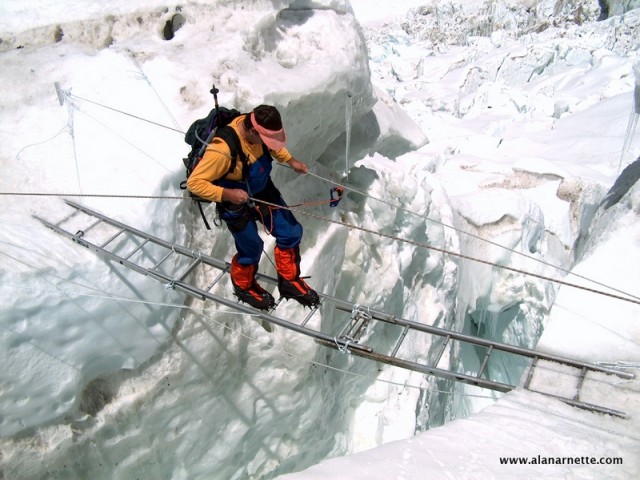
Today was another milestone for some Everest 2014 climbers – their first steps into the Khumbu Icefall. Of all the experiences written and talked about for Everest, crossing the ladders has to rank near the top. Todays Update But first a look at the current action. EverestER is starting off very busy caring for climbers, click Sherpas, Porters and anyone who needs help: We’re busy! Our volunteer doctors have already seen 70+ s and had 2 s hospitalized overnight and 3 evacuations. As usual, our problems run the gamut – from blisters and sprained knees to life threatening HAPE and head trauma. We are enjoying meeting all the different groups and hearing stories from all over the world (including the first team from Myanmar to ever attempt the mtn!) I want to acknowledge Jagged Globe for their transparency around one of their team members. I’m sure with his approval they posted this update today. On Monday morning Philip collapsed in Base Camp. It is not entirely clear if he fainted or simply tripped on a rock. However he fell hitting his head on the ground and lost consciousness for a few minutes. He received immediate ment from members of the Jagged Globe team and the HRA doctor in Base Camp. Philip was carried by stretcher to the HRA a short distance from the Jagged Globe Base Camp where he received oxygen and IV medication. The doctor was concerned about the possible risk of a head injury and advised immediate evacuation to hospital in Kathmandu. A helicopter was requested and fortunately one was available nearby. Within 30 minutes of the request (and little over an hour from the original incident) Philip was airlifted from Base Camp to Kathmandu. From the news reaching us at Everest Base Camp it seems that Philip is making a good recovery in hospital. Jagged Globe staff in Kathmandu are working to make Philip’s stay in hospital as comfortable as possible and all the team at Base Camp wish him a full and speedy recovery. Many of the teams are working out the kinks before heading into the icefall by climbing to camp 1 on Pumori. This is the beautiful pyramid shaped peak that looms to the east over Everest Base Camp. It will occasionally spray the camp with avalanche debris but does not pose a threat. Adventure Consultants described it this way: A beautiful and mostly clear day today so the team climbed up above base camp to a high point on Mt Pumori at about 5800m, which is a similar height to Camp 1 on Everest. We had clear skies and great views of Everest including the North Col and North Ridge, and most importantly looking straight at the route up the Lhotse Face, the South Col. One blog I’m enjoying by Andy Holzer, the blind Austrian climbing from the south. It is in German so I have to use Google translate but you can get the idea. Tibet Side Multiple teams arrived at the Chinese Base Camp (CBC) yesterday. This is probably the of Everest in the world – the North Face. And also the windiest, coldest and dustiest camp in the world. Similar to the south side, teams will take a few days to rest up and acclimatize before starting their trek to Advanced Base Camp. CBC is at 17,000’/5182m and ABC is 21,300’/6492m. This is quite a jump so most teams take one night on the first trip to ABC at a desolate interim camp at 20,300’/6187m. The SummitClimb team arrived posting their schedule: Looking ahead, we will spend another two days here in EBC before heading to Interim Camp (5800m) on 19 April. After two nights at Interim Camp, we will make our way to Advanced Base Camp (6400m) where we will stay for approximately 4 nights practicing our ice climbing skills and fixed line management skills ahead of making our ascent of the North Col (7000m). The Triple 8 team climbing Cho Oyu, Everest and Lhotse arrived at their base camp at 15,500′ for Cho Oyu and will also make a move to their Advanced Base Camp in a few days. Cho Oyu has two base camps like many of these mountains. The first is at the end of the road, just like on Everest from Tibet. Then it is a six hour trek covering 15 miles to ABC at 18,500′ on a trail snaking over small hilltops where you can see the Gyabrag Glacier. Some teams take two days to make this trek. Most climbers will take daily acclimatization hikes to 18,000′ on nearby hills at the end of the road base camp before leaving for ABC. The Triple 8 team has targeted May 6 as a potential summit day with their next goal Everest somewhere around May 21 or so. By the way, there are also expeditions on other Himalayan 8000 meter mountains including Manaslu, Makalu, Dhaulagiri I , Kangchenjunga, and Annapurna. Who said spring is all about Everest? Communications Update An update on the communications problem. Asian Trekking worked with the the largest Internet provider (ISP) in Nepal, Mercantile Systems, to provide wireless Internet at base camp. So far the system is working well providing relatively high speed access of 256KB upload and download speeds. Teams had to arrange in advance to unlimited access costing several thousand dollars, quite reasonable when spread across many users. However, Ncell, the mobile provider in the Khumbu has been the only choice for non-satellite comms at base camp for several years thus many teams assumed they would be there in 2014. Apparently there are problems with capacity ad bandwidth, nothing new here as this has been the case since day one, and apparently their station at Gorak Shep has some issues. Bottom line, users of the Ncell system are offline or have intermittent service until the problems are fixed. Users of the satellite systems including Immarsat, Thuraya and Iridium seem to be working as always. But they require clear line of sight and heavy clouds
Everest 2014: Regrouping at EBC
Everest and Lhotse climbers are getting down to business today preparing to make their first acclimatization rotations into the Khumbu Icefall or on nearby trekking peaks like Lobuche. The many trekkers who came along are now heading down valley with a lifetime of memories to share forever. The communications situation seems to have gotten a bit better based on an increase of posts but the Ncell network still appears to be down and many people assumed it would be available and had no backup. It has been snowing quite heavily at EBC, also hurting the ability to make a satellite connection. So we are back to the early days of expeditions where families said goodbye to loved ones and heard from them via postcard or letter several months later, if at all! I can tell you from personal experience that this is more frustrating for our climbers than for us back home. The last thing they want is for their friends and family to be worried. This is a good case study for future expeditions in not counting on only one form of communication e.g cell phone or sat phone or Bgan only. If communication is important to you, have a backup system. I promise you that the Discovery Channel will have multiple backups to stream the wingsuit stunt next month! So not a lot of new information to share today. This post from Andy James‘ home team sums it up for a lot climbers: Andy has been struggling to get wi-fi and 3G coverage so I’m sending this little note to let you all know that I have spoken to him. He wants you all to know that he is safe and well in his wee tent in base camp. Although it is snowing heavily he is in very good spirits and is acclimatising well. The RMI group also captured the spirit of base camp: Today was a well-timed rest day. Following our recent daily pattern, it was sunny and calm in the morning and snowing and socked in by noon. The team took the chance to wash up and get clean during the sunny hours, and then hunkered down within the tents for the afternoon. While it may seem frustrating to have these down days so early, it is actually pretty normal and not any concern. Most teams will try to be be fully acclimatized by the second week of May targeting a summit push from May 15th on. Cold days with heavy snow are also fairly typical in mid April. Remember, climbing Everest is all about patience. Smart climbers take advantage of this time to relax, regroup from the trek in and focus on taking care of themselves by getting into routines. Climb On! Alan Memories are Everything
Everest 2014: Base Camp Life
The communication problems for teams now at Everest Base Camp is improving, slightly. The Ncell mobile network is still down but the Mercantile Communications systems seems to be up as well as the satellite access. A good omen for New Year’s day in Nepal, year 2071! It has been snowing and cloudy at base camp for several days taking a toll on solar charging capability. It is often all about power, there are no power lines in the upper Khumbu or Everest Base Camp. In spite of the comms issues, teams are settling into base camp after their week or more trek. Many had their Puja ceremony over the weekend, worked on the obstacle course to hone fixed rope skills and are resting up. The next big event is the climb to Camp 1 through the Khumbu Icefall. The RMI team did their first sorte’ into the icefall, about halfway up just to get a feel for the ladders. The Sherpas from almost every team are already in the Icefall taking tents, stoves, fuel, and oxygen bottles higher. At this point, every morning around 4:00 am there is a long line of headlamps snaking their way up the Icefall. Usually the Sherpa will climb to Camp 1 and even Camp 2 and return before some westerners crawl out of their tent to start the day! Happy to Be at EBC Jeff Smith with Himex said all is well, albeit with the normal adjustment period, with his team just before they leave EBC to acclimatize on Lobuche: Got some wifi at last, so here’s a quick update, tomorrow 15th, we leave to climb a local peak called Lobuche, which is 6400m and will allow us to acclimatise safer than going over the Khumbu Icefall too many times as it is one of the most dangerous parts of the climb. We climb and sleep for about a week, and then back to BC to recover. I have been acclimatising ok apart from the one terrible night where I lost my appetite, started hallucinating, and had a stonking headache, oh the joys of altitude, I’m much better now, but it was the worst I’ve ever had, so hopefully I’m in the groove now. I think this is day 18 of being away from home, which is very tough, but I knew what I signed up for, so I just need to keep on being strong. We had our Puja religious ceremony yesterday, which was great being blessed, and a super colourful ritual. So tomorrow crampons and climbing gear on, and the next step on this great journey begins. Similarly David Bradley with Jagged Globe discussed how pleased he was to be at base camp: At last – a new blog update. Communications and charging facilities have been non-existent for a week. We are now at base camp. We stayed at Dingboche and Chukkung in the Imja Valley and did a couple of high climbs before making our way to base camp via Gorak Shep where we climbed Kala Pattar. I have had real difficulty eating the lodge food. Maybe I am too picky but the constant supply of fried pasta, noodles and potatoes all tainted with the smell of burning Yak dung and eaten in the half light, meant that I arrived in base camp in pretty poor shape. On Jagged Globe advice I visited the doctor who said that I had no symptoms of AMS (acute mountain sickness) but I that my reserves were seriously depleted. Fortunately we have a few days rest and the food at base camp is really good. I am feeling better – particularly as normal bodily functions have also returned. Jagged Globe, who pride themselves on over the top food, welcomed their team with a feast: We’re all settled in at base camp nicely after a cool, snowy walk up yesterday. We were greeted with a sausages and mash dinner complete with onion gravy then a chocolate marble sponge pudding with chocolate sauce – all a very welcome change from the standard tea house fare of recent days. Meanwhile, teams traveling over road to the Chinese Base Camp for Everest or Cho Oyu are making good progress. They are passing through some of the most desolate, poverty stricken towns on earth in central Tibet. Historically the hotels have been about as basic as one can find but Jim Walkley, with the Triple 8 team, posted this insight on improvements: Last town before basecamp, Tingri is a simple town at 14,000? with a strip of simple buildings on either side of the highway, which itself is actually very well constructed. You can see the Chinese influence from an infrastructure standpoint – great road in particular. Apparently these teahouses were much worse in the past but are quite decent today. Imagine a Motel 6 with no heat and only sporadic hot water, but we have our own rooms with two beds each that we share and a private toilet, which is big step-up even from most teahouses in the Khumbu Valley in Nepal where shared toilets at the end of the hall are the norm. We are having a rest day today to acclimate to 14,000? and then we head to Cho Oyu base camp tomorrow. Wingsuit Jump Airing The Discovery Channel has announced the date for Joby Ogwyn’s wingsuit flight from the summit of Everest as May 11. This lines up with my previous thought that he will most likely climb as close as possible with the Sherpa fixing the ropes to the summit to avoid any delays from other climbers. Of course, the weather has the last say for any schedule. The normal weather pattern for Everest is a good April, followed by poor early May then the traditional weather window starting around May 15th. The sweet spot for Everest summits is between May 13th and May 22nd with 70% of the summits historically occurring during this period. In addition to a live broadcast of his