Everest 2014: Lukla: Traveller to Trekker
Everest 2014 continues as the climbers who arrived in Kathmandu a few days ago have now flown to Lukla to begin their week long trek to Everest Base Camp. For many, case this is a flight of a lifetime, or at least they hope. 🙂 A few teams will take a helicopter, considered safer by some, thus bypassing all the fun, but the views are the same. And a privileged few will bypass the trek altogether taking the chopper all the way to Gorak Shep missing the point entirely in my humble opinion. As for those climbing from Tibet, normally they drive to their base camp and don’t arrive until mid April. A few reports are coming in but it is mostly quiet as the first real opportunity to connect to the Internet will be in Namache, couple of days after flying to Lukla. Those teams posting updates are commenting on the great weather and stunning views of everest and the plume indicating high winds off the summit – normal for this time of year. Preparing Flying to Lukla, now named Tenzing-Hillary Airport, starts early. A 3:00 am wake-up call begins the action. This is early, even by climber’s standards as many have been rushing to get last minute items, connect back home and, in general, rest up knowing what is ahead. When the phone in your room rings, you are already awake, staring at the ceiling, wondering what you forget to pack, what you forget to say. The anxiety is high. The question now is whether to take a long hot shower, your last for six weeks. Yes, take a shower, wash your hair, perhaps shave – if appropriate – knowing it will be a temporary cleansing. You packed your duffels, for the fifth time, the night before, but you take one more look to make sure. It really doesn’t matter. It is too late to get anything you forgot. It is time to go. The tiny man who carried your huge duffels to your room is fast asleep so you hoist the bag on your shoulder and struggle down the stairs. You begin to sweat, you start to breath heavily. And you are about to climb Everest. Doubts enter your mind as to your training, your fitness, are you ready? Now at the hotel desk, you check out. Pay for the laundry so you have clean clothes upon your return. Your bar bill, yes it was too much, but … All of a sudden, you hear a voice behind you, the tiny man. He retrieves your last bag. You are glad. This time you tip him ten US dollars. The team slowly convenes in the lobby. Everyone looks asleep. The joker of the group maintains his facade. Everyone goes along, too tired, too nervous to compete. The cattle call comes and everyone goes to the bus, a small bus already loaded with your gear. Driving the quiet streets of Kathmandu, you see the city from a different perspective. It looks clean, quiet, serene. Everyone is quiet, except for the jokester. Everyone ignores him. Waiting Arriving at the Kathmandu domestic terminal, you are struck at how different it is from your arrival. Several other teams also arrive, flying to Lukla. You inspect one another like gladiators preparing for a fight, but you don’t have the energy. You simply smile. Your leader gets the tickets for Yeti Air, Nepal Air, Sita Air and, your favorite, Buddha Air. Passing through the security, you smile, inside. The metal detectors are unplugged, just a wooden frame you pass through. The guard pats you down. He ask if you have a knife or lighter in your bag. You say no, he searches anyway and pushes you on. Entering the departure lounge, you look for your teammates and take a seat on one for the many nondescript chairs. The small talk is quiet. Those with cell phones and local sim cards check email, Facebook, send a tweet. Those without, nod off, chat quietly. All of sudden another tiny man swings through announcing something in Nepali. Your team gets up and moves in unison following one of your Sherpa. Lining up at the door, ticket in hand, you wait, and wait, and wait. False alarm, the weather has shut down Lukla. This drill is repeated four more times. Your 6:00 am departure is now 10:00 am. Then it is canceled. Returning to the hotel, you crawl back to bed, knowing the same drill will be repeated tomorrow, and perhaps the next day. Your schedule is out of your control and in the hands of the weather Gods, get used to it, this will be your life the next two months. Flying Finally the Gods are happy and you step on the small plane, a DeHavilland Twin Otter designed for short runways. It is a mainstay for this type of flying around the world. All it needs is 1000 feet of gravel or pavement to land. Lukla’s runway is 1,509 feet. Lukla is notorious as one of, if not, the most dangerous airport in the world. While paved today, in 1997, cows grazed on the grass runway. When a plane approached a kid was sent to shoo off the bovine from the runway. But the flight is suspended animation. Every seat is a good seat. if you want to video the pilots take row one, but the s are out any window. The small plane skirts the mountain tops sending cows and goats running along high ridges, their road, dirt paths. The clouds envelope the plane. You wonder how the pilots can see where they are going. You stop wondering. As the flight continues, it is only 30 minutes but seems shorter, no longer; it doesn’t matter. Your face is pressed against the window, staring but not seeing. You are lost in thought. The Sherpa on your flight are fast asleep some are snoring. You know your place. You review the safety record of the airport
Everest 2014: Goodbye Home, Hello Kathmandu
Our climbers are starting their Everest experience in full force. After 18 hour flights, and crossing multiple timezones, they are arriving in Kathmandu, the capital of Nepal. Once they are settled into their hotels, one of the first orders of business for many climbers, and trekkers, these days is to get a sim card for their cell phone. How times have changed Ncell is the preferred carrier because they charge 1.99 Nepalese Rupee (USD $0.02) per minute for a call to the US! There is coverage throughout Nepal and up to Everest Base Camp. In 2011, I was able to get a weak signal all the way to Camp 2 and some report a connection from the summit itself! Another task is to get their briefing and climbing permits from the Ministry of Tourism. Normally this is handled by their lead guides but for 2014, the Ministry is requiring that the climbers attend a briefing on how to behave on the mountain. As I have covered in previous posts, this is not a bad thing but I wish that they would focus on removal of human waste and not etiquette. Eric Simonson of IMG, is doing his usual great job of keeping us updated on conditions. He reports that the Icefall Doctors have the route fixed to the Football Field (about half way) in the Khumbu Icefall and should be at Camp 1 in a few more days. This is good news in many ways as it indicates the Icefall is not showing any unusual problems with stability and that the Doctors are working together well. Climbers will not be arriving at Base Camp for at least another week. Russell Brice of Himex just posted his first update for the season. He has a lot going on with teams on Everest (17 climbers, 4 guides, 17 Sherpa), Lhotse (3 climbers, 1 guide, 4 Sherpa) and Makalu (7 climbers, 2 guides, 7 Sherpa). In an unusual move he is having his Makalu team join the others to acclimatize on Lobuche Peak then taking a helicopter to Makalu Base camp thus avoiding the 10 day trek. Russ also talks about supporting his two film crews including Tim Medvetz with his organization, The Heroes Project. USMC SSgt Charlie Linville will be climbing Everest. He lost his foot to a below the knee amputation the summer of 2013 after fighting for over a year to save it. Goodbye Our young climber, Alex Staniforth with Tim Mosedale sent a great picture while en-route acknowledging his supporters. Can’t possibly reply to every good luck message as there’s just so many, but here’s a small message of my own from 35,000ft. Nothing worth fighting for is ever easy but I couldn’t have got here without you all in the past 15 months. Now to find some good coffee in Kathmandu… I am always inspired by what our climbers write as they leave home or upon their arrival in Kathmandu. Ricardo Pena, climbing with Altitude Junkies made this Facebook post as he left home: What a moment! About to take off from Denver to LA. I will fly LA to Seoul, Korea and from there to Kathmandu, Nepal! I will arrive there in two days! After many years of dreaming about Everest, after 10 crazy months of fundraising like crazy, training harder than usual, 10 months of guiding many mountains including Rainier, Crestone needle, winter 14ers, one expedition to the Andes and three to Mexico’s high volcanoes, 10 months of trying to keep some sort of balance in my life between all this and being a full time musician, music teacher, father (and I guess that makes me in the words of Stevie wonder a “part time lover” hahaha) I finally put everything behind and focus on the biggest mountaineering challenge of my life: to climb Mt. Everest! And the adventure begins now!!! I am psyched! Very happy!!! Once in Kathmandu, many teams will stay in small hotels in the Thamel District. Others will stay in western hotels like th Hyatt or Four Seasons. Melissa Arnot posted a great description of her arrival: Arriving in the hustle and bustle that is Kathmandu always feels oddly comfortable. The cars, people, and animals all follow the same traffic rules, in that there aren’t any. Kathmandu Many teams have a day or two in the schedule to explore Kathmandu. This is a great opportunity to make the transition from home to, well, whatever you want to call climbing Everest. The city itself is a contradiction for the senses. It looks chaotic but somehow works. The policeman directing traffic look in control, but it is a mirage. There are 11 hour power blackouts so the hotels have backup generators. Restaurants are full, yet the service is personal. Smiles abound amongst the trash heaps. It is easy to get frustrated or anxious in this new environment so it is a case study in how to accept what you cannot change and go with it. A lesson for later in the expedition. Many people will visit the standard tourists spots including a trip to the Bagmati River which is the home of a significant Hindu temple. Ghats or river steps line the river. They can witness cremations. Bodies are painted and positioned on top of logs and set afire. When all that remains are the ashes, they are put in a small bowl with milk and flower petals covering them, and then washed into the river with an elaborate religious ceremony. Certain areas of this temple are reserved for cremating royalty and others for the lower classes. Pashupatinath is the holiest Hindu pilgrimage destination in Nepal. Boudhanath is among the largest stupas in South Asia and it has become the focal point of Tibetan Buddhism in Nepal. Monks walk about in maroon robes as well as Tibetans with prayer wheels in their hands. The climbers will also see the ritual of prostration where worshippers circle the stupa on their hands and knees, bowing down
Everest 2014: Weekend Update March 30 – Arrivals and Confusion
Kathmandu has become flooded with climbers in addition to the normal spring trekkers. The hotels are full, the restaurants noisy and an overall feeling of anticipation in the air. In spite of all the bad press Everest receives each year, it is forgotten once the team arrives in Thamel. The climbing teams will trickle in over the next week to begin the trek to Everest Base Camp (EBC). The trek will take between 7 and 10 days so look for the first sorties’ into the Icefall around April 10th or so. The climbers looking at the Tibet side usually lag about a week. The next big thing is the flight from Kathmandu to Lukla to begin the trek to EBC. Teams arrive in Lukla at 9400’ and finish at EBC at 17,500’. While it is “only” 30 miles, it is the altitude that makes for the slow going. The general rule of thumb for acclimatizing is to gain about 1000’ a day, which almost no one does that little, to allow the body to adjust to the thinner air. There have been some reports of delayed flights to Lukla but that is somewhat normal. This time however, it was low visibility at Kathmandu and not storms at Lukla that created the delays. In any event, that flight is one of the milestones of an Everest climb. More on that later next week. Out of the Ordinary Attempting a new route via the Southeast Face are Horia Colibasanu and Peter Hamor. Not many people attempt Everest without supplemental oxygen. In fact to date about 192 have summited sans gas. This year there will be several including Isaiah Janzen. I will be posting an in-depth interview with this novel team but wanted to give everyone a heads up that a team of three climbers lead by Willie Benegas will attempt something never before accomplished: climbing Cho Oyu, Everest then skiing the Lhotse Coulair all in one push in one season. Father and son, Mike and Matt Moniz will be joined by Jim Walkley for this effort. To get a preview, visit Jim’s blog. Jagged Globe reports that one of their two chefs will be making an attempt. JG has become known for their culinary delights on Everest, but also their recent success rate – around 90% over the last three years. So they are doing many things right, it appears! 72 year-old Bill Burke is heading back to another attempt on the North side. I love this picture he posted on his blog. He does a great job of keeping us informed and will be one to follow this season on the north. Celebrity Sighting? Jeff Smith, climbing with Himex, reports that Tim Medvetz of the Discovery “Rest of Everest” series in on the Himex team this year. Tim has used his fame for some amazingly good work with The Heroes Project, working with wounded soldiers. Landed in Kathmandu, just had a meeting with Russell and the teams about the plan, and introducing everyone. Discovery Channel fans may remember Tim Medvetz who is on our team this year, and finally I fell up the stairs wearing flip flops, fortunately only one witness, and I’m quite glad we wear boots on the hill! Himex is hosting two film crews this year so Russ will be busier than normal. Speaking of celebrities, wing suit flier Joby Ogwyn is making the celebrity appearance rounds on his way to Nepal. Looks like the Discovery Channel is going all out to make this a rating hit. You can see his interview with Jimmy Fallon of the Tonight Show. It is actually pretty funny and interesting. He thinks he will hit 200 mph (321kph) on the flight down. Filed under the category of something your spouse would not like to read, Joby told CNN: “I’m very scared. I think it’s the fear of death or destruction that kind of keeps you above that, but I’m not afraid to die. I’m not afraid to live my life on my own terms. And this is my dream and I am willing to risk everything to make it happen.” Lhotse Rush As expected there are many climbers attempting the world’s 4th highest peak, Lhotse at 27,940′ (8,516 m). The Altitude Junkies team has five on the schedule. Of note, all have climbed with the Junkies before, a good sign when you have such loyal customers! Confusing North I am still looking into this but apparently several climbers have been refused entry visa to climb Everest from Tibet. The reasons sound suspicious including age and “not having been to Tibet before.” If anyone is also hearing about this, please contact me. Confusing South Just when you think the Nepalese have leaked all the new rules they could possibly leak, a new one showed up late last week. Now they are floating the idea that every climber must be accompanied by a “local guide”. I have no idea what this means but Ang Tshering was quoted as saying that “Most of the accidents that take place on Everest involve mountaineers from abroad who don’t use local guides”. The last time I checked, with the exception of professional climbers like Simone Moro and Ueli Steck, all climbers have a Sherpa with them. But then again, a Sherpa might not be considered a local guide. Oddly, the Ministry gave improving accessibility and lowering cost as one of their primary reasons for doing away with the single permit fee of $25,000, now $11,000. Requiring a “local guide” will certainly increase costs. Like I said, I really don’t know what to make of this one but will have no impact on 99.9% of all climbers this year. Deserved Recognition Started in 1991, the highest award in the world of alpinism is the The Piolet d’Or (French for The Golden Ice Axe) determined by the French magazine Montagnes and The Groupe de Haute Montagne. Last night the 2014 winners were announced: Ueli Steck (Annapurna South Face solo) and
Everest 2014: Moving a Small City
Many people focus on the climbers when thinking about Everest, and rightfully so. However supporting those climbers is a massive exercise in logistics. The team from International Mountain Guides starts around the first of every year gathering gear and sending it to Kathmandu for further transport to Everest Base Camp. They use a variety of methods from trucks to airplanes to helicopters to porters, and of course, yaks. Eric Simonson and Ang Jang Bu of IMG sums it up this way through a series of posts: The Sherpas finished packing up another batch of supplies, and today they loaded up the truck to drive it all to Jiri. All total we have 143 porter/yak loads (3,626kg) of food and gear all packed and ready. The plan is that it will get flown by helicopter from Jiri to Shyangboche in the next few days. Up in the Khumbu, Jangbu reports that we had 143 loads flown by helicopter to Shyangboche yesterday, with more cargo still in Jiri waiting to fly. the weather has been marginal the last four days, so a lot of the Lukla flights have been canceled. The result is a massive backlog of cargo in Kathmandu waiting to fly to Lukla (this is why we started flying team supplies in to Khumbu many weeks ago). To mitigate the current situation, Jangbu reports that today they sent Kaji Sherpa with a smaller truck filled with base camp duffels to Manthali (a small airstrip south of Jiri). There is a better chance to get cargo flights tomorrow into Lukla from Manthali than from Kathmandu. In addition to the member climbers, there are the Sherpas and support staff at Base camp that all have to be fed and provided tents for sleeping eating, cooking, toilet and shower – a lot of tents!! For example this is the Jagged Globe team: Our team of 33 comprises; 3 expedition leaders, 1 Sirdar, 12 climbing Sherpas, 9 climbers, 2 chefs (Gavin Melgaard is also on our climbing permit), 4 cook staff in base camp and 2 Camp 2 cooks. Altitude Junkies has 30 Sherpas supporting their team. Arnold Coster has 11 tons of gear – 22,000 pounds or 9979kg! And sometimes the life of a guide is not all that glamorous as shown by Willie Benegas waiting for bags at 3:45Am in the Salt Lake City airport! Filling the Duffel Of course individual climbers have the same challenge but in a significantly smaller way. They must cram all their gear into two large duffel bags suitable for transport on porters’ back or the side of a yak. But just getting their gear to Kathmandu can also be a serious challenge with excess baggage fees, lost bags. Some climbers will send their gear weeks in advance using freight companies in order to lessen the mental burden. Usually climbers spread out all their gear on the floor much to the chagrin of their spouse but to the delight of their pets! This was my gear recently for Mansalu which shrunk down to the two duffel bags. Trekking to Base Camp Teams continue to stream into the Khumbu. Dave Han leading an RMI team posted this: Yesterday was a whirlwind marathon of packing and prepping in the chaos of Kathmandu. This morning was the staccato hurry up and wait of getting up and out to the airport and hanging to see if the weather would permit flying. Flying conditions weren’t perfect when we got through security at the domestic terminal in Kathmandu. We ended up waiting several hours -swilling coffee, listening to music and people watching- until the pilots felt good about taking off for Lukla. Once up and out of the smog layers of the Kathmandu Valley, we were ed to stupendous views of the Himalaya. Those with port-side window seats could pick out Mt. Everest as the flight progressed. But we were only up about 45 minutes before the pilots put the Twin Otter into a dive. They had Lukla’s crazy-angled airstrip in their sites and it was clear from the steep mountain walls all around that this was our one shot at parking the plane. Heart rates shot up, cameras were clicked on and the wheels touched down perfectly. OK, Everest 2014 is well on its way. Climb On!AlanMemories are Everything
Everest 2014: The Pre-Season Frenzy

In my 12 years of covering Everest, I have never seen so much early interest from the mainstream media, not to mention climbing media. They usually wait until there is a death or a disaster to cover Everest. So what is going on this year and what does it mean for this year’s climbers? The Fight A lot of the interest goes back to the fight on the Lhotse Face last year between Simone Moro, Ueli Steck and the Sherpas fixing the rope for the commercial teams. This incident was analyzed, scrutinized, plagiarized and hypeized (not sure about that last word) so much that the facts may have been lost, much less any hint of what it meant. My bottom line today remains similar to what I thought when it first happened – egos out of control and not an indication of any long term or systemic issues between Westerners and Sherpas. The public ate this story up with a passion – it seems everyone loves a good fight – especially if it is 22,000′ on a mountain side! You can read my 2013 recap for the full story. The Nepal Ministry of Tourism, feeling the heat from the bad press, must have felt inspired to make a public statement that they were in control of their mountain. So they have been leaking a series of policy changes throughout the last six months. The changes have been confusing and not well thought out, even if their intent was noble. Ladders Not Needed Just after the 2013 season, they floated an idea to put up a ladder on the Hillary Step to speed up climbers. This same idea was re-floated a couple of weeks ago. I think it is a bad, bad idea and wrote an entire post on it. But basically it will not speed up climbers or solve any crowding issues. To put it in perspective, there have been 2,450 north side summits, less than 10 were accomplished without using the ladder on the 2nd Step. There would be almost no summits today on the north without that ladder. Of the 4,416 summits on the south side, none were accomplished using a ladder at the Hillary Step since it has never been there. A qualified climber can easily overcome the Hillary Step in five minutes, and half that on the descent. A ladder is not needed and will increase the mis-perception that Everest is easy thus increasing risks, deaths and attracting ill-prepared climbers in my opinion. The primary reason for high traffic at the Hillary Step is the weather, i.e. high winds prevent suitable summit days forcing climbers into a few days instead of spreading them out over many days. There are normally 8 to 12 summit days. In 2012 when crowds were severe at the Hillary Step, there were less than five suitable weather days in the entire season to attempt a summit forcing hundreds of climbers into making their attempt in a short window. Fees Go UP Next up was huge headlines saying that Nepal was lowering the permit fees from $25,000 to $11,000. The mainstream media, and most climbing media who should have known better, parroted the headline giving the impression that Nepal had done the climbing world a great favor. The truth is they raised the virtual permit fee from $10,000 to $11,000 per climber. Again, I go into all the details on a separate post. Actually I agree with increasing the permit fee but not misleading the public. I updated my annual Cost to Climb Everest post with these new numbers. Climbers Collect Trash Then there was the announcement that Nepal was going to force climbers to become trash collectors by requiring they exit Base Camp at the end of the season with 18 pounds of trash they had collected above Base Camp that was not their’s. The headlines screamed that Everest was the world’s largest trash dump and climbers were selfish litters. It even made the evening TV news. But a couple of weeks ago, they backtracked saying they only need to bring their own trash down. Climbers now getting permits are being told this is an “experiment” and no one will be fined or banned. Yes, cleaning up after oneself is good. I just wish they would include solid human waste via Clean Mountain Cans like on Denali or Aconcagua. Climbing Etiquette Along with the trash announcement was a requirement that climbers attend a “special pre-orientation programme for the climbers and their helpers to alert them on ‘dos and don’ts’ to maintain peace in the region.” Is this really needed or should they brief climbers on waste management and give them the tools like blue bags and clean mountain cans? Dual Ropes, Again Just last week was an announcement that double ropes would be put in the bottle neck areas including the Lhotse Face, Yellow Band, Geneva Spur and Hillary Step (what happened to the ladder?). The only thing missing from the announcement was the fact that dual lines have been in many of these same areas for years. Dejavu A lot of this reminds me of the confusion back in 2008 when the Chinese gave Nepal a multi-million dollar incentive to keep climbers off the summit until they could take the Olympic Torch there. Again, there were last minutes rules about communications, who could climb, when and where. There was massive confusion and in the end, armed guards patrolled areas from Base Camp to Camp 2 creating an unfriendly environment. Lights, Camera, Action In addition to all the policy changes, several stunts are taking place that have attracted the media’s attention. The grandest is Joby Ogwyn’s attempt to fly off the summit in a wingsuit flight. The Discovery Channel will televise it live. There are several other movies being made, one is very deserving about the Sherpas’ role on Everest. The Impact You now, Everest is located on the Nepal boarder. It is their country and they can choose to
Everest 2014: Weekend Update March 23 – Transitions
Transitions: where an end meets a beginning; where a beginning meets an end. This is when emotions are fueled, salve relationships defined, sense awoken. Births, deaths, marriages, divorces, beaches and oceans, mountains and plains. This weekend marks a major transition for our Everest 2014 climbers and their families. The dreaming has ended, the climbing is about to begin. All around the globe, a climber holds on tight to a special person, looks into their eyes and says good-bye, Sayounara, au revoir, auf Wiedersehen or perhaps see you soon. No matter the language the feeling is the same, a journey begins anew. Arriving in Kathmandu, they will meet their teammates for the first time. They will have a grateful smile upon seeing their two duffel bags on the creaky conveyor belt. A long held breath will release as their passport receives the 90-day visa from the customs officer who never makes eye contact. Their senses will go into overload as they walk out of the airport and see hundreds of signs with hundreds of names but only one will count. Driving to their hotel, the climber begins the adjustment from whatever they once had to a new one, a new start, a new journey. They will never be the same. For the past several months many of their friends, and some strangers, upon hearing they were going to Everest asked about crowds, garbage, ladders, costs, and of course, deaths. The climber tried to explain what they knew but the other side had the latest facts as portrayed by the evening news, all in 60 seconds. But all of that no longer matters. They are in Kathmandu, wishing they had worn shorts, not jeans as the humidity seeps into their pores. A cow sits in the middle of a four lane road, quietly chewing its cud. A tiny car with a huge horn blasts by, the cow doesn’t blink. If there was a picture of inner serenity, this is an example. The climber takes notice. Looking for relief from jet lag, the climber checks into the hotel. A tiny man smaller than the duffel bag, hoists it on his shoulder and carries it up four flights of stairs. He returns while you are still checking in to take up the second bag. You meet him in your room where he takes your US five dollar bill with gratitude, and sweat dripping off his brow. Your left leg twitches like it was on fire. Your heart races as your eyes blink. You struggle for breath. You were on the Lhotse Face. It was icy, very slick. The storm had moved in creating a whiteout. All you could see was your yellow boot on the blue-white ice. Your goggles are in your pack but you don’t want to stop to get them, a mistake. The thin white safety line marks the way ahead. You are separated from your teammates, your Sherpa. You are alone. You unclip the carabiner to move above an anchor when it happened. Your left foot slipped on the hard ice, your crampons didn’t gain the needed. You fall downwards, you grab for the rope, your icy glove is no match. The angle is steep, sharp, you gain speed, faster, faster as you pass another climber who can only turn her head to watch as you fly by. A dream. A nightmare. You wake up in a sweat. Welcome to Kathmandu. Climb On!AlanMemories are Everything
Everest 2014: Predicting Tropical Storms and Massive Snowfalls at Everest
Guest post by Michael Fagin Most of the discussion of Mt. Everest weather revolves around when we will have that prefect weather window when the jet stream briefly shifts to the north and get reasonable summit winds, usually 20 mph or less occurs. This can occur briefly in early May but more common in the middle or the end of May. The winds are of course key to any summit bid. Also important is to make sure you are done climbing before the heavy precipitation of the monsoon season starts. This is usually starts in June or can be in late May. However, there are occasions when a tropical depression forms south of Everest in early May, in the Bay of Bengal and these can be of great concern. These tropical storms bring an enormous amount of moisture inland. One such storm, Cyclone Laila, formed in May of 2010 and brought 18 inches of water equivalent (460 mm) in a two day period in areas south of Everest. Fortunately the main impacts of this storm passed to the south and east of Everest. The type of storms in the Bay of Bengal and the Atlantic are listed in the table . You can also look at satellite imagery to see the extent of moisture field from cyclones. Storms by Category Winds under 32mph Winds 39-54mph Winds 64-72 mph Winds 99 – 113 mph US Atlantic Tropical depression Tropical storm Category 1 hurricane Category 3 hurricane Indian Ocean (Bay of Bengal) Depression Cyclonic storm Severe Cyclonic Very severe Cyclonic storm We have also seen several strong tropical storms form during the post monsoon climbing season, usually after September towards end of November. I have seen several storms get close to Everest and bring of 30 inches of snow a day over 2 to 4 day period. The big question is how get advance notice of a cyclone. However before we discuss that let us go over what type of weather forecast data that is available to the general public. One forecast is generated from grid points (latitude- longitude coordinates) of Everest and with some minor programming one can get a nice graphic display of key weather elements. Current grid forecast for Everest One of the drawbacks of these grid forecasts is giving you the weather forecast for an exact grid point. It does not tell you if there is a tropical storm to your south that might be moving towards your location. Also these types of grid forecasts have many other drawbacks but we can discuss that at another time. Bottom line it gives you a very quick snapshot look at the weather. I like to look at the big picture of upper level weather maps. Surface maps are not the of maps since the major weather peaks are much higher of course. Thus, I look at the 500 mb map which gives conditions at 18,000 foot level. This forecast maps shows ridges of high pressure (usually dry conditions). Contrary to that pattern are troughs of low pressure, (usually precipitation.). One source of these maps is from the Europe (ECMWF) If you see a consistent pattern of the low getting stronger over time in the Bay of Bengal than perhaps a cyclone might be forming However this takes a lot of studying and understanding the formations cyclones as their movement and formation is similar to the tropical storms in the Atlantic off the US coast which can develop into hurricanes. Once a cyclone forms and has developed and becomes a named cyclone you can go to in order to see exactly where it is. Although once this is named than the storm might be having impacts on Everest in a short period of time. Frankly, it is much better to get an earlier warning from weather professional so you can plan accordingly to stay out of harm’s way. See if there is a named cyclone This is just a brief description of what I look at while forecasting for storms. I usually spent up to four hours a day looking at six major numerical forecast models and analyze the major upper level forecast maps, and satellite imagery. Finally getting real time observations from basecamp from my members helps calibrate my forecasts. Michael Fagin has been forecasting for Mt. Everest since 2003 for expedition groups. For information on his company you can visit his web site www.everestweather.com or email him at michalfagin@comcast.net . You can read my previous interviews with Michael Thanks Michael, Let’s hope for a calm climbing season! Climb On! Alan Memories are Everything
Everest 2014: Sherpas Arrive at Base Camp
Right on schedule, look the Sherpas have arrived at Everest Base Camp (EBC) to begin establishing the route and camps. To reserve their favorite spots, some teams sent Sherpas to “reserve” a place as early as mid February. Most climbing members will not arrive until April 10th at the earliest. International Mountain Guides’ Eric Simonson has always been one of the first teams on the Nepal side and posted an update this week: Ang Jangbu reports from Nepal that the Icefall Sherpas (the “doctors”) have now reached Base Camp and are starting to work on the route. Today the first wave of sixteen IMG sherpas are on their way to Base Camp, under the leadership of veteran guide Ang Chhiring (Kami) from Pangboche. These guys will be working hard the next two weeks getting our Classic and Hybrid camps put together. Also, today our Kathmandu team sent another large container truck of food and gear to Jiri for transport by helicopter to Shyangboche. These supplies will be received by Phunuru and Ang Pasang for transport to Base Camp by yaks and porters. It is a busy time of the year in Nepal, so we are continuing to move supplies uphill to stay ahead of the wave! The Icefall Doctors are a dedicated team of Sherpa who are paid to establish and maintain the fixed ropes from Base Camp (17,500′) to Camp 2 in the Western Cwm (21,500′). Remember that the Khumbu Icefall is 2,000′ of moving ice and can shift up to three feet a day. While the route is somewhat the same each year, it takes the Doctors a lot of time to find the safest route that has the lowest risk of movement. Also they are very aware of avalanches off the West Shoulder of Everest that could damage the route and, of course, kill or injure climbers. Once established, the route must be maintained each day. Sometimes ladders are twisted by the movement or fall into a crevasse requiring the Doctors to carry new ladders back into the Icefall and re-open the route. It takes over 33,000 feet or 10,000 meters of rope to “fix” the route from EBC to the summit on the south side. Usually one team takes ownership of ing the rope and getting it to EBC and the other teams contribute money and manpower to set the lines above Camp 2. There has been talk of creating a special Sherpa team to fix the lines from C2 to the summit but I don’t think that has been firmed up for 2014. The rope fixing team takes great pride in their work and generally is allowed to set the route before anyone climbs. But independent climbers or those not wanting to use the rope are free to climb. It was this tension that generated the infamous fight last year and set the stage for some of the changes the Ministry of Tourism put in place for 2014. By “fixing” the route, Sherpas will tie the thin, 8mm, nylon line onto aluminum pickets, ice screws, pitons and other anchors roughly every 100 meters. Climbers will attach themselves to the line with a carabiner attached to a piece of nylon webbing that is attached to their climbing harness. On the steeper section including the Lhotse Face or in parts of the Icefall, a second device called a jumar is used to assist in climbing. The jumar has teeth that clutch the line during a fall stopping the climber immediately – at least that is the theory! There are bolts that have been drilled into the route on the Yellow Band, below the Balcony and at the Hillary Step. This allows the Sherpa to fix the line faster and increase the safety in these area where the anchor may experience extreme stress from many climbers and multiple rotations. The traditional bottleneck areas usually have two fixed lines – one for climbing up and the other for descending. These area include the Lhotse Face and the Hillary Step. In 2013, a new line was established allowing climbers to rapel off the Hillary Step, thus avoiding one of the more notorious bottle neck sections. In practice, only a few guides actually used it since crowding was not a huge problem last year given many days of good weather for summit attempts thus spreading the crowds out. Starting next week, climbers from around the world will say good bye to friends and family as they fly to Kathmandu. Climb OnAlanMemories are Everything
Everest 2014: Interview with Greg Paul and his New Knees
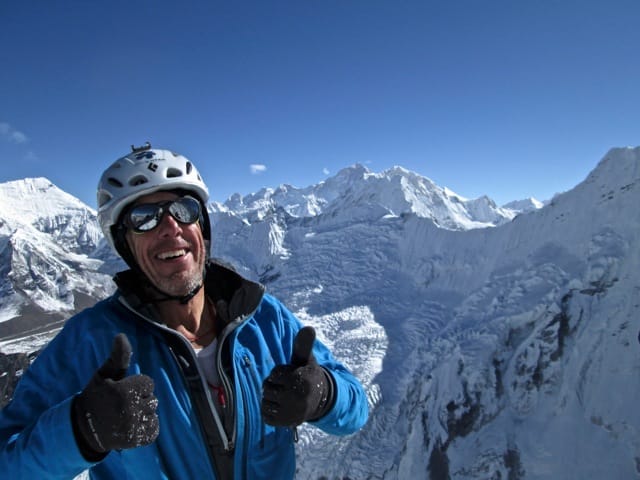
How often do we have an ache, sit down or just stop. As I like to ask “Are you hurt or are you hurting?” Well, hospital one day Greg Paul found himself beyond hurting, advice he was hurt and needed to fix it. Now with two new knees, he is back to climb Everest – his second attempt in three years. The owner of Momentum Climbing Gym in Salt Lake City, Greg is an avid climber. Just last autumn he attempted the rarely climbed and difficult North Ridge of Ama Dablam. His knee problems however became serious while he was in Nepal for his 2012 Everest expedition. He had climbed Lobuche Peak and Island Peak in addition to getting up to just below the Lhotse Face. The previous July he had climbed Alpamayo and Rainer. His left knee has been bothering him for some time but was particularly sore on any down climbs. Being in pain most of the time, he had his right knee replaced in 2008 after experiencing similar pain climbing Rainer in 2007 and the Haute Route and the Monk in Switzerland during 2008. He says his right knee felt pretty good after becoming “bionic” so he decided to have the left knee done replaced in November 2012. With the help of Dr Marc Mariani (who provided input in the design of the artificial knee), Greg convinced the manufacturer of the artificial knees (Ortho Development Corp or ODC of Draper, Utah) to sponsor his 2014 climb of Mt Everest. Greg believes he will be the first person to attempt to climb Everest with two total knee replacements. I know that Ellen Miller summited both Manaslu and Lhotse with two artificial hips. Greg’s first attempt on Everest, in 2012, was with Himalayan Experience. That climb was brought to an abrupt and controversial stop (as viewed outside the team) when Russell Brice and his Sherpas deemed the mountain too dangerous to climb due to rock fall and avalanche danger. Lets meet Greg: Q: So, back again? Your 2012 climb was stopped half way through due to extreme danger in the judgment of your guide. That must have been difficult. How did you handle it? Upon learning that our expedition was over many of my team-mates just wanted to return home as soon as possible as EBC is not the most comfortable place to hang out at unless you have a purpose. Some tried to join other expeditions. I flirted with that possibility for a day but then it quickly became apparent that it was not an option for me. Observing climbers from the National Geographic/North Face Expedition (next door to us at EBC) testing their oxygen systems was the hardest thing for me. I stood there feeling sorry for myself and wishing they could use an old guy like me to contribute more data to their altitude studies. Ultimately I took solace in the fact that a decision had been made by some of the most experienced people on Everest based on events…avalanches, rock and ice fall, injuries and death….that I personally witnessed. Finally, Russell Brice took pity on me and another climber, Hector Sanchez, knowing that both of us were just not ready to go home and arranged for us to climb Island Peak. That was an incredibly joyful and cathartic experience. Q: Is there a singular lesson you learned from that experience you will take with you this year? Disappointment is an inherent element of mountaineering. The disappointment of not summiting does not have to negate the joy of the journey. Q: You attempted the rarely climbed Ama Dablam North Ridge last autumn spring with Himex. How was it? (1)Disappointing :)….rare cyclone spawned snow storm dumped 3 meters of snow throughout the Khumbu region making climbing anywhere slow and treacherous. (2) One of the most incredible adventures that I have had. Ama Dablam is among the most beautiful mountains in the world and the North Ridge is a stunning route. We had a three person expedition and enjoyed getting to know one another, getting to know the Sherpas and our guides. In addition it was a real to see Russell Brice’s excitement in returning to one of his first Himalayan climbs. He was like a kid in a candy store as he sped by us on his “memory lane” ascent to Russell’s Roost or Camp 1. The North Ridge is a serious route right from the start. Even though we were not able to summit the excitement of climbing just part of the route made it all worth it. We had base camp and the route to ourselves which is quite unique compared to other popular Himalayan mountains. Q: Ok, you have had both knees replaced and you are still climbing big mountains. What’s up with that? I was a rambunctious skier who loved skiing bumps and doing jumps. I should have throttled it back as I got older but I couldn’t resist showing my teenage kids that their “old man” still had it in him. All those bumps and missed-jumps finally made a mess of my knees. I tried most of the non-surgical procedures to alleviate the pain in my knees but the relief was only temporary. Eventually it came down to choice between curtailing my favorite outdoor activities or have total knee replacement. At 54 I had my right knee replaced. It made a huge difference. Four years later and several months after my 2012 Everest attempt and a successful Alpamayo climb I knew that it was time to get my left knee replaced. I have talked to a lot of people who have stopped doing the things they enjoy because of bad knees but do not want to get them replaced until they are older. I guess I am the poster child for getting them replaced sooner than later so you don’t have to stop doing what you enjoy. Q: Do you have to do anything differently with respect to to training with
Everest 2014: Nothing Left Unsaid
For many climbers, medical people, they will be leaving their homes and families for Everest in less than a month. This can be the culmination to a difficult, trying and, for some, a very exciting time in their lives. A fictional essay: The kids are in bed, the house is quiet; now is the time. “Honey, I want to talk to you”, she said in a soft voice. “Sure, let’s sit on the couch”, he responded expecting a discussion about one of their children’s schoolwork. Holding his hand, she looked in his eyes and said, “I want to climb Everest”. He fought to hold onto his emotions. He knew of her love of mountains before they were married. She had climbed Rainier in her early twenties, Aconcagua in her thirties and then Denali. She was good. She was safe. She was a natural. But Everest, the highest? Everest, where people die every year? He fought to hold on. She squeezed his hand gently yet firmly. “You know I’ve always dreamed of this. The kids are in a good place. We are in a good place.” We have the money, I have the time off work …” He interrupted, “You have already talked to your boss?” he said defensively. “No, not yet but I know I can get it. I wanted to talk to you first – before anyone else.” He relaxed. She smiled. That night they crawled into bed, a king-size bed – he flops around a lot. They had their usual hug and goodnight kiss before rolling on their sides, facing away from one another. As she laid with her eyes wide open, she felt him move closer. “Yes. Yes, I will support you in your dream.” She didn’t need his permission. She needed his support. The next year was a whirlwind. She trained like there was no tomorrow. He picked up the kids from school as she ran laps up the local hill. As he rolled over at 4 a.m. when the alarm went off, she went for her morning run. She gave him a loving peck as she came back from her workout with her trainer after work. He cooked the endless chicken breasts, fueling her for the next workout. He agreed, reluctantly, to remove their beloved wine collection to support her training. This was about them, not him, not her. Each night, they both went to sleep committed yet still uncertain about their bargain. That Christmas, around the table, she lifted a glass of wine, an exception, for a toast. She looked across the table at him. She looked at her children. She paused as she took a deep breath. “Kids, I want to tell you something.” The duffel bags took up most of the room in the minivan. He drove as she carried on the normal conversation with the kids. They had seen their mom leave before on many business trips. “OK, you guys behave while I’m gone. OK? I want you to be good for your dad. OK? I will call as much as I can but remember what I told you about satellite phones. Remember?” Tears welled up as she quickly looked away, avoiding eye contact. She squeezed her husband’s hand. He squeezed back. The night before, they talked – they talked like they had never have talked. The tears came and flowed freely. No pretense, no tough guy, no tough gal. Real people, real emotions. Brutal honesty. “Honey, if something happens…” He stopped her. “Nothing will happen. I am sure of that.” Yes, but if something does …”, her voice trailed off. She was very thorough, she had signed all the forms, all the legal papers, every contingency was covered. Every base was covered … except for the unexpected. The hugs at the airport were long. The parking police came over but unexpectedly left as they witnessed the scene. Her children looked at her. “I love you, mom.” “I love you too sweetie. Mommy will be home soon. You be good like we talked about. OK?” She broke the hugs knowing that she could never really let go. With the kids back in the minivan, he looked deeply into his wife’s eyes, her soul, her essence; she looked back. The embrace was long, it was strong, it was full of love. Nothing was left unsaid. Climb On! Alan Memories are Everything