Everest 2013: Can I be Rescued on Everest?

A common question for Everest climbers is if they can be rescued. Yes helicopters are available but with huge risks. I look at the options as we prepare for Everest 2013. In this world of instant communication, even from the summit of Everest, search some people believe rescues are easy and available on the high mountains. Nothing could be farther from the truth. When a climber gets sick there are generally three options: on your own, help from others or helicopter rescue. If the climber needs assistance, it generally falls on the Sherpas to help. Strong expedition guides also sometimes contribute. Manpower I have seen climbers with snow blindness short roped by Sherpas down the Lhotse Face. This is a technique where the climber is tied to another climber, sometimes in front and behind to guide him or her lower. The climber is able to walk on their own but needs significant help. It is slow, cumbersome and dangerous. I have also seen climbers dragged down steep faces using their sleeping bags or in rare occasions, a canvas sled. Again, this takes enormous manpower to keep the individual going straight, or carried over crevasses or bumps. If the grip is lost, the climber risk more injury or even death by dropping into a crevasse. It can take five to ten Sherpas to safely lower someone on Everest. In 2012, it took a dedicated team of seven Sherpas, two days to retrieve the body of Shirya Shah-Klorfine after she died between the South Col (Camp 4) and the Balcony. She was helicoptered back to Kathmandu from Camp 2 at a reported cost of $25,000. Helicopters Helicopter are available but only from some camps on a huge mountain like Everest. There are no helicopter rescues available on the north side of Everest as the Chinese prohibit helicopters flying over Everest or to Base Camp. In the “old” days, 2008 and earlier, the Nepal Army was the dominate provider of helicopter services for climbing expeditions. It was dangerous, difficult, expensive and took a lot of work to arrange an evacuation. Today, a private company, Fishtail Air, has taken over many of the evacuations with their four helicopter fleet. While not a tourist flight in Hawaii, it is slightly safer and much easier and more reliable than the Army. The Army still helps with large load transport. I wrote an article in 2010 on Fishtail that examines helicopter services in Nepal. Today they land at Camp 2 (21,000’/6400m) in the Western Cwm, but not higher. Depending on where the helicopter flights starts and fly to, it costs between USD$4,000 to $20,000 per flight and is very weather dependent. In 2012, 30 people were helicoptered from Base Camp to Lukla at a cost of $4,000 each due to illness. Most climbers have rescue insurance to cover the costs but insurance companies are getting wary of this coverage. 1996 Rescue Helicopter rescue on Everest came to the world’s attention during the 1996 disaster. In his book, Into Thin Air, Jon Krakauer detailed the daring rescue of climbers at the top of the Icefall at 19,800?. Nepal pilot and army captain, KC Madan, became a hero with his rescue of Beck Weathers and Makalu Gau via a stripped down helicopter, a B-2 Squirrel A-Star Ecuriel helicopter, that barely flew in the thin air of the Western Cwm. Today, the helicopters are more advanced. Fishtail air in Kathmandu worked on new techniques with Switzerland’s Air Zermatt’s who has a track record of rescue operations have saved many lives in Europe.  Helicopters can fly higher than the summit of Everest but landing to take on a passenger or body is dangerous. In some cases a special technique is used. Air Zermatt is also known as an expert in conducting Human Sling Operations, a difficult aerial rescue maneuver involving dropping an expert mountain guide at an inaccessible point to lift stranded people using ropes. In 2005, Eurocopter claimed a helicopter landing on the summit of Everest. It was a serial Ecureuil/AStar AS 350 B3 piloted by the Eurocopter X test pilot Didier Delsalle. They reported landing on the summit for 2 minutes before returning to Lukla. According to an interview with climber and helicopter pilot Simone Moro, the Fishtail helicopters are rated to reach an altitude of 23,051’/7026m but have flown as high as 7400m. This would be between Camp 3 and the South Col on Everest. As of 2012, the highest Fishtail will go for a rescue or body recovery is Camp 2 at 21,000’/6400m. The terrain is a contributing factor with a flat, stable area free of crevasses required. The Lhotse Face is steep and icy. Crashes It is easy to be lulled into thinking helicopters are a safe and easy, albeit expensive, way of getting to the high camps. But as I reported in November 2010, one of the Fishtail helicopters crashed performing a rescue on nearby Ama Dablam (22,349′ /6812 m). There have been two other crashes of the Fishtail helicopters. On Ama Dablam two climbers needed help. One was successfully snatched from the mountain side and as the helicopter was returning for the second climber, it crashed. It appeared to “fall out of the sky”, according to eye-witnesses. In 1973, an Italian Army helicopter crashed around 20,670’/6300m. Wreckage from that crash was only removed in 2011 after the Khumbu Icefall took it lower. There have been multiple deadly helicopter crashes at Everest Base Camp including 1997, 2003, 2005 and 2007. Ignoring all the risks, many climbers use helicopters to fly in and out of Everest Base Camp. While tempting at the end of a long season, they miss what I think is one of the parts of an Everest climb, the Khumbu trek. Climb On!AlanMemories are Everything

Everest 2013: Interview with Bob Kerr – A Dream from Age 12

This interview with Bob Kerr is one of an ongoing series I do each season with Everest climbers. Not the famous, sponsored ones who get plenty of publicity but the regular people, who often have full time jobs, full time families and climb for the love of the climb. I welcome suggestions for anyone climbing in 2013 I should interview. Now here’s Bob:  For many Everest climbers, the idea was set in their mind as a young child. Sometimes it came from a TV show, a newspaper article or a poster they saw in school. Then there are other motivations. Bob Kerr, living in Scotland saw mountaineering as a way to overcome fear. To say he has embraced his plan with fever is an understatement as he has now climbed 6 of the 7 Summits. Bob has been a member of the Assynt Mountain Rescue Team since December 1999. He tells everyone that he joined the mountain rescue team because “I like the values of mountain rescue – unpaid volunteers helping out those in need. I hope that if I am ever in need in the mountains then someone will give up some of their time to help me.” A very active climber, Bob has completed the Scottish Munros (282 Scottish peaks over 3,000 feet) and scaled over 700 of the 1554 Marilyns (relative hills of Britain). Please meet Bob Kerr: Q: You set your sights on climbing Everest at age 12. What was your inspiration back then? At around age 10, I had realised that I had a fear of heights. I started to work at overcoming this fear by starting to do some hillwalking and gradually pushing myself to address this issue.  At age 12, I quietly set myself a goal in my mind to really overcome this irrational fear. The goal was to climb Scotland’s highest mountain Ben Nevis by the age of 16, to climb Mont Blanc by the age of 30 and to climb Mount Everest by the age of 50.  At the time I didn’t know how I would achieve these things or how I would find the finance or whether it was possible but what I did know is that surely by aiming to climb Everest it would help me overcome my fear of heights. So the goal was set and this has inspired me and driven me on to gradually achieve my objectives. I now have a healthy respect for heights and at age 35, I have plenty of time on my side to achieve my goal of Everest. Q: Having climbed 6 of the 7 thus far, what was your most interesting climb? This is a hard question. Each of the other continental high points have had various interesting aspects to them but if I had to choose between them all then my ascent of Carstensz Pyramid in 2008 probably has to win as the most interesting climb, so far, of the 7. I was privileged to have trekked into Carstensz Pyramid from Ilaga with members of the Dani tribe and we had a brief delay on route following an encounter with the OPM (Organisasi Papua Merdeka) who are fighting for an independent Papua.  The trekking allowed us to get to experience the country properly and get to know the Dani tribe – this was much better than flying in by helicopter but a bit riskier. After 9 days in the country, we finally got to the mountain, the climbing was good and the tyrolean traverse at altitude on the summit ridge is probably the most exposed thing that I have ever done.  Q: Living in Scotland, you have many wonderful training opportunities. Do you have a favorite training area? Scotland is an amazing country to live in and the training opportunities are vast. My favourite training area is the mountains of the far north of Scotland, partly because they are my local mountains but also because they are not too busy. I am often seen popping up my local Munro called Ben Hope (927m). This year I have ascended it in the dark after work and also wearing an elevation training mask set at it’s maximum so the summit of Ben Hope recently felt like 21,000’ for me. Q: OK, can you tell us about that mask you are wearing in this picture? As most people know, Scotland does not have the highest mountains in the world, although they can be very challenging.  The highest mountain we have is Ben Nevis which is only 1,344 metres or 4,409 ft high. When training for an ascent of Everest, the training would be to spend lots of time at high altitude getting a work out. Unfortunately, I have to hold down a full time job, so the closest that I can come to high altitude training between work periods is to use an Elevation mask.  This mask is a training aid that provides significant resistance to breathing.  The maximum setting with the Elevation respirator gives an effective height increase of 18,000 ft so allows the mountains of Scotland to be ascended as if they were Himalayan foothills.  The mask makes an ascent of a mountain much harder work for your lungs but is great training for high altitude. I’d recommend others thinking about attempting high altitude peaks to consider trying this as a tool for training your lungs. Q: Can you share your thoughts on selecting to climb from the North side? I debated long and hard which side to attempt Everest from. There are pros and cons on both sides. The main pros that I could see of going from the South side are that it is the warmer side of the mountain and that you can rapidly descend from the summit back to the South Col so that you minimise your time above 8000m in the death zone.  However the main negative aspects that I saw were that it is the busier side of the mountain so there are more likely to be queues on the mountain and I didn’t fancy taking

Everest 2013: The Ethics of Everest Reporting

Some teams are leaving home this week for Kathmandu to start their journeys hoping to reach the top of the world in mid May. This will mark my 12th year of either climbing or covering Everest on my website. Each year, I begin to get the same nervous feelings of excitement and uncertainty about what the season will bring. As I report on Everest, cheap I feel a strong responsibility to be accurate, sensitive and informative. My coverage is based on my own experiences, research, sources, and public information. I try to provide insight and interpretation of the activities ranging from routes to weather to the challenge of climbing Everest. If I have learned anything over the years, it is that information on Everest is filled with inaccuracies, spin and exaggeration. There are those who write about Everest to amplify the drama if for no other reason. There are those who cover it to sell newspapers, website hits, gear or other reasons. For me, I cover Everest due to my deep feelings of respect, admiration and wonderment of the mountain, the Sherpas and the climbers themselves. But also I use my coverage to hopefully get you to read my articles and then, by chance, learn something about Alzheimer’s disease. If you really like my coverage, then maybe make a donation to one of the non-profits I work with – nothing ever goes to me. At the end of each post is a short fact about this disease that took my mom, two aunts and impacts over 36 million worldwide. My Personal Experiences with Death on the Mountain My teammate rushing down hill blurted out “Alex has died” and with that I learned that one of my teammates on Cho Oyu in 1998 had died in his sleep at camp 3 after his successful summit. The next morning I helped wrap him in his sleeping bag, drag him over to the crevasse edge and, after a brief ceremony, let his body fall gently into an abyss of ice and snow. My wife, back home in Switzerland where we lived in 1998, saw a short text across the television screen “42 year-old man from Geneva area dies on Cho Oyu.” It shook her to her core as I matched the description perfectly; except she didn’t know if I was alive or dead. Unable to access a sat phone, I was not able to contact her for days to assure her I was safe. For her to be in suspense was beyond unfair. In 2011, I was in my tent at Everest Base Camp when I heard loud, yet hushed voices. I knew something had gone wrong. One of my teammates had collapsed just below Camp 3. Climbers, Sherpas and guides from many organizations rushed to his aid. Drugs and oxygen were applied. Doctors, who were climbers, gave assistance. But my teammate died. Our expedition was devastated. In contrast to 2008, I was able to call my wife immediately using my satellite phone to let her know I was safe before she saw the news. These incidents have shaped the way I cover death on mountains. The Official Process When a death occurs on Everest, the standard procedure is for the leader of the expedition (as noted on the permit) to report the incident to their Nepalese or Chinese Liaison Officer. That individual then files a report with their respective mountaineering/government agencies. At that point a press release is sometimes, but not always issued.  Embassies are a great asset to families for repatriation, information and support. This process can takes days or even weeks so obviously, the news leaks out much faster. Reporting Death Sadly each year, there are deaths on Everest. While I have written recently about how it has become safer statistically, people still die every year. Unfortunately 2013 will not be any different. In spite of better gear, warmer clothes, more Sherpas, more oxygen; mistakes will be made. The weather will present big surprises and some will lose their life. The vast majority of deaths will be preventable. Climbers needed to turn back sooner, wait out bad weather or listen to their bodies as the warning signs emerged. For some they should have gained more experience before attempting Everest or selected a different guide service. With everyone on modern climbs having sat phones, cell phones or internet access, news of an accident travels fast – too fast. And on the mountain, it travels even faster; well at least rumors do. This instant information creates an environment where some people try to break the news first for whatever reason, and others pass on unconfirmed rumors. While often done in the spirit of trying to be helpful, it often does the opposite. When a death occurs, I follow a strict protocol. My first thoughts are for the family, then the teammates and finally the public. My policy is not to comment until I have a first hand witness report and preferably more than one report that confirms the story then not to report names until it is clear the family has had an opportunity to be notified. I only pass on what I know and do not speculate. I never place blame or speculate about the cause of death. I struggle with each report of a death. Sometimes all the facts do not come out for months. The Headline Stampede The expedition leader usually takes the responsibility to notify the family. But this is where the rumor mill gets in the way. An incident occurs, someone posts on Facebook, Twitter or their blog some vague facts in an effort to reassure their own family or followers that they are safe. But once the word “death” and “Everest” are put together, it seems everyone notices. The mainstream press calls their sources, even climbers on the mountain who may even be on the opposite side. Comments are made, speculation ensues; families are terrified. There is no stopping this machine in this era of

Everest 2013: Interview with Guy Cotter – Boss and Climber

This interview with Guy Cotter is one of an ongoing series I do each season with Everest climbers. In addition to the regular climbers, the world’s leading guides occasionally pause to answer my questions.  I welcome suggestions for anyone climbing in 2013 I should interview. Now here’s Guy: There are a handful of companies that professionally guide the world’s mountains year in, year out. Adventure Consultants is one of the in the world running trips to every corner of the globe and has for over two decades. Guy Cotter has been running the company since 1996 with a strong philosophy of keeping it small, and safe. But he is not a behind the scenes boss, but rather climbing with the of them, including Peter Hillary recently. I climbed with Guy or his team three times: Ama Dablam, and Everest twice. An Adventure Consultants expedition is well run with a team of Sherpas who have seen it all. Guy prides himself on not competing on price but rather charging what is needed to ensure personal attention to each of his members. Guy, a native Kiwi, lives on the South Island of New Zealand in the amazing town of Wanaka on the shores of Lake Wanaka. He takes total advantage of everything his country offers from climbing to skiing to mountain biking. As the owner of Adventure Consultants, his company supports the of New Zealand by being part of world-class movies, and running guided trips to their pristine mountains and ski slopes. I caught up with Guy just as he was leaving for Nepal to lead the 2013 Adventure Consultants Lhotse and Everest teams. Q: Adventure Consultants just moved into a large headquarters in Wanaka New Zealand. Business must be good! Tell us about the new place.  The building we’d been in was getting too small so we renovated a nice old building right near the centre of our small alpine town called Wanaka. Wanaka is close to Mt Aspiring and has heaps of outdoor activities close by and really good weather so it’s a natural hub for climbers. The building has excellent views across Lake Wanaka and the surrounding mountains. It’s nice to have the additonal space of the bigger building. One benefit of the new location is that the staff get better views of our local ski hill meaning that on a good looking ski day the office might be empty! Q: Peter Hillary came to your grand opening. I understand both your fathers climbed together. I guess it was more history in the making with you and Peter together and climbing again?  Both Peters father and mine were climbing together in the early 1950’s and were on an expedition together to a peak in the Garwhal called Mukat Parbat (7135m). After the ascent two members were invited by Shipton to join the Everest reconnaissance but my dad was too broke to join so didn’t get to go that one. The rest is history! Peter and I decided it’d be nice to get back in the hills as he was coming down to help us open our new premises so we took the time to climb of Mt Aspiring, a classic peak near Wanaka. We had a great catch up as it’d been a while since we’d been in the hills together. Q: You continue to be an active mountaineer as the owner of Adventure Consultants. Why is this important to you Guy? I got into this game because I love climbing. Guiding became a natural extension of my climbing and has provided me with a fantastic lifestyle. When I was a young climber I figured I knew what I was doing but it wasn’t until I started guiding that I realised how much I still had to learn! So I figure guiding has helped me evolve as a mountaineer at the same time as enabling me to go to some amazing places and get to know some great people. I think one of the main benefits I get from mountaineering is the relationships we develop with people by sharing experiences.       Q: At this point you have summited 5 of the 8000m mountains (Everest (4x), Manaslu, Cho Oyu, Makalu, and Gasherbrum II ) and climbed on two others (Dhaulagiri and Gasherbrum I). Any plans to do all 14?  I’m not focusing on doing all the 8k mountains. It may end up happening by default as I enjoy getting away on expeditions to 8k peaks and will continue to do so for the foreseeable future but I’m also doing lots of other neat trips too that I really enjoy. For instance I ran another horsetrek to Mustang in Nepal this year with a group of members I’m very friendly with and that style of trip inspires me too. I also want to try to find time to do more technical climbing as I got out of shape when I had knee issues that required surgery so I’m slowly dragging myself back to some semblance of technical climbing fitness! Q: You are climbing Lhotse this year and being both guide and climber as part of your Everest 2013 team. How is your overall season shaping up thus far?  We’ve got a good solid team for Everest this year and a nice small group for Lhotse. I’ve always maintained that small groups are the way forward for expeditioning to reduce impacts and enhance the experience.  During the recession it was interesting to see prospective members shift towards the large impersonal groups because they are cheaper, but we’re now seeing people want more than that again now. From a business perspective I’d be better to steer AC towards running large groups with fewer guides as it’d be a way to make some margins but my philosophy has always been towards doing it properly, even if that means we have very small margins. If we run great trips for our members and provide employment for our team of guides/Sherpas/admin staff then I’m happy.   Q:

Everest 2013: Interview with David Liano – Double Summit

This interview with David Liano is one of an ongoing series I do each season with Everest climbers. Not the famous, sponsored ones who get plenty of publicity but the regular people, who often have full time jobs, full time families and climb for the love of the climb. I welcome suggestions for anyone climbing in 2013 I should interview. Now here’s David: For most Everest climbers who are suffering severe headaches, and an unsteady heartbeat it is enough to rethink their climbing goals. But for David Liano, it was motivation to hone his condition, find peace with his goals and double down, literally. This mountain climber loves adventure whether it is solo ocean racing, triathlons, paragliding off mountain tops, the 7 Summits or, the casual Everest climb. This was his wrap-up for 2012: The 2012 was a wonderful year for me. Sailed nearly 5,000 miles offshore, took courses and returned to the world of mountaineering after both the cardiologist and the neurologist told me I could climb again. I prepared for the New York marathon for the first time since its inception in 1979 was canceled by the wake of Hurricane Sandy, I participated in three triathlons, I lost 16 kilos in weight and glider flew about 40 hours on two continents. In aircraft covered more than 160,000 kilometers, enough to go around the world almost four times. He will be attempting in 2013 something no climber has ever done on Everest – climb both sides separately in one season. David is no stranger to Everest with three summits on five different climbs, so he knows what he is getting into. David lives in Mexico City thus giving him an advantage when it comes to acclimatization. Please meet David: Q: You are quite famous in Mexico and their leading high altitude climber. How popular is alpine mountaineering in Mexico? Thank you for the kind comments. In Mexico, and especially around Mexico City, we are fortunate to have amazing volcanoes with very easy access. Pico de Orizaba (5,636m) is the third highest mountain in North America. Also, living in Mexico City has a significant advantage for climbers: I live at 2,800 meters, the same altitude as Lukla in the Khumbu and that’s one of the reasons I usually acclimatize well. I’m very proud of the mountaineering tradition we have, starting with Ricardo Torres Nava, the first Mexican and Latin-American to summit Everest and then with Carlos Carsolio, only the fourth person to successfully climb all fourteen 8,000 meter peaks Q: You have an interesting relationship with Everest. 2013 will be your 5th climb with three summits yet you want to return. Before we get into the double, what is the attraction of Everest to you as a veteran climber? Every year I’ve summited I have tried a different thing. I first dreamt of climbing Everest in 2003 after reading coverage of the 50th anniversary of the first ascent. Two years later I finally reached the summit for the first time. In the 2008 season I was not being able to get a traverse permit, or even a permit to climb on the Tibet side, so I changed my goal and summited Lhotse and Everest on the South side within four days of each other. After two more years of trying to get a traverse permit, in 2010 I once again adapted my goal and planned for a double ascent of Everest with Bill Burke. Since traversing was the problem we decided to climb up and down on both the North and South side on the same season, which has yet to be done. I was successful in summiting only on the South side that year. Q: In 2010, you became very ill on the north side, was evacuated to Kathmandu for ment then returned to summit from the south. Most people would have stopped when they returned to Kathmandu, what kept you going? During my summit push I spent a night alone at the North Col and I started having chest pains. I could feel my heart skipping a beat now and then to be followed by an unusually strong beat. Since I knew that things would only get worse with altitude I decided to head back to Kathmandu and see a cardiologist. Fortunately I was only diagnosed with a benign type of heart arrhythmia and I was able to take a helicopter flight to Everest Base camp on the South side and I summited for the third time just four days later. Leaving the mountain in the middle of the expedition was definitely hard and I was ready to head home. But after my check-up in Kathmandu it was as if the sky cleared and I could see the summit again. There was nowhere for me to go but back up Q: You are as passionate about sailing as you are about climbing even sailing solo last year from San Francisco to Hawaii. Can you tell us about sailing and the connection to climbing? I started having strong headaches at Advanced Base Camp during my 2011 attempt of a Double Ascent of Everest. The headaches wouldn’t go away even after driving all the way back to the China-Nepal border. At the time I was afraid it could be cerebral edema or even a brain tumor since I only had the headaches on the left side of my head. The headaches continued for several months after the expedition and I was diagnosed with an occipital neuralgia, a damaged nerve on the back of my neck. It made sense to take some time off high-altitude mountaineering and let my body heal but I needed to set myself some challenging goals. That’s when I decided to sail around the world solo and non-stop. I will begin that circumnavigation on September of 2013. As part of the planning and preparation I raced on the 2012 Singlehanded Transpac from San Francisco to Hawaii. Mountaineering is extremely hard on the human body. I don’t know many

Everest 2013: The Continuing Search for Mallory & Irvine’s Camera

Who were the first climbers to summit Everest continues to be a mystery that enthralls Everest followers and borders on obsession for a few historians. The key question that remains is; can it be proven that George Mallory and Sandy Irvine summited Mt. Everest in 1924, or not? You see, Mallory’s body has been found but not Sandy Irvine, view and he had a camera. Without proof, the world will always accept that Sir Edmund Hillary and Tenzing Norgay were the first to summit in 1953, 29 years later. Everest Historian Tom Holzel, has new data on where Irvine, and perhaps the camera, might be found and is looking for partners to solve the mystery once and for all. Before we take a look at this effort, a tiny bit of background of the north. The north side of Everest is steeped in history with multiple attempts throughout the 1920?s. The first attempt was by a British team in 1921 when Mallory led a small team becoming the first known human to set foot on the mountain’s flanks by climbing up to the North Col (7003m).  The second expedition in 1922 reached 27,300? before turning back, and was the first team to use supplemental oxygen – an unknown tool at that time. But it was the 1924 Mallory and Irvine effort that was most notable as a climber was sighted on the high summit ridge but then disappeared.  Mallory’s body was found in 1999 but there was no proof that he died going up or coming down thus the importance of finding the camera and potential photos of a summit. The first summit of Everest from Tibet was by a Chinese team on May 25, 1960.  Nawang Gombu (Tibetan) and Chinese Chu Yin-Hau and Wang Fu-zhou, who is said to have climbed the Second Step in his sock feet, claimed the honor. However without a summit photo, many doubted the summit claim. In 1975, a successful summit was again claimed by the Chinese when the ladder on the Second Step was installed. With the mystery of who was first dominating Everest gossip for almost a century, teams have looked in vain for positive proof of a 1924 summit. There have been valiant efforts and vague clues throughout the years. In 1933, Irvine’s wooden ice axe was found in the fall line of the climber’s last known route. A Chinese porter reported seeing an “an english dead” in 1960 but there were no pictures. Then in 1999, a team led by IMG founder Eric Simonson conducted a serious search. Conrad Anker found Mallory’s body on the north side below the Chinese reported location. Neither Irvine’s body nor the camera was located. Simonson returned in 2001 to look for the camera, without success. It was the classic needle in the haystack search complicated by snow cover. While the discovery of Mallory’s body created excitement throughout the climbing world, it did not provide any evidence of a summit. In fact it just fueled the speculation. One of the members of that 1999 expedition, Jake Norton wrote a very interesting view on the summit question on his blog in 2010 making the case that they did summit. But no one knows for sure and the camera might be able to close the case. Tom Holzel, who conducted a thwarted search expedition in 1986, took a new approach to locating the camera using two images; one from a photo taken in 1933 and another taken in 1984 from a SwissPhoto, AG, Learjet flying over Everest. This last image was very high-resolution. Holzel used imaging technology to compare the photographs and discovered that the location of an ice ax marking a certain fall of the two climbers, was misplaced by 60 yards. Everyone was looking in the wrong place! Following the new line, he identified what he calls an “oblong blob”. The blob is near where the Chinese porter reported his sighting in 1975. Holzel strongly believes this is Irvine who is thought to have been carrying the Vest Pocket Kodak camera when he and Mallory disappeared. Now Holzel wants to be certain by taking a new image with another flyover using the latest advancements in photography, but he needs $10,000. Once he proves the location of Irvine, he wants to continue the search with a small team that would include Thom Pollard and Jake Norton of the 1999 expedition. Kodak Scientists have consulted with them on the project so if they find the camera, they have processes on how to handle it to prevent further damage. Tom was kind enough to do yet another interview with me. Mind you, he has been interviewed extensively and asked almost every question imaginable so we explored his latest thoughts and case for the flyover. AA: Tom, you’ve been after the Mallory & Irvine (M&I) mystery for quite a while now.  And general opinion of what really happened to them is still all over the map. Are we any closer to finding out how far they actually got? TH: I think so, but the conclusion we are being driven to is not what most Mallory &Irvine fans want to hear—and I’m the one at fault.  In 1971 in Mountain Magazine #17  I did an analysis of all the known climbs on Mt Everest—69 segments in all—to plot how much of a difference the use of oxygen made on climbing speed. And because M & I were using oxygen, it looked to me like their chances of success had been grossly underestimated. The pre WW-II British leaders thought any theoretical advantage was nullified by the added weight. The chart showed a marked speed advantage for using oxygen. AA: And how were those calculations used? TH: It let us estimate how fast M & I would have climbed on June 6th. However, it also showed a dramatic drop in climbing speed the higher one went—which was an unknown factor  to the pre-WW-II British climbers. So M & I weren’t aware

Everest 2013: Interview with Richard Salisbury, Behind the Summit Numbers
Richard Salisbury

This interview with Richard Salisbury is one of an ongoing series I do each season with Everest climbers. In addition to regular climbers, there occasionally I get the chance to speak with those important figures behind the scenes,   I welcome suggestions for anyone climbing in 2013 I should interview. Now here’s Richard: Richard Salisbury was as much of an unknown name to me as Elizabeth Hawley in 1998. I was in Kathmandu on my way to climb Cho Oyu when I was told by the clerk in my hotel that I had a phone call. “Who would be calling me here?” I asked myself. “This is Elizabeth Hawley. What is your full name, where do you live? How old are you?” She fired off in rapid succession. Pausing, I gently asked “Who are you again?” With a huff of indigence she simply said “Elizabeth Hawley”. And that was that! I answered her questions politely and hung up not knowing I had just spoken with a legend as famous as Hillary or Messner. Miss Hawley went to Kathmandu some 50 years ago and never left. As a journalist for Reuters she reported on climbs for various news services and the American Alpine Journal, Climb, Vertical and other magazines. Not only has she earned the respect (and fear) of climbers she is also sought out as a resource on routes and “beta” for the mountains. But there is much more to this story. The man behind the numbers is quiet, unassuming and virtually invisible. Richard Salisbury is the brains behind the Himalayan Database. Richard is a retired computer analyst who specialized in databases while at the University of Michigan. A climber himself, he met Ms. Hawley on one of his trips and the rest is history. Each year, Richard takes all the first hand interviews and tirelessly updates the database. To be clear, if you are not in the Himalayan Database, then your summit claim is suspect or unknown. Today, if you have a question about the number of summits, who was first, records, or any obscure question, the answer is within the Himalayan Database. Used by climbers, expedition operators and news media as well as by universities and physicians for research, the database is available for in CD-format. Summiter and fatality lists for recent seasons are freely available on-line at the Himalayan Database web site. A companion book, The Himalaya by the Numbers, A Statistical Analysis of Mountaineering in the Nepal Himalaya, summarizes much of information in the database and is available in printed format from bookstores. I caught up with Richard as he returned from Nepal to discuss the upcoming season, the numbers and, of course, his relationship with the famous Liz. Please meet Richard Salisbury: Q: Let?s start by getting to know you a bit better. You have trekked and climbed in the Himalayas for 25 years. Do you have a favorite area or climb? I have especially liked the Khumbu regions due to many Sherpa friends living in Namche and the western regions where I led treks in the early 1990s into the Upper Dolpo and Mustang regions when they were first opened for trekking. I got into climbing in the early 1980s when I took a two-week alpine course in Washington in order to get the skills to lead trekking groups in Nepal over some of the high-pass routes such as Tashi Laptsa, Sherpani Col, West Col and Amphu Laptsa. Q: When was your last trip? My last big mountain climb was to Annapurna IV in 1991, my last trek as a guide was to Upper Dolpo in 1993, and my last visit to Khumbu was in 2003. All of my recent trips to Nepal have been to Kathmandu to work with Liz Hawley. Q: Can you tell us how you met Ms. Hawley? In 1991 I was leading an Annapurna IV expedition, so Liz Hawley came to interview me as the leader. She brought her notes for Annapurna IV to show me and I had an Excel spreadsheet to show her on which I had calculated the minimal, average and maximum days from reaching BC to summit (as a planning tool for determining the optimal amount of supplies to bring). After reviewing what we both had, I suggested that she consider publishing her information as a database. She told me that she already had a Nepali working on this. But a year later she contacted me saying that the Nepali had gone to graduate school in Arkansas and was not likely to return to Nepal any time soon, and wanted to know if I was still interested in helping her produce a database. So we started our collaboration in 1992. We hired a Nepali woman half-time to start entering the data in autumn 1992. The amount of information she had from interviewing almost all of the teams that had climbed since 1963 was massive. The data entry job was finally finished in 2004 when the American Alpine Club published the Himalayan Database. Q: How do you work together with her in Kathmandu and you in Michigan? We have a system set up where we can both work independently on our own copies of the database. Then periodically I reconcile the changes we have both made to the database by using a program that compares our changes and merges them into a new combined/updated database. Where we have conflicting changes, the program allows me to select the proper updates for the new database. I also travel to Kathmandu twice a year in April and October so that we can further discuss conflicting, unclear or missing information. Visiting Liz during the two principle climbing seasons also gives me a chance to meet many of the team leaders. Q: The Himalayan database, both book and CD, is a massive effort. How long did it take to write ‘The Himalaya by the Numbers’ book published in 2007 and will there be another book? The first e-book edition of ‘The Himalaya

Everest 2013: Interview with David Tait, Mr. Traverse is Back

This interview with David Tait is one of an ongoing series I do each season with Everest climbers. Not the famous, drugstore sponsored ones who get plenty of publicity but the regular people, who often have full time jobs, full time families and climb for the love of the climb. I welcome suggestions for anyone climbing in 2013 I should interview. Now here’s David: David Tait’s very tough beginning in life shaped him in ways he probably never imagined. He was abused as a child, became estranged from his parents, lost his mother to suicide and his father to cancer. He was stopped from taking his own life by two policemen as he stood at the top of the chalky cliffs of Beachy Head in East Sussex in 1996. David went on to become a very successful investment banker and focused a large part of his life on National Society for Prevention of Cruelty to Children (NSPCC) as a board member. David used his passion for adventure to raise millions of dollars money for the charity. His five climbs on Mt. Everest expanded his following. He was a central figure in the Discovery Channel’s Everest Beyond the Limits series and his 2007 attempt at a double traverse of Everest showed his true character. He is back for 2013 with a secret mission. All he will say at this point is that it involves “stamina”. I interviewed David last week and he talks about something much more important than Everest. Please meet David Tait: Q: Climbing Everest is more than a summit for you, it is a tool to get your message out about the NSPCC. Can you tell us how climbing became your vehicle of choice? It was frankly a default process as I had tried most other “crazy” things to raise money and awareness for the charity. I had been raising money from an early age – I think the first thing was a sponsored abseil …. And then eventually, after motor racing, sky diving etc, I landed in the mountains. It had always held a fascination, but using it as a vehicle was the key. Q: How have your Everest expeditions made an impact on the NSPCC? Each of my climbs have raised approximately £250k each. My speeches on behalf of the charity and sexually abused kids have raised a combined $11mio. My speech is a combination of climbing and personal – the personal segment will appear front and centre on my new website in a few days. It will be self-explanatory [and I’m very nervous] Q: The 2007 north to south traverse was intended to be a round trip but you stopped after the single traverse. Was there a singular lesson from that experience? It was not fatigue – Yes, be humble as there is always someone better than yourself. I was trying to achieve a first, but to have done so would have been at the expense of the worlds (Phurba Tashi) whom i would have had to ask/order to follow me – despite being twice as capable. Once I realised this, it was an easy decision to decline. If I had been allowed to climb solo, claiming the title would have been ligitimate, but asking Phurba to follow behind me was not the way to do it. Q: In 2009 you summited with the Sherpa rope fixing team, a rare experience for a Westerner. How was that? To date one of my experiences…..quite an honour, and I was grateful to be asked. Watching them free climb with a rope tucked through their belt is jaw-dropping. it was only upon my return that i realised the extent of my privilege. Q: In your first Everest attempt in 2004, your body never acclimatized forcing you to abandon that bid. But now you climb incredibly fast and intended to climb without supplemental oxygen in 2010 but changed your mind. How do think your body would react to climbing without the extra O’s? It wasn’t an inability to acclimatise – it was simply that my mind wasn’t right and i hadn’t understood what was needed. I think (know) I have the fitness – I have zero doubt, but my right hand (not both) suffers from the cold. I don’t want to lose fingers at my age, but if the weather were exceptional I might go for it. Q: Your dispatches during the climb are quite unique with your candid, sometimes direct comments about the experience. Have you received any feedback from your followers? Yes, and its quite nice and flattering. I deliberately try to open this alternative world I now love so much. Anyone can describe cold/snow and rock, but I try and make people feel what I’m feeling. its the emotional side of the story i believe people engage with – not facts. Q: You have now climbed from the North 3 times and the South 2. Do feel one is significantly more difficult than the other? No, but I much prefer the North. If one could literally walk in to the Tibet side (driving diminishes the experience to me) it would be perfect. It feels more remote on the nth – I suppose that’s why I like it. I remember descending in 2005 and from summit to nth Col i only saw/met one human being – Russ at BC. Q: You are climbing for the 6th time with Himalayan Experience (Russell Brice). What is about his expeditions that brings you back? He’s the dad I didn’t have.. I trust him and enjoy his company. He’s proffessional, kind and always tries to improve. I know he looks out for me and I respect him. I think we are loyal to each other. He’s synonymous with my success. Q: For you personally, can you quantify how much of climbing Everest is physical or mental taking into account the entire expedition. To me the challenge is mental. I take good care of my fitness. I train to exhaustion and this provides me

Everest 2013: Has Everest Become More Dangerous?
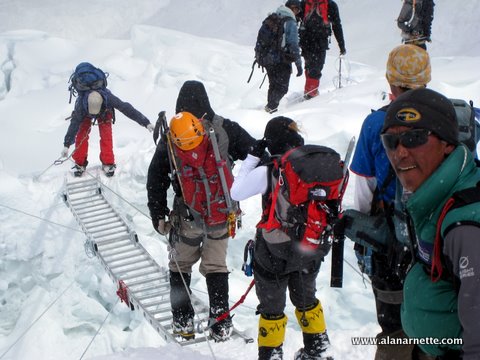
Has climbing Everest become more dangerous? If you only read the headlines after an accident, you would say yes. But the facts say no. One measure is the number of deaths per summit. The facts are available through the Himalayan Database, research, Wikipedia and my personal observations and reports. All the numbers are very close approximations but accurate enough to reveal a trend. For most of the 20th Century, Everest was the domain of professional climbers or heavily supported national expeditions. They took years to prepare and had extensive experience before attempting new or even the most straightforward routes. In the 1990s, commercialization took off seeing over 100 summits in a single season for the first time in 1993. Guided expeditions became the norm as many professional climbers went on to pursue other 8000 meter mountains or new routes on unclimbed peaks. With this migration, a logical assumption would have been to see the death rates soar as less experienced climbers took over Everest, however, just the opposite happened. Before I go on, note that historically Sherpas represent about 30% of the deaths on Everest primarily from falls and avalanches while fixing ropes. With this, here is the bottom line: Everest actually became safer as the death per summit ratio dropped from 5.56% in the 1990s to 1.5% in the 2000’s. But statistics can be deceptive so lets look at the details. Crowds and Deaths Crowds are not new on Everest and neither are deaths in large numbers. There have been several years when the annual death toll on Everest exceeded 10: 1982: 11, 1988: 10, 1996: 15, 2006: 11 and 2012: 10. The deaths have been spread across all types of climbing styles: large commercial teams, small private teams, independent climbers, with and without supplemental oxygen, low budget and high price expeditions. Also, while it is popular to place blame for deaths on crowds, this is rarely the root cause for a tragedy. With the exception of 1996, the largest western commercial operators appear to have the safest record as measured by number of deaths per summit. In looking at the average annual death rate over three different periods, the story begins to reveal itself. Since the first attempt in 1922 there have been around 6,214 summits and 234 deaths with a median of 23 summits, 4 deaths per year for a 3.3% death to summit ratio. Looking only at the 1990s when commercialization took off, there was a total of 882 summits and 59 total deaths. The annual numbers increased dramatically to median of 88 summits, 5 deaths per year for a 5.56% death to summit ratio. 15 Sherpas died during this period. And if you look at the same numbers since 2000 there have been 5,048 summits and 69 total deaths, resulting in a startling annual median of 423 summits, 5 deaths per year for a 1.5% death to summit ratio. 13 Sherpas died during this period. In other words, comparing the 1990s to the 2000’s there was a 5.7 times more summiters but only 1.2 times the number of deaths. Everest has become safer in the 21st century for climbers. Death/Summits Period Summits Deaths Median Summits Median Deaths Death/Summit % 1922-2012 6,214 234 23 4 3.2% 1990-1999 882 59 88 5 5.56% 2000-2012 5,048 69 423 5 1.50% Cause of Death Working on the assumption that the approximate 5,000 summiters in recent years were mostly likely less experienced than the early pioneers, when we dig deeper into the cause of deaths over those two periods we can see the impact of less experienced climbers on the death toll. Both periods have falls as the major cause of death but the number of altitude related deaths (HAPE, HACE, AMS, exhaustion) soared since 2000 which could imply that climbers with less experience at altitude took more chances and suffered the results. It is common to see less experienced climbers pushing themselves into exhaustion, climbing in poor weather, refusing to turn around knowing their oxygen will run out or learning that altitude related illnesses are unpredictable and often unrecoverable. Sadly, many deaths since 2000 were avoidable. Reported Cause of Everest Deaths Cause of Death 1990’s 2000’s Fall 21 17 Altitude* 5 16 Exhaustion 5 10 Avalanche 7 7 Exposure (frostbite) 14 4 Heart Attack 2 5 Unkown 1 5 Illness 0 3 Disappearance 4 2   59 69 * High Altitude Pulmonary Odemea,  High Altitude Cerebral Odemea, Acute Mountain Sickness So why has Everest become safer? Today, there are almost no new routes attempted on Everest, a major cause of death in the early days. 2013 is an exception with three teams attempting new routes. Over 95% of expeditions take one of two routes: Southeast Ridge or Northeast Ridge in modern times.. Those routes, mostly unchanged for almost 60 years, are well known, with the dangers identified and risks mitigated by avoiding dangerous terrain as much as possible. In some sections bolts have been installed to anchor the fixed ropes. This makes the route more stable and reduces the time Sherpas spend installing the fixed line. That said, avalanches still occur, and climbers still fall into crevasses. The Khumbu Icefall remains a treacherous section as does the entire summit night on both sides of Everest, particularly on the descent. The climbing gear has improved dramatically since the early days of heavy wool, poplin outwear and hemp ropes. Modern sunglasses protect eyes better. Full down suits protect climbers from -40F wind chills. The overall gear is lighter thus reducing the wear on climbers. Improved boots and gloves prevent most frostbite but it still happens, most often to those climbing too slowly, in extreme weather or those climbing without supplemental oxygen. The death toll from exposure and frostbite is a third today than a decade ago. Oxygen delivery has also seen major advances. The original masks used a bladder system, was loose fitting and very uncomfortable. Today, the model made by TopOut is the standard providing a comfortable and reliable

Everest 2013: New Route Attempts by Three Different Teams – Updated

For the first time in recent memory, three separate teams will attempt new routes on Everest in the same season on both the Nepal and Tibet sides. While all these faces have been climbed, they are so expansive that new routes are always available. This 2004 article posted on ExplorersWeb provides an excellent overview of the various routes Information is still a bit vague on this year’s attempts but this is what has been made public this far:   East Face: Glab Sokolov and Alexander Kirikov – Updated Updated from russianclimb.com that “20 March, 2013 Gleb Sokolov didn’t find enough money for his Everest project (new line on Kanchung Face in alpine style), so postponed it to next year” A report via the 7 Summits Club website is that they plan to climb a new route from Tibet on the East Face ( Kangshung Face) in alpine style without oxygen. They will acclimatize on Changtse Peak (7550m), via the northern normal route. Gleb Sokolov has extensive experience including climbing on the north face of Everest, on the west face of K2, and on the first ascent of Lhotse Middle. Plus he climbed also Makalu, Lhotse Shar, Lhotse Main, Cho Oyu and Manaslu. Southwest Face: Denis Urubko and Alexey Bolotov From the Nepal side, there appears to be two new efforts. The first is by Denis Urubko and Alexey Bolotov. Urubko reveals some interesting details in this interview with Spainish site desnivel.com They will climb the Southeast Face starting from the Western Cwm in alpine style with no support: Sherpas, oxygen or even satellite phones which Urubko feels is a “distraction”. He goes on to say they will go slowly enjoying the flowers as they trek in. Sponsored by The North Face and Commercial Bank ‘Financially-Capital Industry’, Urubko said this is about pure alpinism and they are “… just two friends who are ready to work hard and die if necessary.” Their plan is to climb in the area of the pillar on the left flank of the Southwest Face. They are drawn to the vertical line from the Cwm to the Summit. He saluted the previous efforts saying “all are incredible difficulty”. On the crowds and nonprofessional climbers on Everest, Urubko is generous saying ”I like. It means that there are many people who prefer not to stay in the chair in front of the television, but to act. Moreover, like mountaineering and can support the economy of Nepal. For me, it is important not to create problems in a normal way for that kind of climbers. Mountaineering is free for everyone, not only for expert alpinists.” Denis Urobko was born in 1973 in Russia and lives in Almaty, Kazakhstan. He has over 1,500 climbs with 5 climbs on 6,000m peaks, 10 on 7,000m peaks, all 14 8,000m peaks without supplemental oxygen. Alexey Bolotov, also Russian, was born in 1963 and was recognized on one of the world’s alpinist with the Piolet d’Or for his 1997 ascent of Makalu Ueli Steck and Simone Moro: South Face Another new route on the Southwest Face. Details are still a bit sketchy. But they have posted an extensive interview on the montagna site Simone Moro, from Italy, is a world class climber starting his career in the Dolomites. He has focused on winter expeditions with climbs on Aconcagua, Broad Peak, Shishapangma, Makalu, and Gasherbrum II. He has four summits of Everest. Ueli Steck, has an extensive resume including El Capitan free climbs to 8,000 meter peaks. He is probably known today as a speed climber. Born in Switzerland in 1976 his recent climb of the Eiger North Face received worldwide acclaim, climbing the 6,000 foot North Face in 2hr and 47 minutes. Best of luck to all these teams. Climb On!AlanMemories are Everything